📌 Definition — quantum algorithm
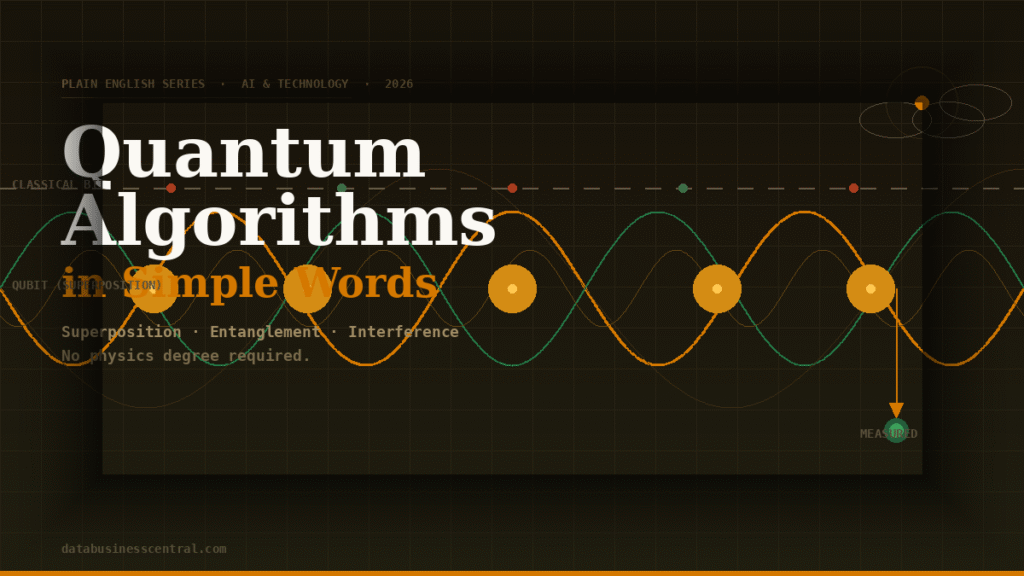
A quantum algorithm is a set of step-by-step instructions designed for a quantum computer — one that harnesses three properties of quantum physics (superposition, entanglement, and interference) to solve certain problems exponentially faster than any ordinary computer. Unlike a regular algorithm that tests one possibility at a time, a quantum algorithm explores many possibilities simultaneously, then uses interference to amplify the correct answer while cancelling out all the wrong ones.
Every computer in the world — from your phone to the most powerful supercomputer at a national laboratory — follows the same basic logic: try one thing, evaluate it, try the next. Do this billions of times per second and you can accomplish remarkable things. This sequential approach has powered the entire digital economy for seventy years.
But some problems resist it. Finding the optimal route for 1,000 delivery vehicles. Simulating how a drug molecule folds and binds to a protein target. Optimizing a portfolio of 10,000 correlated financial assets simultaneously. Factoring a 2,048-digit number. For problems like these, the number of possibilities grows so fast — exponentially — that even the fastest classical supercomputer would need more time than the universe has existed to check every option.
Quantum algorithms take a different approach entirely. Instead of checking possibilities one at a time, they check all possibilities simultaneously — and then use a mathematical trick called interference to make the right answer the only one you see. The result is a class of solutions to problems that were previously considered computationally intractable.
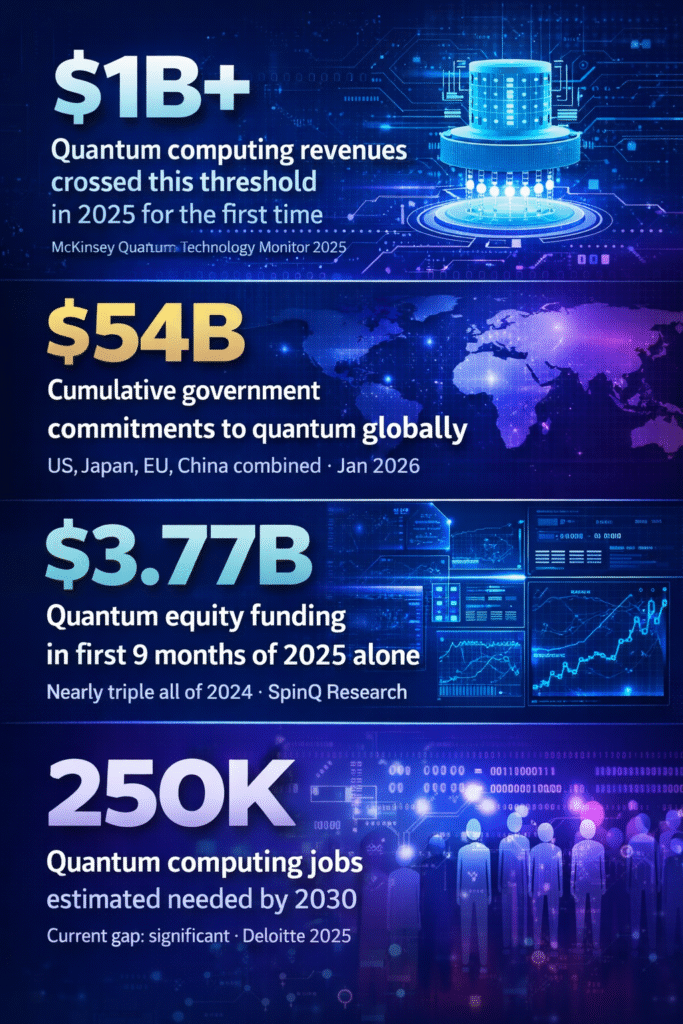
This is no longer a theoretical curiosity. According to McKinsey’s Quantum Technology Monitor 2025, global quantum computing revenues first exceeded $1 billion in 2025 — a historic industry threshold. Google stated that commercial quantum computing applications are arriving within five years, according to Reuters in February 2025. And Deloitte’s scenario research found that early movers who invested in 2025 gained significant business advantages and were first in line for talent resources — while those who waited faced competitive disadvantage and found themselves locked out of vendor ecosystems. The window to start building quantum literacy is not tomorrow. It is now.
What Is a Regular Algorithm — And Why Does It Hit a Wall?
An algorithm is simply a precise, ordered recipe for solving a problem. Your GPS uses an algorithm to find the fastest route. Your email uses an algorithm to detect spam. Your bank uses an algorithm to flag unusual transactions. Every one of these algorithms runs on classical computers that process bits — each bit fixed as either 0 or 1 — following instructions sequentially, one logical step at a time.
For most tasks, this is extraordinarily powerful. But for certain categories of problems, the number of possibilities to evaluate grows exponentially with the complexity of the problem. Double the number of variables and the work does not double — it might multiply by a thousand. Classical computers hit a structural ceiling where no amount of added processing power provides a practical solution, because the territory of possibilities is simply too vast to navigate sequentially.
🗺️ Analogy — The Maze Explorer
Imagine a massive maze with one million branching paths and one correct exit. A classical computer sends one explorer who tries one corridor, hits a dead end, backtracks, tries the next, methodically working through every option. A quantum computer releases a fog that instantly fills every corridor simultaneously — then uses interference to make the correct path glow and all dead ends go dark. You see only the exit.
The three categories of problems where quantum algorithms deliver their most dramatic advantages are: optimization (finding the best solution among exponentially many options), simulation (modeling the quantum behavior of molecules and materials that classical physics cannot accurately represent), and cryptography (factoring enormous numbers that underpin most current internet security). These happen to map directly to some of the most valuable unsolved problems in finance, pharmaceuticals, logistics, and national security.
The Three Quantum Properties That Make Everything Possible
You do not need to understand the physics to grasp the practical effect. Three properties of quantum mechanics are what give quantum computers their extraordinary capability for specific problem types. Each one is genuinely strange — and each has a simple everyday analogy that makes the concept click.
🪙Property 01
Superposition
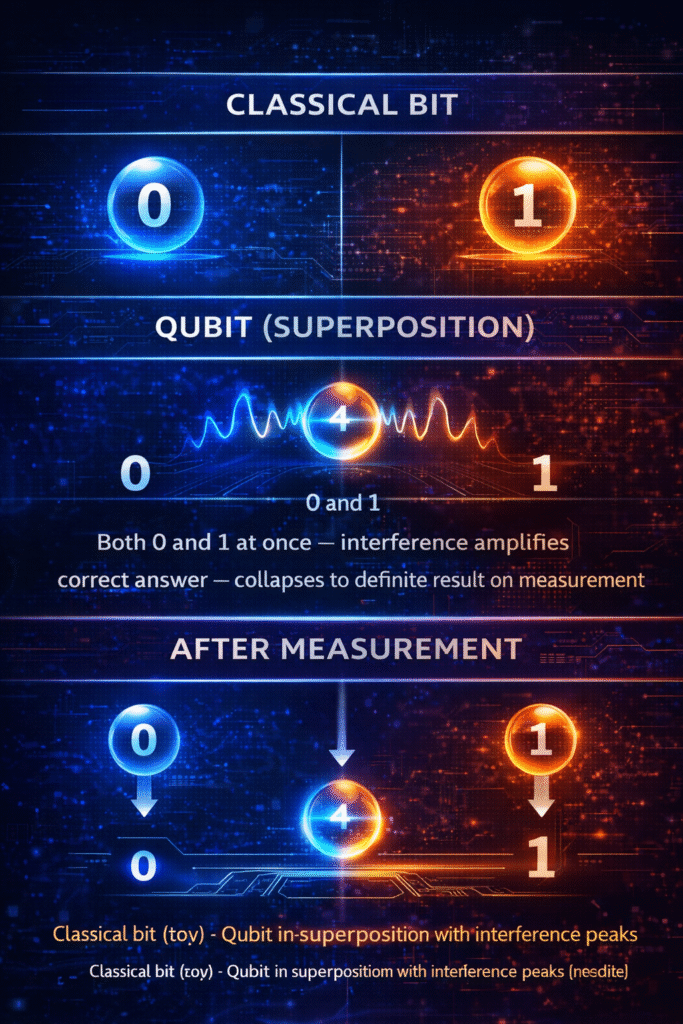
A qubit can be 0, 1, or both simultaneously until measured. A 50-qubit computer represents over 1 quadrillion states at once — exploring all solutions in parallel rather than sequentially.
🎲Property 02
Entanglement
Two qubits become linked: changing one instantly determines the other, regardless of distance. This enables the coordination of information across many qubits simultaneously in ways classical bits cannot replicate.
🎧Property 03
Interference
The mechanism that makes algorithms useful. Wrong-answer paths cancel each other out; the correct-answer path is amplified. The result you observe when measurement collapses the quantum state is the right answer — with very high probability.
Superposition — the spinning coin
🪙 Plain English Analogy
A classical computer bit is a coin lying flat on a table — definitively heads (1) or tails (0). A qubit is a coin spinning in the air. While spinning, it is simultaneously heads and tails in a precise mathematical blend of both states. The moment it lands, it resolves to one. A quantum algorithm exploits this spinning state — processing all possible values at once before ever making the coin land. With 50 qubits spinning simultaneously, you are evaluating over one quadrillion combinations in parallel.
Entanglement — the magic dice
🎲 Plain English Analogy
Imagine two dice that share a secret rule. Roll one and get a 6 — the other instantly shows a predetermined matching result, wherever it is in the world. No signal passes between them; they are simply correlated at a deep physical level. Entangled qubits work exactly like these magic dice. Quantum algorithms use this coordination to process information across many qubits simultaneously, enabling the kind of parallel exploration of solution spaces that no amount of classical hardware can replicate.
Interference — the noise-cancelling headphones
🎧 Plain English Analogy
Noise-cancelling headphones detect ambient sound and generate a precise opposite waveform that neutralizes it — leaving only the music you want. Quantum interference works identically, but for computational paths. A quantum algorithm is engineered so that every path leading to a wrong answer generates an opposing quantum signal that cancels itself out, while the path leading to the correct answer is amplified until it dominates the result. The answer emerges the way a radio frequency emerges when you tune out all static.
“Quantum computing is the difference between checking every room of a building one by one versus flooding it with light and seeing everything illuminated at once.”
Common teaching analogy in quantum computing education
The 4 Most Important Quantum Algorithms — Explained Without Mathematics
Hundreds of quantum algorithms exist in research literature, but four have the clearest relevance to business strategy, competitive advantage, and risk management for US organizations right now. Understanding what each does — without any mathematics — is everything a business leader needs to assess quantum’s strategic implications.
1,Shor’s Algorithm
The Encryption Breaker
Finds the prime factors of enormous numbers exponentially faster than any classical computer. This matters because RSA encryption — protecting banks, governments, hospitals, and websites — relies on the fact that factoring large numbers is practically impossible classically. A sufficiently powerful quantum computer running Shor’s Algorithm changes that assumption entirely. The post-quantum cryptography (PQC) market is valued at $1.9 billion in 2025 and projected to reach $12.4 billion by 2035, driven by the urgent “harvest-now, decrypt-later” risk — where adversaries collect encrypted data today to decrypt it once quantum hardware matures. NIST published five certified post-quantum cryptographic standards in 2024. Any organization with long-lived sensitive data needs a migration plan now.⚠️ Urgent: cryptography migration needed now
2.Grover’s Algorithm
The Quadratic Search Engine
Searches an unsorted database quadratically faster than classical computers. Example: finding one name in an unsorted million-entry list takes classical computers an average of 500,000 checks. Grover’s Algorithm finds it in roughly 1,000 steps using quantum superposition to check all entries simultaneously. This applies to drug compound screening, fraud pattern detection, supply chain optimization, and database search at scale. It also has a security consequence: Grover’s Algorithm halves the effective length of symmetric encryption keys, which is why AES-256 has become the recommended minimum standard for any organization planning for a quantum-capable future.Available via hybrid cloud platforms today
3.QAOA Optimizer
The Business Optimizer
The Quantum Approximate Optimization Algorithm tackles combinatorial optimization — problems where the number of possible configurations grows exponentially with each added variable. Logistics routing with thousands of delivery points, financial portfolio construction with correlated assets, hospital scheduling, network infrastructure design. In March 2025, IonQ and Ansys achieved a milestone by running a medical device simulation on IonQ’s 36-qubit computer that outperformed classical high-performance computing by 12% — one of the first documented real-world quantum advantages over classical methods. QAOA is the most immediately accessible quantum algorithm for enterprise use cases via hybrid cloud platforms available today on IBM Quantum, Google Quantum AI, Microsoft Azure Quantum, and Amazon Braket.Active enterprise pilots running now
4.VQE Simulator
The Molecular Simulator
Variational Quantum Eigensolver simulates molecular and chemical interactions at a level of accuracy that exceeds what classical computers can model. A molecule as complex as caffeine involves so many simultaneous quantum interactions that even the world’s fastest supercomputers can only approximate its behavior. VQE runs these simulations accurately on quantum hardware. Applications: drug discovery (simulating how candidate compounds interact with disease proteins), battery chemistry research, semiconductor design, and carbon capture catalyst development. McKinsey’s Quantum Technology Monitor identifies chemistry simulation alongside optimization as the earliest-traction commercial domain for quantum computing. This algorithm is most likely to produce a major pharmaceutical or materials breakthrough in the 2026–2030 window.
Classical vs Quantum Computing — A Clear Side-by-Side
| Dimension | Classical Computer | Quantum Computer |
|---|---|---|
| Basic Unit | Bit: always 0 or 1, never both | Qubit: 0, 1, or both simultaneously |
| Processing | Sequential — one path at a time | Parallel — all paths simultaneously |
| Scaling | More variables = more work (linear/polynomial) | More qubits = exponentially more power |
| Best problems | Everything we do today: apps, databases, AI | Optimization, simulation, search, cryptography |
| Simple analogy | One explorer navigating a maze | Fog that fills every corridor instantly |
| Reliability | Extremely reliable, billions of ops daily | Fragile — noise causes errors; improving fast |
| Temperature | Room temperature | Near absolute zero (−273°C) |
| Access today | Every device you own | Cloud (IBM, Google, Microsoft, Amazon) |
| Timeline | Now — mature technology | Hybrid now; fault-tolerant scale: early 2030s |
📌 The Critical Point
Quantum computers will not replace classical computers. As Bain’s Technology Report 2025 notes, quantum computing will complement classical computing — becoming an important part of a broad mosaic of solutions that plays a targeted role solving specific problems where classical systems fall short. Think of the relationship the way GPU acceleration works alongside CPUs: specialized for a class of problems, not a wholesale replacement for general computing.
Why This Is a 2026 Business Issue, Not a 2035 Research Curiosity
The most common executive response to quantum computing briefings is some variation of “fascinating, let’s revisit in five years.” This is precisely the posture that Deloitte’s 2025 scenario research identifies as strategically costly. Two forces make 2026 the correct year to engage — not 2030.
The encryption threat is already active
Shor’s Algorithm running on a sufficiently powerful quantum computer would break RSA encryption — the standard protecting banks, healthcare records, government communications, and most of the internet’s secure infrastructure. That computer does not exist yet at the required scale. But the threat is present today because of what security researchers call “harvest now, decrypt later.”
⚠️ Harvest Now, Decrypt Later — This Is Happening Right Now
Nation-state actors are already intercepting and storing encrypted data — financial communications, health records, intellectual property, and government transmissions — with the explicit intention of decrypting it once a capable quantum computer becomes available. The post-quantum cryptography market is valued at $1.9 billion in 2025, projected to reach $12.4 billion by 2035, driven precisely by this accelerating “harvest-now, decrypt-later” risk. Bain’s 2025 survey found the transition to post-quantum cryptography could take years for large or legacy-heavy organizations — which means organizations that start now are the ones that finish in time. Any organization with data that is sensitive today and will remain sensitive in 5–10 years faces real exposure right now, before any quantum computer capable of breaking it exists.
The commercial advantage window is open
Quantum computing companies raised $3.77 billion in equity funding during the first nine months of 2025 alone — nearly triple the $1.3 billion raised in all of 2024. The technology has crossed from pure research into early commercial deployment. JPMorganChase, Goldman Sachs, Amgen, BMW, and SoftBank all have active quantum programs producing published results. Early testers of Quantinuum’s Helios quantum computer include JPMorgan Chase conducting commercially relevant research, Amgen exploring hybrid quantum-machine learning for biologics, and BMW researching fuel cells. Organizations building quantum literacy and running hybrid pilots today are establishing the talent base and institutional knowledge that will be difficult to replicate quickly once the technology reaches mainstream commercial scale in the early 2030s.
🏦 Financial Services
Portfolio optimization, real-time risk modeling, fraud detection, options pricing. JPMorganChase and Goldman Sachs both have active quantum research programs with published results.Active: JPMorganChase quantum streaming algorithm pilot
💊 Pharmaceuticals
Molecular simulation for drug discovery, protein folding accuracy, clinical trial optimization. Amgen is running hybrid quantum-machine learning for biologics development.Active: Amgen, Quantinuum Helios early access program
🚛 Logistics & Supply Chain
Vehicle routing, supply chain scheduling, warehouse layout. QAOA optimization addresses combinatorial problems where classical computers can only approximate the best solution.Active: IonQ + Ansys 12% HPC improvement, March 2025
🔒 Cybersecurity
Both the threat (Shor’s breaks RSA) and the solution (post-quantum cryptography). Every organization with sensitive data is affected. NIST published 5 PQC standards in 2024.PQC market: $1.9B in 2025 → $12.4B by 2035
🔋 Energy & Materials
Battery chemistry simulation, carbon capture catalyst design, semiconductor material discovery — all exceed classical simulation limits. BMW running quantum fuel cell research.Active: BMW quantum fuel cell pilot, Quantinuum Helios
🏥 Healthcare
Genomic data analysis, medical imaging optimization, treatment pathway modeling. VQE simulation directly addresses molecular complexity that classical hardware cannot resolve accurately.
Three Things Every US Business Leader Should Do Right Now
You do not need to understand quantum physics to take the right strategic actions in 2026. Here are the three concrete steps that apply to organizations of every size and industry.
Step 1 — Cryptography Audit (Urgent for Every Regulated Industry)
Inventory every encryption system your organization uses: data storage, file transfers, email, financial transactions, customer records, and vendor communications. Identify which systems use RSA or ECC encryption — the standards most vulnerable to Shor’s Algorithm. Begin planning migration to one of the five NIST-certified post-quantum algorithms (CRYSTALS-Kyber, CRYSTALS-Dilithium, FALCON, SPHINCS+, or BIKE). The “harvest now, decrypt later” threat means the risk is active today. Large organizations may need 3–5 years to complete the migration, which means starting in 2026 is the minimum responsible timeline.
Step 2 — Identify Your Quantum-Relevant Problems
Review your organization’s hardest optimization and simulation challenges. Do you have logistics routing problems with thousands of constraints and permutations? Portfolio optimization with many correlated assets? Drug or materials simulation where accuracy is a current bottleneck? Supply chain scheduling with exponential complexity? These are candidates for hybrid quantum-classical pilots available right now on IBM Quantum, Google Quantum AI, Microsoft Azure Quantum, and Amazon Braket — no quantum hardware ownership required. The IonQ-Ansys medical device simulation result proves that real advantages are achievable today on current hardware.
Step 3 — Build Quantum Literacy Before the Talent Gap Widens
Analysts estimate 250,000 quantum computing jobs will be needed by 2030, while current job posting growth has slowed to just 4.4% over 12 months — meaning the supply gap is already significant and widening. Deloitte’s scenario research concludes that organizations acting in 2025 have already gained significant business advantages, been first in line for talent, and helped shape the ecosystem to their needs — while organizations that waited face longer production cycles and increased competition for scarce expertise. Begin with executive education, cloud platform exploration, and partnerships with universities or quantum-as-a-service vendors. Quantum literacy built now compounds in value as the technology scales.
Q1. What is a quantum algorithm in simple words?
A quantum algorithm is a set of step-by-step instructions designed for a quantum computer — one that uses superposition, entanglement, and interference to solve certain problems exponentially faster than any ordinary computer. Unlike a classical algorithm that tests one possibility at a time, a quantum algorithm explores many possibilities simultaneously, then uses interference to amplify the correct answer while cancelling all the wrong ones.
Q2. What is superposition in quantum computing — simply explained?
Superposition means a quantum bit (qubit) can be 0, 1, or both states simultaneously — until you measure it. Think of a coin spinning in the air: while spinning, it is neither heads nor tails but both at once. The moment it lands, it becomes one. A 50-qubit computer can represent over 1 quadrillion states simultaneously, exploring all of them in parallel rather than one at a time.
Q3. What is quantum entanglement in plain English?
Entanglement is when two qubits become linked so that the state of one instantly influences the other — regardless of distance. Think of two magic dice: roll one and get a 6, and the other instantly shows the matching result, wherever it is. Quantum algorithms use entanglement to coordinate information across many qubits simultaneously in ways classical bits physically cannot replicate.
Q4. What is Shor’s Algorithm and why does it threaten encryption?
Shor’s Algorithm factors enormous numbers exponentially faster than classical computers. Most internet encryption (RSA) relies on the fact that factoring large numbers is practically impossible classically. A sufficiently powerful quantum computer running Shor’s Algorithm could break RSA — threatening banks, hospitals, and governments. This is why NIST published five post-quantum cryptographic standards in 2024, and why the “harvest now, decrypt later” threat means organizations with long-lived sensitive data need migration plans today.
Q5. What is Grover’s Algorithm in simple terms?
Grover’s Algorithm is a quantum search algorithm. Finding one name in a million-entry unsorted list: a classical computer averages 500,000 checks. Grover’s Algorithm uses superposition to search simultaneously, finding the answer in roughly 1,000 steps — a quadratic speedup. It also effectively halves symmetric encryption key strength, which is why AES-256 is now the recommended minimum in a quantum-capable world.
Q6. What is the quantum computing market size in 2026?
According to McKinsey’s Quantum Technology Monitor 2025, global quantum computing revenues first exceeded $1 billion in 2025 — a historic industry threshold. The broader market reached $1.8–3.5 billion at a 32.7% CAGR, with projections of $5.3 billion by 2029 and $45–131 billion by 2040. Governments worldwide have committed over $54 billion cumulatively, and quantum companies raised $3.77 billion in equity funding in just the first nine months of 2025.
Q7. When will quantum computing be commercially useful for US businesses?
Early commercial applications are available now via hybrid workflows on IBM Quantum, Google Quantum AI, Microsoft Azure Quantum, and Amazon Braket. In March 2025, IonQ and Ansys ran a medical device simulation that outperformed classical HPC by 12% — one of the first documented real-world quantum advantages. Google stated commercial applications are arriving within five years. Fully fault-tolerant systems are expected in the early-to-mid 2030s.
Q8. Which industries will quantum algorithms impact most?
The five industries with the clearest near-term impact are: financial services (JPMorganChase, Goldman Sachs — portfolio optimization, risk modeling); pharmaceuticals (Amgen — drug discovery, molecular simulation); logistics (routing and supply chain optimization); cybersecurity (both the encryption threat from Shor’s and the post-quantum cryptography opportunity — a $1.9B market in 2025); and materials science (battery chemistry, semiconductor design, carbon capture).
Q9. What is the difference between a classical and a quantum computer?
A classical computer processes bits that are always 0 or 1, working sequentially. A quantum computer uses qubits that can be 0, 1, or both simultaneously, coordinates them through entanglement, and uses interference to amplify correct answers. This enables quantum computers to explore exponentially larger solution spaces for specific problem types. Quantum computers will not replace classical ones — they will specialize in optimization, simulation, and cryptography, working alongside classical systems in a hybrid architecture.
Q10. What should US business leaders do about quantum computing right now?
Three steps: (1) Cryptography audit — inventory RSA/ECC encryption and begin planning migration to NIST-certified post-quantum algorithms; the harvest-now-decrypt-later threat is active today. (2) Identify quantum-relevant problems — logistics routing, portfolio optimization, and drug simulation are candidates for hybrid quantum pilots available right now on cloud platforms. (3) Build quantum literacy — Deloitte’s 2025 research found early movers gained significant business advantages and first access to scarce quantum talent. The 250,000 quantum jobs needed by 2030 represent a widening gap that organizations building expertise today will be positioned to fill.
