Introduction
Data analytics is the systematic process of collecting, organizing, analyzing, and interpreting data to generate actionable insights. It enables organizations to make evidence-based decisions, improve operational performance, reduce risk, and uncover new growth opportunities.
In a digital-first economy, every transaction, interaction, and system generates data. However, raw data alone has little value. The real advantage lies in the ability to transform that data into meaningful intelligence. Data analytics provides the methodologies, technologies, and frameworks required to achieve this transformation.
Why Data Analytics Matters
Organizations that adopt data analytics effectively gain measurable advantages:
- Improved decision accuracy based on quantitative evidence
- Increased operational efficiency through process optimization
- Better customer understanding and personalization
- Early identification of risks and anomalies
- Strategic forecasting and competitive positioning
In competitive markets, data-driven organizations consistently outperform intuition-driven ones.
The Data Analytics Lifecycle
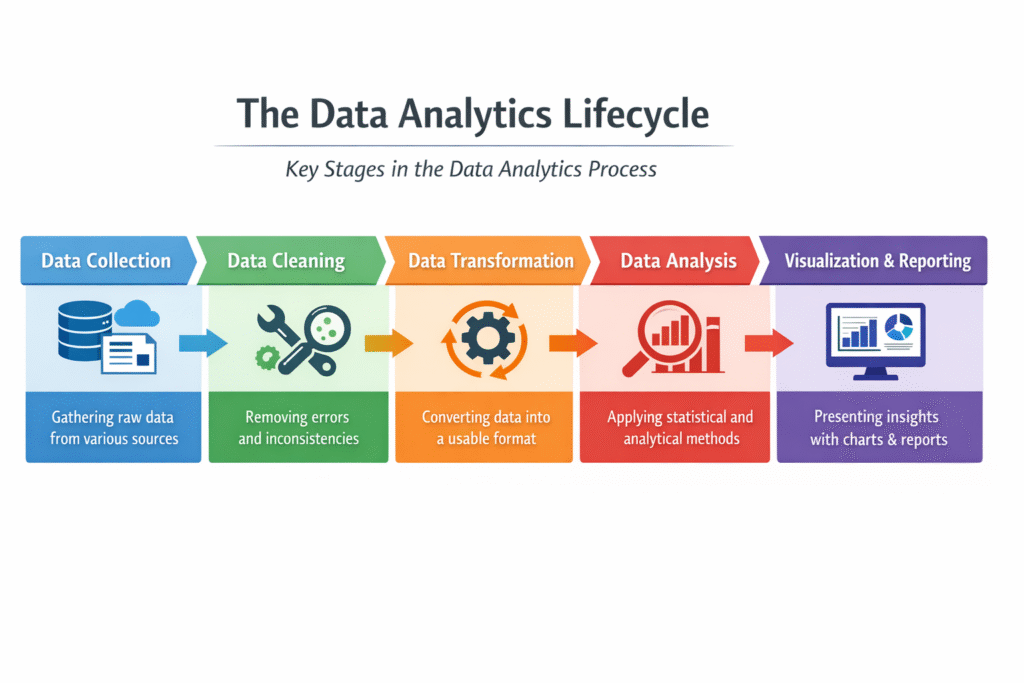
Data analytics follows a structured lifecycle to ensure reliability and business relevance.
| Stage | Description | Objective |
|---|---|---|
| Data Collection | Gathering structured and unstructured data from multiple sources | Establish a reliable dataset |
| Data Cleaning | Removing errors, duplicates, and inconsistencies | Ensure data accuracy |
| Data Transformation | Structuring and formatting data for analysis | Prepare data for modeling |
| Data Analysis | Applying statistical and computational techniques | Extract patterns and insights |
| Visualization & Reporting | Presenting findings in dashboards and reports | Support strategic decisions |
Each stage is critical. Poor data preparation leads to inaccurate conclusions, regardless of analytical sophistication.
Types of Data Analytics
Data analytics can be categorized based on the business questions it answers.
| Type | Key Question | Business Application |
|---|---|---|
| Descriptive Analytics | What happened? | Performance reports and dashboards |
| Diagnostic Analytics | Why did it happen? | Root cause analysis |
| Predictive Analytics | What is likely to happen? | Demand forecasting and risk modeling |
| Prescriptive Analytics | What should be done? | Optimization and decision recommendations |
Organizations typically progress from descriptive analytics to predictive and prescriptive capabilities as analytical maturity increases.
Core Techniques Used in Data Analytics
Modern analytics integrates multiple technical approaches:
- Statistical analysis for hypothesis testing and correlation measurement
- Machine learning for predictive modeling and pattern recognition
- Data mining for discovering hidden relationships
- Text analytics for extracting insights from unstructured content
- Data visualization for communicating complex findings clearly
These techniques work together to convert data into strategic knowledge.
Structured vs. Unstructured Data
Understanding data types is fundamental to effective analytics.
| Data Type | Examples | Analytical Complexity |
|---|---|---|
| Structured Data | Databases, spreadsheets, transactional records | Easier to process and analyze |
| Unstructured Data | Emails, videos, customer reviews, social media posts | Requires advanced processing methods |
A growing percentage of enterprise data is unstructured, increasing the importance of advanced analytics tools.
Benefits of Data Analytics
Improved Decision-Making
Analytics enables leaders to base decisions on measurable evidence rather than assumptions.
Operational Optimization
Data reveals inefficiencies, bottlenecks, and cost-saving opportunities across processes.
Risk Reduction
Analytics detects fraud, compliance risks, and operational anomalies before they escalate.
Customer-Centric Strategies
Organizations can analyze behavior patterns to deliver personalized experiences.
Revenue Growth
Predictive models identify high-value segments and optimize pricing and marketing strategies.
Data Analytics vs. Data Science
Although related, these disciplines serve distinct purposes.
| Aspect | Data Analytics | Data Science |
|---|---|---|
| Primary Focus | Interpreting data to support business decisions | Building advanced predictive models and intelligent systems |
| Scope | Insight generation and reporting | Algorithm design, AI systems, and experimentation |
| Outcome | Dashboards and business recommendations | Automated decision systems and advanced AI solutions |
Data science is broader in scope, while data analytics is more directly focused on business interpretation.
Industry Applications of Data Analytics
Data analytics is used across sectors:
| Industry | Application |
|---|---|
| Healthcare | Predictive diagnostics and patient outcome optimization |
| Finance | Fraud detection and credit risk assessment |
| Retail | Customer segmentation and demand forecasting |
| Manufacturing | Predictive maintenance and quality control |
| Telecommunications | Customer churn prediction and network optimization |
The adaptability of analytics makes it valuable across virtually all industries.
Role of Cloud Computing in Data Analytics
Cloud infrastructure has significantly expanded analytics capabilities by enabling:
- Scalable data storage
- Real-time processing
- Integration with artificial intelligence systems
- Reduced infrastructure costs
Cloud-based analytics platforms allow organizations to deploy advanced models without heavy capital investment.
Challenges in Data Analytics Implementation
Despite its benefits, analytics adoption presents challenges.
| Challenge | Business Impact |
|---|---|
| Poor Data Quality | Inaccurate or misleading insights |
| Data Silos | Fragmented and incomplete intelligence |
| Security & Compliance Risks | Regulatory penalties and reputational damage |
| Skill Gaps | Slower implementation and limited analytical depth |
Strong governance frameworks and skilled professionals are essential for overcoming these obstacles.
Emerging Trends in Data Analytics (2026 and Beyond)
The future of data analytics is shaped by:
- AI-driven automation of insights
- Real-time and streaming analytics
- Edge computing for faster processing
- Augmented analytics for self-service business users
- Greater data democratization across organizations
As analytical tools become more accessible, decision-making will increasingly shift toward automated and predictive systems.
Conclusion
Data analytics has evolved from a reporting function into a strategic business capability. Organizations that systematically collect, prepare, analyze, and interpret data gain measurable advantages in efficiency, profitability, and innovation.
In 2026 and beyond, analytics will not simply support decisions—it will shape them. Enterprises that embed analytics deeply into their operational and strategic frameworks will lead their industries, while those that neglect it risk losing competitive relevance.
