
What is Cybersecurity?
Cybersecurity refers to the structured set of technologies, controls, processes, and governance frameworks designed to protect digital systems, networks, applications, and data from unauthorized access, disruption, manipulation, or destruction. It spans multiple layers including:
- Network Security – Firewalls, IDS/IPS, Zero Trust architecture
- Application Security – Secure SDLC, vulnerability testing
- Endpoint Security – Device monitoring and protection
- Cloud Security – Data encryption, identity access management
- Operational Security (OpSec) – Policies and risk management
In regulated industries like healthcare, finance, and government, cybersecurity is not optional—it is foundational to operational continuity and compliance.
What is Digital Trust?
Digital trust is the confidence that users, customers, partners, and regulators place in an organization’s ability to:
- Protect sensitive data
- Ensure system reliability and availability
- Maintain transparency and ethical technology use
- Comply with legal and regulatory standards
Digital trust is earned through consistent security posture, privacy protection, system integrity, and transparent governance.
In sectors like the Internet of Medical Things (IoMT), digital trust directly affects patient adoption, clinician confidence, and regulatory approval.
Relationship Between Cybersecurity and Digital Trust
Cybersecurity is the technical backbone, while digital trust is the strategic outcome.
| Cybersecurity | Digital Trust |
|---|---|
| Technical controls and safeguards | User confidence and brand credibility |
| Risk mitigation | Long-term stakeholder loyalty |
| Compliance enforcement | Reputation and market positioning |
| Incident response | Transparency and accountability |
Strong cybersecurity builds digital trust. Weak security erodes it rapidly.
Why Cybersecurity & Digital Trust Matter in 2026
As AI, cloud computing, and connected devices scale globally:
- Cyberattacks are becoming more sophisticated (ransomware-as-a-service, AI-driven attacks).
- Regulatory scrutiny is increasing.
- Customers demand data transparency.
- Businesses rely heavily on digital ecosystems.
Organizations that treat cybersecurity as a strategic investment—not just an IT cost—gain competitive advantage.
Core Pillars of Cybersecurity
1. Zero Trust Architecture
“Never trust, always verify.” Continuous authentication and micro-segmentation.
2. Encryption & Data Protection
End-to-end encryption for data at rest and in transit.
3. Identity & Access Management (IAM)
Role-based access control and multi-factor authentication.
4. Continuous Monitoring & Threat Intelligence
Real-time anomaly detection using AI-powered analytics.
5. Incident Response & Recovery
Business continuity planning and cyber resilience frameworks.
Key Drivers of Digital Trust
- Transparent privacy policies
- Ethical AI deployment
- Regulatory compliance
- Secure digital transformation
- Clear communication during incidents
Trust is not built by marketing—it is built by operational integrity.
Cybersecurity & Digital Trust in Healthcare and IoMT
In connected healthcare environments:
- Medical devices transmit real-time patient data
- Remote monitoring platforms store sensitive health records
- Cloud-based analytics process AI-driven diagnostics
Without strong cybersecurity:
- Patient data breaches occur
- Devices can be compromised
- Clinical operations may be disrupted
Digital trust determines whether patients are willing to use wearable devices, remote monitoring systems, or AI-assisted diagnostics.
Major Challenges
- Increasing attack surface due to IoT devices
- Legacy system vulnerabilities
- Talent shortage in cybersecurity
- Regulatory complexity across countries
- AI-generated cyber threats
Strategic Recommendations
- Adopt Zero Trust framework
- Conduct regular penetration testing
- Implement AI-driven threat detection
- Build cross-functional governance teams
- Invest in cyber awareness training
Conclusion
Cybersecurity is no longer just a defensive mechanism—it is a strategic business enabler. Digital trust is the measurable outcome of robust security, transparency, and ethical technology governance. Organizations that align cybersecurity strategy with digital trust objectives will lead in an AI-driven, hyper-connected global economy.
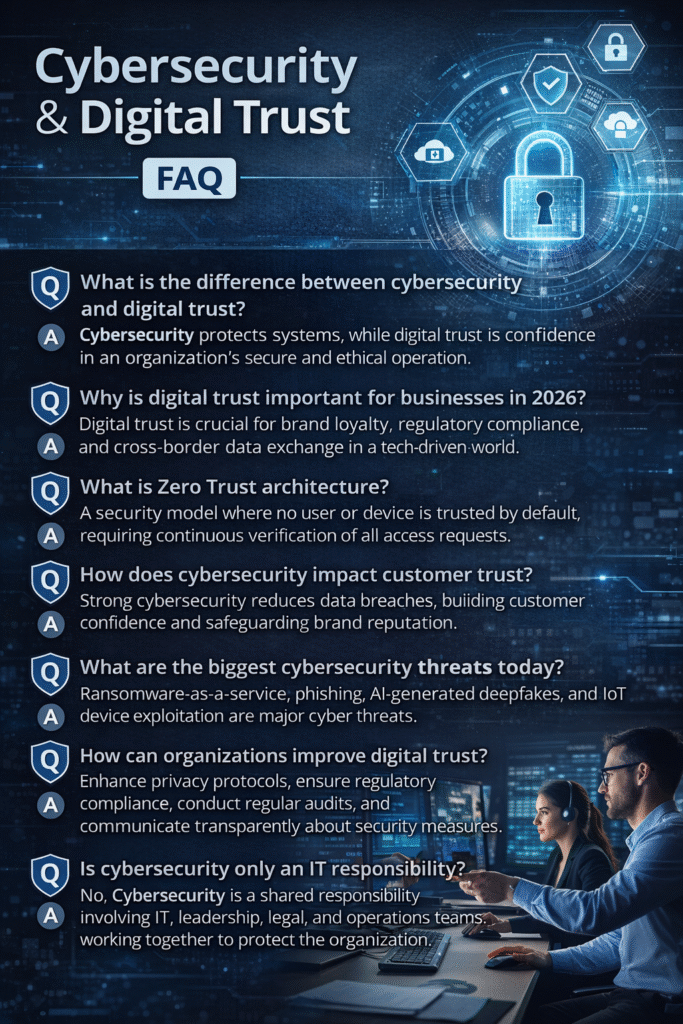
FAQ: Cybersecurity & Digital Trust
1. What is the difference between cybersecurity and digital trust?
Cybersecurity focuses on protecting systems, networks, and data from cyber threats using technical controls such as encryption, firewalls, Zero Trust architecture, and intrusion detection systems. Digital trust, on the other hand, is the confidence stakeholders place in an organization’s ability to protect data, ensure privacy, maintain system integrity, and operate transparently. Cybersecurity is the operational foundation; digital trust is the strategic outcome.
2. Why is digital trust important for businesses in 2026?
In 2026, businesses operate in highly interconnected ecosystems involving AI, cloud computing, IoT, and cross-border data exchange. Customers and regulators demand transparency, compliance, and ethical data handling. Organizations that fail to maintain digital trust risk reputational damage, financial penalties, and customer attrition. Digital trust directly impacts brand equity and long-term sustainability.
3. What is Zero Trust architecture?
Zero Trust is a security framework based on the principle “never trust, always verify.” It requires continuous authentication, strict access controls, and segmentation of networks. Instead of assuming internal users are safe, every access request is verified regardless of location. This approach significantly reduces insider threats and lateral movement during cyberattacks.
4. How does cybersecurity impact customer trust?
When organizations implement strong security measures—such as multi-factor authentication, encryption, and regular vulnerability testing—they reduce the likelihood of data breaches. Fewer incidents mean higher reliability and credibility. Conversely, repeated breaches erode customer confidence and can lead to regulatory scrutiny and financial loss.
5. What are the biggest cybersecurity threats today?
Major threats include ransomware-as-a-service, phishing attacks, AI-generated deepfake scams, supply chain vulnerabilities, and IoT device exploitation. As digital transformation expands, the attack surface grows, making proactive security strategy essential.
6. How can organizations improve digital trust?
Organizations can enhance digital trust by implementing transparent privacy policies, complying with global regulations, conducting regular security audits, investing in employee cyber awareness training, and communicating openly during security incidents. Trust is built through consistent governance and ethical technology deployment.
7. Is cybersecurity only an IT responsibility?
No. While IT teams implement technical controls, cybersecurity is an enterprise-wide responsibility. Leadership, legal, HR, and operations must collaborate to create governance frameworks, enforce policies, and align security with business strategy.
