
Introduction
Quantum computing represents a paradigm shift in computational science. Unlike classical computers that process information in binary bits (0 or 1), quantum computers use qubits, which can exist in multiple states simultaneously due to superposition and entanglement. This enables exponential computational power for specific problem classes.
While quantum computing is still in its early commercialization phase, its long-term impact on industries such as pharmaceuticals, finance, cybersecurity, logistics, and artificial intelligence could be transformative. However, alongside opportunity comes significant technical, economic, and security risks.
Understanding the risks, benefits, and challenges is essential for evaluating its importance in shaping the future of technology.
Benefits of Quantum Computing
1. Exponential Processing Power
Quantum computers can evaluate multiple possible solutions simultaneously. For optimization, molecular simulation, and cryptographic analysis, this provides a theoretical advantage over classical supercomputers.
2. Breakthrough Drug Discovery
Quantum simulation can model molecular structures at atomic precision. This accelerates drug development, protein folding research, and materials discovery.
Impact areas:
- Faster vaccine development
- Cancer treatment modeling
- Advanced pharmaceutical research
3. Optimization at Scale
Industries such as logistics, aviation, and finance rely heavily on optimization problems. Quantum algorithms may dramatically improve:
- Supply chain routing
- Portfolio optimization
- Traffic and energy grid management
4. Artificial Intelligence Acceleration
Quantum machine learning could enhance pattern recognition and model training efficiency, particularly for high-dimensional datasets.
5. Advanced Materials & Energy Innovation
Quantum simulation can design superconductors, battery materials, and sustainable energy solutions more efficiently than classical modeling.
Risks of Quantum Computing
1. Cryptographic Threats
One of the most discussed risks is the ability of quantum computers to break current public-key encryption systems (RSA, ECC). Once fault-tolerant quantum machines are available, they could decrypt previously secure communications.
This creates:
- National security risks
- Financial system vulnerabilities
- Data privacy concerns
2. Unequal Access & Technological Divide
Quantum infrastructure is expensive and complex. Early dominance by a few nations or corporations could widen global technological inequality.
3. Misuse in Cyber Warfare
Quantum-powered decryption or optimization tools could enhance offensive cyber capabilities if not properly regulated.
4. Overinvestment & Market Hype
Quantum computing remains technically immature. Overinvestment without clear commercial timelines may create speculative bubbles.
Challenges in Quantum Computing Development
1. Qubit Stability (Decoherence)
Qubits are extremely sensitive to environmental noise. Maintaining stable quantum states for meaningful computation is one of the biggest engineering challenges.
2. Error Correction
Quantum systems have high error rates. Developing fault-tolerant, error-corrected logical qubits requires massive scaling.
3. Scalability
Current machines operate with tens to hundreds of qubits. Useful large-scale applications may require thousands or millions of stable qubits.
4. Infrastructure Cost
Quantum hardware requires extreme cooling (near absolute zero), advanced isolation systems, and specialized facilities.
5. Talent Shortage
Quantum computing requires interdisciplinary expertise in physics, mathematics, computer science, and engineering — a rare combination.
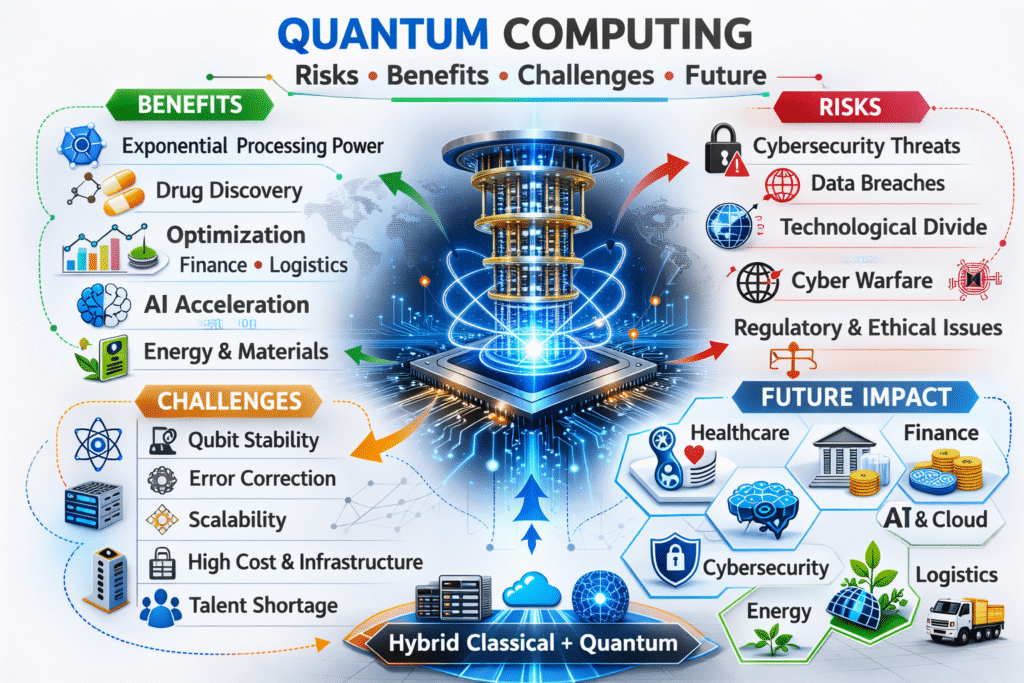
Why Quantum Computing Is Important for the Future of Technology
1. Solving Problems Beyond Classical Limits
Certain computational problems are infeasible for classical systems within realistic timeframes. Quantum computing offers potential solutions to:
- Climate modeling
- Complex AI simulations
- Advanced cryptography
- National defense analytics
2. Post-Quantum Cybersecurity Transition
The development of quantum computing is forcing the adoption of quantum-resistant cryptography. This transition will redefine global cybersecurity standards.
3. Competitive Technological Leadership
Countries investing in quantum research view it as a strategic asset comparable to space exploration or nuclear technology in the 20th century.
4. Integration with AI & Cloud
Future hybrid systems will combine classical cloud infrastructure with quantum processors, creating new computational ecosystems.
5. Innovation Catalyst
Even partial quantum advantage may stimulate new industries, startups, research disciplines, and academic programs.
Long-Term Outlook
The next major milestone is achieving fault-tolerant, scalable quantum computing. Until then, the industry remains in the NISQ (Noisy Intermediate-Scale Quantum) era, where experimentation continues but practical impact is limited.
Experts predict:
- Hybrid quantum-classical systems will dominate first
- Financial services and pharma will be early adopters
- Post-quantum cryptography will become mandatory
- AI and optimization applications will drive early revenue
Quantum computing will not replace classical systems. Instead, it will become a specialized acceleration layer for complex computational tasks.
Conclusion
Quantum computing carries enormous promise alongside significant uncertainty. Its benefits include breakthroughs in medicine, energy, optimization, and artificial intelligence. Its risks involve cybersecurity disruption, economic inequality, and premature commercial expectations. Its challenges are deeply technical, centered on error correction, scalability, and qubit stability.
Despite these barriers, quantum computing is strategically important for the future of technology. It represents the next frontier of computational capability and will likely shape global innovation, cybersecurity standards, and scientific discovery for decades to come.
Organizations that begin preparing today — through research, talent development, and post-quantum security planning — will be better positioned for the quantum era.
