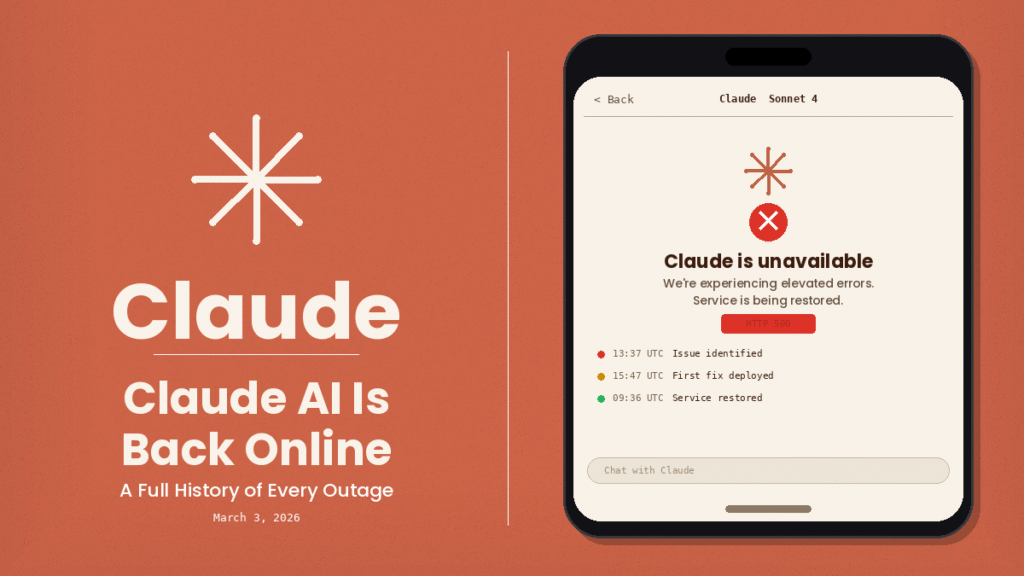
If you tried to open Claude yesterday and were greeted with a spinning wheel, a 500 error, or a cryptic “That’s not working right now” message, you weren’t alone. Claude experienced one of its most disruptive outages to date on March 2 and 3, 2026, knocking out access for thousands of users worldwide. Now that service has been restored, it’s a good moment to step back and look at the bigger picture: how often does Claude go down, what causes it, and what does the track record really look like?
August 24, 2026: Elevated Errors Across Claude 5 Models
On August 24, 2026, Anthropic experienced a significant service disruption causing elevated request errors across its newer model lineup, as well as legacy versions.
Models Affected: Claude Mythos 5, Claude Fable 5, Claude Opus 5, and Claude Opus 4.8.
Incident Timeline (UTC):
- 05:27 AM: Anthropic began investigating reports of elevated errors and failed requests across the Claude 5 tier and Opus 4.8.
- 06:42 AM: The engineering team officially identified the root cause of the elevated requests and began working on a resolution.
- Ongoing: The team continued to deploy fixes to stabilize the models and resolve the elevated error rates.
The March 2 to 3, 2026 Outage: The Big One
The most significant outage in recent memory began in the early hours of March 2, 2026. Here’s how it unfolded, according to Anthropic’s official status page:
| Time (UTC) | Status Update |
|---|---|
| Mar 2 – 13:37 | Issue identified; fix being implemented |
| Mar 2 – 14:05 | Some API methods found non-functional; investigation expands |
| Mar 2 – 14:35 | Elevated errors confirmed on claude.ai, console, and Claude Code |
| Mar 2 – 15:25 | Team continues working on fix |
| Mar 2 – 15:47 | Incident resolved (first wave) |
| Mar 2 – 17:15 | Fix being implemented (second wave) |
| Mar 2 – 17:24 | Fix deployed; monitoring begins |
| Mar 2 – 17:56 | New investigation starts |
| Mar 2 – 18:07 | Fix implemented, monitoring continues |
| Mar 2 – 18:18 | Issue repeats; investigation resumes |
| Mar 2 – 18:54 | Another fix deployed |
| Mar 2 – 21:16 | Incident resolved (second wave) |
| Mar 3 – 03:15 | Issue identified again (third wave) |
| Mar 3 – 04:39 | Third investigation begins |
| Mar 3 – 08:39 | Investigation continues |
| Mar 3 – 09:36 | Fix implemented; monitoring in progress |
Outage tracking site Downdetector logged between 1,700 and 4,700 user reports during the March 2 event alone. Users experienced HTTP 500 and 529 errors, login failures, and complete timeouts. Developers using the API reported elevated failure rates across all endpoints.
Anthropic attributed the disruptions in part to unprecedented demand for its services in the preceding week. The company also confirmed the issues were related to claude.ai’s login and logout paths, not just the underlying model API itself.
Late February 2026: Usage Reporting Outage (Feb 26 to 27)
Just days before the big March outage, Claude suffered a quieter but impactful disruption to its usage reporting systems.
| Time (UTC) | Status Update |
|---|---|
| Feb 26 – 15:56 | Outage identified in usage reporting via Console and admin API |
| Feb 26 – 17:24 | Team working on a fix |
| Feb 26 – 18:52 | Fix deployed for /v1/organizations/usage_report/messages |
| Feb 26 – 22:10 | Further work continues on remaining endpoints |
| Feb 27 – 03:04 | Usage reporting restored, but data after Feb 25 18:40 UTC was missing |
| Feb 27 – 13:12 | Fully resolved; all historical data restored |
Usage report API endpoints and analytics dashboards displayed errors and missing data for roughly 28 hours due to an internal data service issue. All endpoints were eventually restored with historical data intact.
February 24, 2026: Platform Error Surge
A significant error spike hit the Claude platform in late February 2026. Outage trackers reported more than 4,700 error reports, with HTTP 500 internal server errors and broad communication failures across the Claude chatbot and developer tools. This event preceded the even larger March 2 disruption and raised early questions about infrastructure capacity at scale.
November 18, 2025: The Cloudflare Cascade
Claude wasn’t the only victim on November 18, 2025. A widespread Cloudflare outage disrupted major AI platforms globally, including Claude and ChatGPT. Users worldwide encountered error messages and latency spikes, with elevated error rates affecting both consumer chat interfaces and business API access throughout much of the day.
This incident highlighted a key vulnerability: AI platforms, no matter how robust their own infrastructure, can be taken down by failures in the underlying internet backbone they depend on.
The Ongoing Pattern: 965 Plus Incidents Since June 2024
According to StatusGator, which has been monitoring Anthropic’s services since June 20, 2024, there have been more than 965 recorded outages and service disruptions affecting Claude users over that period. That’s an average of roughly two or more incidents per day, though the vast majority are minor, brief, or limited in scope.
Claude’s status page tracks five key components: claude.ai (the main web and mobile interface), the Claude API used by developers and businesses, the platform console for developers, Claude Code for agentic coding, and Cowork for desktop automation. Each of these components can be affected independently, meaning a platform issue doesn’t always mean the chatbot itself is down, and vice versa.
Why Does Claude Go Down? The Technical Reality
AI platforms like Claude are fundamentally different from traditional web apps, and that makes them more susceptible to outages.
Running large language models requires enormous compute clusters. A sudden traffic surge caused by a viral moment, a new feature launch, or even a geopolitical event sending users flocking to the platform can overwhelm model-serving capacity faster than engineers can scale it.
As seen in February and March 2026, a fix in one part of the system can surface issues in another. Claude’s login path, its API routing, and its analytics backend are separate services, and a problem in any one of them can appear as a total outage to end users.
External dependencies add another layer of risk. The Cloudflare outage in November 2025 demonstrated that even a fully healthy Claude can go dark due to third-party infrastructure failures. And as AI adoption grows, the pressure only increases. Anthropic itself cited unprecedented demand as a contributing factor to the March 2026 outages.
Claude Is Back: What To Do During Future Outages
Claude is currently operational as of March 3, 2026. Checking the official Claude status page is the best first step when something seems off, as Anthropic posts real-time updates there. Switching networks can also help during partial outages, since some routing paths recover faster than others.
For developers, implementing exponential backoff and graceful retries is good practice, along with temporarily lowering concurrency to reduce failure cascades. Having a fallback workflow in place makes it possible to queue prompts for later or use an alternate assistant for time-sensitive tasks until service stabilizes. Services like StatusGator and Downdetector often provide early warning signals, frequently before Anthropic’s official acknowledgment.
The Bigger Picture
Repeated outages within a short window have raised legitimate questions about infrastructure robustness as enterprise reliance on Claude grows. Anthropic is no longer just a research lab. It is critical infrastructure for developers, businesses, and professionals worldwide. The March 2026 events were a reminder that uptime, in the age of AI, is no longer just a convenience. It is a business imperative.
For now, Claude is back. The lights are on. And Anthropic’s engineers are monitoring closely.
Sources: Anthropic status.claude.com, StatusGator, Bloomberg, TechCrunch, PYMNTS, Storyboard 18, Downdetector

1 thought on “Claude AI Is Back Online: A Full History of Every Major Outage (updated)”
Pingback: Claude Science: How Claude AI Is Helping Scientists Now