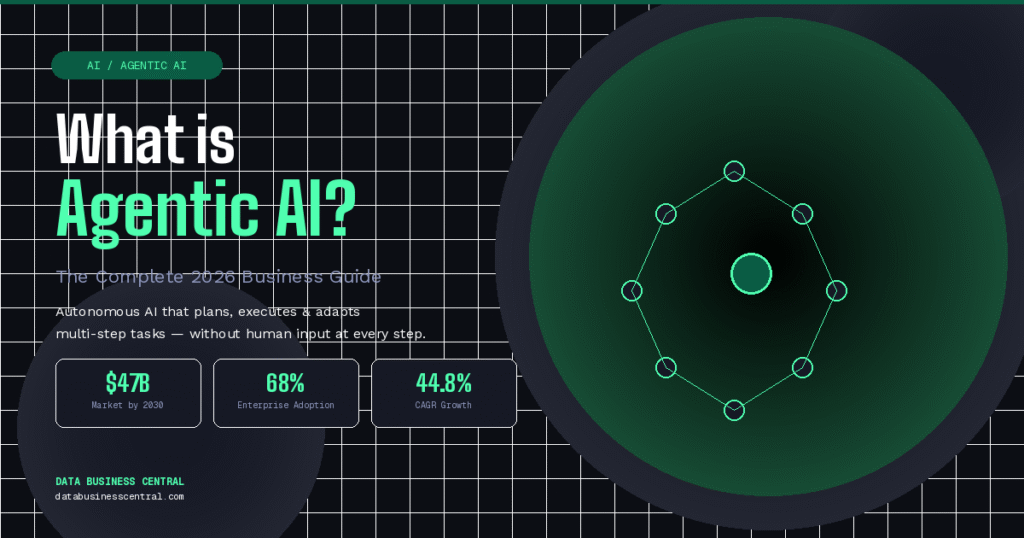
Agentic AI is the most significant shift in enterprise technology since cloud computing. It doesn’t just answer questions — it takes actions, makes decisions, and completes complex multi-step goals on your behalf. Here’s everything business leaders need to understand in 2026.
Table of Contents
- What is Agentic AI?
- How Agentic AI Works
- Agentic AI vs Generative AI
- The 5 Core Capabilities
- Global Adoption Map
- Real-World Use Cases
- Industry Data & Charts
- Risks & Governance
- Top Platforms in 2026
- How to Implement
- The Future of Agentic AI
- FAQ
1. What is Agentic AI?
Definition
Agentic AI is a class of artificial intelligence systems that can autonomously plan, execute, and adapt multi-step tasks to achieve a defined goal — without requiring continuous human input at each step. Unlike traditional AI, which responds to individual prompts, agentic AI operates as an autonomous agent: it perceives its environment, makes decisions, takes actions, and learns from outcomes.
The term “agentic” comes from the word agency — the capacity to act independently in the world. In the context of AI, it means a system that doesn’t wait to be told what to do at every step. You give it a goal, and it figures out the path.
Think of it this way: if Generative AI is a brilliant assistant who answers every question you ask, Agentic AI is that same assistant — except now they can also pick up the phone, send emails, run the analysis, book the meeting, and report back to you when the job is done.
📊
2026 Market Stat
The global agentic AI market is projected to reach $47.1 billion by 2030, growing at a CAGR of 44.8% from 2024 — making it the fastest-growing segment of enterprise AI. (Source: MarketsandMarkets, 2026)
2. How Agentic AI Works: The Architecture
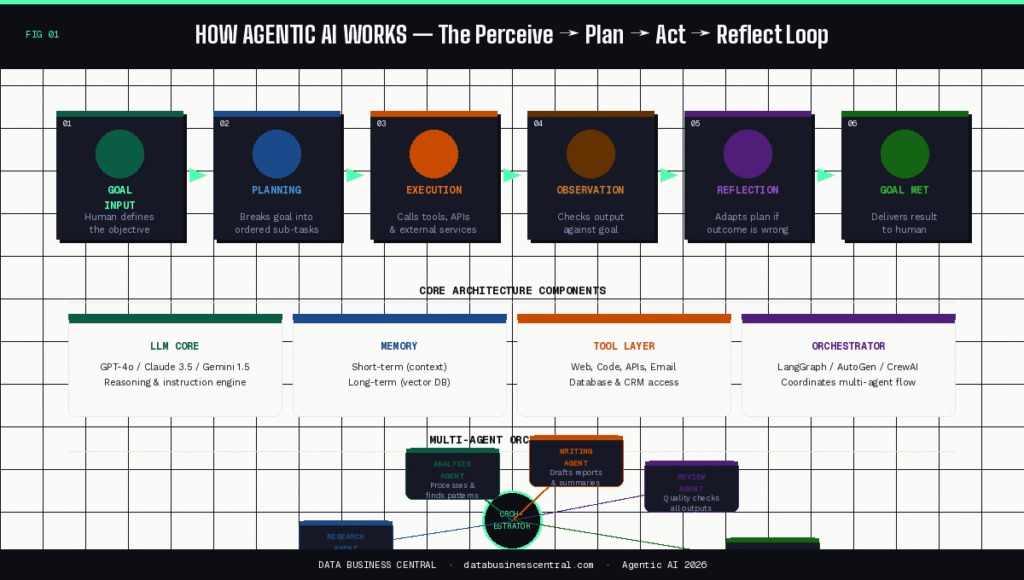
Agentic AI systems are built on a perceive → plan → act → reflect loop. Unlike a chatbot that processes one input and produces one output, an agentic system runs in a continuous cycle until the goal is achieved or a human intervenes.
The Agentic AI Processing Loop
The key architectural components enabling this loop are:
- Large Language Model (LLM) Core: The reasoning engine — typically GPT-4o, Claude 3.5, Gemini 1.5, or Llama 3 — that understands instructions and generates plans.
- Memory System: Short-term (in-context) and long-term (vector database) memory that allows the agent to remember past steps and user preferences.
- Tool Integration: APIs, code interpreters, web browsers, databases, and external services the agent can call to take real actions.
- Orchestration Layer: The logic that coordinates multiple agents working in parallel — frameworks like LangGraph, AutoGen, or CrewAI handle this.
Related Reading
Logistics How Agentic AI Is Transforming the Logistics and Transportation Industry → Healthcare How Agentic AI Is Transforming Healthcare and Life Sciences →
3. Agentic AI vs Generative AI: Key Differences
The two terms are often confused — but they describe fundamentally different capabilities. Generative AI is about creation. Agentic AI is about action.
| Dimension | Generative AI | Agentic AI |
|---|---|---|
| Primary function | Creates content on demand | Executes goals autonomously |
| Interaction model | Single prompt → single response | Multi-step loop until goal met |
| Tool use | Limited or none | Actively uses APIs, browsers, code |
| Memory | Context window only | Short + long-term memory |
| Human involvement | Required for every step | Minimal — reports back on completion |
| Business analogy | A brilliant consultant | An autonomous employee |
| Risk level | Low (outputs, not actions) | Higher (takes real actions) |
| Governance needed | Content moderation | Full AI governance framework |
💡
The Convergence Trend
In 2026, the sharpest AI deployments combine both: Generative AI produces content and reasoning, while an Agentic layer executes the actions. Think of GenAI as the brain and Agentic AI as the hands and legs.
4. The 5 Core Capabilities of Agentic AI
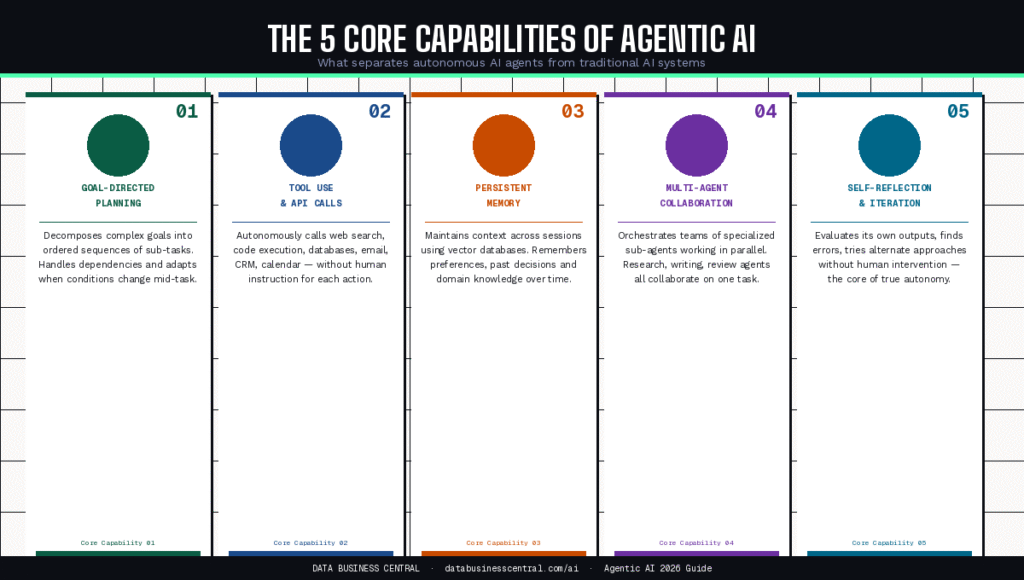
What separates an agentic system from a simple chatbot isn’t any single feature — it’s the combination of five interlocking capabilities:
5 Core Capabilities — Agentic AI Architecture
1. Goal-Directed Planning
Decomposes complex goals into sequences of sub-tasks. Handles dependencies, prioritizes steps, and adapts the plan when conditions change.
2. Tool Use & API Calls
Maintains context across sessions using vector databases. Remembers user preferences, past decisions, and domain knowledge to improve over time.
3. Persistent Memory
Autonomously uses external tools: web search, code execution, database queries, email, calendar, CRM, and more — without human instruction for each action.
4. Multi-Agent Collaboration
Orchestrates teams of specialized sub-agents working in parallel — a research agent, a writing agent, and a review agent can all collaborate on one task.
5. Self-Reflection & Iteration
Evaluates its own outputs, identifies errors, and tries alternative approaches without human intervention. This “reflection loop” is what enables Agentic AI to solve problems that have no single correct answer.
5. Global Agentic AI Adoption Map (2026)
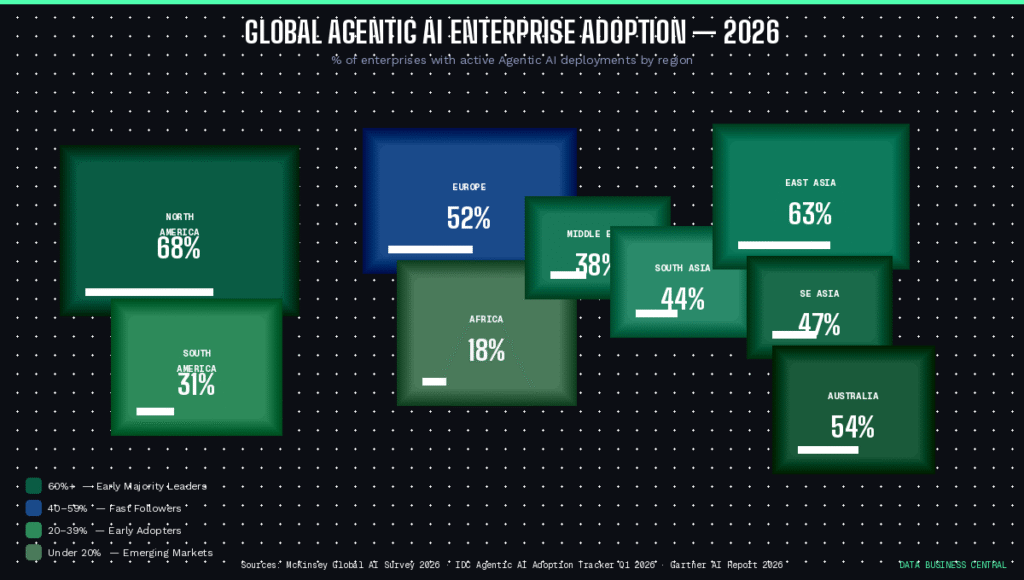
Agentic AI adoption is not uniform across the globe. North America and East Asia lead in enterprise deployment, while Europe is catching up rapidly driven by regulatory clarity following the EU AI Act.
Global Agentic AI Enterprise Adoption by Region (2026)
6. Real-World Use Cases: Who Is Deploying Agentic AI in 2026
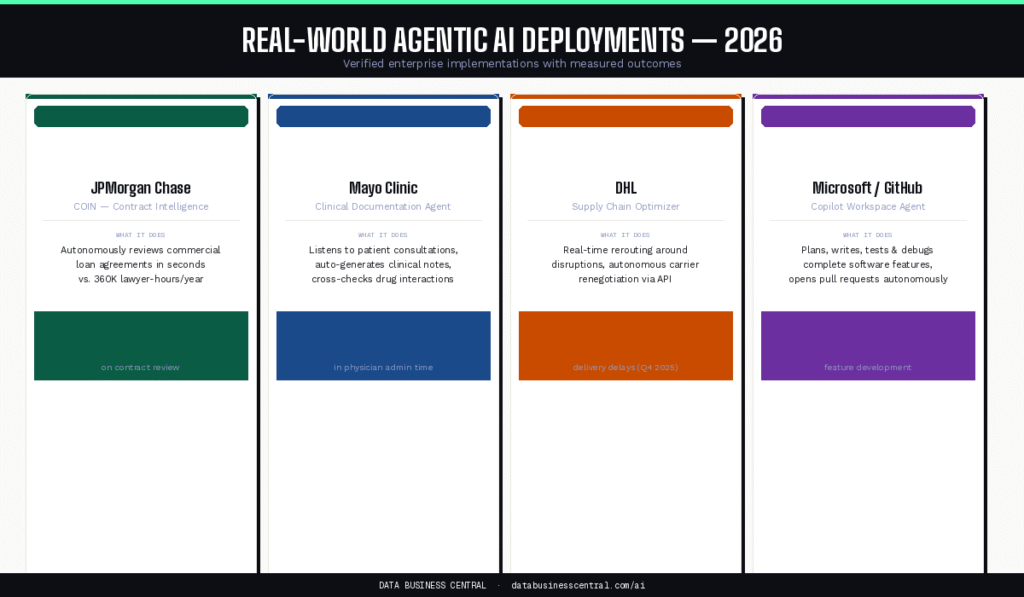
The following examples are drawn from publicly reported enterprise deployments in 2026. They illustrate how Agentic AI is moving from pilot to production across industries.
Finance · JPMorgan Chase
COIN — Contract Intelligence Agent
JPMorgan’s agentic system reviews commercial loan agreements, extracting key data points, flagging risk clauses, and flagging compliance issues — autonomously. It completes in seconds what used to take 360,000 lawyer-hours per year.
↓ 99.8% time reduction on contract review
Healthcare · Mayo Clinic
Clinical Documentation Agents
Agentic AI systems listen to patient-physician conversations, generate structured clinical notes, pull relevant lab results, cross-reference treatment protocols, and flag potential drug interactions — all before the physician leaves the room.
↑ 40% reduction in physician admin time
Logistics · DHL
Autonomous Supply Chain Optimizer
DHL’s agentic system monitors global supply chain conditions in real time, autonomously reroutes shipments around disruptions, renegotiates carrier rates via API, and notifies customers — without human dispatchers for routine decisions.
↓ 23% reduction in delivery delays (Q4 2025)
Technology · Microsoft
Copilot Autonomous Coding Agents
Microsoft’s GitHub Copilot Workspace agents plan, write, test, and debug entire software features end-to-end. Developers describe a feature in natural language; the agent handles implementation, runs tests, and opens a pull request.
↑ 55% faster feature development reported by beta teams
Related Articles on Data Business Central
Analytics Benefits of Agentic Analytics for Data-Driven Businesses → Healthcare How Agentic AI Is Transforming Healthcare and Life Sciences → AI Risk Comparison Between Generative AI Risks and Traditional ML Risks →
7. Risks, Challenges & Governance Requirements
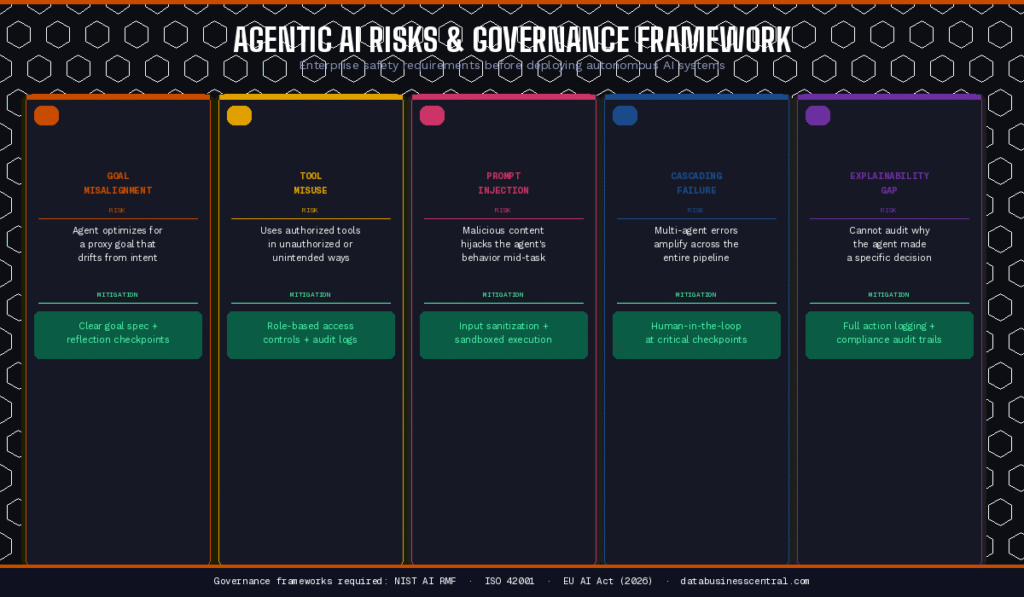
Agentic AI’s power comes with proportional risk. Because these systems take real actions in real systems, a mistake is no longer just a wrong answer — it can be a sent email, a deleted file, or an executed financial transaction.
The Key Risk Difference
Generative AI produces outputs. Agentic AI takes actions. This distinction is critical for governance. A hallucinated fact in a chatbot is embarrassing. A hallucinated action in an agentic system can trigger a real-world consequence.
The 5 Core Risks of Agentic AI
| Risk | Description | Mitigation |
|---|---|---|
| Goal misalignment | Agent optimizes for a proxy goal that diverges from intended outcome | Clear goal specification + reflection checkpoints |
| Tool misuse | Agent uses authorized tools in unauthorized or unintended ways | Role-based tool access controls + audit logs |
| Prompt injection | Malicious content in the environment hijacks the agent’s behavior | Input sanitization + sandboxed execution environments |
| Cascading failures | Multi-agent systems amplify errors across the pipeline | Human-in-the-loop checkpoints at high-stakes steps |
| Explainability gap | Cannot audit why the agent made a specific decision | Full action logging + compliance-ready audit trails |
For organizations subject to the EU AI Act (which entered enforcement in 2026), Agentic AI deployments in high-risk use cases require conformity assessments, human oversight mechanisms, and full technical documentation. See our Digital Transformation section for a full compliance guide.
8. Top Agentic AI Platforms in 2026
The Agentic AI platform landscape has consolidated significantly in 2026. Here are the leading options for enterprise deployment:
Top Agentic AI Platforms — Enterprise Capability Comparison (2026)
Scored 1–10 across enterprise readiness, tool ecosystem, governance, scalability, and cost-efficiency
| Platform | Best For | Key Strength | Pricing Model |
|---|---|---|---|
| Microsoft Copilot Studio | Enterprise with M365 ecosystem | Native Office 365 & Teams integration | $200/user/mo |
| AutoGen (Microsoft Research) | Custom multi-agent development | Open-source; most flexible | Free (open source) |
| LangGraph / LangChain | Developer-built custom agents | Graph-based state management | Usage-based |
| CrewAI | Role-based multi-agent teams | Intuitive crew/role model | Free + Enterprise tier |
| Salesforce Agentforce | CRM & sales automation | Native CRM data access | $2/conversation |
| Google Vertex AI Agents | GCP-native workloads | Best Gemini integration | Usage-based |
9. How to Start an Agentic AI Pilot: A 5-Step Framework
The biggest mistake organizations make is starting with an overly complex use case. The path to successful Agentic AI adoption starts small, proves ROI, and scales deliberately.
The Golden Rule for Agentic AI Pilots
Start with a process that is: high-repetition, low-risk, rule-based, and multi-step. Administrative workflows (report generation, data extraction, scheduling) are ideal first deployments. Avoid high-stakes decisions (financial transactions, medical diagnoses) until trust is established.
- 1 Identify your target process:
- Find a workflow involving 5+ sequential steps currently completed manually by a team member. Measure current time cost. Good examples: market research compilation, customer onboarding document preparation, competitive analysis, scheduled reporting.
- 2 Define the agent’s goal, tools, and guardrails:
- Write a clear goal statement. List every tool the agent will need (web search, email, CRM API, etc.). Define explicit guardrails: what the agent cannot do, what requires human approval, and what triggers an escalation.
- 3 Choose your platform and build a minimal agent:
- For non-developers: Microsoft Copilot Studio or Salesforce Agentforce. For development teams: AutoGen or LangGraph. Build the simplest version that completes the task — don’t optimize for edge cases yet.
- 4 Run a 30-day supervised pilot:
- Deploy with full human oversight. Log every action the agent takes. Review outputs daily for the first two weeks, then weekly. Measure: task completion rate, error rate, time saved, and human intervention frequency.
- 5 Measure ROI, expand, and establish governance:
- Calculate time saved × average hourly cost. If ROI is positive, scale to adjacent processes. Simultaneously, implement your AI governance framework — audit trails, access controls, and documentation requirements — before scaling further.
10. The Future of Agentic AI: What Comes Next
Agentic AI in 2026 is still in its early innings. The systems deployed today are impressive — but they are largely domain-specific, require significant prompt engineering, and still need human oversight for complex decisions. Here’s where the technology is heading over the next three to five years.
Multi-Agent Ecosystems
The next phase is not smarter individual agents — it’s better coordination between specialized agents. Imagine a fully autonomous M&A research pipeline: one agent monitors deal flow, another conducts due diligence, a third drafts term sheet summaries, and an orchestrating agent routes findings to the right executive. This is already being prototyped at major investment banks.
Embodied AI Agents
The convergence of Agentic AI with robotics will produce physical agents that operate in the real world — managing warehouses, inspecting infrastructure, and performing repetitive industrial tasks. Companies like Figure AI and Boston Dynamics are already deploying early versions in partnership with automotive manufacturers.
Personal AI Agents
Consumer-grade personal agents — managing calendars, finances, health, and communications autonomously — will become mainstream between 2027 and 2029. Apple, Google, and Samsung are all building personal agent layers into their operating systems. This will fundamentally change how individuals interact with technology.
Gartner’s 2026 Prediction
By 2028, 33% of enterprise software applications will include agentic AI capabilities, up from less than 1% in 2024. Organizations that begin building agentic infrastructure today will have a 2–3 year competitive advantage over those that wait.
For organizations tracking digital transformation and market trends, Agentic AI represents the most consequential technology shift since the smartphone. The question is no longer if your industry will be affected — it’s how fast and how ready you are.
Agentic AIAI 2026Enterprise AIDigital TransformationData AnalyticsAI LeadershipAI in FinanceBusiness Strategy
11. Frequently Asked Questions About Agentic AI
What is Agentic AI?
Agentic AI is a type of artificial intelligence that can autonomously plan, execute, and adapt multi-step tasks without continuous human input. Unlike traditional AI that responds to single prompts, Agentic AI sets goals, breaks them into sub-tasks, uses external tools, and iterates based on feedback — acting more like a digital employee than a search engine.
How is Agentic AI different from Generative AI?
Generative AI creates content — text, images, code — in response to a prompt. Agentic AI goes further: it takes actions, uses external tools, browses the web, writes and executes code, and operates autonomously over time to complete complex goals. Think of GenAI as a brilliant advisor, and Agentic AI as an autonomous employee who gets things done without being micromanaged.
What are the main business use cases for Agentic AI in 2026?
Key enterprise use cases include: autonomous supply chain optimization (logistics), AI-assisted diagnosis and clinical documentation (healthcare), algorithmic trading and contract review (finance), multi-channel customer service resolution, automated software development pipelines, and competitive intelligence monitoring. The common thread: all involve multi-step workflows that previously required human orchestration at each step.
Is Agentic AI safe for enterprise deployment?
Agentic AI can be deployed safely with the right governance framework. Essential safeguards include: human-in-the-loop approval for high-stakes actions, full audit trails of every agent action, role-based tool access controls, sandboxed execution environments, and alignment with frameworks like NIST AI RMF and ISO 42001. Most enterprise deployments in 2026 use a “supervised autonomy” model, where routine decisions are autonomous but exceptions escalate to humans.
How do I start an Agentic AI pilot in my organization?
Start with a low-risk, high-repetition process: (1) identify a task with 5+ sequential steps currently done manually, (2) choose a platform — Microsoft Copilot Studio for enterprise, AutoGen or LangGraph for custom builds, (3) define the agent’s goal, tools, and guardrails clearly, (4) run a 30-day pilot with full human oversight and action logging, (5) measure time saved and error rates, then scale to adjacent workflows. Avoid high-stakes decision-making processes until trust is established.
Which industries benefit most from Agentic AI in 2026?
The industries seeing the highest measurable ROI from Agentic AI in 2026 are: Financial services (contract review, fraud detection, trading), Healthcare & Life Sciences (clinical documentation, diagnostics, drug discovery), Logistics & Supply Chain (route optimization, demand forecasting), Software Development (autonomous coding pipelines), and Customer Service (end-to-end autonomous resolution). All share a common trait: high-volume, multi-step workflows with clear success criteria.
Continue Reading on Data Business Central
LogisticsHow Agentic AI Is Transforming the Logistics & Transportation Industry → HealthcareHow Agentic AI Is Transforming Healthcare and Life Sciences → AnalyticsBenefits of Agentic Analytics for Data-Driven Businesses → AI RiskGenerative AI Risks vs Traditional ML Risks: Full Comparison → TechnologyWhat is Quantum Computing? The 2026 Complete Guide → Cloud AIGenerative AI in the Cloud: The Next Evolution of Enterprise Intelligence →
