The era of AI as a passive assistant is over. In 2026, enterprises aren’t looking for tools that wait to be asked — they want systems that observe, decide, and act. Agentic AI delivers exactly that: autonomous agents capable of orchestrating multi-step workflows, interfacing with enterprise platforms, and delivering outcomes with minimal human intervention.
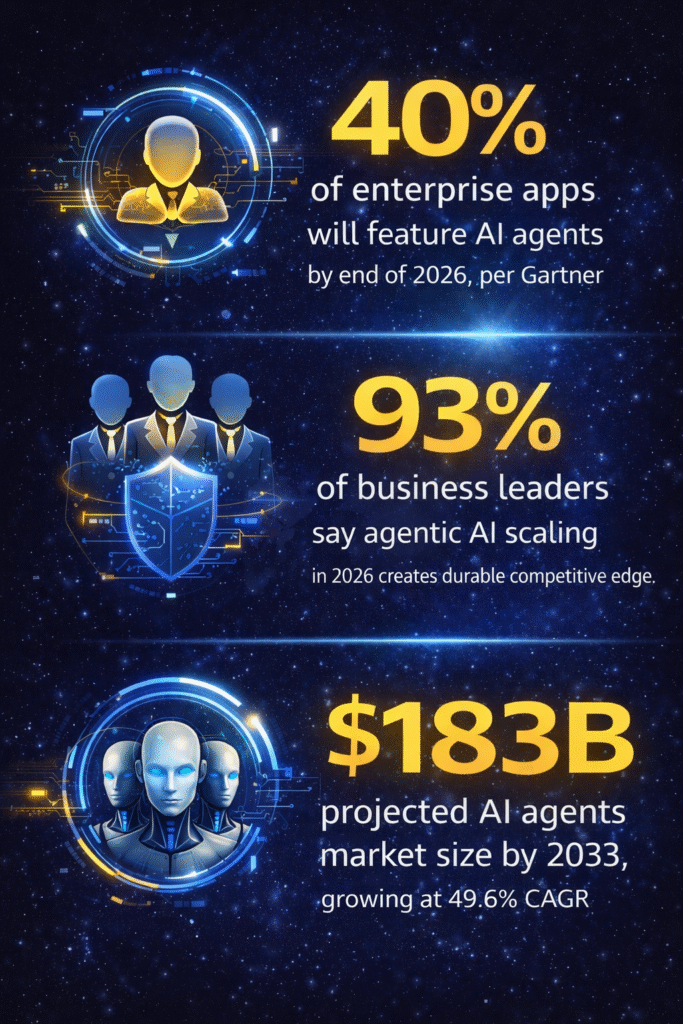
The shift is already underway. According to McKinsey, 23% of companies are actively scaling agentic AI systems, while another 39% are deep in experimentation. Gartner forecasts that 40% of enterprise applications will feature task-specific AI agents by end of 2026 — up from less than 5% just last year. The competitive window is open right now.
Here are the ten use cases generating the most real-world enterprise ROI in 2026.
Autonomous Customer Service Resolution
Customer service has long been a bottleneck of manual triage, repetitive queries, and costly human bandwidth. Agentic AI is dismantling that bottleneck entirely. Intelligent agents now handle Tier-1 and Tier-2 support issues across chat, email, and voice channels — integrating in real time with CRM systems, order management platforms, and ticketing tools to resolve issues end-to-end without escalation.
What sets agentic approaches apart from previous chatbot generations is cross-channel continuity: if a customer begins on WhatsApp and continues via email, the agent retains full context and resumes seamlessly. For logistics and e-commerce, this extends to proactive service — agents monitor delivery systems, detect delays, and initiate refunds or rebookings before customers file a complaint.
Impact:Gartner projects agentic AI will autonomously resolve 80% of common customer service issues without human intervention by 2029 — with support cost reductions approaching 30%.
Finance & Compliance
Intelligent Finance Operations & Fraud Detection
Finance teams are deploying agentic AI to manage the full lifecycle of high-volume, rule-bound workflows: invoice reconciliation, credit scoring adjustments, KYC (Know Your Customer) checks, loan calculations, and continuous monitoring of financial health indicators. Rather than pulling data from a single source, these agents cross-reference CRM systems, payment gateways, banking data, credit bureaus, and sanction databases simultaneously.
On the fraud side, multi-agent systems apply real-time anomaly detection across transaction streams — cross-referencing entity names, addresses, and social media signals to flag shell companies and sanctioned actors. This is the kind of parallel, cross-system reasoning that human analysts simply cannot perform at transaction speed or volume.
Impact:Financial services firms using agentic reconciliation report dramatic reductions in close cycle times and a near-elimination of manual exception-handling queues.
“
“An agentic AI system is more like an employee to whom you can delegate a project — one who will interact with other systems and return with a completed work product”.
— Morgan Lewis Technology & Sourcing, April 2026
Supply Chain
End-to-End Supply Chain Orchestration
Supply chain management involves an almost overwhelming density of variables: demand signals, supplier reliability, logistics constraints, inventory thresholds, and geopolitical risk. Traditional planning tools require human analysts to synthesize these signals manually and make decisions on compressed timelines. Agentic AI replaces this with continuous, autonomous orchestration.
Agents monitor upstream supplier feeds, correlate them with demand forecasts from ERP systems, and autonomously trigger purchase orders, reroute shipments, or flag procurement escalations — without waiting for a weekly review meeting. In manufacturing contexts, the same agents interface with production floor systems to rebalance lines when component shortages are detected.
Impact:Enterprises embedding agentic planning into core supply chain workflows report reduced stockout rates, faster supplier response cycles, and measurable working capital improvements.
IT & DevOps
Autonomous IT Service Management & DevOps
IT operations teams are drowning in alert noise, repetitive runbooks, and routine incident triage. Agentic AI changes the operating model fundamentally. Agents now monitor infrastructure health, correlate incident signals across observability platforms, execute predefined remediation runbooks, and — critically — learn from each resolution cycle to improve future response accuracy.
In DevOps pipelines, agentic systems handle code review triage, dependency vulnerability scanning, test suite orchestration, and deployment gate decisions. Development teams report significant reductions in time-to-deploy while security and compliance posture improves, since agents enforce policy consistently rather than relying on human checklists.
Impact:Organizations using agentic IT operations platforms report up to 60% reductions in mean time to resolution (MTTR) for Tier-1 incidents.
Sales & Revenue
Autonomous Sales Pipeline & Revenue Operations
Sales development is one of the most labor-intensive functions in any enterprise — and one of the most amenable to agentic automation. Modern agents identify high-intent leads from CRM data, craft and launch personalized outreach sequences, handle follow-up replies, qualify prospects through multi-turn dialogue, and book demos directly into AE calendars. The entire top-of-funnel can run autonomously while human sellers focus exclusively on discovery and closing.
Further down the funnel, agentic systems monitor deal health, flag at-risk opportunities based on engagement signals, and surface recommended next actions — integrating with Salesforce, HubSpot, and other revenue platforms via native APIs.
Impact:Sales teams using agentic SDR tools report 3-5x increases in outreach capacity with no corresponding headcount growth — and improved personalization at scale.
Healthcare
Clinical Operations & Patient Care Coordination
Healthcare is a sector with immense data volume, strict compliance requirements, and life-critical decision stakes. Agentic AI is proving its value across the administrative and clinical layers simultaneously. On the administrative side, agents handle billing automation, appointment scheduling, prior authorizations, and resource allocation — removing massive administrative burden from clinical staff.
Clinically, agents analyze patient data from notes, lab reports, and medical histories to surface anomalies and suggest personalized care pathways for physician review. Remote patient monitoring systems use agents to trigger interventions when wearable or home-device data exceeds defined thresholds — reducing preventable readmissions without increasing staffing requirements.
Impact:Health systems using agentic administrative automation report 40–60% reductions in time spent on prior authorizations, with measurable improvements in patient throughput.
Legal & Procurement
Contract Intelligence & Legal Document Automation
Legal and procurement workflows are high-stakes, highly structured, and historically slow — making them prime candidates for agentic transformation. Agents now extract key terms, obligations, and risk clauses from contracts at scale, compare them against standard playbooks, flag deviations for counsel review, and route approval workflows to the right stakeholders automatically.
In procurement, agents manage the full sourcing cycle: issuing RFPs, scoring vendor responses against weighted criteria, flagging compliance requirements, and drafting initial SOW documents. The handoff to human lawyers and procurement officers happens only at decision gates — not throughout the entire administrative process.
Impact:Legal teams report 70%+ reductions in contract review cycle times, with agents processing in hours what previously required days of paralegal effort.
HR & Talent
Intelligent HR Operations & Employee Experience
Human resources departments manage an enormous volume of repetitive, high-touch interactions: benefits inquiries, onboarding workflows, policy lookups, leave management, and performance review facilitation. Agentic AI handles these interactions via intelligent assistants integrated with HRIS platforms — providing employees with accurate, contextual answers without routing every question to an HR generalist.
On the talent acquisition side, agents screen CVs against job requirements, schedule interviews, generate candidate summaries for hiring managers, and even personalize candidate communications throughout the hiring journey. Workforce planning agents analyze attrition signals and proactively surface retention risk flags before valuable employees disengage.
Impact:Organizations deploying HR agents report significantly higher employee satisfaction scores and reduction in time-to-hire, while HR generalists redirect their time to culture and strategic workforce planning.
Marketing & Content
Autonomous Content Operations & Marketing Intelligence
Marketing operations require an ever-increasing volume of content, personalization, and campaign orchestration across fragmented channels. Agentic AI is transforming the function from a bottlenecked creative process into a scalable content engine. Agents autonomously create articles, social media assets, email campaigns, and branded visuals — tailored to specific audience segments and campaign objectives.
Campaign orchestration agents monitor performance metrics across channels, detect underperforming ad creatives, and autonomously reallocate budget or swap in alternative content variants. This closes the loop between data signal and creative response in hours rather than the days typically required by manual optimization cycles.
Impact:Marketing teams report 4-6x increases in content output volume while maintaining brand consistency — and meaningful improvements in campaign ROAS through autonomous optimization.
Energy & Sustainability
Energy Management & Sustainability Operations
As enterprises face mounting pressure on their carbon commitments and energy expenditure, agentic AI is proving its value in real-time grid and facility management. Agents proactively analyze data from energy equipment to predict maintenance schedules, foresee infrastructure failure, and flag anomalies before they escalate into costly outages.
More strategically, energy management agents balance supply and demand across facilities in real time — adjusting HVAC loads, renegotiating demand-response contracts, and optimizing renewable energy utilization against grid pricing signals. For large industrial enterprises, this represents not just operational savings but a direct contribution to measurable Scope 2 emission reductions.
Impact:Enterprises deploying energy management agents report 15–25% reductions in facility energy costs alongside verified improvements in carbon footprint reporting accuracy.
The Governance Imperative
Agentic AI is not a capability that can be deployed carelessly. When an autonomous agent approves a refund, triggers a payment, or modifies a contract record, the consequences are operational and potentially financial — not merely informational. Enterprises scaling these systems in 2026 are investing equally in governance frameworks: defining human oversight checkpoints, establishing clear accountability structures, and building audit trails that satisfy compliance requirements.
Deloitte notes a critical failure mode to watch: “agent washing” — vendors rebranding existing automation capabilities as agentic AI, and organizations deploying agents where simpler tools would suffice. The enterprises generating durable returns from agentic AI are those that pair autonomous capability with process redesign, clear KPIs, and robust human-in-the-loop controls at the right decision gates.
The competitive window for first-mover advantage in agentic AI is measurable in months, not years. The organizations pulling ahead in 2026 are not those that understood the technology first — they’re the ones that committed to it, governed it well, and moved while others were still forming committees.
Key Stat
65% of companies have already automated some workflows with agentic AI — and expect adoption to grow another 33% in 2026, expanding well beyond early pilots.

1 thought on “Top 10 Agentic AI Use Cases Transforming Enterprise Operations in 2026”
Pingback: AI Agents in the Enterprise: Use Cases, Risks & ROI 2026