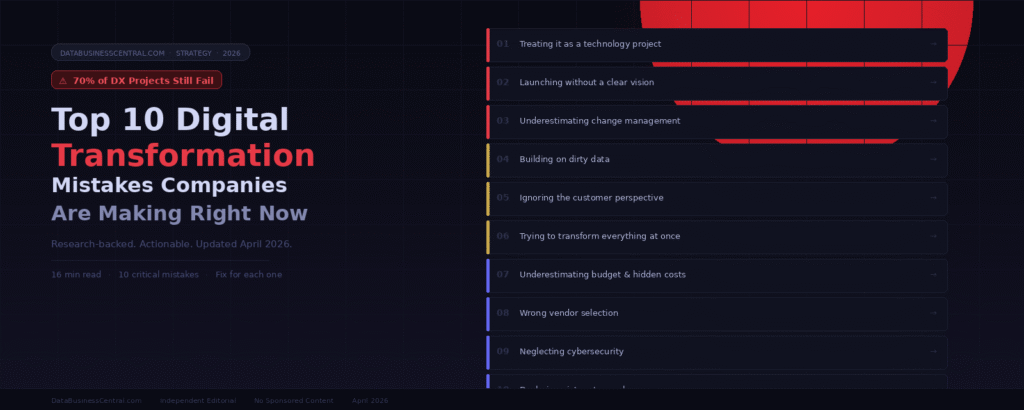
$2.3 trillion is wasted annually on failed digital transformation projects. The technology is rarely the problem. Here are the 10 mistakes quietly killing initiatives at companies of every size — and how to course-correct before it’s too late
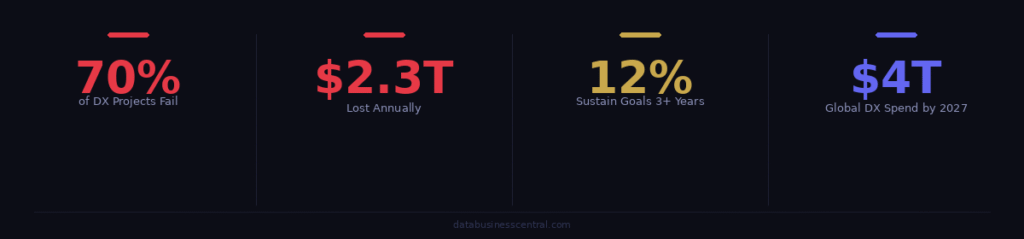
Table of Contents
- #1 — Treating It as a Tech Project
- #2 — No Clear Vision or Strategy
- #3 — Ignoring Change Management
- #4 — Poor Data Quality
- #5 — Skipping the Customer Perspective
- #6 — Trying to Do Everything at Once
- #7 — Underestimating Budget & Hidden Costs
- #8 — Wrong Vendor Selection
- #9 — Neglecting Cybersecurity
- #10 — Declaring Victory Too Early
Digital transformation has moved from boardroom buzzword to business survival imperative. Global spending on DX initiatives is projected to approach $4 trillion in coming years, with organizations racing to embed AI, cloud, and advanced analytics across every process. And yet — a sobering statistic has barely moved in a decade.
Roughly 70% of digital transformation programmes still fall short of their stated objectives in 2026. Only 12% of organizations report sustaining their transformation goals for more than three years, according to McKinsey research. The pattern is consistent across industries, geographies, and company sizes.
The problem almost never lies with the technology itself. It lies in strategy, culture, and execution falling out of sync. Here are the ten mistakes we see most often — and more importantly, what to do instead.
Most Common
Treating Digital Transformation as a Technology Project
This is the single most persistent and expensive mistake in the playbook. Companies invest millions in new ERP systems, AI platforms, and cloud infrastructure — then wonder why nothing has actually changed. The technology works. The business doesn’t move.
As Antony Edwards, managing director at PSG, puts it plainly: digital transformation is not about infrastructure and IT. It is about company culture, business DNA, and operating models. Organizations that approach it purely through a technology lens are upgrading systems without transforming outcomes.
$50-Mprojects have failed while $500K initiatives transformed entire departments. The difference? Understanding the human element before touching the technology.
The narrow tech focus is compounded when organizations jump to the next technology trend before proving the last one has delivered value — burning budget and organizational goodwill simultaneously.
The Fix
Reframe the initiative from the start. Define what business outcomes you are transforming toward — customer experience, speed to market, revenue model — and let that drive technology decisions, not the reverse. Technology is the enabler, never the goal.
Strategic Error
Launching Without a Clear Vision or Roadmap
A well-defined vision is the North Star of any transformation. When organizations skip this step — or treat it as a formality to be rubber-stamped in a strategy deck — initiatives inevitably drift or collapse under their own complexity. Without it, teams fill the vacuum themselves, resulting in misaligned priorities, interdepartmental confusion, and a patchwork of disconnected tools that drain resources without delivering results.
The most dangerous version of this mistake is launching a programme where different people at every level have a completely different understanding of what the transformation is actually for. The executive team sees operational efficiency. The IT department sees infrastructure modernisation. The sales team sees a new CRM. None of them are wrong — and none of them are aligned.
The Fix
Before a single vendor is contacted, answer three questions as a leadership team: What does the organisation look like when this succeeds? What business problem are we solving — not what technology are we deploying? And what does success look like at 6, 18, and 36 months? Publish the answers widely and revisit them quarterly.
People Problem
Underestimating Change Management
This is where most well-planned transformations die quietly. The technology goes live. The dashboards look great. And almost immediately, people revert to spreadsheets, old workflows, and the tools they already know. Digital fatigue is real — and it is severely underestimated at the planning stage.
A common assumption is that a single decision from the executive board constitutes a rollout. It doesn’t. People need to be trained, immersed, and convinced — not just informed. Resistance to change isn’t irrational stubbornness; it’s a predictable human response to disruption that must be designed for, not managed around.
Cultural barriers are the most common failure point: risk aversion that suppresses experimentation, siloed departments that limit cross-functional collaboration, and hierarchy-heavy decision-making that prevents agile responses. These don’t disappear when a new platform goes live.
The Fix
Invest in change management from day one — not as an afterthought. Identify change champions in every department. Communicate the “why” continuously, not just at launch. Create feedback loops that allow employees to raise friction, and close those loops visibly. Culture shifts through demonstrated leadership behaviour, not policy documents.
Data Issue
Building on Dirty Data
No AI system, analytics platform, or automated workflow can compensate for poor underlying data. Yet organisations consistently underestimate the condition of their data estate until a transformation project exposes it — at the worst possible moment, with the most expensive possible consequences.
One CIO recalled a global sales analytics platform that looked perfect on paper but collapsed after burning through millions of dollars — because regional teams were using incompatible sales metrics. Some markets tracked daily sales, others monthly. The data was fundamentally incompatible, and no amount of software investment could bridge the gap.
42%of financial benefits are lost during the latter stages of large-scale change efforts — frequently due to data quality issues that weren’t addressed upfront.
The Fix
Conduct a data readiness audit before any platform selection. Identify inconsistencies in formats, definitions, and ownership. Establish data governance policies — who owns each data domain, what the single source of truth is, and how quality will be maintained. Clean data is infrastructure; treat it as such.
CX Blind Spot
Designing for Internal Efficiency, Ignoring the Customer
At the heart of every successful transformation lie two goals: serve customers better and add genuine value to their experience. Every facet of a transformation, from design to implementation, should be anchored to these aims. Yet a frequent mistake is allowing internal process optimisation to dominate the agenda entirely — delivering leaner operations while delivering a worse experience to the people who actually pay for the product.
A cautionary example: one real estate analytics company scrapped its entire first version of a new platform after realising agents needed mobile-first solutions. The team had built desktop dashboards — excellent ones, internally — but they reflected how the team thought agents should work, not how agents actually worked. The rebuild cost months and significant budget.
The Fix
Map the customer journey before you map the internal process. Run discovery interviews with real users — employees, partners, customers — before architecture decisions are made. Build feedback mechanisms into the product so the transformation continues to be shaped by real usage, not assumptions.
Execution Error
Trying to Transform Everything at Once
Ambition is necessary. Attempting to execute that ambition across every function, process, and system simultaneously is where organisations burn out, lose focus, and ultimately stall. The competitive and technological landscape is evolving rapidly — a transformation programme launched in early 2024 may need significant course corrections by 2026 without an agile approach. Long multi-year projects designed to deliver everything at the end risk arriving obsolete.
Even the largest, most successful transformation programmes are built on a series of small, validated wins. The organisations that sustain transformation don’t attempt a single moonshot — they build a compound track record of delivered value that funds and justifies the next phase.
The Fix
Start with a limited MVP scoped to one high-impact problem. Ship it, measure it, and share the results — even small positive outcomes — quickly and visibly. Use early wins to build organisational confidence, secure continued investment, and refine your approach before scaling. Momentum is built, not decreed.
Budget Risk
Underestimating Budget and Hidden Costs
The visible costs of transformation — software licences, implementation fees, infrastructure — are the ones that appear in the original business case. The hidden costs are the ones that derail it. Unexpected delays, additional training requirements, integration work with legacy systems, change management consultancy, new hires needed mid-project, and productivity losses during transition all accumulate with alarming speed.
Companies that jump straight from planning to execution without detailed budgeting or an honest assessment of internal capability gaps consistently find themselves funding those gaps reactively — at the worst possible moments in the project timeline.
The Fix
Add explicit buffers to every budget line — a minimum 20–30% contingency per workstream is realistic for complex implementations. Audit internal skills before the project starts, not six months in. Identify where capability gaps will require external expertise or new hires, and price that into the original case rather than treating it as an escalation.
Vendor Risk
Choosing the Wrong Vendor — or Too Many Vendors
Poor vendor selection leaves organisations with systems that don’t meet their requirements, insufficient support during the implementation phase, and expensive switching costs discovered too late. A related but equally damaging mistake is the opposite — hiring a fragmented collection of vendors to fill individual gaps, creating an unmanageable patchwork of systems that are nearly impossible to keep consistent or strategically aligned.
The most avoidable version of this mistake is when IT proposes a technology because it’s technically impressive — and no one stops to validate whether it solves an actual business problem. Automation initiatives that meet technical goals but aren’t aligned with business case objectives are a recurring example: budgets misspent on initiatives that were destined to underachieve from the day they were approved.
The Fix
Define evaluation criteria before you speak to a single vendor. Prioritise fit with your business problem, integration capability with your existing ecosystem, quality of post-implementation support, and long-term scalability. Limit implementation partners to one or two primary vendors where possible. Ask every vendor for references from similar-sized implementations — and actually call them.
Security Gap
Treating Cybersecurity as an Afterthought
As organisations adopt more digital tools, they generate and store vastly more sensitive data — contracts, financials, customer details, operational plans. In the urgency of transformation delivery, security architecture is routinely deprioritised, added at the end, or delegated to a team without the resource or authority to enforce it properly. The result is new digital surface area with old security assumptions.
In 2026, this is no longer a theoretical risk. Regulatory requirements under GDPR and emerging frameworks are tightening. Ransomware incidents targeting organisations mid-transformation — when systems are in a transitional, often partially-integrated state — are a documented pattern. A transformation that delivers operational value but introduces a critical vulnerability has not succeeded; it has created a different kind of failure with a deferred detonation date.
The Fix
Embed security architecture into the design phase, not the deployment checklist. Require all vendors to demonstrate compliance with relevant standards before selection. Implement role-based access controls, data classification policies, and incident response playbooks as foundational infrastructure — not optional modules to be added post-launch.
Long Game
Declaring Victory Too Early
Go-live is not the finish line. It is the beginning of the hardest phase. Yet organisations consistently treat the launch of a new system as the end of the transformation story — scaling back investment, reassigning the project team, and redirecting executive attention to the next initiative. Within 12–18 months, adoption has slipped, workarounds have proliferated, and the original business case has quietly failed to materialise.
McKinsey’s research makes this concrete: only 12% of organisations report sustaining their transformation goals for more than three years. The gap between short-term wins and sustained impact is real, and it is almost always explained by what happened — or didn’t happen — in the 12 months after go-live.
12%of organisations sustain digital transformation goals beyond 3 years. The majority celebrate go-live and quietly let the gains erode.
The Fix
Build a post-launch operating model before you go live. Assign ownership of continuous improvement, define leading and lagging KPIs tracked at 30, 90, 180, and 365 days post-launch, and ring-fence budget for the optimisation phase. Transformation is a capability, not a project. The organisations that win treat it as ongoing.
Before You Launch: 10-Point Readiness Checklist
Use this before any digital transformation initiative goes to the board for approval.
✓ Business case is outcome-led, not technology-led — specific business problem defined
✓ Vision is written, shared, and understood at every level of the organisation
✓ Change management budget and owner are in place before the first line of code
✓ Data readiness audit completed — quality, ownership, and governance defined
✓ Customer journey mapped and real user research completed before architecture decisions
✓ MVP scope defined — first phase is deliverable within 90 days and measurable
✓ Budget includes 25% contingency and full hidden cost identification across all workstreams
✓ Vendor shortlist evaluated against business criteria — not feature lists — with reference checks done
✓ Security architecture scoped in the design phase with compliance requirements documented
✓ Post-launch operating model defined — KPIs, ownership, and optimisation budget confirmed
The Bottom Line
The failure statistics for digital transformation have barely moved in a decade — not because the technology has failed to improve, but because organisations keep making the same human mistakes. The technology is rarely the problem. Strategy, culture, and execution falling out of sync almost always is.
The companies that consistently succeed share a common pattern: they define outcomes before selecting tools, invest in their people with the same seriousness as their infrastructure, start smaller than feels comfortable, and treat transformation as an ongoing organisational capability rather than a finite project with a go-live date.
The $2.3 trillion wasted annually on failed initiatives isn’t an industry problem. It’s a series of individual decisions, made in boardrooms and project teams, that compound into an avoidable outcome. The checklist above won’t guarantee success — but it will remove the most common causes of failure before they become expensive lessons.
