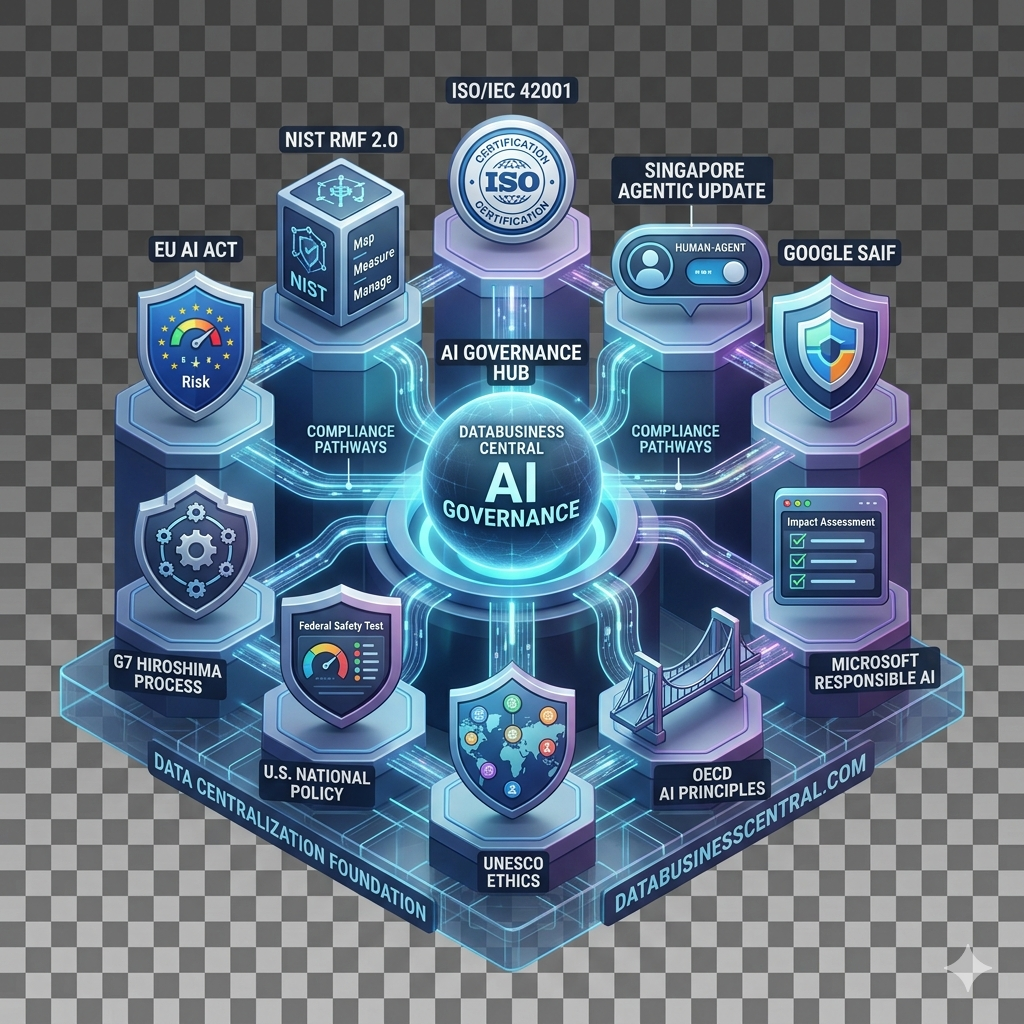
As AI transitions from a “cool feature” to the literal nervous system of the enterprise, the risk landscape has shifted. In 2026, we are no longer just managing “chatbots”; we are governing Autonomous AI Agents that have the power to execute financial transactions, hire employees, and manage supply chains.
For the modern executive, “Governance” is no longer a bureaucratic hurdle—it is a competitive moat. Below are the 10 frameworks every leader must integrate into their data business strategy.
1. The EU AI Act (2026 Fully Operational Version)
The “Gold Standard” of global AI regulation is now fully active. In 2026, the EU AI Act has moved from a legislative proposal to a strict enforcement reality with heavy fines for non-compliance.
- The Risk-Based Approach: It categorizes AI into four levels: Unacceptable (Banned), High-Risk (Heavily Regulated), Limited Risk (Transparency required), and Minimal Risk.
- The 2026 Reality: Most business-critical AI agents (recruitment, credit scoring, infrastructure) are now classified as “High-Risk,” requiring mandatory conformity assessments and fundamental rights impact assessments.
- Leader’s Takeaway: If you operate globally, your baseline should be the EU AI Act. It is easier to scale down for other regions than to scale up for Europe.
2. NIST AI Risk Management Framework (RMF) 2.0
NIST remains the most practical “how-to” guide for American and global enterprises. The 2.0 version, updated for 2026, places a massive emphasis on Generative and Agentic AI.
- The Four Functions: Govern, Map, Measure, and Manage.
- New for 2026: NIST 2.0 introduces specific sub-categories for “Model Drift” and “Adversarial Prompting,” helping IT teams secure agents that interact with external web tools.
- Leader’s Takeaway: Use NIST to bridge the gap between your Legal team’s requirements and your IT team’s execution.
3. ISO/IEC 42001: The AI Management System (AIMS)
Think of this as “ISO 9001 for AI.” It is the first international standard that allows a company to be officially certified in AI governance.
- Holistic Management: It covers everything from how you acquire data to how you retire an old model.
- Certification Value: In 2026, having ISO 42001 certification is becoming a prerequisite for B2B contracts. It proves to your partners that your AI isn’t just “good”—it’s standardized.
4. Singapore Model AI Governance Framework (Agentic Update)
Singapore has taken the lead in governing the “Agentic Era.” Their 2026 update is the first-of-its-kind focused on Autonomous AI Agents.
- Human-in-the-Loop vs. Human-on-the-Loop: This framework provides clear definitions of when a human must click “approve” (high-stakes financial transfers) versus when they can just monitor a dashboard.
- Leader’s Takeaway: Excellent for companies building autonomous sales or customer service agents that need to operate without constant human hand-holding.
5. Google Secure AI Framework (SAIF)
Google’s SAIF is the industry leader for Security-First AI. It treats AI models not as static software, but as dynamic, attackable surfaces.
- Red-Teaming: SAIF mandates “AI Red-Teaming”—hiring experts to try and “break” your AI agents to find vulnerabilities.
- The “Defense-in-Depth” Model: It ensures that even if a model is “hallucinating,” the surrounding security layers prevent that hallucination from leaking sensitive customer data.
6. Microsoft Responsible AI Standard v2.1
Microsoft has open-sourced their internal blueprint, providing a rare look at how a tech giant manages risk across millions of users.
- The Six Pillars: Accountability, Transparency, Fairness, Reliability, Privacy, and Inclusiveness.
- Practical Tools: It includes the “Impact Assessment Template,” which your team can use today to evaluate if a new AI project is too risky to launch.
7. OECD AI Principles (Intergovernmental Standard)
This framework is the bedrock for policy in 40+ countries. It’s less about “code” and more about “long-term strategy.”
- Sustainable & Inclusive Growth: It pushes businesses to ensure their AI doesn’t just increase profit, but also reduces social inequality and environmental impact.
- Leader’s Takeaway: Perfect for ESG-focused (Environmental, Social, and Governance) organizations that want to align their AI use with global sustainability goals.
8. UNESCO Recommendation on the Ethics of AI
The UNESCO framework is critical for companies operating in emerging markets. It is the only framework backed by 193 member states.
- Focus on Diversity: It ensures that AI doesn’t just work for the “Western Data” it was trained on, but respects local cultures and languages.
- Leader’s Takeaway: If your business is expanding into Africa, SE Asia, or Latin America, this is the framework you need to avoid “Digital Colonialism” and build local trust.
9. The U.S. National Policy Framework (2026 White House Update)
Following the 2025 Executive Orders, the 2026 Framework creates a unified federal standard for AI in the United States.
- Preemption of State Laws: This framework aims to simplify the “patchwork” of state laws (like California’s AI bills), giving businesses one federal standard to follow.
- Safety Testing: It mandates that companies developing the most powerful models must share their safety test results with the government before public release.
10. G7 Hiroshima AI Process (International Interoperability)
For the truly global enterprise, the G7 process ensures that your governance in the UK works with your governance in Japan.
- Interoperability: It focuses on making sure that “Risk Level 1” in one country means the same thing in another, reducing the administrative burden on multinational corporations.
Conclusion: Centralizing Your Governance Hub
The common thread across all 10 frameworks is Centralized Intelligence. You cannot govern what you cannot see. To succeed in 2026, your “Data Business Central” must include a governance dashboard that monitors every model, agent, and dataset in real-time.
Don’t wait for a lawsuit to build your framework. Start with NIST 2.0 or ISO 42001 today to secure your digital future.
