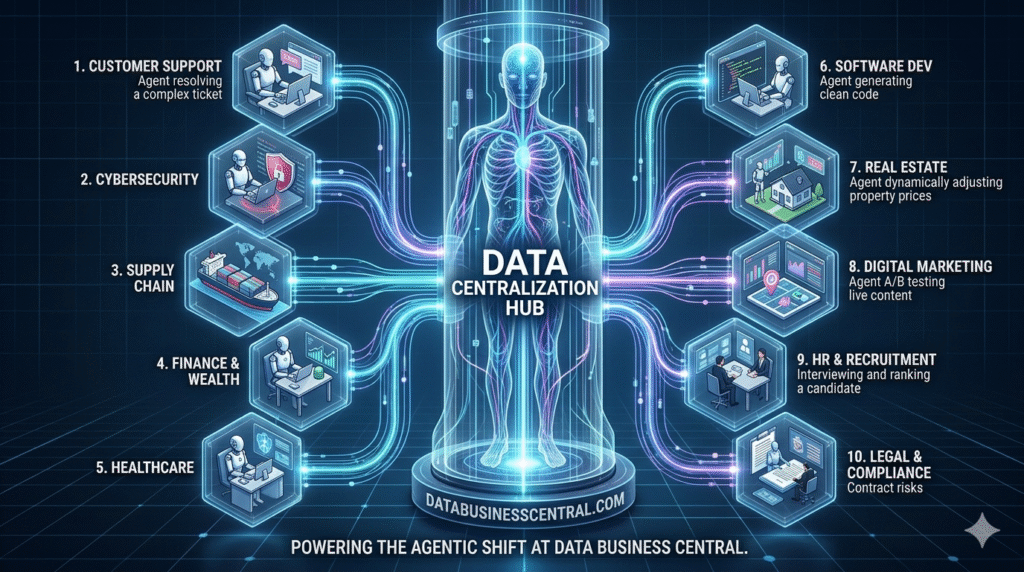
1. Customer Experience (CX): The End of the “Ticket”
In 2026, the concept of a “support ticket” is becoming an artifact of the past. AI Agents have transitioned from simple conversationalists to Resolution Engines.
- Autonomous Problem Solving: Unlike early chatbots that simply provided links to help articles, today’s agents use “Reasoning Loops” to execute tasks. They can access your CRM, verify a customer’s warranty status, and initiate a replacement shipment or a refund through your ERP—all without a human ever touching the request.
- The “Vibe” Shift: Advanced emotion recognition now allows agents to detect frustration or sarcasm with over 90% accuracy, automatically escalating sensitive cases to humans while handling 70% of standard inquiries entirely on their own.
2. Cybersecurity: Defensive Swarm Intelligence
The “Agentic Shift” has moved cybersecurity from reactive defense to Autonomous Threat Hunting.
- Digital Immune Systems: AI Agents act as independent “guards” within a network. They simulate “red team” attacks on their own infrastructure to identify vulnerabilities before hackers do.
- Real-Time Remediation: When an anomaly is detected, an agent doesn’t just send an alert to a dashboard; it can instantly isolate the affected server, rewrite firewall rules, and “self-heal” the system in milliseconds—narrowing the window of attack to a timeframe humans can’t match.
3. Supply Chain: From Maps to Manifests
Logistics was once a game of spreadsheets; now it’s a game of Autonomous Coordination.
- Predictive Re-routing: AI Agents monitor global data streams—weather, port congestion, and geopolitical shifts. If an agent sees a delay in the Suez Canal, it doesn’t wait for a manager. It evaluates alternative routes, calculates the fuel-to-time cost ratio, and secures new carrier bids automatically.
- Swarm Intelligence: Multiple agents now operate in parallel, linking warehouse inventory levels directly to shipping schedules, ensuring that supply perfectly mirrors demand with zero “buffer” waste.
4. Financial Services: The Autonomous Wealth Advisor
High-end wealth management, once reserved for the ultra-rich, has been democratized through Agentic Fintech.
- “Do-Bots” for Dollars: We’ve moved from “Robo-advisors” (which just suggested portfolios) to “Agentic Advisors.” These agents can be granted permission to move money—harvesting tax losses daily, rebalancing portfolios across different asset classes, and finding the highest yield for idle cash across global markets in real-time.
- Fraud Detection 2.0: Agents now identify fraud by “thinking” like a human investigator, looking for subtle shifts in behavioral patterns rather than just checking against static rules.
5. Healthcare: Reducing the “Administrative Burden”
Healthcare is leveraging agents to solve the “Doctor Burnout” crisis by automating the Clinical Workflow.
- Intake to Insurance: Agents handle the entire patient lifecycle. They verify insurance eligibility in real-time, cross-reference medical history with current symptoms to prioritize urgent cases, and even handle the complex back-and-forth of “prior authorizations” with insurance companies.
- Clinical Decision Support: Multi-agent systems work together: one agent summarizes lab reports, another searches the latest PubMed research for matching cases, and a third compiles a treatment recommendation for the doctor to review, saving hours of research time.
6. Software Development: The “Architect” Era
The barrier between an idea and a working application is being demolished by Autonomous DevOps.
- Self-Coding Pipelines: Systems like Devin are now standard. An AI Agent can take a high-level business requirement (e.g., “build a checkout page with Apple Pay”), write the code, set up the database, run its own unit tests, and deploy it to the cloud.
- Legacy Maintenance: Agents are being used to “babysit” old codebases, automatically identifying security flaws and rewriting outdated functions into modern languages without human oversight.
7. Real Estate: Dynamic Asset Management
Real estate is shifting from a static “Location” business to an Intelligence-driven one.
- Dynamic Pricing Models: Agents evaluate micro-market demand, interest rate fluctuations, and neighborhood traffic patterns to adjust rent or sale prices daily—similar to how airlines price seats.
- Virtual Property Managers: In property management, agents coordinate maintenance autonomously. If a tenant reports a leak, the agent identifies the issue via a photo, finds a local plumber with the best rating/price, and schedules the repair within minutes.
8. Digital Marketing: The Iterative Creative
Marketing has moved from “Campaigns” to Living Content Ecosystems.
- Hyper-Personalization at Scale: Agents don’t just send emails; they create them on-the-fly. They monitor how a specific user interacts with a website and instantly regenerate the page layout, copy, and images to match that user’s specific “buying triggers.”
- Autonomous Budgeting: Marketing agents manage ad spend across platforms, shifting budget from a failing Facebook ad to a trending TikTok video in real-time, optimizing ROI faster than any agency.
9. HR & Recruitment: Contextual Talent Discovery
Recruitment is moving away from “Keyword Matching” to Predictive Fit.
- Holistic Screening: AI Agents conduct initial “vibe and logic” screenings via conversational interfaces. They evaluate how a candidate solves a problem, not just what’s on their resume.
- Lifecycle Automation: Once hired, agents handle the onboarding—assigning hardware, setting up payroll, and guiding the employee through company policy, which reduces HR administrative overhead by up to 60%.
10. Legal & Compliance: The Automated Auditor
In a world of complex regulations (like the EU AI Act), agents are the only way to remain Compliant at Scale.
- Contract Intelligence: Legal agents can ingest 10,000 contracts and instantly identify every instance of a “Force Majeure” clause that doesn’t meet new standards. They don’t just flag them; they can draft the updated amendments for review.
- Risk Monitoring: Agents continuously monitor company communications and transactions to ensure they stay within legal and ethical boundaries, acting as a 24/7 internal auditor.
Conclusion: The Roadmap to an Agentic Future
The transition from passive AI tools to autonomous AI agents marks the most significant shift in business operations since the dawn of the internet. As we have seen across these ten industries, the focus is no longer on how much data you can collect, but on how effectively your data infrastructure can empower agents to act.
For leaders and organizations, the “Agentic Shift” offers a choice: continue managing legacy systems through manual oversight, or build a centralized intelligence hub that allows for 24/7, autonomous growth.
Key Takeaways for Your Strategy:
- Infrastructure First: AI agents are only as capable as the data they can access. Centralizing your data is the prerequisite for automation.
- Start Small, Scale Fast: Identify one high-friction area—be it customer support or lead generation—and pilot an agentic workflow.
- Human-Centric Oversight: While agents handle the execution, the human role shifts toward architecting the intent and governing the ethics of these systems.
