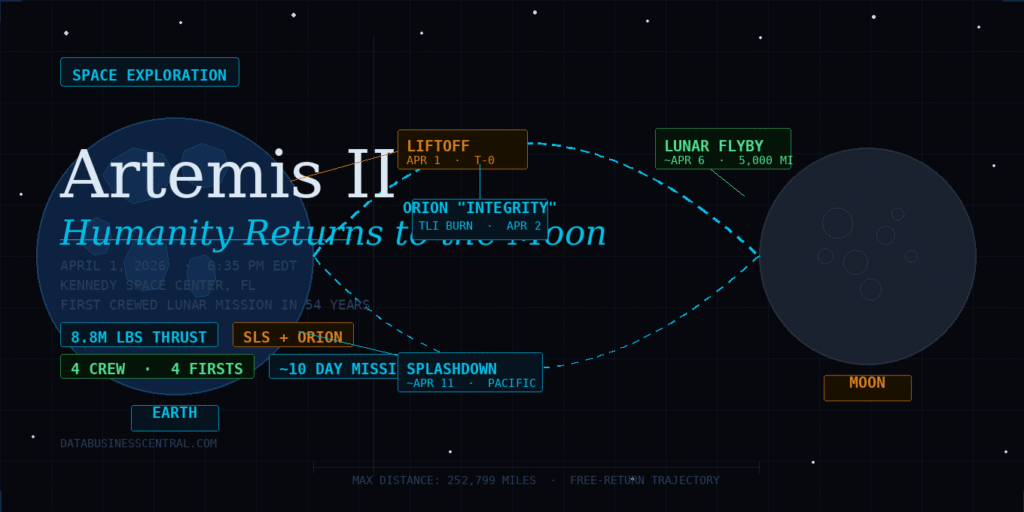
On April 1, 2026, NASA’s Artemis II lifted off from Kennedy Space Center — sending four astronauts on the first crewed journey toward the Moon since Apollo 17 in December 1972. Here is everything that happened and why it marks one of the most significant moments in spaceflight history.
What Is Artemis II?
Artemis II is an ongoing U.S. spaceflight sending four astronauts on a flyby around the Moon and back to Earth. It is the second flight of the Space Launch System, the first crewed mission of the Orion spacecraft, and the first crewed mission beyond low Earth orbit since Apollo 17 in December 1972.
Unlike the Apollo missions that landed on the lunar surface, Artemis II is a test flight — a critical proving ground for the hardware, systems, and procedures that will carry future crews to the Moon’s surface. The mission flies a free-return trajectory, meaning the spacecraft uses the Moon’s gravity to slingshot back toward Earth, requiring less fuel and providing a continuous abort option throughout the journey.
🚀 Why It Matters
Artemis II is not just a space milestone — it is a statement of renewed national and international commitment to deep space exploration, paving the road toward a permanent lunar presence and, eventually, crewed missions to Mars.
The Crew
The mission is crewed by NASA astronauts Reid Wiseman, Victor Glover, and Christina Koch, along with Canadian Space Agency astronaut Jeremy Hansen. Each crew member carries a historic distinction that makes this mission particularly significant.
Reid Wiseman
Commander · NASA
Oldest person to travel beyond low Earth orbit
Victor Glover
Pilot · NASA
First person of color to travel beyond low Earth orbit
Christina Koch
Mission Specialist · NASA
First woman to travel beyond low Earth orbit
Jeremy Hansen
Mission Specialist · CSA
First non-U.S. citizen to travel beyond low Earth orbit
🌍 Historic Firsts
Glover became the first person of color, Koch the first woman, Wiseman the oldest person, and Hansen — a Canadian — the first non-U.S. citizen to travel beyond low Earth orbit and near the Moon. Together they represent the most diverse crew ever sent toward the Moon.
Launch Day: April 1, 2026
NASA’s Artemis II SLS rocket and Orion spacecraft lifted off from Launch Complex 39B at NASA’s Kennedy Space Center in Florida at 6:35 p.m. EDT. The launch was remarkably smooth — the SLS rocket is notorious for fuel leaks and technical holds, but it cleared the pad on the first attempt, right at the opening of the launch window.
6:35 PM -Liftoff from Launch Complex 39B
The twin solid rocket boosters ignited first, delivering more than 75% of the thrust needed, generating 8.8 million pounds of force at liftoff.
~7:24 PM -Solar arrays deploy, core stage separates
The Orion spacecraft’s four solar array wings fully deployed, giving Orion a wingspan of roughly 63 feet when fully extended. Core stage separation completed the first major propulsion phase.
~10:00 PM -Proximity operations demo
Pilot Victor Glover hand-flew Integrity for nearly an hour, using the interim cryogenic propulsion stage as a target. “Overall, guys, this flies very nicely,” Glover declared.
Apr 2, 7:49 PM -Translunar injection burn — point of no return
Orion’s main engine fired for five minutes and 50 seconds, sending the crew on a trajectory toward the Moon. Orion’s mass at the time of the burn was 58,000 pounds. The crew were now officially bound for the Moon.
~Apr 6 -Lunar flyby — closest approach
The crew will fly within approximately 5,000 miles of the lunar surface, conduct a six-hour lunar observation session, and witness a nearly one-hour solar eclipse from the far side of the Moon.
~Apr 11 -Pacific Ocean splashdown
Orion will re-enter Earth’s atmosphere at a steeper angle than Artemis I to protect the crew from heat shield stress, then splash down off the coast of California.
04Records Being Broken
Artemis II is setting multiple human spaceflight records. According to NASA’s pre-launch calculations, the mission’s April 1 launch date was expected to allow the crew to travel a maximum distance from Earth of 252,799 statute miles — besting the Apollo 13 distance record by 4,144 miles.
| Record | Previous Mark | Artemis II |
|---|---|---|
| Max distance from Earth | 248,655 mi (Apollo 13) | 252,799 mi |
| Distance beyond the Moon | ~69 mi (Apollo lunar orbit) | ~4,700 mi |
| First woman beyond low Earth orbit | Never achieved | Christina Koch |
| First person of color beyond LEO | Never achieved | Victor Glover |
| First non-U.S. citizen beyond LEO | Never achieved | Jeremy Hansen |
| First crewed mission beyond LEO | Apollo 17, Dec 1972 | 54 years later |
The Technology Behind the Mission
Space Launch System (SLS)
The SLS is NASA’s most powerful rocket ever built. At liftoff it generated 8.8 million pounds of thrust — more than the Saturn V used during Apollo. It is the only rocket capable of sending Orion, astronauts, and cargo directly to the Moon in a single launch. The rocket stands 322 feet tall and weighs 5.75 million pounds fully fueled.
Orion Spacecraft “Integrity”
The Orion capsule — named Integrity for this mission — is the crew’s home for the 10-day journey. It carries life support, communications, and a heat shield redesigned after Artemis I revealed unexpected ablative material erosion. For exercise, Orion carries a flywheel device that weighs just 30 pounds and is about the size of a carry-on suitcase, supporting loads up to 400 pounds for both aerobic and resistance exercises — a stark contrast to the ISS’s 4,000-pound gym.
European Service Module
Built by ESA, the European Service Module provides propulsion, power, temperature control, and consumables (water, oxygen). Orion’s four solar array wings — each about 23 feet long with 15,000 solar cells — are part of the ESM and fully deployed minutes after launch.
Science on Board
Despite being a test flight, Artemis II carries real science. The AVATAR (A Virtual Astronaut Tissue Analog Response) investigation uses organ-on-a-chip devices to study the effects of increased radiation and microgravity on human health. Crew members also donated blood to create miniature stand-ins of their bone marrow — bone marrow being particularly sensitive to deep-space radiation.
On April 6, the crew will spend approximately six hours conducting lunar observations, photographing craters, ancient lava flows, and geological features that will inform planning for future surface landings. They will also witness a nearly hour-long total solar eclipse from the far side of the Moon — and NASA has sent along eclipse glasses for the occasion.
🔭 Lunar Science
The lunar science team is building a Lunar Targeting Plan — a guide to what the crew will observe on the Moon’s surface, including craters, ancient lava flows, and cracks and ridges created as the Moon’s outer layer slowly shifted over time.
What Comes Next: Artemis III and Beyond
Artemis II is the bridge to Artemis III — currently planned for 2028 — which will be the first lunar landing since Apollo 17. The landing site is targeted near the Moon’s south pole, where water ice in permanently shadowed craters could support long-term human presence. Blue Origin’s lunar lander is being developed to carry crew from Orion down to the surface.
NASA administrator Jared Isaacman recently announced plans to increase the frequency of launches to the Moon and a plan to establish a permanent base on the lunar surface. The Artemis program is not a flag-and-footprints exercise — the stated goal is sustained human presence on and around the Moon, and ultimately as a proving ground for the first crewed Mars missions.
📌 The Bigger Picture
Every system Artemis II tests — Orion’s life support, the SLS performance envelope, deep space communications, crew health protocols — directly reduces risk for Artemis III and the permanent lunar outpost that follows. This mission is infrastructure, not just exploration.
