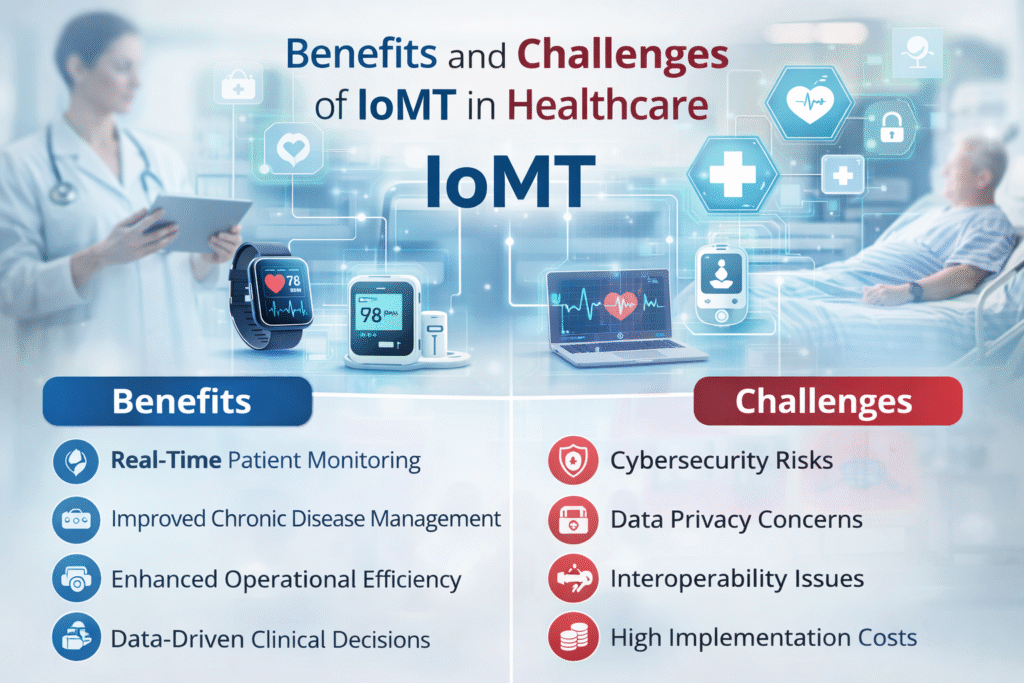
The Internet of Medical Things (IoMT) refers to interconnected medical devices, software platforms, and healthcare systems that collect, transmit, and analyze patient data in real time. IoMT ecosystems include wearable health trackers, smart implants, connected diagnostic tools, remote patient monitoring systems, and hospital asset management platforms.
Below is a structured, in-depth analysis of its key benefits and major challenges.
✅ Benefits of IoMT
1. Real-Time Patient Monitoring
IoMT enables continuous health tracking through connected devices such as heart rate monitors, glucose sensors, and blood pressure trackers. This real-time data transmission allows clinicians to detect anomalies early and intervene before conditions escalate.
For chronic diseases like diabetes, cardiovascular disorders, and respiratory illnesses, real-time monitoring reduces hospital readmissions and improves long-term health outcomes.
2. Improved Chronic Disease Management
Chronic disease care shifts from reactive treatment to proactive management. IoMT devices can track vital signs continuously and send alerts when thresholds are crossed.
This reduces emergency admissions and supports personalized treatment adjustments based on real-time patient data rather than periodic clinic visits.
3. Enhanced Operational Efficiency in Hospitals
IoMT improves hospital workflows by tracking medical equipment, optimizing bed management, and automating inventory monitoring.
Smart infusion pumps, connected ventilators, and RFID-enabled asset tracking reduce manual errors and equipment misplacement. This improves utilization rates and reduces operational costs.
4. Data-Driven Clinical Decision Making
IoMT integrates with AI-powered analytics platforms to convert raw patient data into actionable insights.
Predictive analytics can identify at-risk patients, recommend treatment pathways, and support evidence-based decision-making. This reduces diagnostic errors and improves clinical accuracy.
5. Cost Reduction in Healthcare Delivery
Remote patient monitoring decreases unnecessary hospital visits and readmissions.
Healthcare systems can lower inpatient care costs, reduce emergency department overload, and optimize staffing needs. Over time, this shifts care delivery from expensive acute care to cost-efficient preventive care.
6. Better Patient Engagement and Experience
Patients gain more visibility into their health metrics through mobile apps and dashboards connected to IoMT devices.
This transparency encourages medication adherence, lifestyle changes, and preventive health behavior. Patients become active participants in their care journey rather than passive recipients.
7. Expansion of Telemedicine Services
IoMT strengthens telehealth by providing clinicians with real-time biometric data during virtual consultations.
Doctors can assess patient vitals remotely, making telemedicine more reliable and clinically effective compared to traditional video-only consultations.
⚠️ Challenges of IoMT
1. Cybersecurity Risks
IoMT devices are connected endpoints within healthcare networks, making them potential targets for cyberattacks.
Medical devices often lack robust security architecture. A compromised device could expose sensitive patient data or disrupt critical care systems.
Healthcare cybersecurity remains one of the largest barriers to IoMT scalability.
2. Data Privacy and Regulatory Compliance
IoMT generates massive volumes of sensitive patient information.
Healthcare organizations must comply with data protection regulations (such as HIPAA, GDPR, and other regional frameworks). Ensuring secure data storage, encryption, and consent management is complex and costly.
3. Interoperability Issues
Different IoMT devices and platforms often operate on incompatible standards.
Lack of standardization limits seamless data exchange between hospitals, insurers, labs, and cloud platforms. Without interoperability, the full value of IoMT data cannot be realized.
4. High Initial Implementation Costs
Although IoMT reduces long-term costs, initial deployment requires significant investment:
- Device procurement
- Cloud infrastructure
- Data analytics platforms
- IT integration
- Staff training
Smaller healthcare facilities may struggle with upfront capital expenditure.
5. Data Overload and Management Complexity
Continuous monitoring generates large volumes of real-time data.
Without proper analytics and filtering systems, clinicians may experience alert fatigue or information overload. Managing and extracting meaningful insights from massive datasets requires advanced AI and robust IT infrastructure.
6. Reliability and Device Maintenance
IoMT devices must operate with high reliability. Device malfunction, battery failure, or network downtime can disrupt patient monitoring.
Regular maintenance, firmware updates, and quality assurance protocols are essential to maintain system integrity.
7. Ethical and Legal Concerns
Questions arise regarding:
- Liability in case of device failure
- AI-based clinical decisions
- Data ownership
- Patient consent
Legal frameworks are still evolving to address accountability in connected healthcare ecosystems.
📊 Summary Table
| Category | Benefits | Challenges |
|---|---|---|
| Clinical Impact | Real-time monitoring, improved diagnosis | Risk of incorrect data interpretation |
| Financial | Reduced readmissions, lower long-term cost | High upfront infrastructure cost |
| Operational | Better asset tracking, workflow automation | Integration complexity |
| Data | Predictive analytics, AI insights | Cybersecurity & privacy risks |
| Patient Experience | Higher engagement, remote care | Digital literacy gaps |
Conclusion
The Internet of Medical Things is transforming healthcare from reactive, hospital-centered care to proactive, patient-centric care. It enhances monitoring, reduces costs, and improves clinical outcomes through real-time data integration and analytics.
However, cybersecurity vulnerabilities, interoperability gaps, regulatory compliance burdens, and infrastructure costs remain substantial challenges.
For healthcare systems to fully realize IoMT’s potential, investments in cybersecurity architecture, standardized data protocols, AI-driven analytics, and regulatory alignment are essential.
IoMT is not just a technological upgrade—it represents a structural shift in how healthcare is delivered, managed, and optimized in the digital era.
