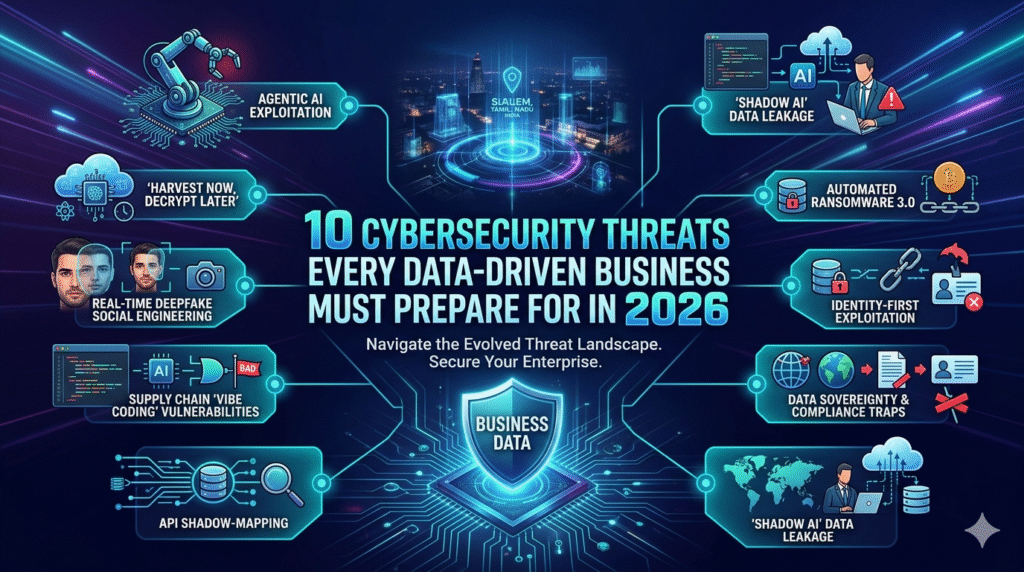
Your data is your most valuable asset — and the most targeted. Here’s what’s coming, and how to stay ahead of it.
In 2026, cybercriminals are more organized, AI-powered, and relentless than ever before. Data-driven businesses — those running analytics pipelines, machine learning models, cloud warehouses, and BI dashboards — face a uniquely dangerous attack surface. Here are the 10 threats your security team cannot afford to overlook, along with concrete steps to defend against each one.
- $4.9MAverage ransom demand in 2025–26
- 62%Of breaches traced to third-party vendors
- 38dAverage time to detect data pipeline attack
The 2026 Threat Landscape
AI-powered phishing attacks
4.7×More convincing than 2024
91%Of breaches start with phishing
Generative AI now crafts hyper-personalized phishing emails indistinguishable from real colleagues. Attackers scrape LinkedIn and Slack to mimic your tone, job title, and ongoing projects — then send from near-identical domains. Traditional spam filters miss over 60% of these messages, leaving your team exposed.
What to do now
- Deploy AI-powered email security tools (e.g., Abnormal Security, Proofpoint)
- Run quarterly simulated phishing drills with real-time scoring and staff feedback
- Enforce multi-factor authentication on all email accounts, no exceptions
Ransomware-as-a-Service(RAAS)2.0
$4.9MAvg. ransom demand 2025
72hrsAvg. downtime per attack
Ransomware gangs now operate like SaaS companies — selling attack kits, offering customer support, and splitting revenue with affiliates. In 2026, RaaS groups increasingly target data warehouses, BI tools, and cloud databases where recovery is most painful and downtime is most costly.
What to do now
- Maintain immutable, air-gapped backups and test restores monthly
- Segment your network to prevent lateral movement between systems
- Create and rehearse a documented incident response plan with defined roles
Data pipeline poisoning
340%Rise in pipeline attacks 2024–25
38 daysAvg. time to detect
Attackers quietly corrupt the data flowing into your models and dashboards — without triggering alerts. Poisoned training data leads to catastrophically wrong business decisions; poisoned reports mislead executives for weeks before anyone notices. The attack is silent, slow, and devastating.
What to do now
- Implement end-to-end data lineage tracking for all critical pipelines
- Set statistical anomaly alerts on key data streams at every transformation stage
- Validate data checksums and schema integrity at every ingestion point
Insider threats &credential threats
34%Of breaches involve insiders
$15MAvg. annual cost per org
Disgruntled employees, contractors with over-privileged access, and stolen credentials are a top source of data breaches. In data-heavy businesses, a single compromised account can expose millions of customer records. Insider threats are notoriously difficult to detect with traditional tools.
What to do now
- Apply least-privilege access principles across all data systems and warehouses
- Deploy User and Entity Behavior Analytics (UEBA) to flag unusual access patterns
- Enforce same-day access revocation procedures for all departing employees and contractors
Third party & supply chain attack
62%Of breaches traced to 3rd parties
1,000+Avg. vendors per enterprise
Your security is only as strong as your weakest vendor. Attackers compromise software libraries, SaaS integrations, and analytics tools to reach your data indirectly. The 2024 MOVEit-style attacks showed how one vulnerable shared tool can cascade across thousands of businesses simultaneously.
What to do now
- Audit all third-party access to data systems on a quarterly basis
- Require SOC 2 Type II reports from all critical data vendors
- Maintain a Software Bill of Materials (SBOM) for every integration and dependency
cloud misconfiguration expoilts
80%Of cloud breaches from misconfig
6 minTo exploit exposed S3 bucket
Exposed S3 buckets, overly permissive IAM roles, and public Snowflake instances remain embarrassingly common. As data stacks grow more complex across AWS, GCP, and Azure, misconfiguration risk multiplies. Automated scanners on the dark web hunt for these exposures 24 hours a day.
What to do now
- Run Cloud Security Posture Management (CSPM) tools continuously in all environments
- Enable default-deny policies on all new storage buckets and data resources
- Conduct quarterly cloud configuration audits using standardized security benchmarks
LLM & AI modal attacks
New-Threat class emerging in 2025–26
500%-Rise in prompt injection attempts YoY
As businesses embed AI into core workflows, attackers exploit the models themselves. Prompt injection tricks LLMs into leaking sensitive data or bypassing access controls. Model inversion attacks extract proprietary training data. If your AI system touches sensitive data, it has become a new attack surface.
What to do now
- Validate and sanitize all user inputs before they reach any AI system
- Never train production models on raw, unsanitized, or sensitive PII datasets
- Red-team and adversarially test AI systems before every production deployment
API security vulnerablities
83%Of web traffic is now API traffic
2×API attacks grew in 2025
Data-driven businesses depend on hundreds of APIs connecting dashboards, data lakes, and external services. Broken object-level authorization (BOLA), missing rate limiting, and unauthenticated endpoints allow attackers to exfiltrate data at scale — silently and systematically over extended periods.
What to do now
- Inventory every API including shadow and undocumented APIs using discovery tools
- Enforce OAuth 2.0, strict rate limiting, and authentication on all API endpoints
- Deploy an API gateway with built-in anomaly detection and real-time traffic monitoring
Deepfake &enabled fraud
3,000%Rise in deepfake fraud 2022–26
$25MLost in single deepfake CFO call
Real-time deepfake video and voice now convincingly impersonate executives with startling accuracy. In 2024, a finance employee wired $25M after a deepfake CFO video call. In 2026, these attacks increasingly target data access rather than money — fake executives demanding urgent data exports.
What to do now
- Establish verbal code words for any high-stakes financial or data access requests
- Require secondary out-of-band confirmation for unusual data access requests over video
- Train all staff to be deeply skeptical of urgency and pressure in any unexpected request
Quantum computing threads to encryption
2028Projected year encryption breaks at scale
NowHarvest-now, decrypt-later attacks active
Nation-state actors are already harvesting encrypted data today, waiting for quantum computers powerful enough to break current encryption — a strategy called ‘harvest now, decrypt later.’ If your business stores sensitive data for years, the risk is already materializing and migration must begin now.
What to do now
- Inventory all data with long-term sensitivity requirements (5+ years of retention)
- Begin migrating to NIST-approved post-quantum cryptography algorithms proactively
- Encrypt sensitive archives using quantum-resistant algorithms as a priority initiative now
1. AI Governance & Model Security
Data-driven businesses now rely on LLMs and agentic AI. Your audit must go beyond the database to the “model weights.”
- [ ] Algorithmic Transparency: Are model logic and training data sources documented to comply with the EU AI Act and 2026 U.S. state statutes (e.g., California, Texas)?
- [ ] Prompt Injection Defense: Are there active filters and “jailbreak” monitoring for customer-facing AI interfaces?
- [ ] AI Data Lineage: Can you trace if “Right to be Forgotten” requests have been propagated to your AI training sets?
- [ ] Synthetic Data Audit: If using synthetic data for training, is it regularly audited to ensure no “membership inference” attacks can leak original sensitive data?
2. Zero Trust & Identity-First Security
The “perimeter” is dead. Every access request must be verified in real-time based on context.
- [ ] Phishing-Resistant MFA: Have you moved away from SMS/Push and toward hardware keys or FIDO2-compliant passkeys for all employees?
- [ ] Micro-segmentation: Are data stores isolated so a breach in a web server cannot move laterally to the customer database?
- [ ] Just-In-Time (JIT) Access: Are admin privileges granted only for the duration of a specific task rather than held permanently?
- [ ] Device Posture Check: Does the system verify OS patch levels and disk encryption status before granting access to cloud data?
3. The “Quantum-Safe” Transition
With “Q-Day” (quantum computers breaking encryption) approaching, 2026 is the year for cryptographic inventory.
- [ ] Crypto-Agility Inventory: Do you have a list of all encryption algorithms currently in use across your stack (SSL/TLS, SSH, Disk Encryption)?
- [ ] PQC Roadmap: Is there a documented plan to transition to NIST-standard Post-Quantum Cryptography (PQC)?
- [ ] “Harvest Now, Decrypt Later” Protection: Are your most sensitive, long-lived data assets (e.g., genetic data, 20-year contracts) already being protected with hybrid classical/quantum-resistant layers?
4. Modern Privacy & Sovereignty
Global laws now focus on where data sits and who “inferred” what about a user.
- [ ] Data Localization: Does your cloud architecture ensure that data for EU, Indian, or Chinese citizens stays within their respective borders as per 2025/2026 mandates?
- [ ] Inference Rights: Can you provide a user with a report on what your AI has inferred about them (e.g., health status, disability, or profiling), as now required by updated acts like the CTDPA?
- [ ] Dark Pattern Audit: Has your UI been audited to ensure consent is not being manipulated (now a high-penalty focus for the FTC and GDPR)?
5. Resilience & Automated Response
In 2026, “Incident Response” is an automated playbook, not a manual PDF.
- [ ] Immutable Backups: Are your data backups stored in a “Write Once, Read Many” (WORM) format that ransomware cannot encrypt or delete?
- [ ] Automated Remediation: Do you have “Kill Switches” that automatically revoke access if a user’s behavior (e.g., downloading 5000 files in 1 minute) deviates from their ML-generated baseline?
- [ ] Supply Chain/API Visibility: Are you monitoring the security posture of your 3rd-party SaaS vendors via real-time API attestations rather than annual spreadsheets?
| Score | Status | Action |
| 85% – 100% | Quantum-Ready | Maintain posture; focus on continuous AI red-teaming. |
| 60% – 84% | Legacy-Risk | High risk of lateral movement. Prioritize Zero Trust & MFA. |
| Below 60% | Critical Vulnerability | You are likely non-compliant with 2026 AI and Privacy laws. |
Since we’re navigating a year where AI Agents are doing as much work as humans, here is a 2026-specific pro tip for your security strategy:
The “Identity Deception” Audit
In 2026, the biggest threat to your data isn’t a leaked password; it’s a High-Fidelity Deepfake. Traditional “Security Awareness Training” is no longer enough when an attacker can join a video call using a real-time voice and face clone of your CFO.
- Implement a “Shared Secret” Protocol: Establish non-digital, offline “safe words” or challenge-response phrases for high-stakes actions (like authorizing a massive data migration or a wire transfer).
- Audit your “Human Latency”: Ensure your security policy requires a secondary, out-of-band verification (e.g., a physical token or a separate encrypted messaging app) for any request that bypasses standard automated controls.
If your security relies solely on “seeing is believing,” your data is already at risk. Move toward Cryptographic Verification for every person, not just every device.
