
Introduction
Modern software development no longer operates in isolated phases. Businesses today demand faster releases, continuous innovation, and stable digital systems. DevOps and Agile methodologies emerged as structured responses to these demands. Agile reshaped how teams design and build software through iterative delivery and adaptive planning. DevOps extended that philosophy into operations, integrating development and infrastructure to enable continuous deployment and reliability.
Together, DevOps and Agile create an end-to-end framework that reduces time-to-market, enhances product quality, improves collaboration, and aligns technology with business objectives. Their adoption is no longer limited to technology companies; enterprises across healthcare, finance, retail, and manufacturing rely on these methodologies to remain competitive in a digital-first economy.
Understanding Agile Methodology
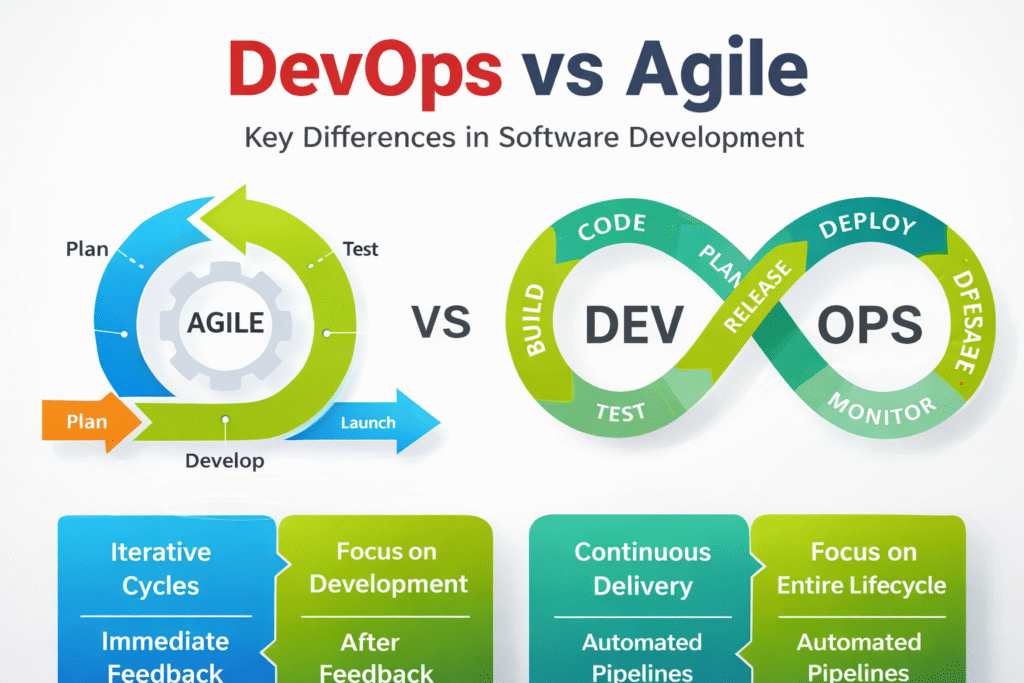
Agile is a development philosophy built around incremental progress, collaboration, and rapid feedback. Instead of delivering a complete product after long development cycles, Agile divides projects into short, manageable iterations called sprints. Each sprint produces a functional increment of the product.
Agile emphasizes:
- Continuous stakeholder involvement
- Adaptive planning
- Cross-functional teamwork
- Regular feedback loops
- Incremental value delivery
Frameworks such as Scrum and Kanban operationalize Agile principles. Scrum organizes work into structured sprints with defined roles like Product Owner and Scrum Master. Kanban focuses on workflow visualization and limiting work in progress. Both approaches prioritize transparency and responsiveness.
Agile enables organizations to adapt to changing customer expectations and evolving market conditions without derailing entire projects.
Understanding DevOps
DevOps is both a cultural shift and a technical framework. It bridges the gap between development teams that create applications and operations teams that deploy and maintain them. Traditionally, these teams worked in silos, often leading to delays, deployment failures, and accountability issues.
DevOps introduces automation, shared responsibility, and continuous processes to eliminate bottlenecks.
Core components include:
- Continuous Integration (CI)
- Continuous Delivery/Deployment (CD)
- Infrastructure as Code (IaC)
- Automated testing
- Monitoring and observability
Through automation and collaboration, DevOps shortens development cycles while maintaining system stability and scalability.
How Agile and DevOps Work Together
Agile focuses on how software is planned and developed. DevOps focuses on how that software is tested, deployed, and maintained. When implemented together, they create a seamless pipeline from concept to production.
Agile ensures the product evolves based on real user feedback. DevOps ensures those updates are delivered efficiently and reliably. Without DevOps, Agile teams may produce features quickly but face deployment delays. Without Agile, DevOps may automate inefficient workflows. Their integration eliminates friction between speed and stability.
Benefits of DevOps & Agile Integration
Faster Time-to-Market
Short development iterations combined with automated deployment pipelines accelerate product releases.
Improved Software Quality
Continuous testing and monitoring reduce defects before production release.
Enhanced Collaboration
Cross-functional teams increase accountability and reduce communication gaps.
Increased Deployment Frequency
Organizations can release updates multiple times daily instead of monthly or quarterly.
Greater Business Alignment
Frequent stakeholder involvement ensures product development aligns with strategic goals.
Implementation Challenges
Despite clear benefits, adopting DevOps and Agile requires organizational transformation.
Cultural Resistance
Teams accustomed to traditional workflows may resist shared ownership and automation.
Skill Gaps
Cloud infrastructure, containerization, and CI/CD require technical expertise that may not be readily available.
Legacy Systems
Older architectures are difficult to integrate into modern DevOps pipelines.
Security Risks
Rapid deployment cycles can introduce vulnerabilities without integrated security practices.
Addressing these challenges requires leadership commitment, training, and phased implementation strategies.
DevSecOps: Integrating Security
As deployment speeds increase, security must be embedded within the development lifecycle. DevSecOps integrates automated security checks into CI/CD pipelines, ensuring vulnerabilities are identified early.
This approach includes:
- Automated code scanning
- Compliance validation
- Container security testing
- Runtime monitoring
Security becomes a continuous process rather than a final checkpoint.
The Future of DevOps & Agile
The evolution of DevOps and Agile is accelerating with advancements in artificial intelligence and cloud-native technologies.
AI-Driven DevOps
Machine learning models are increasingly used for predictive monitoring, anomaly detection, and automated incident response.
Platform Engineering
Organizations are building internal developer platforms to standardize tools and streamline workflows.
GitOps Adoption
Declarative infrastructure management through version-controlled repositories enhances consistency and transparency.
Cloud-Native Expansion
Microservices, Kubernetes orchestration, and serverless computing are redefining application architecture.
Hyperautomation
Automation will extend beyond deployment into testing, scaling, compliance, and cost optimization.
In the coming years, DevOps pipelines are expected to become increasingly autonomous, data-driven, and resilient.
Conclusion
DevOps and Agile methodologies have fundamentally transformed how software is built and delivered. Agile enhances adaptability and customer alignment, while DevOps ensures operational efficiency and reliability. Their integration enables organizations to innovate rapidly without sacrificing stability.
The future lies in intelligent automation, AI-driven monitoring, cloud-native ecosystems, and secure-by-design development frameworks. Organizations that continue to refine their DevOps and Agile practices will be better positioned to compete in an increasingly digital and performance-driven global market.
FAQ: DevOps & Agile Methodologies
1. What is the primary goal of Agile methodology?
Agile aims to deliver incremental software improvements through short development cycles and continuous feedback.
2. What does DevOps improve in software development?
DevOps enhances automation, deployment frequency, operational stability, and collaboration between development and operations teams.
3. Can Agile exist without DevOps?
Yes, but deployment may become a bottleneck. DevOps complements Agile by streamlining release processes.
4. What tools are commonly used in DevOps?
Common tools include version control systems, CI/CD platforms, containerization technologies, cloud orchestration tools, and monitoring systems.
5. Is DevOps suitable for small businesses?
Yes. Startups and small enterprises benefit from faster iteration, lower operational overhead, and scalable cloud infrastructure.
6. How will AI influence DevOps in the future?
AI will enable predictive analytics, automated troubleshooting, intelligent testing, and self-healing infrastructure systems.

1 thought on “DevOps & Agile Methodologies”
Pingback: Top 25 DevOps & Agile Companies in 2026