
Introduction: The Acceleration of Enterprise Cloud in the U.S.
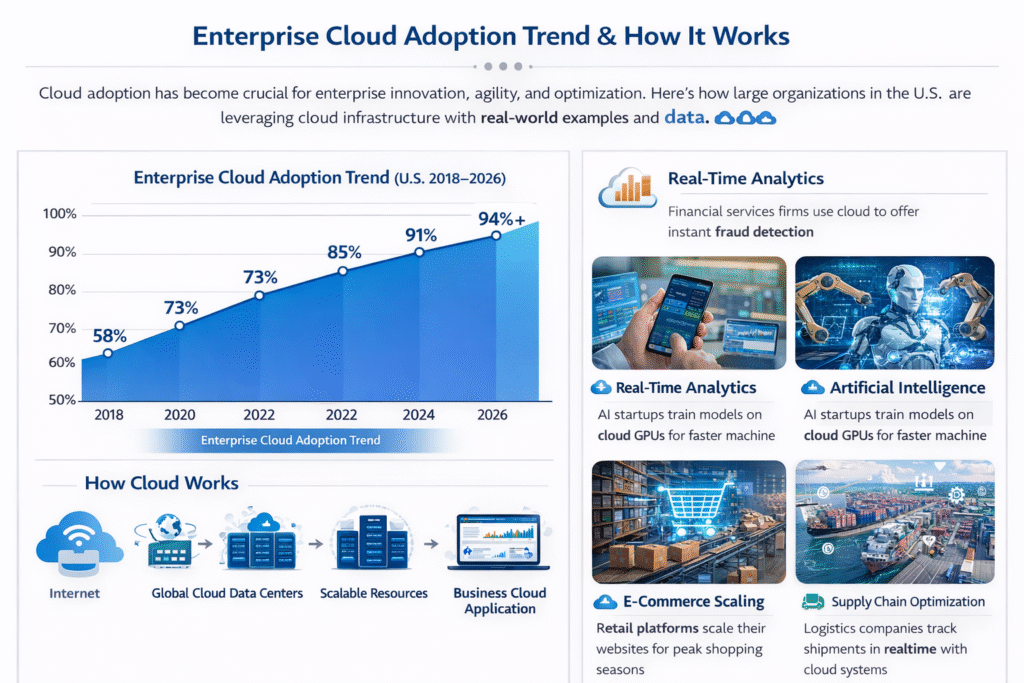
Enterprise cloud adoption in the United States has shifted from experimental IT upgrades to mission-critical infrastructure. The chart reflects growth from roughly 58% adoption in 2018 to a projected 94%+ by 2026. This expansion aligns with AI acceleration, digital transformation investments, cybersecurity modernization, and enterprise automation.
Major providers such as Amazon Web Services, Microsoft Azure, and Google Cloud dominate U.S. enterprise workloads. Cloud now supports data analytics, blockchain nodes, fintech platforms, SaaS systems, and AI model training.
1. 2018: Early Enterprise Migration Phase (58%)
In 2018, most enterprises began shifting non-critical workloads such as data backup, testing environments, and SaaS platforms to cloud environments. Infrastructure modernization was the primary driver.
Real-time example: Mid-size retail businesses moved inventory databases to cloud-hosted ERP systems to reduce hardware maintenance costs and improve data accessibility.
This stage emphasized cost reduction and infrastructure simplification.
2. 2020: Remote Work & Digital Surge (73%)
Adoption accelerated significantly during 2020 as organizations needed scalable infrastructure for remote operations. Cloud-based collaboration tools and digital workflows became essential.
Real-time example: Zoom expanded rapidly by leveraging AWS data centers to support millions of concurrent video sessions during peak demand.
Cloud demonstrated its elasticity and business continuity value.
3. 2022: Multi-Cloud Strategy Expansion (85%)
By 2022, enterprises diversified cloud providers to reduce dependency risks and improve performance optimization. Multi-cloud architectures became mainstream.
Real-time example: Financial institutions deployed compliance workloads on Azure while using Google Cloud AI services for predictive risk analytics.
This phase focused on resilience and strategic workload distribution.
4. 2024: AI-Driven Cloud Workloads (91%)
AI and machine learning became major drivers of cloud consumption. GPU-based infrastructure enabled advanced data modeling and automation.
Real-time example: U.S. e-commerce companies use cloud AI models to personalize product recommendations in real time based on browsing behavior.
Cloud evolved from storage infrastructure to intelligent compute platforms.
5. 2026: Near Universal Enterprise Integration (94%+)
The projection for 2026 suggests that nearly all enterprises operate in hybrid or fully cloud-enabled environments. Adoption reflects infrastructure standardization rather than experimentation.
Enterprises without a structured cloud strategy risk lagging in innovation and operational efficiency.
6. How Enterprise Cloud Architecture Works
Enterprise cloud systems operate through distributed global data centers. When a user accesses an application:
- The request travels through the internet.
- A load balancer distributes traffic.
- Virtual machines or containers process the request.
- Data is retrieved from distributed databases.
- The response returns within milliseconds.
This automation ensures high availability and scalability.
7. Real-Time Analytics in Practice
Cloud enables high-velocity data processing for operational intelligence.
Real-time example: U.S. banks use cloud-based fraud detection engines that analyze transaction patterns instantly to prevent financial losses.
Latency reduction and instant compute power improve decision accuracy.
8. AI Infrastructure & GPU Scaling
Cloud platforms offer on-demand GPU clusters without capital investment.
Real-time example: AI startups train natural language processing models using cloud GPU instances instead of investing millions in physical servers.
This model democratizes innovation.
9. E-Commerce Elasticity & Revenue Protection
Retail systems require dynamic resource scaling during traffic spikes.
Real-time example: Amazon scales infrastructure during Prime Day events to handle millions of transactions per minute without downtime.
Elastic cloud resources directly protect revenue streams.
10. IoT & Supply Chain Optimization
Cloud integrates IoT sensors with centralized dashboards for predictive analytics.
Real-time example: U.S. logistics companies monitor fleet movement in real time using cloud dashboards to optimize delivery routes and reduce fuel costs.
Operational transparency improves profitability.
11. Cost Efficiency & IT Budget Optimization
Cloud converts fixed capital expenses into flexible operational expenses. Enterprises pay only for usage.
Organizations report measurable reductions in infrastructure waste through auto-scaling and workload optimization strategies.
Financial predictability improves long-term planning.
12. Enterprise Security & Compliance
Cloud providers invest heavily in cybersecurity frameworks, encryption standards, and compliance certifications.
Real-time example: Healthcare providers use encrypted cloud environments that meet HIPAA compliance standards for patient data protection.
Security posture management has become stronger in cloud-native environments.
Conclusion: Data-Driven Enterprise Infrastructure Evolution
The adoption curve from 58% in 2018 to 94%+ projected by 2026 illustrates structural transformation across U.S. industries. Cloud now powers AI innovation, blockchain deployment, SaaS ecosystems, fintech transactions, and real-time analytics engines.
Enterprise competitiveness increasingly depends on scalable infrastructure, automation capabilities, and intelligent compute platforms. The data confirms that cloud is no longer optional—it is foundational infrastructure for the digital economy.
Organizations embracing multi-cloud, AI integration, and cost governance frameworks will lead the next phase of digital expansion.
Frequently Asked Questions (FAQ)
1. Why is enterprise cloud adoption rising so quickly?
Businesses require scalable infrastructure, AI capabilities, cybersecurity modernization, and operational agility.
2. Is cloud more secure than traditional data centers?
Major providers invest billions annually in security, often exceeding legacy on-prem standards when configured correctly.
3. What industries lead in adoption?
Finance, retail, healthcare, logistics, and technology sectors lead U.S. enterprise cloud growth.
4. What is hybrid cloud?
A combination of on-prem infrastructure and public cloud services operating together.
5. Will cloud completely replace on-prem systems?
Hybrid models will likely remain in regulated industries, but cloud will dominate enterprise workloads.
For your reference
