
Introduction: Data-Driven Infrastructure Meets Decentralized Trust
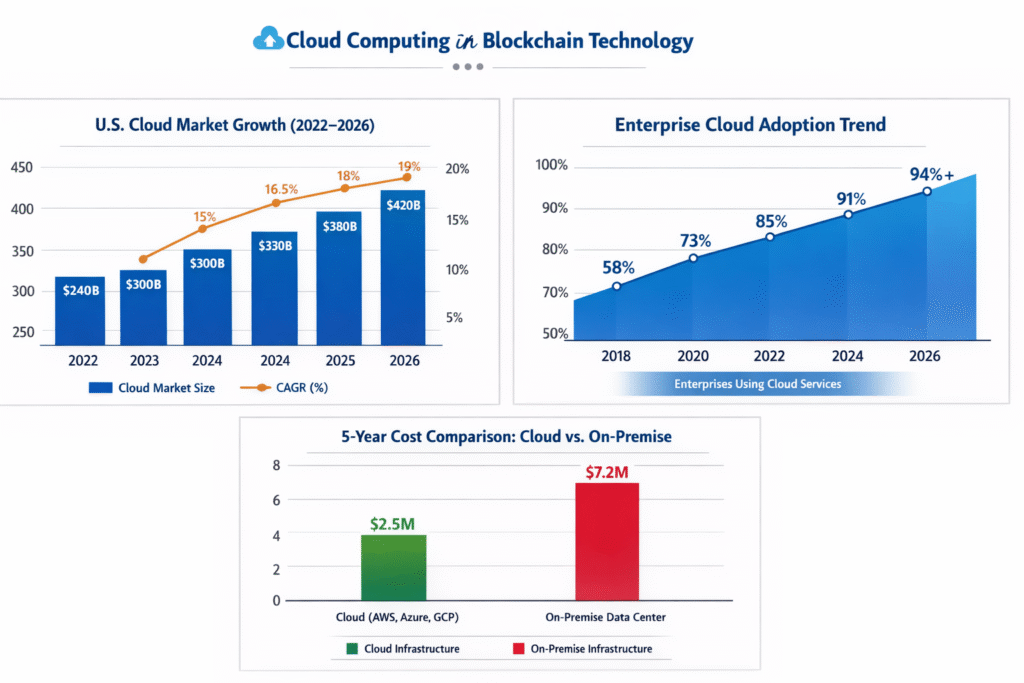
In 2026, the convergence of cloud computing and blockchain technology is reshaping enterprise architecture across the United States. The U.S. cloud computing market is projected to exceed $400 billion in annual spending, while the blockchain market is expected to surpass $65 billion domestically within the next few years. More than 90% of U.S. enterprises now rely on cloud infrastructure, and a growing percentage of blockchain deployments are running on public cloud platforms rather than self-hosted nodes.
Why? Because blockchain requires scalable compute power, distributed storage, networking reliability, and continuous uptime — all of which cloud platforms deliver efficiently. Major providers such as Amazon Web Services, Microsoft Azure, and Google Cloud offer managed blockchain services that reduce infrastructure complexity for enterprises.
Cloud computing is not replacing blockchain’s decentralized model — it is enabling its operational scalability.
1. Cloud Infrastructure as the Backbone of Blockchain Nodes
Running a blockchain node requires persistent compute resources, high availability, and stable networking. In the U.S., enterprises increasingly deploy validator nodes and full nodes on cloud virtual machines rather than on-premise servers. Cloud platforms provide elastic scaling and automated monitoring, ensuring nodes remain synchronized with the network.
For example, fintech startups running Ethereum nodes often use AWS EC2 instances to maintain uptime while scaling resources during network congestion spikes.
2. Blockchain-as-a-Service (BaaS) Platforms
Blockchain-as-a-Service allows organizations to deploy and manage blockchain networks without building infrastructure from scratch. Azure’s managed blockchain solutions enable financial institutions to launch private consortium networks for trade finance or supply chain verification.
Real-time example: A U.S. logistics firm uses BaaS to track shipment authenticity across multiple states without maintaining physical data centers.
3. Scalability Through Elastic Cloud Resources
Blockchain networks often face scalability challenges. Cloud computing enables dynamic scaling of compute and storage resources to handle transaction spikes.
During NFT surges or DeFi trading spikes, cloud-hosted infrastructure allows nodes and APIs to scale horizontally without service interruption.
4. Cloud Storage Supporting Distributed Ledgers
While blockchain stores transaction hashes on-chain, large datasets are frequently stored off-chain. Cloud storage services provide secure, redundant, and encrypted environments for storing supporting data such as documents or smart contract metadata.
Healthcare blockchain pilots in the U.S. store patient verification hashes on-chain while storing encrypted medical files in cloud storage.
5. Security and Compliance in Regulated U.S. Markets
U.S. financial institutions must meet strict regulatory standards. Cloud providers offer compliance frameworks aligned with SOC 2, HIPAA, and FedRAMP requirements.
Banks experimenting with blockchain settlement systems rely on cloud-based encryption, identity management, and audit logging tools.
6. Smart Contract Development in Cloud Environments
Developers use cloud-hosted IDEs and DevOps pipelines to build and test smart contracts. Continuous integration and deployment tools accelerate blockchain application releases.
Example: A U.S.-based DeFi startup uses cloud CI/CD pipelines to test Solidity contracts before deployment.
7. Cloud Networking for Decentralized Connectivity
Blockchain nodes require low-latency networking to maintain consensus. Cloud providers offer global regions and availability zones, ensuring faster propagation of blocks.
For instance, hosting validator nodes across multiple U.S. regions improves resilience.
8. Disaster Recovery and Node Redundancy
Cloud infrastructure allows automated backups and multi-region failover. If one data center fails, blockchain nodes hosted in other regions continue operations.
This redundancy is critical for crypto exchanges operating in high-frequency trading environments.
9. AI + Blockchain Powered by Cloud
Cloud platforms integrate AI tools with blockchain data analytics. Machine learning models detect fraud patterns in crypto transactions.
U.S. regulatory monitoring firms use cloud analytics to flag suspicious blockchain activity.
10. Cost Efficiency Compared to On-Premise Deployment
Operating in-house blockchain infrastructure requires capital investment in servers, cooling, and security. Cloud deployment converts those costs into operational expenses.
Startups in Silicon Valley prefer cloud hosting to reduce upfront infrastructure costs.
11. Multi-Cloud Strategies for Blockchain Resilience
Enterprises often deploy blockchain nodes across multiple cloud providers to reduce vendor dependency.
This approach enhances network reliability and mitigates outages.
12. API Management and Cloud Gateways
Blockchain applications rely on APIs for wallet integration, token transfers, and smart contract interaction. Cloud gateways ensure secure, rate-limited access.
Example: Payment processors use managed API gateways to integrate blockchain-based settlement systems.
13. Cloud-Based Mining Infrastructure
Although large-scale mining operations often use dedicated hardware, smaller U.S. miners leverage cloud GPU instances for blockchain experimentation and research.
14. Enterprise Blockchain Adoption in U.S. Industries
Industries including healthcare, supply chain, insurance, and real estate deploy blockchain pilots using cloud infrastructure.
Example: Real estate firms use blockchain for title verification while hosting transaction nodes in cloud environments.
15. Future Outlook: Cloud-Blockchain Convergence by 2030
By 2030, analysts predict deeper integration between decentralized applications (dApps) and cloud-native services. Hybrid models combining decentralized trust with centralized scalability will dominate enterprise architectures.
Cloud computing is becoming the operational layer that supports blockchain innovation.
Conclusion: Data-Driven Convergence Shaping the U.S. Digital Economy
Cloud computing and blockchain are not competing technologies — they are complementary forces. U.S. enterprises are increasingly leveraging cloud infrastructure to deploy blockchain solutions efficiently and securely. With cloud spending exceeding hundreds of billions annually and blockchain adoption accelerating across regulated industries, the integration of these technologies is becoming foundational to digital transformation strategies.
As blockchain use cases expand into finance, supply chain, identity management, and decentralized finance, cloud computing will remain the operational engine driving scalability, resilience, and compliance.
For U.S. businesses, the strategic advantage lies not in choosing one over the other — but in architecting intelligent systems where cloud infrastructure amplifies blockchain’s decentralized trust model.
FAQ Section
1. Why does blockchain need cloud computing?
Blockchain requires scalable computing power, secure storage, and reliable networking — all efficiently provided by cloud platforms.
2. Does cloud hosting reduce decentralization?
It centralizes infrastructure hosting but does not alter blockchain consensus mechanisms.
3. What is Blockchain-as-a-Service?
It is a managed cloud offering that allows businesses to deploy blockchain networks without managing infrastructure.
4. Is blockchain secure on cloud platforms?
Yes, when configured properly with encryption, identity controls, and compliance monitoring.
5. Which U.S. industries use cloud-based blockchain?
Finance, healthcare, logistics, real estate, and insurance sectors are leading adopters.
For your reference

1 thought on “How Cloud Computing Is Involved in Blockchain Technology”
Pingback: Enterprise Cloud Adoption Trend Explained