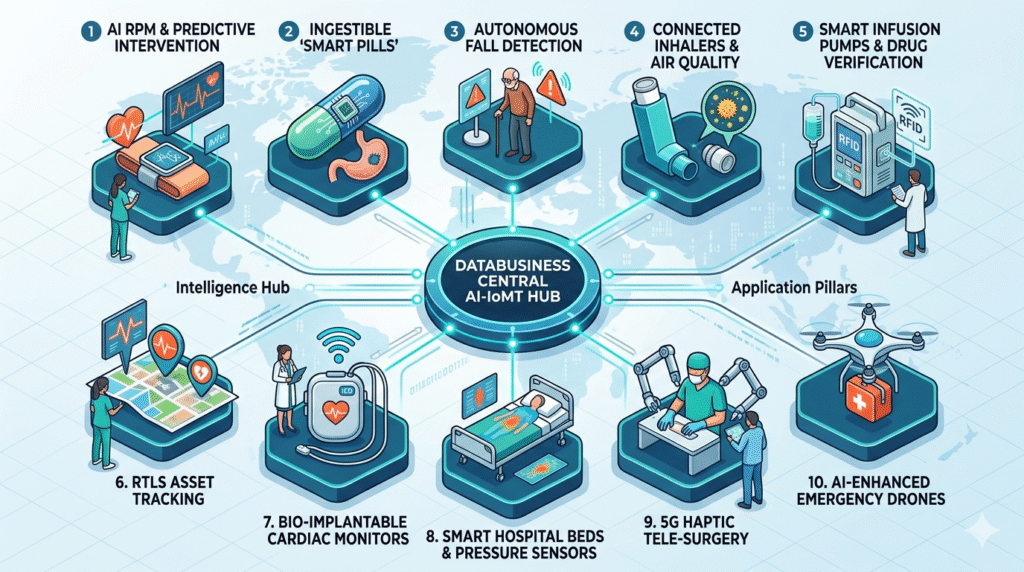
In 2026, the Internet of Medical Things (IoMT) is no longer a futuristic concept—it is the backbone of a hyper-connected healthcare ecosystem that has reduced hospital readmissions by 50% and saved the industry over $300 billion annually.
| Feature | Healthcare 2020 (Reactive) | IoMT 2026 (Proactive) |
| Data Collection | Manual, episodic (Clinics) | Continuous, real-time (Wearables/Implants) |
| Response Time | Hours to days | Seconds (Autonomous Agents) |
| Diagnostics | Hindsight (Symptom-based) | Foresight (Pattern-based) |
| Connectivity | Wi-Fi / 4G (High Latency) | 5G / Satellite (Zero Latency) |
1. AI-Driven Remote Patient Monitoring (RPM)
In 2026, RPM has evolved from simple data logging to predictive intervention.
- The Technology: Wearable biosensors continuously track V02 max, ECG, and interstitial fluid glucose levels.
- Life-Saving Impact: AI agents analyze these data streams in real-time. For heart failure patients, these systems now predict clinical degradation up to 72 hours before physical symptoms appear, reducing mortality rates by 20%.
- Business Central Insight: RPM isn’t just a clinical tool; it’s a data pipeline that optimizes hospital bed occupancy by keeping stable patients safe at home.
2. Smart Pills and Ingestible Sensors
The “Internal Internet” is now a reality. Smart pills have moved from clinical trials to standard diagnostic protocols for gastrointestinal health.
- The Technology: Ingestible capsules equipped with micro-cameras and chemical sensors transmit data as they move through the digestive tract.
- Life-Saving Impact: These sensors detect early-stage colorectal cancers and internal hemorrhaging that traditional imaging might miss. They also monitor medication adherence by “pinging” a wearable patch once the pill is digested.
3. Autonomous Fall Detection for Aging Populations
With the 2026 elderly population at an all-time high, IoMT-enabled fall detection has become a critical safety net.
- The Technology: Smart flooring and wearable pendants use computer vision and accelerometers to distinguish between a “hard fall” and a person sitting down quickly.
- Life-Saving Impact: These systems reduce emergency response times by 78%. In 2026, an aging adult who falls is reached within minutes, preventing the “long lie” complications that lead to permanent disability or death.
4. Connected Inhalers for Asthma Management
Asthma and COPD management have been revolutionized by “Digital Respiratory” ecosystems.
- The Technology: Sensors attached to inhalers record the time, date, and geographic location of each puff, cross-referencing this with local air quality and pollen data.
- Life-Saving Impact: This has led to a 57% decrease in asthma exacerbations. Patients receive push notifications on their smartwatches if they are entering a high-pollen zone where they’ve previously had attacks.
5. Smart Infusion Pumps and Medication Cabinets
Inside the hospital, IoMT is eliminating the “human error” factor in drug delivery.
- The Technology: Infusion pumps are now integrated with the Electronic Health Record (EHR). They automatically verify the patient’s ID via RFID wristbands before dispensing medication.
- Life-Saving Impact: This system flags drug-drug interactions in real-time. If a nurse attempts to administer a dose that conflicts with the patient’s current blood chemistry, the pump locks and alerts the attending physician.
6. Real-Time Location Systems (RTLS) for Critical Assets
In a crisis, seconds matter. RTLS ensures that life-saving equipment is never “missing.”
- The Technology: Bluetooth Low Energy (BLE) tags are placed on every ventilator, defibrillator, and crash cart in the hospital.
- Life-Saving Impact: During a cardiac arrest, staff can instantly locate the nearest automated external defibrillator (AED) via a tablet dashboard. It also tracks the maintenance status of oxygen tanks, ensuring no “empty” tank is ever brought to a bedside.
7. Bio-Implantable Cardiac Monitors
The latest generation of pacemakers and ICDs (Implantable Cardioverter Defibrillators) are fully integrated IoMT nodes.
- The Technology: These devices utilize 5G-RedCap (Reduced Capability) to transmit cardiac data directly to the cloud without needing a bulky external home monitor.
- Life-Saving Impact: If a patient in a rural area experiences an arrhythmia, their cardiologist is alerted instantly with a full ECG strip. In many cases, the device can be reprogrammed remotely to stabilize the patient before they even reach the hospital.
8. Smart Hospital Beds and Pressure Sensors
The “Invisible Nurse” is a network of pressure-sensitive mats and bed sensors.
- The Technology: Sensors monitor the patient’s weight distribution, movement, and even respiratory rate through the mattress.
- Life-Saving Impact: They prevent pressure ulcers (bedsores) by alerting staff when a patient hasn’t moved for a set period. More critically, they detect “bed exit” attempts in confused patients, preventing falls before they happen.
9. 5G-Enabled Haptic Tele-Surgery
In 2026, a specialist in London can operate on a patient in a rural village using robotic arms and low-latency 5G.
- The Technology: Surgeons use haptic gloves that allow them to “feel” the resistance of the tissue thousands of miles away.
- Life-Saving Impact: This brings Tier-1 surgical expertise to underserved areas, providing life-saving trauma care during the “Golden Hour” where transport to a city would be fatal.
10. AI-Enhanced Drones for Emergency Response
The “Ambulance of the Air” is the newest member of the IoMT family.
- The Technology: Drones equipped with AEDs and EpiPens are dispatched the moment a 911 call is placed.
- Life-Saving Impact: In congested cities or remote wilderness, these drones arrive 5 to 10 minutes faster than ground vehicles. Bystanders are guided through the equipment use via an onboard video screen until paramedics arrive.
Conclusion: The Data-Driven Pulse of 2026
The Internet of Medical Things has moved from “monitoring” to “acting.” For DataBusinessCentral.com readers, the takeaway is clear: the future of healthcare isn’t just about better medicine; it’s about better data orchestration.
By centralizing the data from these 10 applications, we aren’t just creating a “Smart Hospital”—we are creating a proactive shield that preserves human life with surgical precision.
