The AI revolution isn’t coming to America — it’s already here. Here’s what every business leader needs to understand, act on, and prepare for before the decade ends.
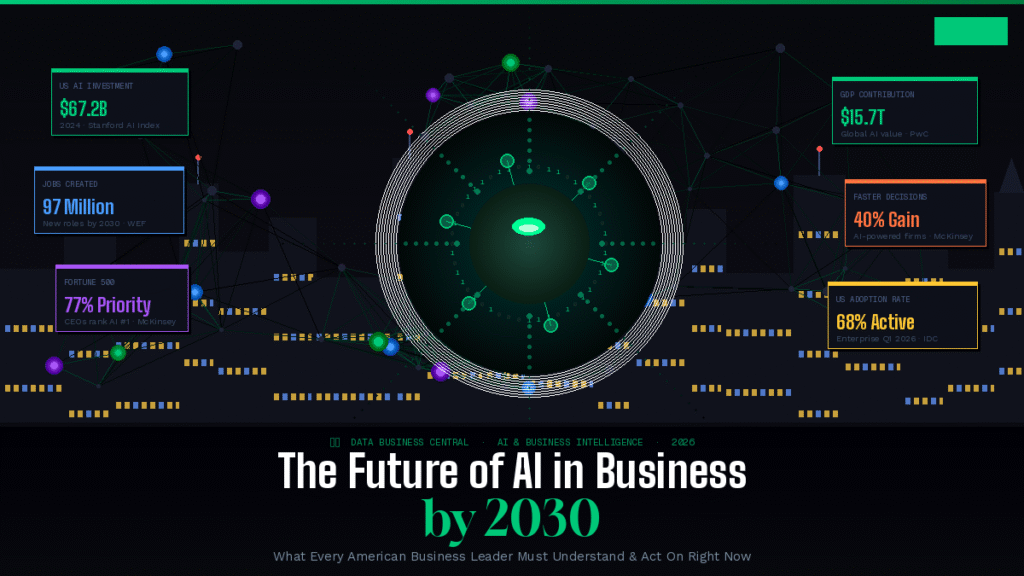
$15.7TAI’s global contribution by 2030
97MNew jobs AI will create
$67BUS AI investment in 2024
77%Fortune 500 CEOs: AI is 1st priority
Here is the reality that no business leader in America can afford to ignore: the companies that treat artificial intelligence as an optional upgrade are already falling behind. Not in five years. Right now. In 2026, the gap between AI-native businesses and AI-hesitant ones is measured not in quarters but competitive survival.
This is not a hype piece about robot takeovers. This is a practical, data-grounded guide for American business leaders — CEOs, VPs, founders, and department heads — who want an honest look at where AI is heading by 2030, what it means for their industry, their workforce, and their competitive position, and crucially, what to do about it before it’s too late.
We will cover the six distinct waves of AI transformation rolling through the US economy between now and 2030, break down the industry-by-industry impact, address the jobs question honestly, and give you a concrete action framework to future-proof your organization.
“The companies that win the next five years won’t necessarily be the ones that built the best AI — they’ll be the ones that deployed it fastest inside their existing operations.”— McKinsey Global Institute, 2025 AI Adoption Report
The AI Timeline
The 6 Waves of AI Transformation (2025–2030)
AI doesn’t transform business all at once. It arrives in overlapping waves, each building on the last. Understanding which wave is hitting your industry right now — and which is coming next — is the foundation of any serious business strategy.
Wave 1 · 2023–2025 · Already Here
Generative AI Proliferation
Content creation, coding assistance, and customer service chatbots. The democratization phase — every employee got a powerful AI assistant. Companies that mastered this wave cut content costs by 60–80%.
Wave 2 · 2025–2027 · Right Now
Agentic AI & Workflow Automation
Autonomous AI agents completing multi-step business tasks end-to-end. Research, analysis, reporting, emails, scheduling — without a human at every step. Currently delivering 40% efficiency gains in early adopters.
Wave 3 · 2026–2028 · Building Now
AI-Native Business Processes
Core business workflows redesigned from scratch around AI capabilities. Companies stop bolting AI onto old processes and start rebuilding operations with AI as the foundation — not the add-on.
Wave 4 · 2027–2029 · On The Horizon
Physical-Digital AI Integration
AI systems managing physical infrastructure in real time — smart factories, AI-directed logistics networks, autonomous supply chains. Manufacturing and logistics see the most immediate disruption here.
Wave 5 · 2028–2030 · Emerging
Personalized AI at Consumer Scale
Every customer interaction mediated by a personal AI agent that knows their preferences, history, and needs. B2C companies that don’t deploy personalization AI lose competitive ground in pricing, loyalty, and conversion.
Wave 6 · 2029–2030 · Coming Fast
Multi-Agent Enterprise Ecosystems
Hundreds of specialized AI agents working as interconnected networks across entire organizations. Not one AI — an AI economy inside your business. The companies building this infrastructure now will own the next decade.
🔑 Key Insight for US Business Leaders
Most American companies are still operating in Wave 1 — using AI for content and chat. The businesses pulling ahead in 2026 are those entering Wave 2 with agentic AI deployments. The window to close this gap is 12–18 months before it becomes a structural disadvantage.
Industry Impact
How AI Reshapes Every Major US Industry by 2030
AI doesn’t hit every sector with equal force or at equal speed. Here is a frank, data-driven breakdown of the five industries experiencing the deepest transformation heading into 2030 — and what it specifically means if you operate in them.
| Industry | AI Impact Level | Primary Change | Key Metric by 2030 |
|---|---|---|---|
| Financial Services | Critical | Autonomous compliance, fraud detection, AI-driven trading | 70% routine compliance tasks automated |
| Healthcare | Critical | AI diagnostics, clinical documentation, drug discovery | 45% reduction in diagnostic errors |
| Manufacturing | Very High | Predictive maintenance, autonomous quality control | 35% productivity gain vs. non-AI peers |
| Retail & E-commerce | Very High | Hyper-personalization, AI inventory management | 28% revenue increase from AI personalization |
| Legal Services | High | Contract review, legal research, document automation | 60% reduction in document review time |
Financial Services: The First and Deepest Transformation
No US industry has moved faster into AI than financial services — and the results are already measurable. JPMorgan’s COIN system reviews commercial loan agreements in seconds, eliminating what previously consumed 360,000 lawyer-hours annually. Mastercard’s AI fraud detection now processes 143 billion transactions annually with a 30% higher fraud detection rate than previous systems. Goldman Sachs reports that AI tools have compressed the equity research production cycle by 40%.
By 2030, the financial services firms that survive will be those that treat AI not as a compliance checkbox but as the operating system of the entire organization. Risk management, portfolio construction, client advisory, and regulatory reporting will all run on AI infrastructure. The boutique firms that resist this transition will find their margins compressed to the point of non-viability by AI-powered competitors operating at a fraction of the cost $900B.
The estimated annual value AI could unlock in US financial services by 2030 — primarily through fraud reduction, compliance automation, and personalized advisory at scale. Source: McKinsey Global Banking Annual Review 2025
Healthcare: Saving Lives and Saving Costs Simultaneously
American healthcare has a productivity crisis that AI is uniquely positioned to solve. Physicians spend nearly 50% of their working hours on administrative tasks rather than patient care — a systemic failure that costs the US healthcare system an estimated $11 billion annually in physician burnout and turnover alone.
AI clinical documentation agents, already deployed at institutions like Mayo Clinic and Cleveland Clinic, are cutting physician administrative burden by 40%. Ambient AI tools listen to consultations, generate clinical notes, check for drug interactions, and pre-fill billing codes — invisibly and instantly. Meanwhile, AI diagnostic systems are achieving radiologist-level accuracy in identifying cancers, diabetic retinopathy, and cardiac anomalies from imaging data.
The AI transformation in healthcare by 2030 isn’t about replacing doctors — it’s about giving every physician the capabilities of an entire support staff. The hospitals and health systems that embed AI across the care continuum will deliver better outcomes at lower cost. Those that don’t will face a brutal choice between cutting quality or running unsustainable deficits.
The Workforce Reality
The Jobs Reality: What Disappears, What Explodes
Let’s address the question that every American worker and business leader is really asking: what happens to jobs? The honest answer is more nuanced — and ultimately more optimistic — than the headlines suggest.
The World Economic Forum projects that by 2030, AI and automation will displace approximately 85 million jobs globally while creating 97 million new ones. In the United States specifically, the displacement is heavily concentrated in a specific category: routine, rule-based, single-channel tasks. The growth is equally concentrated in roles that require human judgment, creativity, and the ability to work alongside AI systems.
⚠️ Roles Under Pressure by 2030
- Data entry clerks –65%
- Basic customer service reps –40%
- Routine financial analysts –38%
- Basic legal document reviewers –55%
- Invoice processing specialists –70%
- Basic content writers (SEO mill) –45%
- Scheduling coordinators –50%
✅ Roles Growing Fastest by 2030
- AI systems trainers +214%
- Prompt engineers +186%
- AI governance officers +175%
- Human-AI workflow designers +163%
- AI ethics specialists +145%
- Data storytellers / translators +130%
- AI implementation consultants +122%
⚠️ The Leadership Warning
The US companies that will face the most damaging workforce disruption are those that wait for AI to force their hand. The organizations building AI literacy across all levels of their workforce right now will experience AI as a growth accelerator. Those that don’t will experience it as a crisis.
The single most important thing a US business leader can do for their workforce right now is invest in AI fluency training — not just for the tech team, but for every department. The new competitive skill isn’t knowing how to code AI. It’s knowing how to effectively direct, evaluate, and work alongside AI systems. That skill is teachable, learnable, and currently in desperately short supply.
Competitive Intelligence
The AI Leadership Gap: What Separates Winners from Losers
In five years of tracking enterprise AI adoption, one pattern emerges with striking consistency: the gap between AI leaders and AI laggards is not primarily a technology gap. It is a leadership gap. The winning companies aren’t those with the biggest AI budgets — they’re the ones where senior leadership made AI a strategic priority before competitive pressure forced the issue.
McKinsey’s 2025 AI survey found that companies in the top quartile of AI adoption report 40% faster decision-making, 35% lower operational costs in AI-deployed functions, and 2.5× higher revenue growth than bottom-quartile peers. The gap between these groups has widened every year since 2022 — and is projected to become structurally unbridgeable for laggards by 2028.
What specifically do AI-leading US companies do differently? Three things stand out:
First, they appoint dedicated AI leadership. Companies with a Chief AI Officer or VP of AI Strategy outperform those without one by 47% on AI ROI metrics. This isn’t about having a title — it’s about having someone in the room whose full-time job is AI strategy, not someone for whom AI is a side project.
Second, they measure AI outcomes ruthlessly. Leading companies tie AI investments to specific, quantifiable business outcomes — cost per unit reduced by X%, customer resolution time cut to Y minutes, revenue per sales rep increased by Z%. Companies that deploy AI without measurement cannot scale what works or kill what doesn’t.
Third, they build AI into governance, not as an afterthought. The companies that have avoided expensive AI failures — biased hiring tools, privacy breaches, hallucinated financial reports — are those that established AI governance policies before they deployed AI at scale. This is not optional. It is table stakes for any organization deploying AI in regulated industries or with customer-facing applications.
How to Future-Proof Your Business for the AI Decade
Insight without action is just entertainment. Here is a concrete five-step framework for US business leaders who want to be on the right side of the AI transformation by 2030.
1.Audit Your Workflows for AI Opportunity — This Quarter
Spend 90 days mapping your organization’s top 20 most time-consuming, repetitive workflows. Rank them by: volume of hours consumed, error rate, and dependency on routine rule-following. The top 5 on this list are your first AI deployment targets. Don’t start with the flashiest use case — start with the highest-cost, lowest-complexity routine task. This is where AI ROI is fastest and most measurable.
2.Run a 90-Day Pilot With Measurable Success Metrics
Pick one workflow. Choose one AI tool. Define success in numbers before you start — not “this should make things faster” but “this will reduce our invoice processing time from 4 hours to 20 minutes, saving $X per month.” Run the pilot for 90 days with a small team, measure obsessively, and make a go/no-go decision based on data. This discipline separates strategic AI deployment from AI theater.
3.Build Company-Wide AI Fluency — Not Just the Tech Team
Your competitive advantage in 2030 will not be which AI tool you bought. It will be how effectively every person in your organization can work with AI. Allocate training budget to AI fluency for all departments. Start with two half-day workshops — one on how to use AI tools effectively, one on how to critically evaluate AI outputs. The employees who can do both will be your most valuable people by 2028.
4.Establish an AI Governance Policy Before You Scale
Before any company-wide AI rollout, publish an internal AI Acceptable Use Policy. It should cover: which AI tools are approved, what data can and cannot be input into AI systems, how AI-generated outputs must be verified before use, and what the escalation process is when AI makes an error. This document protects your company legally, builds employee trust, and prevents the reputational damage of an AI failure in front of clients or regulators.
5.Appoint an AI Strategy Owner — By Year End
This does not require hiring a new executive. It requires designating someone whose explicit responsibility includes AI strategy. This person reviews new AI tools, tracks ROI on current deployments, monitors competitive AI developments in your industry, and reports to the C-suite quarterly. Without ownership, AI initiatives drift, stall, and die. With it, they compound.
“Every year a US business delays a serious AI strategy is worth approximately 18 months of competitive advantage handed to an early mover in your market.”— Stanford HAI AI Index Report, 2025
The American Competitive Advantage in the AI Decade
The United States enters the 2030 AI decade with structural advantages that no other nation currently matches. American universities produce more AI researchers than any country except China. US venture capital invested $67.2 billion in AI companies in 2024 alone — three times China’s investment. The world’s most powerful AI platforms — OpenAI, Anthropic, Google DeepMind, Microsoft Azure AI — are American-built and American-operated. The infrastructure advantage is real and substantial.
But infrastructure alone does not determine who wins. The 2030 AI decade will be won in boardrooms and operations centers, not research labs. It will be decided by the American business leaders who move first, deploy deliberately, measure obsessively, and build organizations where humans and AI systems work together with genuine competence on both sides.
The question for every reader of this article is not whether AI will transform your industry. It will — and for most of you, it already is. The question is whether your business will be among those leading that transformation or scrambling to catch up with it. That answer is still being written. And the people writing it are the leaders who decide, this quarter, to stop treating AI as a future problem and start treating it as the present opportunity it already is.
📌 Related Reading on Data Business Central
Explore our in-depth coverage: What is Agentic AI? · How Agentic AI is Transforming Healthcare · Agentic AI in Logistics and Transportation · Benefits of Agentic Analytics for Data-Driven Businesses
AI StrategyFuture of WorkAgentic AIBusiness LeadershipAI 2030Digital TransformationUS EconomyAI Governance
