
Introduction
Artificial Intelligence is now embedded in clinical workflows, pharmaceutical research, and hospital operations. AI-driven diagnostics, predictive analytics, and automated drug discovery platforms are reducing costs, accelerating research timelines, and improving patient outcomes. The companies listed below are ranked based on innovation impact, funding strength, regulatory progress, enterprise adoption, and scalability.
Top 25 AI Healthcare Companies (2026)
- Tempus – Precision medicine and oncology data platform
- Insilico Medicine – AI-powered drug discovery
- Recursion Pharmaceuticals – AI-driven therapeutic discovery
- PathAI – AI pathology diagnostics
- Butterfly Network – AI ultrasound devices
- Aidoc – AI radiology workflow automation
- Zebra Medical Vision – Imaging AI solutions
- Freenome – AI-based blood testing
- Owkin – Federated learning research models
- Atomwise – Small molecule AI discovery
- Caption Health – AI-guided imaging systems
- Grail – Multi-cancer early detection
- Viz.ai – AI stroke triage systems
- Babylon Health – AI virtual healthcare platform
- IBM Watson Health – Enterprise healthcare AI solutions
- NVIDIA – AI hardware and medical AI frameworks
- Microsoft – Healthcare cloud AI infrastructure
- Google Health – Medical imaging and diagnostic AI
- Moderna – AI-assisted mRNA development
- Flatiron Health – Oncology data analytics
- Biofourmis – Predictive remote monitoring
- Paige – Cancer diagnostic AI
- Qure.ai – AI radiology screening
- Exscientia – AI-designed drug molecules
- SOPHiA GENETICS – AI genomic analytics
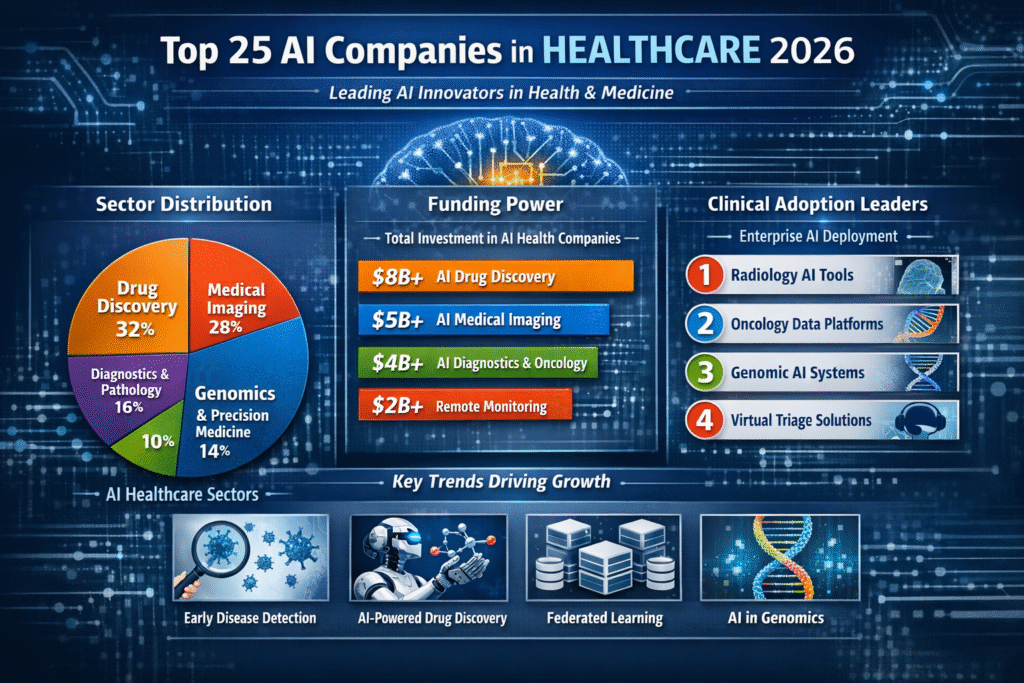
Picture-Based Data Representation (Infographic Structure)
Sector Distribution (Pie Chart Concept)
Drug Discovery 32%
Medical Imaging 28%
Diagnostics and Pathology 16%
Genomics and Precision Medicine 14%
Remote Monitoring and Virtual Care 10%
Explanation
Drug discovery dominates due to pharmaceutical R&D cost pressures and AI’s ability to shorten molecule screening cycles. Imaging remains highly commercialized because it integrates directly with hospital systems and produces measurable ROI.
Funding Power (Bar Chart Concept)
AI Drug Discovery Companies – $8B+ cumulative funding
AI Imaging Startups – $5B+
AI Diagnostics and Oncology – $4B+
Remote Monitoring Platforms – $2B+
Explanation
Capital flows toward AI solutions that reduce development timelines, improve diagnostic accuracy, or enhance hospital operational efficiency.
Clinical Adoption Ranking (Visual Score Chart)
- Radiology AI Tools
- Oncology Data Platforms
- Genomic AI Systems
- Virtual Triage and Remote Monitoring
Explanation
Radiology AI leads adoption due to immediate workflow enhancement and faster regulatory clearance compared to therapeutic AI solutions.
Key Industry Trends Driving Growth
Predictive diagnostics models are detecting diseases earlier than traditional screening methods.
AI-powered drug discovery is compressing research cycles from years to months.
Federated learning is enabling multi-institution collaboration without violating patient privacy.
AI combined with genomics is accelerating precision medicine strategies.
Conclusion
Healthcare AI has moved from experimental pilots to regulated, enterprise-grade clinical systems. The companies listed above are shaping the future of diagnostics, therapeutics, and patient care infrastructure. As regulatory frameworks mature and hospitals digitize further, AI will transition from a support technology to a foundational layer of healthcare delivery. The next five years will determine which platforms become global clinical standards.
FAQ
What is the largest AI segment in healthcare
AI-driven drug discovery currently attracts the highest cumulative investment.
Which AI category has the fastest hospital adoption
Radiology and imaging AI tools lead in real-world deployment.
Are AI healthcare companies profitable
Large enterprise players generate revenue, while many biotech AI firms remain R&D focused.
How is AI used in oncology
AI assists in tumor detection, pathology analysis, genomic profiling, and treatment prediction.
What will dominate AI healthcare in the next five years
Precision medicine, automated drug design, genomic analytics, and predictive diagnostics will drive the next growth phase

1 thought on “Top 25 AI Companies in Healthcare 2026 Ranking”
Pingback: Blockchain in Pharma & Healthcare Supply Chain 2026 Guide