Introduction
Just a year ago, agentic AI was being called the next big revolution in enterprise technology. Vendors were racing to slap the word “agent” on everything from chatbots to spreadsheet macros. Boardrooms were buzzing. Budgets were flowing. And every tech conference had at least five sessions on autonomous AI that would “transform your workflows forever.”
Fast forward to 2026, and the hangover is real.
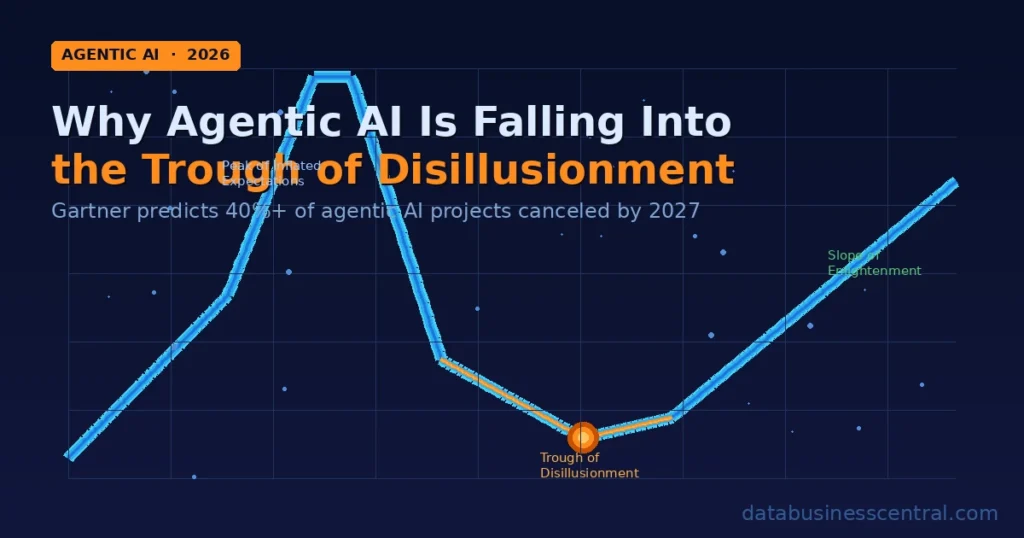
The dream hasn’t died — but it’s taken a serious hit. Agentic AI is now entering what Gartner calls the Trough of Disillusionment, that uncomfortable but necessary phase every transformative technology goes through before it actually matures. And for enterprises that went all-in without a clear strategy, the reckoning has arrived.
So what exactly went wrong? And more importantly — what happens next?
The Hype Built Up Fast
To understand the crash, you need to understand the climb.
Agentic AI — AI systems that can autonomously plan, reason, and execute multi-step tasks without constant human input — promised something generative AI never quite delivered: real, measurable business outcomes. Instead of just drafting emails or summarizing reports, agents could theoretically book your meetings, reconcile invoices, monitor supply chains, and trigger workflows across your entire enterprise stack.
It sounded incredible. And investors, vendors, and enterprises responded accordingly.
Data center spending hit $61 billion in 2025, with money changing hands across infrastructure providers, chip makers, foundation model providers, and energy companies. Every major software vendor rebranded existing features as “agentic.” The FOMO was overwhelming.
According to a January 2025 Gartner poll of 3,412 webinar attendees, 19% said their organization had already made significant investments in agentic AI, 42% made conservative investments, and only 8% had made no investments at all.
Everyone was building. Not everyone knew what they were building.
The Hard Numbers: 40% of Projects Are Getting Canceled
Here is where the story gets uncomfortable.
Gartner predicts over 40% of agentic AI projects will be canceled by the end of 2027, due to escalating costs, unclear business value, or inadequate risk controls.
That is not a minor correction. That is nearly half the industry’s bets going bust.
Gartner’s Senior Director Analyst Anushree Verma put it plainly: “Most agentic AI projects right now are early-stage experiments or proof of concepts that are mostly driven by hype and are often misapplied. This can blind organizations to the real cost and complexity of deploying AI agents at scale.”
And the Gartner data aligns with what we are seeing on the ground in 2026. 70% of developers report integration problems with existing systems, and 42% of AI projects show zero ROI due to measurement failures.
These are not edge cases. This is the mainstream enterprise AI experience right now.
The Agent Washing Problem
One of the biggest contributing factors to this disillusionment? A flood of fake “agents.”
Many vendors have been contributing to the hype by engaging in “agent washing” — rebranding existing products such as AI assistants, robotic process automation, and chatbots without substantial agentic capabilities. Gartner estimates only about 130 of the thousands of agentic AI vendors are real.
Think about that. Thousands of companies claiming to sell autonomous agents. Only around 130 actually delivering them.
When enterprises bought into these products expecting autonomous execution and got glorified chatbots instead, the disillusionment hit fast. A useful working definition: an agent is not a chat interface. An agent is a system that can plan steps, use tools, and act toward a goal with some degree of autonomy, within explicit boundaries. Most of what was sold in 2024–2025 did not meet that bar.
The Strategy Failure Underneath It All
Technology alone rarely fails — strategy does.
We are living in what could be called the “Gen AI paradox” — a moment where mass adoption of generative AI is happening across industries, yet the impact on business fundamentals remains frustratingly elusive. Companies are deploying Gen AI tools at record speed and investing billions into pilots and prototypes, but individual productivity wins are not translating into measurable bottom-line improvements at the organizational level.
Agentic AI inherited exactly this problem at scale.
As INSEAD professors Nathan Furr and Andrew Shipilov have pointed out, today’s corporate leaders are falling into the same trap they fell into a decade ago with digital transformation. Back then, executives were encouraged to “let 10,000 flowers bloom” — to launch countless innovation experiments in the hope that some would become unicorns. Without a strategic framework to align those experiments to core business goals, most of them fizzled out.
History, it seems, has a short memory in tech.
The pattern with agentic AI has been identical: massive experimentation driven by FOMO, no clear ownership, no alignment to real customer problems, and no plan to scale from POC to production. Boards got excited. IT teams got overwhelmed. Projects got shelved.
The Integration Wall Nobody Warned About
Even for companies with clear strategies, there was a brutal technical problem waiting.
The fundamental issue is architectural incompatibility: agents are non-deterministic — they produce different outputs for the same input — while legacy platforms are deterministic, built for predictable and repeatable behavior. This mismatch is not a minor technical hurdle. It is the primary reason projects get canceled.
Most enterprise systems — the ERP platforms, core banking systems, logistics stacks — were built assuming humans would interpret information and make judgment calls. Agents need authority to act autonomously within those same systems. Giving them that authority requires either limiting what agents can do (which eliminates value) or restructuring core processes from scratch (which costs a fortune and takes years).
Neither option is easy to sell to a CFO who expected ROI in the first year.
The ROI Measurement Problem
Here is the part that often goes unsaid: many agentic AI projects that are being “canceled” may actually be working. They are just being measured wrong.
Traditional ROI metrics focused on cost savings or headcount reduction fall woefully short when assessing agentic AI. Success is defined in vague terms like “improved efficiency” without quantifiable proof. But when enterprises measure agents against narrow cost-cutting metrics, they declare failure even when agents deliver real value via productivity gains, proactive issue prevention, and revenue growth.
In the 1910s, factory owners debated whether electricity was cheaper than steam, missing its productivity revolution entirely. In the 2000s, cloud skeptics dismissed it as “too expensive,” only to watch it transform business speed and scale. AI is facing the same scrutiny today.
The companies canceling their agentic AI projects in 2026 may look back in three years the way early cloud skeptics do now — wondering why they bailed at the wrong moment.
The Security Blind Spot
There is one more risk that is not getting enough attention: security and governance.
86% of organizations have no visibility into their AI data flows, and 20% of security breaches are now classified as Shadow AI incidents. Development teams under pressure to ship are spinning up LLM connections, routing sensitive data to models, and expanding agent-to-agent communication — often without security review.
Agentic systems operate differently from traditional automation. The difference between an agent that drafts an email and one that sends it — or one that recommends a refund versus one that issues it — is enormous from a governance and risk standpoint. Many organizations have not designed guardrails for this level of autonomous action, and the consequences are starting to surface.
Where Does This Go from Here?
The trough is real. But it is not the end.
According to Gartner, the Trough of Disillusionment is a necessary stage in the maturation of any disruptive technology. It signals that the market is shifting from speculation to validation, from excitement to execution.
Gartner predicts that at least 15% of day-to-day work decisions will be made autonomously through agentic AI by 2028, up from 0% in 2024. Additionally, 33% of enterprise software applications will include agentic AI by 2028, up from less than 1% in 2024.
The organizations that survive — and thrive — in the post-trough phase will be the ones that resisted the pressure to launch everything at once, focused on constrained, high-value use cases first, built measurement frameworks around real business outcomes, and invested in governance before expanding autonomy.
Successful deployments exist in constrained, well-governed domains. IT operations show the clearest ROI: 30–50% reduction in mean time to resolution, 20–40% fewer tickets via proactive monitoring, and significant SLA compliance improvements. Finance, customer support, and sales automation also show measurable value when properly scoped.
The technology works. The problem was never the technology.
Final Thought
The trough does not mean agentic AI failed. It means the hype cycle ran its course and reality caught up. Every major platform technology — the internet, cloud computing, mobile — went through this exact phase before becoming infrastructure.
What we are seeing in 2026 is not the death of agentic AI. It is the end of the easy phase, where announcements alone generated excitement. The next phase is harder. It requires real engineering, real strategy, and real patience.
The companies doing the unglamorous work right now — building governance frameworks, fixing integration layers, defining meaningful KPIs — are the ones that will look like pioneers when the slope of enlightenment arrives.
And it will arrive. It always does.
