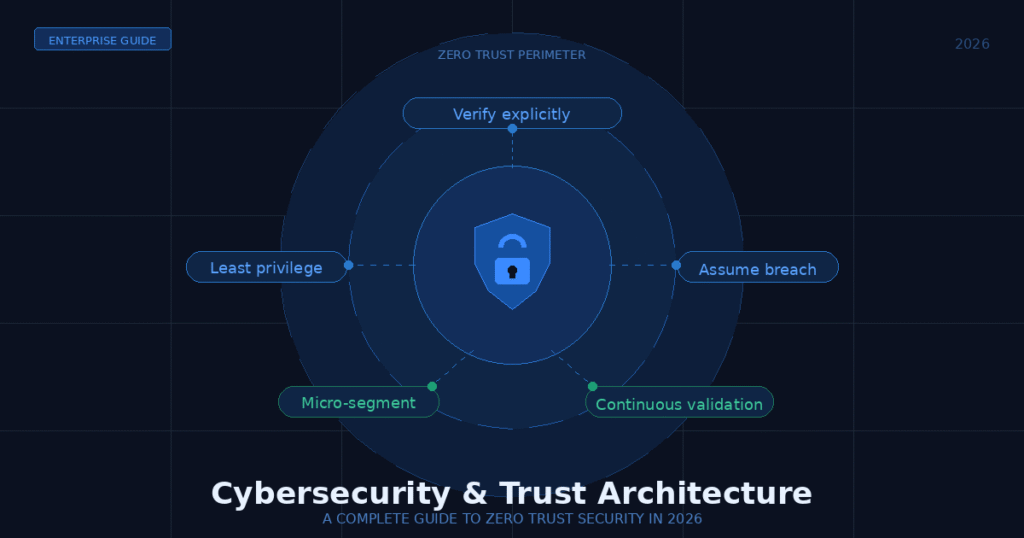
Core principles, key technologies, frameworks, use cases, implementation challenges, and real industry examples — everything enterprise leaders need in one place.
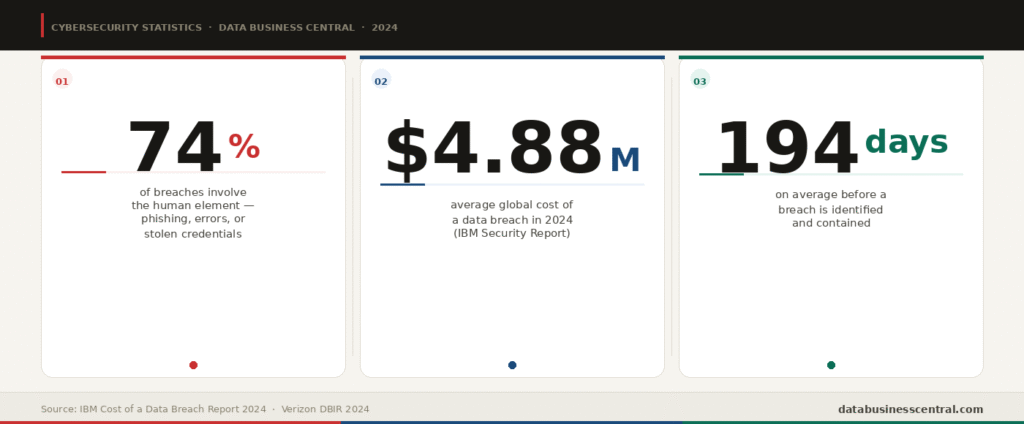
Every enterprise runs on data. And data, by its nature, is a target. In 2024 the average cost of a single data breach crossed $4.88 million — and the average organisation took 194 days to even notice it had happened. These aren’t abstract statistics. They represent customer records exposed, operations disrupted, executives questioned in front of boards, and years of trust undone in a single incident.
This guide covers the full landscape of cybersecurity and trust architecture for enterprise leaders — from foundational concepts to implementation strategy, frameworks, technologies, challenges, and what real industries are doing about it.
What is cybersecurity
Cybersecurity is the practice of protecting your digital assets from people who shouldn’t have access to them.
Think of your organisation as a building. Cybersecurity is every lock, alarm, access badge, camera, security guard, and fence — applied to your digital environment. The assets being protected are anything digital: customer data, financial records, intellectual property, communications, and the systems your operations depend on.
Modern cybersecurity is built on three pillars. Confidentiality ensures only authorised people see sensitive information. Integrity ensures data isn’t tampered with. Availability ensures your systems work when you need them. Ransomware that locks you out is a cybersecurity failure — not because it stole data, but because it destroyed availability.
01 .Confidentiality
Only authorised people can see sensitive information. Your payroll data isn’t visible to the intern.
02 .Integrity
Data cannot be tampered with. The contract your client signed matches the one you’re looking at.
03 .Availability
Systems work when needed. Ransomware that locks you out is a security failure even if nothing was stolen.
The threat landscape enterprises actually face
The most common attack vectors
Phishing — fraudulent emails tricking employees into handing over credentials or clicking malware links. Responsible for the majority of enterprise breaches, now further amplified by AI-generated personalisation that makes fake messages nearly indistinguishable from legitimate ones.
Ransomware — malicious software that encrypts your files and demands payment. Modern operators don’t just lock you out; they exfiltrate data first and threaten to publish it, creating double leverage.
Supply chain attacks — compromising a vendor or software provider to reach their customers. The SolarWinds attack affected over 18,000 organisations through a single software update. One trusted supplier became a master key.
Insider threats — current or former employees, contractors, or partners who misuse their access. Often the hardest to detect because the behaviour looks normal.
Credential stuffing — automated use of stolen username-password pairs from one breach to access accounts elsewhere. Effective because most people reuse passwords across multiple platforms.
What is trust architecture?
Cybersecurity tells you what to protect. Trust architecture tells you how to think about who and what gets access to it.
Traditional IT security was built on a simple idea: inside the network means trusted, outside means not. That model worked when everyone sat in a single office on company laptops connected to a local network. It has nothing useful to say about the world enterprises operate in today — remote workers on personal devices, multi-cloud infrastructure, dozens of SaaS integrations, and vendor ecosystems with access to your most sensitive systems.
“Trust architecture replaces the fiction of a safe ‘inside’ with a rigorous framework built on verification, not assumption. It asks — and answers — the question of who should be trusted, with what, and under what conditions, across your entire digital environment.”
The hotel analogy
A hotel door key lets you into your room and your room only. Not the penthouse, not the kitchen, not the safe behind reception. Trust architecture applies that same scoped-access logic to every user, device, and system in your organisation — at all times, not just at check-in.
Trust architecture answers questions that traditional IT security ignores: Should the finance system automatically trust the marketing laptop? Should a login from Singapore be treated the same as a login from HQ? When a contractor accesses your systems, what exactly should they be able to reach? If an employee’s account is compromised at 2am, how much damage can an attacker do before anyone notices?
Zero Trust: the architecture defining modern enterprise security
The leading model in trust architecture is Zero Trust — a framework whose name captures its core principle precisely: trust nothing and no one by default. Verify everything explicitly. Grant the minimum access necessary. Assume you have already been breached.
Zero Trust is not a single product or platform. It is a set of principles applied systematically across your technology, policies, and culture.01 .Verify every user, every time
Multi-factor authentication is the baseline. Context-aware access adds a second layer — the system checks not just who you are, but where you are, which device you’re using, and whether your behaviour matches your normal pattern before granting access. A valid password from an unusual country at 3am is not a valid login.
02 .Least-privilege access
Every user, system, and application receives only the access needed to do their specific job — no more. A customer service rep doesn’t need access to source code. An API integration shouldn’t be able to read your entire database. Privilege creep — access that accumulates over time and is never revoked — is one of the most common and most dangerous vulnerabilities in enterprise environments.
03 .Micro-segmentation
Rather than a flat network where a breach in one area exposes everything, micro-segmentation divides systems into isolated zones. An attacker who breaches the marketing environment cannot move laterally into the finance system. Think of it as fire doors in a building — one room burns without consuming the floor.
04 .Assume breach
Design systems as if an attacker is already inside. This shifts focus from prevention-only thinking (always insufficient) to rapid detection and containment. Monitor all traffic. Log all activity. Automate response playbooks. Organisations that operate with an assume-breach mindset contain incidents significantly faster than those relying solely on perimeter defence.
05 .Continuous validation
Trust is not granted once at login and held indefinitely. Sessions are continuously evaluated. Unusual activity triggers re-authentication. Privileged access expires automatically and must be explicitly renewed. The session that was legitimate at 9am should not automatically remain legitimate if the user’s device is compromised at noon.
Old security model vs trust architecture
| Dimension | Traditional perimeter security | Zero Trust architecture |
|---|---|---|
| Core assumption | Inside = trusted; outside = untrusted | No implicit trust — verify everything explicitly |
| Access model | Broad network access once authenticated | Least-privilege, context-aware, scoped access |
| Threat containment | Flat network — lateral movement unchecked | Micro-segmented — breach is contained by design |
| Remote workforce | VPN adds friction, often misconfigured or bypassed | Native support for distributed, multi-device access |
| Vendor / third-party | Often granted broad, persistent network access | Scoped, time-limited, monitored access |
| Breach response | Detect → contain → recover (slow cycle) | Assume breach → auto-isolate → alert immediately |
| Identity handling | Username + password at the perimeter | Continuous identity verification with behavioural signals |
Key components and technologies
Trust architecture is not a single product — it is a set of principles implemented through a combination of technologies working together. Here are the building blocks enterprises actually deploy:
Multi-factor authentication (MFA)
The single highest-ROI security control available. Blocks the overwhelming majority of credential-based attacks. Should be mandatory on every system touching sensitive data.
Identity & Access Management (IAM)
The system that manages who has access to what. Includes provisioning, de-provisioning, role assignment, and access reviews. The foundation of a least-privilege model.
SIEM (Security Information & Event Management)
Aggregates logs and events across the entire environment to detect anomalies and threats in real time. The command centre of a security operations capability.
Endpoint Detection & Response (EDR)
Monitors endpoints — laptops, servers, mobile devices — for suspicious behaviour and enables automated or guided response when threats are detected.
Privileged Access Management (PAM)
Controls, monitors, and audits access by administrators and privileged accounts — the highest-risk users in any environment. Limits blast radius if a privileged account is compromised.
Zero Trust Network Access (ZTNA)
Replaces the VPN model with application-level access based on verified identity and context. Users access specific applications, not the whole network.
SASE (Secure Access Service Edge)
Converges network security functions with WAN capabilities, delivered from the cloud. Particularly effective for organisations with a distributed, remote, or hybrid workforce.
Data Loss Prevention (DLP)
Monitors and controls data movement to prevent sensitive information from leaving the organisation’s control — whether through email, cloud uploads, or USB devices.
Cloud Access Security Broker (CASB)
Sits between users and cloud services to enforce security policies, provide visibility into cloud usage, and protect data in SaaS applications.
Security Operations Centre (SOC)
The team and platform that continuously monitors for threats, investigates incidents, and coordinates response. Can be in-house, outsourced, or a hybrid model.
Frameworks and maturity models
Enterprises don’t build security in a vacuum — they benchmark against industry frameworks that provide structure, vocabulary, and measurable maturity milestones. Understanding the major frameworks helps leaders speak the same language as regulators, auditors, and security teams.
NIST Cybersecurity Framework (CSF)
The most widely adopted enterprise security framework globally. Organises security activities into five functions: Identify, Protect, Detect, Respond, and Recover. CSF 2.0 (released 2024) added Govern as a sixth function, recognising that cybersecurity is fundamentally an enterprise risk management issue — not just a technical one.
ISO/IEC 27001
The international standard for information security management systems (ISMS). Certification demonstrates to customers, partners, and regulators that an organisation has a systematic approach to managing sensitive information. Increasingly required in regulated-industry vendor contracts.
MITRE ATT&CK
A globally accessible knowledge base of adversary tactics and techniques based on real-world observations. Used by security teams to understand how attackers operate, map their own defences against known attack patterns, and identify gaps. The most granular view of the threat landscape available to defenders.
CIS Controls
18 prioritised security controls that address the most common and impactful attack vectors. Particularly useful for organisations beginning their security maturity journey — the Implementation Groups (IG1, IG2, IG3) allow organisations to prioritise controls by size and sophistication.
NIST CSF 2.0ISO 27001MITRE ATT&CKCIS ControlsSOC 2 Type IIGDPRPCI DSSHIPAADPDP Act (India)CISA Zero Trust MaturityNIS2 (EU)
Key use cases and areas of focus
Identity as the new perimeter
In a cloud-first, remote-work world, identity has replaced the network as the primary security boundary. If an attacker has valid credentials, they are effectively inside. Identity and Access Management, federated identity, Single Sign-On (SSO), and behavioural analytics around identity signals have become the most critical defence layer for most enterprises.
Cloud security
The shared responsibility model of cloud computing means the provider secures the infrastructure, but the enterprise secures its data, configurations, and access controls. Misconfigured cloud storage buckets and overly permissive IAM roles are among the most common causes of cloud data breaches. Cloud Security Posture Management (CSPM) tools continuously audit configurations against best practices.
Supply chain and third-party risk
Your security is only as strong as your most trusted vendor. Third-party risk management — auditing vendor security postures, scoping their access, and contractually requiring minimum standards — has become a board-level concern since high-profile supply chain attacks demonstrated that even well-defended organisations can be compromised through their partners.
API security
APIs have become the connective tissue of modern enterprise architecture, and they are increasingly targeted. API-specific attacks — broken authentication, excessive data exposure, injection vulnerabilities — are distinct from traditional network attacks and require dedicated tooling and governance.
Insider threat and privileged access
The insider threat is the one that bypasses most perimeter defences by design. It requires detection through behavioural analytics — identifying deviations from normal access patterns — rather than signature-based controls. Privileged Access Management (PAM) limits the blast radius when a privileged account is compromised or misused.
“The most dangerous attacker in many enterprises isn’t an outside actor — it’s a trusted employee, a compromised contractor account, or a vendor with access that was never revoked when the engagement ended.”
Implementation challenges
Talent shortage
The global cybersecurity workforce gap exceeds 4 million professionals. Most non-tech enterprises cannot compete for security talent against technology companies. Managed Security Service Providers (MSSPs) and automation tools are increasingly filling the gap.
Legacy systems
Older systems were not designed with modern security principles. They often cannot support MFA, encryption at rest, or API-based integration with modern identity platforms. Organisations must manage risk around them while building migration pathways.
User friction
Security controls that slow people down get bypassed. Designing security that is invisible or minimally intrusive — especially for frequently used workflows — is a human factors challenge as much as a technical one.
Shadow IT
Employees adopt SaaS tools, browser extensions, and AI applications outside the IT procurement process, creating blind spots in the organisation’s security coverage. Discovery and governance of shadow IT is now a continuous process, not a one-time audit.
Budget justification
Security investments are difficult to justify in ROI terms because success looks like nothing happening. Framing security investment as business risk reduction — with quantified breach probability and cost scenarios — is more effective than technology-led arguments.
Compliance vs agility
Security and compliance requirements add overhead to product development cycles and vendor onboarding processes. DevSecOps practices — embedding security checks directly into CI/CD pipelines — reduce this friction by making security a native part of the build process.
Related concepts
DevSecOps
The practice of embedding security into software development pipelines rather than adding it at the end. Security tests run automatically with every code commit. Vulnerabilities are caught before deployment rather than after. DevSecOps reduces the cost of security issues by orders of magnitude compared to post-production remediation.
Governance, Risk, and Compliance (GRC)
The organisational framework that connects cybersecurity activity to enterprise risk management and regulatory compliance. A mature GRC practice means the board and C-suite have real-time visibility into the organisation’s security posture, expressed in business risk terms rather than technical metrics.
AI in cybersecurity — both sides of the equation
AI is simultaneously the most powerful new attack tool and the most powerful new defence tool. On the attack side: AI enables hyper-personalised phishing at scale, automated vulnerability discovery, and deepfake-enabled social engineering. On the defence side: AI-powered anomaly detection, automated threat hunting, and accelerated incident response are becoming enterprise-grade capabilities accessible to organisations without large security teams.
Cyber resilience vs cybersecurity
Cybersecurity focuses on preventing breaches. Cyber resilience accepts that prevention will sometimes fail and focuses on the organisation’s ability to absorb, adapt, and recover from incidents without business-threatening disruption. The shift from security to resilience is a strategic maturity indicator — organisations that have made it are fundamentally harder to permanently damage.
Privacy engineering
The practice of building data privacy protections into systems by design, not as an afterthought. With GDPR, India’s DPDP Act, CCPA, and similar regulations multiplying globally, privacy engineering is transitioning from a legal compliance function to a product design discipline.
Industry examples
Banking & financial services
Among the most mature cybersecurity postures of any sector. Banks operate under multiple overlapping regulations (PCI DSS, DORA in Europe, RBI guidelines in India) and invest heavily in fraud detection, real-time transaction monitoring, and Zero Trust architectures to protect both customer data and payment rails. Financial institutions are also at the forefront of identity orchestration and behavioural biometrics.
Healthcare
Healthcare organisations hold the most sensitive and valuable personal data in existence — medical records are worth 10–40× more than financial records on dark web markets. HIPAA compliance in the US and equivalent regulations globally set minimum standards. The sector is challenged by legacy medical device infrastructure that cannot be patched and operational requirements that make system downtime potentially life-threatening.
Manufacturing & OT
Operational Technology (OT) environments — factory floors, industrial control systems, critical infrastructure — present unique challenges. These systems were designed for reliability and uptime, not security. The convergence of IT and OT networks has dramatically expanded the attack surface. The 2021 Colonial Pipeline attack, which used ransomware to shut down a major US fuel pipeline, demonstrated the physical-world consequences of OT breaches.
Retail & e-commerce
Retailers are primary targets for payment card theft and customer data breaches. PCI DSS compliance governs payment security. E-commerce organisations face additional risks from bot attacks, account takeover (ATO) fraud, and API abuse. The shift to omnichannel retail — integrating physical POS systems with digital commerce infrastructure — has created complex, hard-to-secure environments.
Government & public sector
Government entities hold extraordinarily sensitive citizen data and operate critical national infrastructure. They face nation-state threat actors motivated by espionage, disruption, and influence operations — adversaries with far greater resources and patience than typical cybercriminal groups. Zero Trust adoption in government has been accelerated by executive mandates in multiple jurisdictions following high-profile breaches.
SaaS & cloud-native
Cloud-native companies often have more mature security practices than traditional enterprises because they built on cloud infrastructure from day one. Their challenge is the speed of growth — security must scale with product velocity. SOC 2 Type II attestation has become the de facto minimum for enterprise SaaS sales. Shared responsibility for security in multi-tenant environments adds complexity for both providers and customers.
Implementation roadmap: where to start
Zero Trust architecture is not implemented overnight. It is built progressively — addressing the highest risks first and expanding maturity over time. Here is a sequenced approach for non-tech enterprises:1 .Enforce MFA everywhere
Enable multi-factor authentication on every system that touches sensitive data — email, identity providers, cloud platforms, VPNs, and financial systems. This single control blocks the vast majority of credential-based attacks and should be treated as an immediate, non-negotiable baseline.
2 .Audit and right-size access privileges
Run a comprehensive access review: who has access to what, right now? Most organisations find significant over-provisioning — former employees with active accounts, vendors with broader access than needed, admin rights granted for a project and never revoked. Revoke what isn’t needed. Schedule quarterly reviews going forward.
3 .Classify your data
Not all data requires equal protection. Classify assets by sensitivity and business impact — typically public, internal, confidential, and restricted. Direct security investment toward your most critical assets first rather than applying expensive controls uniformly across everything.
4 .Train your people continuously
Security awareness training is one of the highest-ROI investments available. A one-time onboarding session is not sufficient. Simulated phishing campaigns, regular refreshers, and clear escalation procedures — combined with a no-blame culture for reporting near-misses — reduce human-element incidents significantly.
5 .Build an incident response plan
Document who gets notified when a breach is detected, which systems get isolated, who communicates to customers and regulators, and how operations are restored. Test the plan at least annually through tabletop exercises. Organisations with practised response plans contain incidents in half the time of those without.
6 .Govern your supply chain
Establish minimum security requirements for third parties with system access. Conduct periodic assessments. Scope vendor access as narrowly as possible and revoke it automatically when engagements end. Treat supply chain security as a continuous programme, not a one-time vendor audit at contract signing.
7 .Progress toward Zero Trust architecture
Use CISA’s Zero Trust Maturity Model or NIST SP 800-207 as a roadmap. Begin with identity (pillar one), progress to device health verification, then network segmentation, then application access controls. Most enterprises take 3–5 years to reach advanced Zero Trust maturity — the journey is the goal, not a specific end state.
Security culture: the layer no technology replaces
Every technical control in this guide can be circumvented by a single employee who doesn’t understand — or doesn’t care — why security matters. Security culture is not a training programme. It is the shared belief, reinforced by leadership behaviour and organisational systems, that everyone is a participant in the organisation’s defence.
In organisations with strong security culture, incidents are reported without fear of punishment. Near-misses are treated as learning opportunities. Leaders model good security behaviour publicly. Security is built into product decisions, procurement processes, and M&A due diligence — not bolted on afterward.
“The organisations that are hardest to breach aren’t necessarily the ones with the most advanced technology. They’re the ones where thinking about security is embedded in how every team makes decisions — every day, not just during compliance season.”
The bottom line
Cybersecurity protects what your business depends on. Trust architecture is the strategic framework for deciding who and what gets access to it — under what conditions, with what verification, and with what automatic response when something goes wrong.
Together, they represent a shift from reactive protection to proactive resilience. The organisations investing in this today are not just reducing risk — they are building a competitive capability. The ability to operate with digital confidence, demonstrate trustworthiness to customers and regulators, and turn security maturity into a market differentiator.
The question is no longer whether your organisation will face a serious security challenge. It will. The question is whether you have built the systems, culture, and governance to respond effectively when it arrives.
Key takeaways
- Cybersecurity protects digital assets across the CIA triad: Confidentiality, Integrity, Availability
- 74% of breaches involve the human element — culture and training matter as much as technology
- Trust architecture is the strategic design of who gets access to what, under what conditions
- Zero Trust — verify everything, assume breach, least privilege — is the leading enterprise model
- Key technologies include MFA, IAM, SIEM, EDR, PAM, ZTNA, CASB, and DLP working together
- NIST CSF, ISO 27001, MITRE ATT&CK, and CIS Controls are the benchmark frameworks
- Start with MFA, access audits, data classification, and an incident response plan
- Security maturity is increasingly a commercial differentiator in regulated industries
