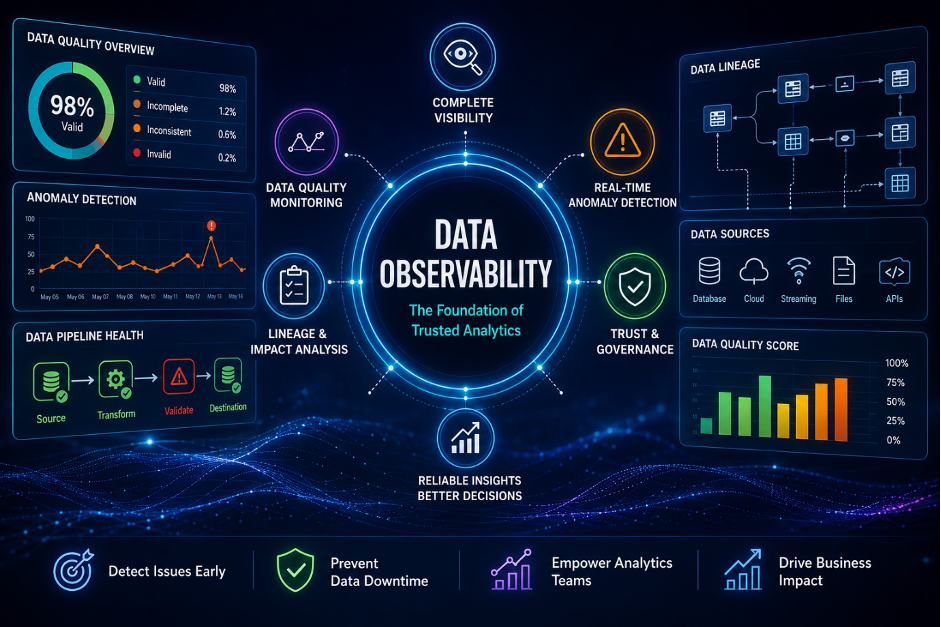
The expansion of data ecosystems has put considerable pressure on analytics teams to deliver insight faster and accurately. Industry predictions indicate that global data creation exceeded 180 zettabytes in 2025 and that companies manage data from over 400 applications on average. Such volume makes the issue of assuring data quality more complex.
As claimed by DataIntelo, the global data observability market was valued at $1.8 billion in 2025 and is projected to increase to $14.7 billion by 2034 with a CAGR of 26.5%. This fast development reflects the growing investment organizations are making in systems that guarantee reliable data as well as detecting anomalies to make sure analytics is trustworthy.
Unlike infrastructure monitoring, data observability offers constant insight into the state of data including quality, mobile, and usage throughout its lifecycle. As analytics become fundamental for both operational and strategic management, ensuring the reliability of data is equally significant as collecting it.
The Growing Complexity of Enterprise Data
Organizations today are no longer dependent on a solitary data storage system. The flow of information travels through a myriad of data channels, be it the cloud or edge, before arriving at data dashboards and ML models.
As per recent research data:
- Large-scale organizations can process up to 150 million data events in the span of a day.
- Approximately 65% of businesses function within multi-cloud infrastructures.
- About 80% of analytical workloads pull data from many internal and external resources.
- Data pipelines malfunctions incur 40% of reporting delays experienced by large organizations.
Data observability assists with this issue by providing data monitoring, ensuring capture of anomalies in datasets, processes, pipelines, and metadata which effectively enables decision making in business.
Why Conventional Monitoring is No Longer Enough
Conventional methods of IT monitoring are focused mostly on servers, storage, network uptime, and application performance. Although this is still relevant in assessing performance, such methods fail to provide enough information regarding whether the data is accurate and complete.
For instance, when the ETL process is finished successfully, but one data source provides only 92% of the expected dataset due to an unnoticed problem with API, the infrastructure monitoring will inform that all is fine, while the executive dashboard will provide the distorted revenue or customer numbers.
Modern data observability platforms typically monitor multiple dimensions simultaneously:
| Data Observability Metric | Typical Monitoring Goal | Business Value |
| Freshness | Detect delayed data arrivals | Prevent outdated reporting |
| Volume | Monitor unexpected data increases or decreases | Identify missing or duplicate records |
| Schema | Track structural changes | Prevent pipeline failures |
| Distribution | Detect abnormal value patterns | Improve analytical accuracy |
| Lineage | Trace data movement across systems | Accelerate root-cause analysis |
Both components enhance analytics teams’ confidence regarding the accuracy of the analytics data they obtain.
Data Quality Is a Priority for Businesses
Substandard data quality has measurable financial consequences. Several sector studies estimate that companies lose millions of dollars each year due to incorrect reporting, chaotic operations, and poor decisions influenced by unreliable data.
Those who conduct analyses understand that the process of improving data quality should include continuous monitoring rather than just cleaning datasets after the problem has occurred.
Examples of data quality issues that might be detected via monitoring:
- Unexpected null values
- Detection of duplicate records in data processing
- Sudden decreases in sales volumes
- Changes in data structure that affect other systems
- Unusual patterns of data distribution that suggest wrong transformations
The early investigation process helps reduce the time employed for investigations as well as increase trust from business users relying on analytics when making daily decisions.
Endorsing Artificial Intelligence and Advanced Analytics
The rise of artificial intelligence means more important reliable data. Machine learning algorithms work effectively according to the data used to develop them.
Businesses are expected that over 70% of AI implementation projects will utilize active data by 2028. The accuracy of the data being received has a cumulative influence on the operational efficiency of the model.
This ability is especially important in the areas of finance, medicine, manufacturing, and commerce where analysis results directly influence decision-making process.
The Concept of Data Lineage Enhances Regulation and Governance
Various global regulations surrounding data governance continue to evolve and broaden. The demand for origin, movements, access, and modifications of data is forcing organizations to comply with stringent conditions.
As a result, the concept of data lineage has become one of the fastest developments within observability technologies.
According to experts, establishments implementing proper lineage documents can cut investigation times by up to 60% as opposed to those that lack insight into their data pipelines.
Future Perspective
As the business landscape continues to evolve, the role of analytics teams has gone from simply dealing with changing situations to the more complex task of managing the reliability of data from thousands of interrelated datasets. Reliance on stability is no longer adequate for producing accurate business intelligence, so the spotlight is on data monitoring, checking the status, quality, freshness, and origin of data now.
Data observability is an important landmark in the development of modern analytics since it enables companies to spot potential problems which would otherwise remain invisible until they affect some business processes. The more data companies have at their disposal, the more important it is for them to stay ahead of problems.
The growing popularity of cloud analytics, real-time data processing, and AI-based decision making indicates that data observability is going to play a key role in keeping analytics teams confident in correctness of their information.
