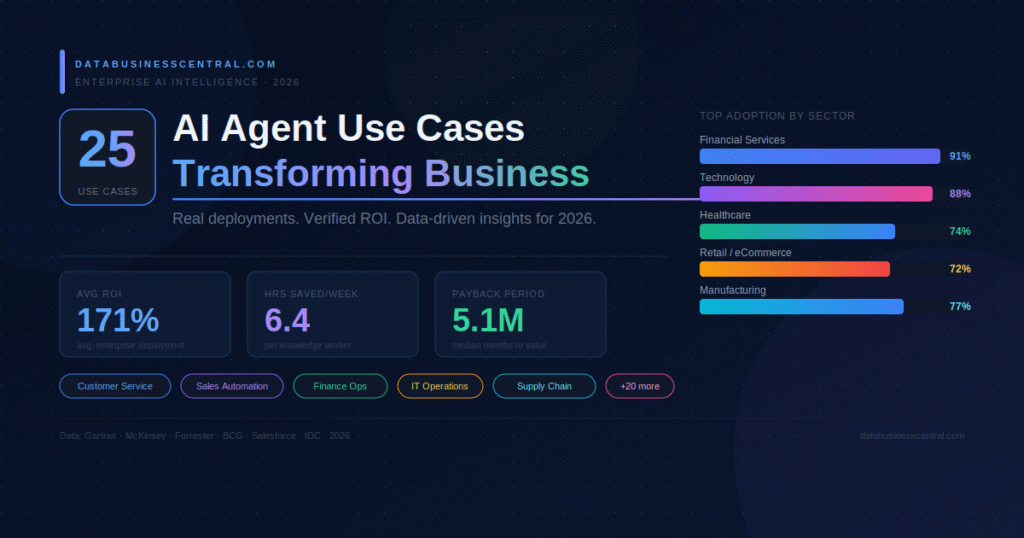
Something significant happened in enterprise technology between 2024 and today. AI agents stopped being a topic on conference slides and became a line item in operating budgets. According to Gartner, 40% of enterprise applications will embed task-specific AI agents by the end of 2026—up from under 5% just a year ago. McKinsey reports that knowledge workers using production AI agents recover a median of 6.4 hours per week. The average enterprise deployment now delivers 171% ROI.
The question is no longer whether AI agents work. It is which use cases work best—and where enterprises are capturing the most value right now.
This guide covers 25 AI agent use cases that are producing verified, measurable outcomes across industries in 2026. Each one is grounded in real enterprise data from Gartner, Forrester, BCG, Salesforce, and IDC.
Why AI Agent Use Cases Matter More Than Ever in 2026
Before diving into the list, it helps to understand what separates 2026 AI agent deployments from the chatbot experiments of prior years.
Modern enterprise AI agents do not wait for prompts. They plan, execute multi-step tasks, call external tools, monitor outcomes, and escalate to humans when appropriate. They work across CRM systems, ERPs, databases, and APIs—simultaneously. A single well-deployed agent can handle what previously required a team of specialists juggling multiple platforms.
Financial services and technology sectors are leading adoption at 91% and 88% respectively, per Accelirate’s 2026 enterprise adoption report. Healthcare sits at 74%. Retail and eCommerce at 72%. Even manufacturing has accelerated rapidly, jumping from 70% to 77% adoption in just 18 months.
The median payback period across functions is 5.1 months. For customer service deployments specifically, it drops to 4.1 months. These are not theoretical returns—they are benchmarks from production deployments tracked by Bain’s Agentic AI Benchmark 2026.
Here are the 25 use cases delivering the strongest outcomes.
Customer Operations (Use Cases 1–6)
1. Autonomous Customer Support Resolution
This is the highest-volume AI agent use case in the enterprise today. Salesforce’s Agentforce handled over 380,000 support interactions in production and resolved 84% of cases without human involvement. Industry-wide, approximately 30% of customer service cases are now handled entirely by AI agents, with Salesforce projecting that number will reach 50% by 2027.
The economics are stark. Forrester TEI studies show AI agents resolve a contained customer ticket for $0.46 versus $4.18 for a human-handled case—a 9x cost differential. The ROI compounds: 41% in year one, 87% in year two, 124%+ by year three.
2. Intelligent Complaint Triage and Escalation
AI agents now read incoming complaints, assess severity, route to the right team, pull up relevant account history, and pre-draft resolution responses—all before a human touches the ticket. Enterprises using this pattern report 20–35% reductions in average handle time and measurably higher customer satisfaction scores.
3. Proactive Churn Prevention
Agentic AI monitors customer behavior signals in real time—usage drops, support spikes, billing friction—and autonomously triggers retention workflows: personalized outreach, discount offers, or success check-ins. Companies deploying AI agents broadly report 3–15% revenue growth, with churn reduction being a primary driver in subscription businesses.
4. Voice AI for Inbound Call Handling
AI phone agents now handle routine inbound calls end-to-end: appointment booking, order status, basic troubleshooting, account updates. Conversational AI is projected to save $80 billion in contact-center labor costs by 2026. The best deployments resolve 70–84% of inbound cases for narrow, repeatable query types without transferring to a human.
5. Personalized Onboarding Agents
New customer onboarding is one of the highest-dropout phases in any product lifecycle. AI agents now guide users through setup, respond to questions contextually, detect where users get stuck, and dynamically adjust onboarding paths. Enterprises using agentic onboarding report measurable improvements in activation rates and 30-day retention.
6. Multilingual Global Support at Scale
AI agents with real-time translation capabilities now serve global customer bases without the cost of building localized human teams. A global biopharma enterprise using AI agents for content localization reduced the process from two months to a single day, according to BCG’s “How Four Companies Use AI for Cost Transformation.”
Sales and Revenue Operations (Use Cases 7–10)
7. AI SDR Agents for Outbound Prospecting
Sales development AI agents research prospects, personalize outreach, send sequences, follow up based on engagement signals, and book meetings autonomously. BCG and Forrester data show SDR agents achieve payback in 3.4 months—the fastest of any enterprise AI agent category. Companies report 10–20% increases in sales ROI from broad AI agent deployment.
8. Real-Time Deal Coaching and CRM Hygiene
AI agents listen to sales calls (with consent), extract key commitments, update CRM records automatically, flag deal risks, and surface next-best-action recommendations to reps. Salesforce reports enterprises currently use an average of 12 AI agents—and sales operations is consistently among the top two categories for deployment.
9. Dynamic Pricing Optimization
AI agents continuously monitor competitor pricing, inventory levels, demand signals, and margin targets, then adjust prices autonomously within set parameters. This use case is particularly advanced in retail and eCommerce, where real-time responsiveness to market conditions creates direct revenue impact.
10. Contract and Proposal Generation
AI agents pull from CRM data, product catalogs, and pricing rules to generate customized proposals and contract drafts in minutes. Salesforce cut $5 million in legal costs through contract automation, per Landbase’s 2026 enterprise case studies.
Finance and Operations (Use Cases 11–15)
11. Accounts Payable and Invoice Processing
AI agents extract data from invoices, match against purchase orders, flag discrepancies, route approvals, and execute payments—with exception handling built in. Finance and operations agents have a median payback period of 8.9 months, but the scale of savings is significant. IBM realized $3.5 billion in cost savings with a 50% productivity increase across enterprise operations using agentic AI systems.
12. Financial Forecasting and Scenario Modeling
Rather than waiting for quarterly finance cycles, AI agents now continuously update forecasts as new data arrives—revenue actuals, pipeline shifts, macro indicators—and generate variance analyses automatically. Finance leaders gain real-time visibility that was previously impossible at the pace and scale of modern business.
13. Fraud Detection and Risk Monitoring
AI agents monitor transactions in real time, cross-reference behavioral baselines, flag anomalies, and initiate investigation workflows without waiting for human review. In the BFSI sector, which holds approximately 25% of the AI agent market share, fraud detection is among the most mature and highest-ROI deployments. JPMorgan runs 450+ AI use cases in production daily, with fraud and risk management among the most scaled.
14. Regulatory Compliance Monitoring
AI agents continuously scan regulatory updates, compare against current policies and contracts, flag compliance gaps, and generate remediation checklists. By 2026, Forrester predicts half of enterprise ERP vendors will have launched autonomous governance modules combining explainable AI, automated audit trails, and real-time compliance monitoring.
15. Expense Management and Audit
AI agents review expense submissions, verify policy compliance, flag violations, and process reimbursements—reducing the manual review burden by 60–80% in reported enterprise deployments. The cost-per-task reduction for routine finance operations mirrors the broader pattern: significant automation of high-volume, low-complexity work.
IT and Software Engineering (Use Cases 16–19)
16. Autonomous Incident Response and IT Ops
AI agents monitor infrastructure, detect anomalies, diagnose root causes, apply standard remediations, and page humans only when novel situations arise. Gartner projects 70% of enterprises will deploy agentic AI as part of IT infrastructure operations by 2029. Early movers are already reporting substantial reductions in mean time to resolution (MTTR).
17. AI-Assisted Code Review and Generation
Code-review agents complete a routine pull request review for $0.72 versus $48 of senior-engineer time—a 66x cost reduction, per Forrester and Anthropic enterprise data. This is the single largest cost-per-task differential of any documented AI agent use case. Stack Overflow’s 2026 Developer Survey confirms that code generation and review are the top two AI agent use cases among engineering teams.
18. Legacy Code Modernization
AI agents analyze legacy codebases, generate documentation, refactor modules incrementally, and propose migration paths. This use case has moved from pilot to production in financial services and healthcare, where decades of accumulated technical debt create both the need and the business case.
19. Automated Security Vulnerability Scanning
AI agents continuously scan code repositories, cloud configurations, and network traffic for vulnerabilities, prioritize findings by severity, and generate remediation guidance. Given that Gartner projects 25% of enterprise breaches will be traced to AI agent abuse by 2028, the irony of using agents to defend against agent-related risk is not lost on security teams—but the effectiveness data is strong.
Supply Chain and Operations (Use Cases 20–22)
20. Supply Chain Demand Forecasting
AI agents ingest sales data, weather patterns, social trends, and supplier signals to generate continuously updated demand forecasts. Companies using AI for supply chain coordination report 25% faster response to disruptions and 30% fewer manual interventions. Unilever’s AI system improved forecast accuracy from 67% to 92%, cutting €300 million in excess inventory, according to IBM’s Institute for Business Value.
21. Supplier Risk Management and Monitoring
AI agents monitor news, financial filings, ESG signals, and geopolitical developments to flag supplier risks before they become supply disruptions. Organizations with higher AI-driven supply chain investment report 15% lower logistics costs and 35% better inventory accuracy.
22. Autonomous Procurement and Reordering
Within defined parameters, AI agents now execute reorders, compare supplier quotes, and process purchase orders without human intervention. By 2028, AI agent ecosystems are projected to intermediate more than $15 trillion in B2B spending—procurement is a major component of that shift.
HR, Legal, and Knowledge Work (Use Cases 23–25)
23. Talent Sourcing and Screening Agents
AI agents search candidate databases, evaluate resumes against job requirements, send initial outreach, schedule interviews, and generate candidate summaries for hiring managers. Human resources is among the top five AI agent deployment categories in enterprise, with measurable reductions in time-to-hire and cost-per-hire in reported deployments.
24. Legal Document Review and Due Diligence
AI agents review contracts, extract key terms, flag non-standard clauses, and compare against playbooks—dramatically compressing the time required for legal due diligence. Salesforce’s legal team cut $5 million in costs through contract automation. Vertical AI agents for legal are part of the fastest-growing segment in the market, with domain-specific agents growing at a 62.7% CAGR, outpacing the overall market at 46.3%.
25. Enterprise Knowledge Retrieval and Research
AI agents search internal knowledge bases, synthesize information from multiple sources, and generate accurate, sourced summaries for employees—reducing the time knowledge workers spend searching for information. McKinsey reports that AI agents help organizations recover a median 6.4 hours per knowledge worker per week, and internal research agents are a primary driver of that figure.
What Separates Successful Deployments from Failed Ones
The data on failure is as important as the data on success. Gartner projects that over 40% of agentic AI projects will be canceled by 2027. Forrester’s root-cause analysis identifies unclear success criteria (41%), insufficient tool or data access (33%), and drift in evaluation coverage (26%) as the primary failure modes.
The organizations achieving the strongest outcomes share three characteristics: they start with use cases where ROI is measurable and unambiguous (customer service, SDRs, finance automation); they build data infrastructure before scaling agents; and they define governance frameworks before deployment rather than after.
Per Deloitte’s 2026 AI survey of 3,235 business leaders, only 1 in 5 companies has a mature governance model for autonomous AI agents. That gap is not a technology problem—it is a management problem, and it is the primary constraint on capturing the value these 25 use cases represent.
The 2026 Opportunity in Numbers
The global AI agents market reached $10.9 billion in 2026, growing at a 44–46% CAGR. By 2030, it is projected to exceed $50 billion. Generative AI is projected to unlock $2.6 to $4.4 trillion in annual economic value across enterprise use cases, with customer operations, marketing, software engineering, and R&D capturing the largest shares.
The 25 use cases above are not a future roadmap. They are a current-state map of where enterprises are deploying AI agents, generating verified returns, and building competitive advantages that compound over time. The window for deploying without competitive disadvantage is closing faster than most organizations realize.
Sources: Gartner, McKinsey Global AI Survey 2026, Forrester Agentic AI Wave Q1 2026, BCG Agentic AI Benchmark 2026, Salesforce State of Service 2026, IDC Worldwide AI Spending Guide, Bain Agentic AI Benchmark 2026, IBM Institute for Business Value, Deloitte 2026 AI Enterprise Survey, Accelirate Agentic AI Statistics 2026, Landbase Enterprise ROI Study 2026.
