The CIO role has never carried more strategic weight — or more personal risk.
In 2026, artificial intelligence is no longer a technology initiative sitting inside the IT function. It’s a board-level priority, a CFO budget conversation, and a CEO competitive mandate — all simultaneously. The CIOs navigating this moment successfully are not the ones chasing every AI headline. They’re the ones who’ve developed sharp judgment about which AI trends are signal and which are noise.
This guide cuts to the signal. These are the ten AI trends that will define enterprise technology strategy in 2026 — not as emerging concepts, but as live forces already reshaping how organizations build, operate, and compete.
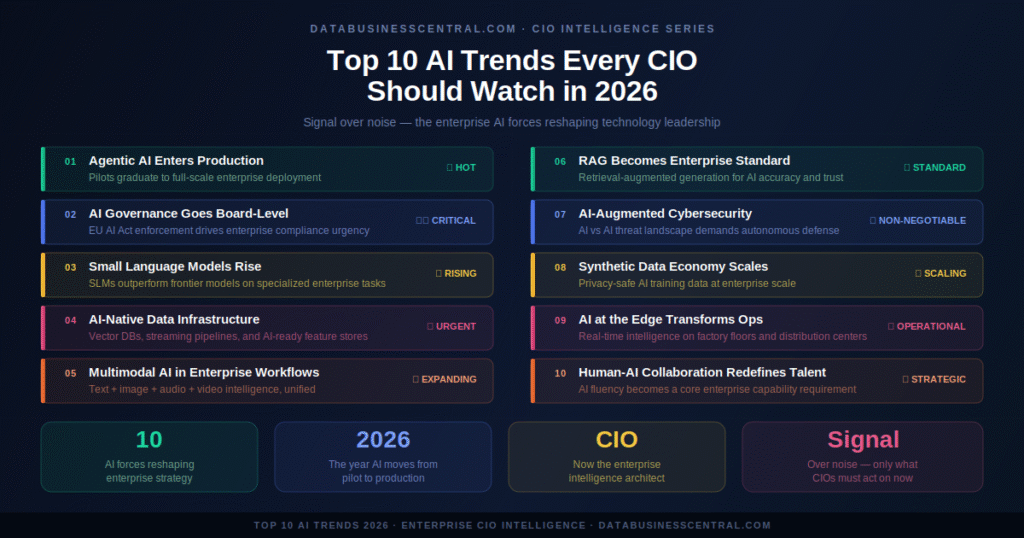
1. Agentic AI Moves from Pilot to Production
The trend: After two years of controlled pilots, enterprise AI agents are entering full-scale production deployment. CIOs who spent 2024–2025 running proofs of concept are now making infrastructure decisions that will define their AI architecture for the next decade.
Agentic AI systems — autonomous AI that pursues goals through multi-step reasoning, tool use, and self-directed action — are being deployed across financial services, healthcare, logistics, and enterprise SaaS operations. The capability shift from AI-as-assistant to AI-as-executor is the defining architecture decision of 2026.
Why CIOs must act: The organizations deploying agentic AI at scale today are building institutional knowledge and competitive muscle that will compound over years. Late movers aren’t just missing a product cycle — they’re falling behind on AI organizational learning that can’t be shortcut later.
What to watch: Multi-agent orchestration frameworks, where multiple specialized AI agents coordinate on complex enterprise workflows, are the next frontier. This is where production deployments are heading in H2 2026.
2. AI Governance Becomes a Board-Level Mandate
The trend: AI governance is graduating from an IT compliance checkbox to a board-level strategic function. Driven by the EU AI Act enforcement timeline, emerging US federal AI policy frameworks, and a growing body of enterprise AI incident case studies, boards are demanding governance infrastructure that can demonstrate responsible AI deployment at scale.
For CIOs, this means AI governance is no longer a legal and compliance hand-off. It’s a technology architecture responsibility — encompassing model explainability, bias auditing, data lineage, output monitoring, and human-in-the-loop checkpoints baked into AI system design.
Why CIOs must act: Organizations without mature AI governance frameworks are accumulating regulatory risk silently. The cost of retrofitting governance into deployed AI systems is dramatically higher than building it in from the start.
What to watch: AI governance platforms from vendors like IBM, Microsoft, and a wave of purpose-built startups are maturing rapidly. CIOs should be evaluating enterprise AI governance tooling as seriously as they evaluate security infrastructure.
3. The Rise of Small Language Models in Enterprise Architecture
The trend: The AI arms race around massive foundation models is giving way to a more nuanced enterprise reality: small language models (SLMs) are delivering enterprise-grade performance at a fraction of the cost, latency, and data exposure risk of their larger counterparts.
Models in the 1–13 billion parameter range, fine-tuned on domain-specific enterprise data, are outperforming general-purpose frontier models on specialized enterprise tasks — while running on-premises, on-device, or in private cloud environments that satisfy data sovereignty requirements.
Why CIOs must act: Enterprises that assumed large foundation model APIs were the only path to AI capability are discovering they’ve been over-spending and over-exposing proprietary data unnecessarily. The SLM architecture shift is both a cost optimization and a security upgrade.
What to watch: Microsoft’s Phi series, Google’s Gemma, and Meta’s Llama family are the anchor SLM platforms. Enterprise fine-tuning pipelines built on these foundations are where the real competitive differentiation is being built.
4. AI-Native Data Infrastructure Replaces Legacy Stacks
The trend: The enterprise data stack is undergoing its most significant architectural transformation since the cloud migration wave of the 2010s. AI-native data infrastructure — designed from the ground up for AI workloads rather than retrofitted from traditional BI and analytics architectures — is becoming the new baseline for data-driven organizations.
This means vector databases for semantic search and retrieval-augmented generation, streaming data pipelines optimized for real-time AI inference, unified data platforms that eliminate the warehouse-vs-lakehouse debate, and AI-ready feature stores that make model training and deployment dramatically more efficient.
Why CIOs must act: Legacy data infrastructure is the single most common bottleneck in enterprise AI deployments. Organizations attempting to build AI capability on top of fragmented, poorly governed, decade-old data architectures are discovering that the limiting factor isn’t AI — it’s the plumbing.
What to watch: The convergence of Databricks and Snowflake’s capabilities, the rise of AI-native databases like Weaviate and Pinecone, and the emergence of unified data and AI platforms are reshaping enterprise data architecture decisions with urgency.
5. Multimodal AI Enters Enterprise Workflows
The trend: Enterprise AI is breaking out of the text-only paradigm. Multimodal AI — systems that process and generate across text, images, audio, video, and structured data simultaneously — is moving from research showcase to enterprise workflow integration.
For CIOs, this manifests as AI systems that can analyze a photograph of a manufacturing defect alongside its maintenance history record, or process a customer service call transcript alongside the caller’s account data and sentiment signals from their vocal tone — generating richer insights than any single-modality system could produce.
Why CIOs must act: Enterprises with significant unstructured data assets — visual inspection workflows, audio documentation, video training content, document-heavy operations — are sitting on untapped AI value that multimodal systems can unlock. The organizations building multimodal pipelines in 2026 are defining next-generation operational intelligence.
What to watch: GPT-4o, Gemini Pro Vision, and Claude’s multimodal capabilities are the current enterprise anchor platforms. The integration of these capabilities into industry-specific vertical applications is where the near-term enterprise value will concentrate.
6. Retrieval-Augmented Generation Becomes Enterprise Standard
The trend: Retrieval-Augmented Generation — the architectural approach of grounding AI outputs in dynamically retrieved enterprise knowledge rather than relying purely on training data — has crossed from early adopter to enterprise standard in 2026.
RAG architecture solves the three most critical enterprise AI reliability problems simultaneously: hallucination reduction, knowledge freshness, and proprietary data integration. An AI system that answers questions by retrieving from your organization’s live documentation, policy libraries, and data systems is fundamentally more trustworthy than one relying on static training knowledge.
Why CIOs must act: RAG is no longer an optional enhancement — it’s the minimum viable architecture for enterprise AI systems where accuracy, currency, and proprietary knowledge integration matter. Organizations still deploying vanilla LLM implementations without RAG are accepting unnecessary accuracy and reliability risk.
What to watch: Enterprise RAG platforms are maturing rapidly, with vendors offering managed RAG infrastructure, hybrid search capabilities, and enterprise-grade retrieval optimization. The evaluation of chunking strategies, embedding models, and retrieval pipelines is becoming a core enterprise AI engineering competency.
7. AI-Augmented Cybersecurity Becomes Non-Negotiable
The trend: The cybersecurity arms race has entered a new phase: attackers are using AI to develop exploits, craft sophisticated phishing at scale, and identify vulnerabilities faster than human security teams can respond. The only viable defense is AI-augmented security — using AI to match and exceed the speed and sophistication of AI-powered attacks.
In 2026, AI-powered threat detection, autonomous incident triage, AI-generated security code review, and LLM-based security operations center (SOC) augmentation are moving from competitive differentiator to baseline enterprise security requirement.
Why CIOs must act: Organizations still relying primarily on rule-based security systems and human-speed threat response are structurally outpaced by the current threat landscape. AI-augmented cybersecurity isn’t a feature upgrade — it’s a fundamental capability requirement for 2026.
What to watch: Microsoft Security Copilot, CrowdStrike’s AI-native platform, and a new generation of AI SOC tools are setting the enterprise security baseline. The integration of security AI into broader enterprise AI governance frameworks is an emerging architectural challenge.
8. The Synthetic Data Economy Scales
The trend: Data scarcity — insufficient labeled training data, privacy constraints on real customer data, rare-event underrepresentation — has been the silent bottleneck of enterprise AI development. Synthetic data generation is rapidly dissolving that constraint, creating high-quality, privacy-compliant AI training data at scale.
Enterprises in healthcare, financial services, and insurance are using synthetic data to train AI models on patient scenarios, fraud patterns, and risk profiles that couldn’t be used in their real form due to regulatory constraints. The result is faster AI development cycles, better-performing models, and dramatically reduced regulatory exposure.
Why CIOs must act: The organizations that crack synthetic data generation in their industry will have a compounding AI development advantage — faster iteration, more diverse training sets, and zero data privacy liability. This is an underappreciated strategic moat.
What to watch: Vendors like Gretel.ai, Mostly AI, and Syntho are building the enterprise synthetic data infrastructure. Expect consolidation as hyperscalers begin integrating synthetic data capabilities into their AI development platforms
9. AI at the Edge Transforms Operations Technology
The trend: Enterprise AI is moving off the cloud and onto the factory floor, the distribution center, the retail shelf, and the hospital bedside. Edge AI — AI inference running on local hardware without cloud dependency — is enabling real-time intelligent automation in environments where latency, connectivity, and data sovereignty make cloud-dependent AI impractical.
Computer vision quality control on manufacturing lines running at millisecond inference speeds. Predictive maintenance on industrial equipment operating in offline environments. Real-time inventory intelligence at the retail edge. These are not future use cases — they’re 2026 production deployments at scale.
Why CIOs must act: For enterprises with significant physical operations — manufacturing, logistics, retail, healthcare — edge AI is the bridge between digital AI capability and physical operational performance. The operational intelligence gap between edge AI adopters and laggards is widening rapidly.
What to watch: NVIDIA’s Jetson platform, Intel’s OpenVINO framework, and the maturation of TinyML are the foundational edge AI technologies. The development of edge AI management and monitoring platforms — handling model deployment, updates, and performance monitoring across distributed edge environments — is the enterprise infrastructure challenge to solve.
10. The Human-AI Collaboration Model Redefines Talent Strategy
The trend: The most consequential AI trend of 2026 isn’t a technology — it’s an organizational transformation. The human-AI collaboration model — where human talent and AI systems are deliberately designed to work in complementary partnership — is redefining how enterprises think about skills, roles, hiring, and workforce development.
Organizations that have deployed AI at scale are discovering that the scarce resource is no longer data or compute. It’s the human judgment, creative leadership, and relationship intelligence that AI cannot replicate — and the organizational capability to design effective human-AI collaboration at every layer of the enterprise.
Why CIOs must act: CIOs who think about AI purely as a technology initiative are missing the defining challenge: AI changes what human talent needs to do, not just how efficiently they do it. Workforce AI readiness — the ability of human employees to work effectively alongside AI systems — is an IT leadership responsibility, not just an HR one.
What to watch: AI fluency programs, human-in-the-loop workflow design, and AI collaboration metrics are emerging as core enterprise capabilities. The CIOs investing in human-AI collaboration infrastructure — not just AI technology infrastructure — are the ones building sustainable competitive advantage.
The CIO’s 2026 AI Mandate: From Technology Leader to Intelligence Architect
The ten trends above share a common thread: in 2026, AI is not a technology category within the enterprise. It’s the operating system of the enterprise — the layer through which every function, workflow, and decision is being mediated and accelerated.
The CIO’s mandate has evolved accordingly. The most effective technology leaders in 2026 are functioning as intelligence architects — not just deploying AI tools, but designing the organizational, data, and governance infrastructure through which AI creates durable enterprise value.
That means making hard choices about build vs. buy vs. partner. It means investing in AI governance before incidents demand it. It means treating data architecture modernization as an AI prerequisite, not an afterthought. And it means taking ownership of the human-AI collaboration model that will ultimately determine whether your AI investments translate into competitive advantage or expensive technical debt.
The CIOs who master this mandate in 2026 won’t just manage technology. They’ll define the intelligence infrastructure of the modern enterprise — and that’s the most strategically powerful position in business technology leadership history.
CIO Action Checklist: 2026 AI Priorities
- Assess agentic AI readiness and identify first production deployment candidates
- Audit AI governance infrastructure against EU AI Act and emerging US frameworks
- Evaluate SLM fine-tuning as an alternative to frontier model API dependency
- Prioritize AI-native data infrastructure modernization in capital planning
- Build RAG architecture competency as enterprise AI reliability baseline
- Upgrade cybersecurity posture to AI-augmented threat detection and response
- Explore synthetic data programs for high-value but data-constrained AI use cases
- Identify edge AI opportunities in physical operations environments
- Define human-AI collaboration model and invest in workforce AI fluency
- Establish AI performance metrics beyond cost savings — intelligence ROI framework
Data Business Central delivers enterprise AI strategy, technology leadership intelligence, and data-driven transformation insights for CIOs, CTOs, and technology executives. Subscribe for weekly analysis on enterprise AI deployment, architecture decisions, and the future of intelligent enterprise.
Tags: AI trends 2026, CIO AI strategy, enterprise AI, agentic AI, AI governance, small language models, AI-native data infrastructure, multimodal AI, retrieval-augmented generation, RAG architecture, AI cybersecurity, synthetic data, edge AI, human-AI collaboration, AI workforce strategy, enterprise technology trends, digital transformation 2026, AI at the edge, SLM enterprise, AI compliance, CIO technology leadership, intelligent enterprise
Related blogs
