Introduction
No industry in America is growing quite like AI infrastructure. Behind every chatbot response, every AI-generated image, and every enterprise AI tool sits a physical building full of servers, GPUs, and cooling systems — and in the US, that building boom has become one of the largest capital investment cycles in corporate history.
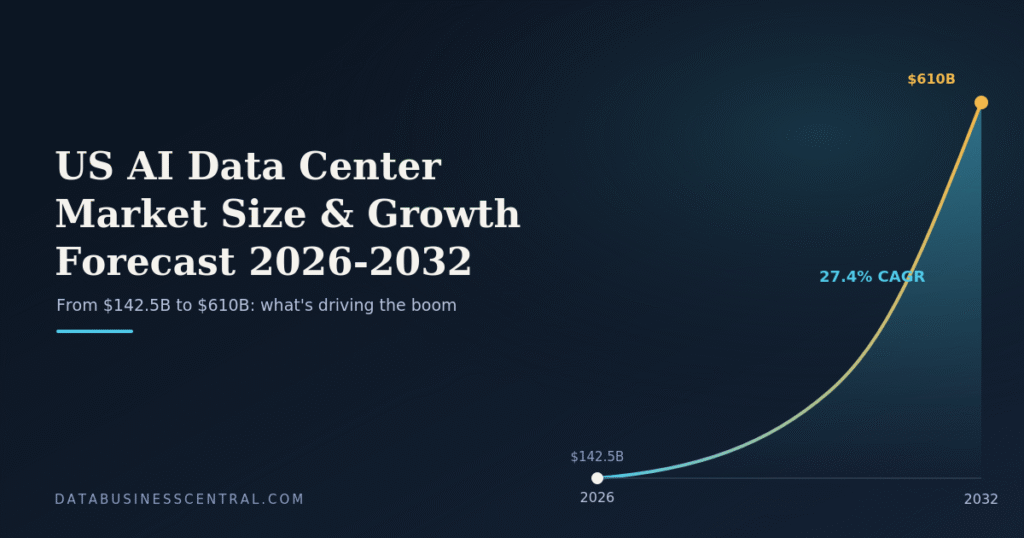
According to MarketsandMarkets, the US AI data center market is projected to grow from $142.50 billion in 2026 to $610.12 billion by 2032, a compound annual growth rate (CAGR) of 27.4%. That’s not a niche tech trend — that’s a market roughly the size of a mid-sized national economy, built almost entirely in the span of a decade.
This article breaks down what’s actually driving that number, where the money is going, and what could slow it down between now and 2032.
US AI Data Center Market Size at a Glance
| Metric | 2026 | 2032 | CAGR |
|---|---|---|---|
| US AI Data Center Market Value | $142.50 billion | $610.12 billion | 27.4% |
| Hyperscale Data Center Share (2032) | — | 68.4% of market | — |
| Cooling Solutions Segment CAGR | — | — | 28.5% |
Source: MarketsandMarkets, US AI Data Center Market Report 2026–2032
It’s worth noting that different research firms estimate the global AI data center market anywhere from roughly $180 billion to $470 billion for 2026, depending on how narrowly “AI data center” is defined — some count only AI-dedicated facilities, others include the AI-driven share of general-purpose data centers. What’s consistent across every major report, though, is the growth rate: nearly every forecast places the CAGR between 25% and 36% through the early 2030s. The US, as the largest single national market, sits at the center of that growth story.
Why the US AI Data Center Market Is Growing So Fast
1. Record Hyperscaler Spending
The clearest driver of this growth is direct capital spending from the handful of companies that dominate US cloud infrastructure. Early 2026 earnings reports confirmed that the five largest hyperscalers — Amazon, Microsoft, Alphabet, Meta, and Oracle — are planning combined 2026 capital expenditures in the range of $660–725 billion, up sharply from roughly $388–450 billion in 2025.
Individually, the numbers are striking:
- Amazon is targeting around $200 billion in 2026 capex, most of it directed at data centers and AI infrastructure.
- Alphabet (Google) has guided to $175–185 billion.
- Meta plans $115–135 billion, including a 1-gigawatt facility in Ohio and a Louisiana site that could eventually scale to 5 gigawatts.
- Microsoft is tracking toward $120 billion or more, with an $80 billion backlog of Azure orders it can’t yet fulfill due to power constraints.
- Oracle is targeting roughly $50 billion, a 136% jump from 2025, backed by $523 billion in remaining performance obligations.
That last detail — Microsoft’s unfulfilled Azure backlog — is important. It signals that demand for AI compute in the US isn’t just strong; it’s currently outpacing the physical infrastructure available to serve it, which is a major reason forecasts through 2032 stay so aggressive.
2. The Shift From General Cloud to AI-Specific Infrastructure
A structural shift is underway inside the data center industry itself. Traditional cloud computing investment focused on general-purpose servers and storage. AI workloads demand something different: dense clusters of GPUs and specialized accelerators, high-bandwidth networking, and cooling systems built for far higher heat loads than a standard server rack produces.
This is why cooling solutions are forecast to be the fastest-growing segment of the US AI data center market, at a 28.5% CAGR — faster than the market overall. As AI hardware gets denser and more power-hungry, the infrastructure required to keep it running cool becomes a bigger share of total spending.
3. Hyperscale Facilities Are Taking Over the Market
By 2032, hyperscale data centers — the massive, company-owned facilities operated by the likes of Amazon, Microsoft, and Google — are projected to hold 68.4% of the entire US AI data center market. This reflects a broader consolidation trend: while colocation providers and smaller operators still play an important role, the sheer capital required to build gigawatt-scale AI infrastructure increasingly favors companies with the balance sheets to fund it directly.
4. Geographic Expansion Beyond Traditional Hubs
Virginia has long been the center of gravity for US data centers, but that’s changing. Industry trackers now expect Texas to overtake Virginia as the leading hub for hyperscale data center construction in 2026, with Arkansas also emerging as a major new investment destination. This shift is driven largely by land availability, more favorable power access, and state-level incentives — even as some of those incentives face growing political pushback.
The Bottleneck: Power, Not Demand
If there’s one theme that runs through nearly every 2026 industry report, it’s this: demand for AI compute is not the limiting factor — power is.
Multiple analysts, including Goldman Sachs, have documented a current US data center capacity shortfall exceeding 11 gigawatts, with some projections suggesting that gap could widen to nearly 49 gigawatts by 2028 if construction and grid upgrades don’t accelerate. Grid connection delays now commonly stretch four to five years, and data centers are estimated to be driving roughly 55% of total US electricity demand growth.
This power constraint is arguably the single biggest wildcard in any AI data center forecast through 2032. Every major hyperscaler has effectively confirmed they could spend more if the power and physical capacity existed to support it — which means the market’s actual growth ceiling may depend less on corporate ambition and more on how quickly the US energy grid can catch up.
Labor Shortages Add Another Layer of Friction
Power isn’t the only physical constraint. The data center construction industry is facing a labor shortage estimated at 439,000 workers, at a time when a single hyperscale site can require 4,000 to 5,000 workers at peak construction. Industry executives have specifically flagged skilled trades and specialized coordination roles — the people who actually build these facilities — as a growing bottleneck heading into the back half of the decade.
Local Pushback Is a Real Financial Risk
Growth forecasts assume that most planned projects eventually get built — but that assumption is being tested. Between May 2024 and March 2025 alone, over $64 billion in planned US data center projects were delayed or canceled due to organized local opposition over electricity costs, water usage, and quality-of-life concerns. Community resistance has grown into enough of a factor that analysts now treat it as a distinct financial risk category for the sector, not just a local political story.
This means the path from $142.5 billion in 2026 to $610 billion in 2032 isn’t likely to be a smooth, uninterrupted climb. Expect regional variation — some states accelerating approvals to attract investment, others slowing or blocking projects — shaping exactly where that growth actually lands.
What This Means for Investors and Businesses
For companies operating in or around this space, a few practical takeaways stand out:
- Power infrastructure is now as strategically important as compute itself. Companies with secured, long-term power agreements — including nuclear and renewable partnerships — have a real competitive edge.
- Cooling technology is a growth market in its own right, not just a supporting function, given its outsized CAGR relative to the broader market.
- Geographic diversification matters. With Texas and Arkansas rising alongside traditional hubs like Virginia, the physical map of US AI infrastructure is actively being redrawn.
- Regulatory and community risk needs to be priced in. The billions in delayed or canceled projects over the past two years show this isn’t a purely theoretical risk.
Conclusion
The US AI data center market’s projected growth — from $142.5 billion in 2026 to $610.12 billion by 2032 — reflects one of the clearest, most well-funded technology buildouts in modern business history. Hyperscaler capital spending is at record levels, demand for AI compute continues to outpace supply, and hyperscale facilities are consolidating an ever-larger share of the market.
But the size of the forecast shouldn’t obscure the real constraints shaping how it plays out: power availability, skilled labor, and local community approval are now just as important to this market’s trajectory as capital spending itself. For businesses, investors, and policymakers watching this space, the headline growth number is only half the story — the other half is whether the physical world can build fast enough to keep up with it.

1 thought on “US AI Data Center Market Size, Growth, and Forecast (2026–2032)”
Pingback: How NVIDIA Is Shaping the Future of AI Data Centers