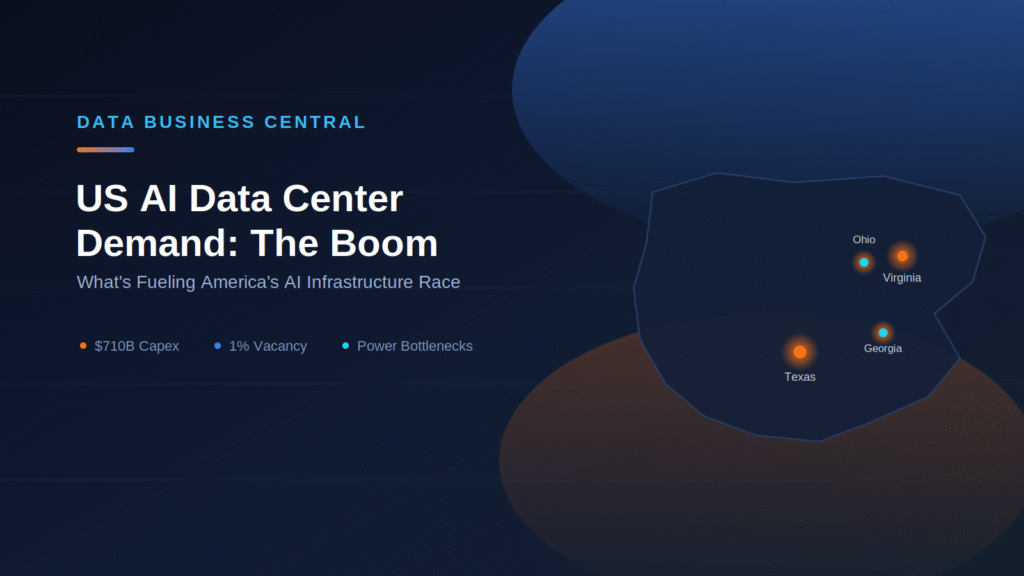
Drive through Loudoun County, Virginia, or the flat scrubland outside Abilene, Texas, and you’ll see it: mile after mile of windowless steel buildings, ringed by transformers, cooling towers, and freshly poured foundations for more of the same. This is what AI data center demand looks like when it hits the ground — and nowhere on Earth is it hitting harder than the United States.
The U.S. isn’t just participating in the AI infrastructure boom. It’s the epicenter of it. American hyperscalers are on pace to spend more on physical infrastructure in a single year than most countries spend on their entire annual budgets. So what, exactly, is driving this surge — and how long can it realistically continue? Here’s what the data says.
The Scale of the Spending Is Almost Hard to Believe
Start with the headline number: the “Big Five” U.S. hyperscalers — Microsoft, Amazon, Google, Meta, and Oracle — have announced roughly $710 billion in combined capital expenditures for 2026 alone. That figure has climbed sharply and repeatedly through the year, up from an already-record $388 billion in 2025 — a jump of more than 60% in just twelve months.
Zoom out further and the trajectory gets even more dramatic. Goldman Sachs projects that total hyperscaler capital expenditure from 2025 through 2027 will reach $1.15 trillion — more than double the $477 billion these same companies spent across the entire 2022–2024 period. Individually, Microsoft is tracking toward roughly $120 billion in infrastructure spending for its 2026 fiscal year. Amazon has guided to $200 billion. Meta’s capex sits in the $115–135 billion range, funding projects like a 1-gigawatt data center in Ohio and a Louisiana campus designed to eventually scale to 5 gigawatts.
These aren’t discretionary technology budgets anymore. Hyperscalers are now spending 45–57% of their revenue on capital expenditures — ratios that used to be reserved for utilities and heavy industry, not software companies.
Demand Is Outrunning Supply — By a Wide Margin
If this spending were simply chasing anticipated demand, it would be notable enough. But the data suggests something more urgent: current AI data center demand is actively outstripping the industry’s ability to build capacity, even at this unprecedented pace.
Microsoft has disclosed an $80 billion backlog of Azure orders it cannot fulfill — not because of a lack of customers, but because of power constraints. Across North America, data center vacancy has held at roughly 1% for two consecutive years, even as construction activity hits record highs. In Q1 2026 alone, U.S. colocation inventory grew 22% quarter-over-quarter to 29.0 gigawatts, with net absorption of 5.29 gigawatts — meaning nearly all of that new capacity was leased almost as fast as it came online.
Northern Virginia, the world’s largest data center market, illustrates the imbalance clearly. The region absorbed 1,102 megawatts of new demand in 2025 — a 144% jump from the prior year — while vacancy fell to just 0.5%. Only 21.5 megawatts of available supply remained by year-end, and 96% of 2026’s scheduled new supply was already committed before it was even built.
In plain terms: hyperscalers aren’t overbuilding. They’re racing to catch up.
Why the Boom Is Happening Now
A handful of forces are converging to produce this level of AI data center demand in the US specifically:
- Generative and agentic AI adoption. Training frontier models and running always-on inference for hundreds of millions of users requires exponentially more compute than previous software workloads ever did.
- Enterprise AI rollout. Beyond the AI labs, mainstream corporations across finance, healthcare, retail, and manufacturing are now standing up dedicated AI infrastructure rather than relying solely on shared cloud capacity.
- The Stargate effect. The Stargate project — a joint venture between OpenAI, SoftBank, Oracle, and MGX — has become a symbol of just how large single AI infrastructure commitments can get, backing a nationwide build-out of dedicated AI compute campuses.
- A supply-constrained market, not a demand-constrained one. Hyperscalers have been explicit on recent earnings calls: the bottleneck isn’t finding customers for AI compute. It’s building fast enough to serve the customers already waiting.
- Investor pressure to show returns. With capex ratios reaching historic highs, investors are increasingly scrutinizing whether this spending converts into usable capacity — adding pressure to build efficiently and quickly.
The Geography Is Shifting — Fast
For years, “data center market” was practically synonymous with Northern Virginia. That’s changing in real time, and the reason is simple: power.
Power wait times in Northern Virginia now average roughly seven years for large loads, pushing developers toward markets with faster access to electricity. Texas has emerged as the clearest beneficiary. As of March 2026, Texas led the nation with 140 data centers under construction, narrowly ahead of Virginia’s 136 — the only two states with more than 100 active projects. Looking at total pipeline (operating, under construction, and announced), Texas is projected to reach 962 total sites, positioning it to overtake Virginia as the country’s largest data center hub by 2030.
Other markets are climbing fast as well:
- Georgia, with Atlanta now the second-largest U.S. data center market by inventory, added 705.8 megawatts of capacity in a single year and currently has the largest active construction pipeline of any U.S. metro.
- Ohio, anchored by Columbus, has become a leading “Tier 2” market thanks to state tax exemption programs and available power — and is now home to Meta’s first gigawatt-scale data center, currently under construction in New Albany.
- West Texas, Wisconsin, and Tennessee are emerging as beneficiaries of hyperscale expansion specifically because they offer available energy resources and business-friendly permitting environments.
Industry group iMasons has identified access to power as the single most decisive factor in AI data center site selection in 2026 — more important than fiber access, tax incentives, or proximity to talent.
Power: The Boom’s Real Bottleneck
This is the throughline connecting every part of the story. AI data center demand in the U.S. isn’t limited by capital, ambition, or even chip supply at this point — it’s limited by electricity.
Nvidia’s Jensen Huang has publicly stated the industry’s compute needs are outpacing available power by orders of magnitude, while Meta’s Mark Zuckerberg has described the bottleneck as having shifted from GPUs to raw energy access. The numbers back up the concern: PJM Interconnection, which manages the electric grid across a large portion of the eastern U.S., projects 32 gigawatts of peak load growth between 2024 and 2030, with roughly 30 gigawatts of that coming directly from data centers.
Transmission infrastructure hasn’t kept pace. Just 322 miles of high-voltage transmission lines were completed in the U.S. in 2024 — the third-slowest year for such construction in the past 15 years, compared to nearly 4,000 miles built in 2013 alone. Meanwhile, more than 2,060 gigawatts of generation and storage capacity were sitting in U.S. interconnection queues awaiting approval by the end of 2025.
There’s also a growing public cost to this demand. A Bloomberg analysis found that monthly electricity costs have risen by as much as 267% in some areas located near large data centers, prompting several U.S. senators to open an inquiry into the relationship between data center power demands and rising consumer electricity prices.
Who’s Actually Building All of This?
Roughly 65% of North American data center demand now comes from hyperscalers directly, rather than colocation tenants — a reflection of how much of this buildout is being driven by a small number of enormously well-capitalized companies. That concentration cuts both ways: it means the AI data center boom is unusually dependent on the continued spending confidence of a handful of firms, but it also means that when those firms move, they move at a scale capable of reshaping entire regional economies and power grids simultaneously.
Specialized “neoclouds” like CoreWeave are capturing meaningful share as well, particularly among AI labs looking for GPU-dense capacity outside the traditional hyperscaler ecosystem — adding yet another layer of demand competing for the same constrained pool of power, land, and skilled labor.
What This Means Going Forward
Pulling the data together, a few conclusions stand out about the state of AI data center demand in the U.S. today:
- Spending is accelerating, not plateauing. Every major hyperscaler has raised its capex guidance multiple times over the past year, and 2027 estimates already point higher still.
- Demand is outpacing supply almost everywhere. Sub-2% vacancy across primary markets, combined with 80%+ pre-leasing on capacity still under construction, suggests this isn’t a temporary imbalance.
- Geography is being redrawn by power availability, not tradition. Texas, Georgia, and Ohio are gaining ground specifically because they can deliver electricity faster than legacy markets like Northern Virginia.
- Power — not capital — is the true constraint on growth. Every dollar of AI data center investment ultimately depends on securing megawatts, and that process is now the longest pole in the tent for new projects.
- The social and economic ripple effects are becoming impossible to ignore. Rising local electricity costs and growing community pushback are shaping where and how new capacity gets approved.
Final Thoughts
The AI data center boom in the U.S. isn’t a story about technology optimism outrunning reality — the demand signals, from backlog orders to sub-1% vacancy rates, are concrete and measurable. What’s less certain is whether the physical world — power grids, transformer supply chains, permitting timelines, and skilled labor pipelines — can expand fast enough to keep up with capital that’s already been committed. For now, the data points to one clear conclusion: this is the most capital-intensive infrastructure buildout in modern U.S. history, and it’s still accelerating.

1 thought on “Global AI Data Center Demand: What’s Driving the Boom in the US?”
Pingback: AI Data Centers: How GPU Clusters Reshape US IT