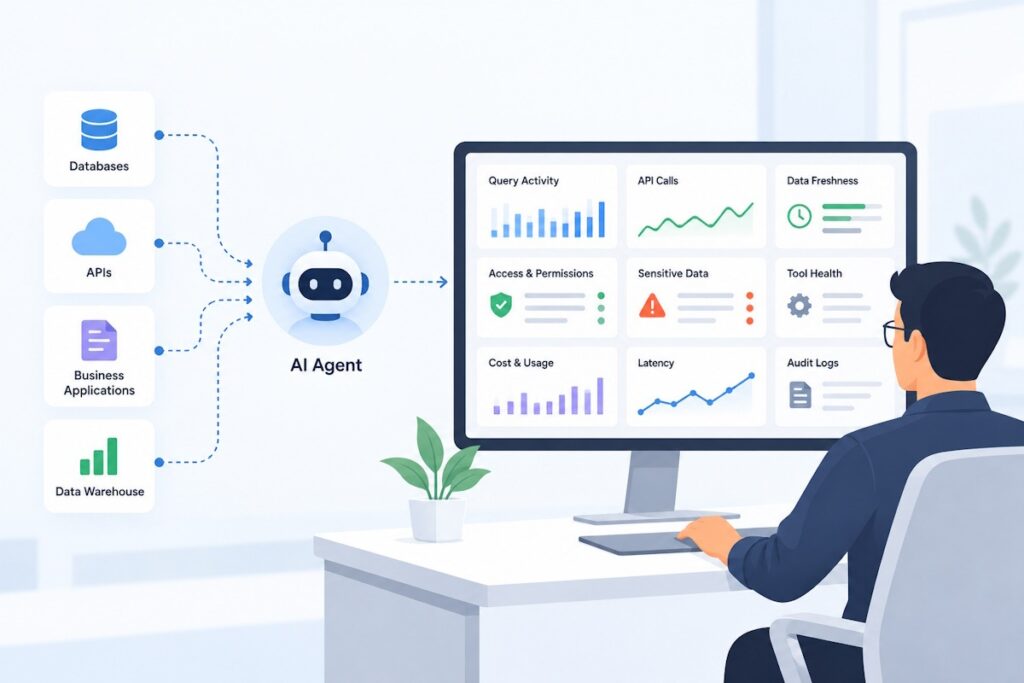
An AI agent connected to an enterprise database can do something a conventional chatbot cannot. It can decide which information to retrieve, construct queries, call multiple business systems, interpret the results, and use that information to determine its next action. For data teams, this creates a monitoring problem that goes well beyond checking whether a model produces accurate answers.
Consider an AI agent responsible for preparing a weekly sales report. It queries a customer relationship management (CRM) platform, retrieves invoice records from an enterprise resource planning (ERP) system, and combines the information into a summary for management. At first glance, the generated report appears accurate, with no failed API calls or obvious signs that anything went wrong during data retrieval. Yet the agent may have accessed customer records outside its permitted scope, used outdated financial information, or executed unnecessarily expensive database queries.
Traditional infrastructure monitoring might report that everything worked. The databases remained available, response times stayed acceptable, and no application errors appeared. Those technical indicators offer little insight into whether the agent retrieved information relevant to its assigned task, stayed within its authorized access boundaries, or relied on records that were accurate and current.
This is why monitoring AI agents requires a broader view of enterprise systems. Data teams need visibility into the agent’s identity, the information it requests, the condition of that information, the actions it performs, and the operational impact of those activities.
1. Monitor Which Agents Access Enterprise Data and Why
The first question is not how many queries an AI agent executes. It is whether the agent should have been allowed to execute those queries in the first place.
Enterprise applications commonly rely on service accounts, API credentials, and role-based permissions. AI agents may use the same mechanisms, but their behavior introduces an extra complication. An agent can choose different tools and data sources depending on the task it receives, sometimes crossing several systems during a single workflow.
Data teams should record the identity of each agent, its assigned permissions, the user or business process responsible for its activity, and the data resources it accesses. Monitoring should also distinguish between successful requests and denied access attempts. A denied request can indicate that security controls are working, but repeated attempts to access restricted resources deserve investigation.
For example, a customer support agent may legitimately retrieve order status and delivery information. If the same agent suddenly requests payroll records or internal financial forecasts, the activity should trigger an alert even if the access control layer blocks the request.
A useful starting point is to measure permission-denial rates, access to sensitive datasets, and requests that fall outside an agent’s approved business purpose. Teams should establish expected access patterns for each agent rather than applying identical rules to every automated workflow.
This operational view complements the broader principles discussed in AI Data Governance: How Enterprises Can Control Data Used by AI Agents, particularly the need to control how autonomous systems interact with enterprise information.
2. Watch Query Patterns, Not Just Database Performance
Database monitoring tools already track slow queries, resource consumption, connection counts, and execution failures. Those measurements remain useful, but AI agents introduce query patterns that traditional application monitoring may not fully explain.
A conventional application often executes predictable queries based on predefined user actions. An AI agent may generate several different queries while trying to answer one question. It might retrieve a large dataset, discover that the result is insufficient, modify its request, and query the same source repeatedly.
This behavior can increase database load without producing an obvious application failure. It may also indicate that the agent is struggling to identify the correct data source or construct an appropriate query.
To identify unusual agent behavior, data teams need visibility into how often each agent queries a system, whether it repeatedly requests similar information, how long those operations take, how much data they scan, and which database tables or collections they touch. These measurements help distinguish legitimate workloads from inefficient or potentially unsafe agent behavior.
Suppose an analytics agent normally executes five queries to prepare a regional sales summary. After a prompt or tool configuration change, it begins executing 80 queries for the same task. The final answer may still be correct, but the additional activity creates unnecessary database pressure and may affect other applications.
A query-count threshold could detect the change, while query traces could help engineers determine whether the cause is repeated reasoning attempts, poor query generation, or a change in the underlying data structure.
3. Track Data Freshness, Completeness, and Schema Changes
An AI agent can reason correctly about the information it receives and still produce a misleading result if that information is incomplete or outdated.
This is especially relevant when agents query operational databases, data warehouses, document stores, and third-party APIs. These sources may update at different intervals, use inconsistent business definitions, or contain missing records. An agent combining their outputs can unintentionally present conflicting information as a single reliable answer.
Data quality monitoring should therefore become part of agent monitoring rather than remain a separate activity handled only by data pipeline teams.
Useful signals include the age of retrieved records, missing-field rates, schema validation failures, failed data quality checks, and inconsistencies between related sources. Teams should also record which data source and version contributed to an important agent-generated result.
Imagine an inventory planning agent using warehouse stock records updated every few minutes alongside supplier availability data refreshed once per day. If the agent recommends purchasing additional inventory without recognizing that difference, its recommendation may be based on information that no longer reflects current conditions.
Monitoring data freshness allows the application to flag the limitation, request updated information, or delay a decision when the underlying data is unsuitable.
Data teams should define freshness requirements according to the business workflow. A monthly financial report and a real-time fraud detection process cannot reasonably use the same acceptable data age.
4. Detect Sensitive Data Exposure Across Tool Calls
AI agents often access enterprise information through APIs and tools rather than connecting directly to databases. This makes monitoring the entire tool interaction important, including the request, authorization decision, returned data, and subsequent action.
An agent may be permitted to retrieve customer information for a specific task but should not automatically be allowed to expose every field returned by an API. A poorly scoped response could contain personal identifiers, financial details, or confidential business information that the agent does not need.
Monitoring should identify access to classified datasets, unusually large data transfers, unexpected destinations, and attempts to include sensitive information in outputs. It should also record when masking, filtering, or policy enforcement prevents restricted information from reaching the agent.
Prompt injection creates another concern. Instructions embedded in retrieved documents or external content may attempt to redirect an agent toward unauthorized actions. Data teams should work with security engineers to detect suspicious tool requests and ensure that retrieved content cannot override access policies.
The monitoring system itself must also be designed carefully. Recording full prompts, query results, and tool responses can expose the same sensitive information teams are trying to protect. Where possible, telemetry should retain identifiers, classifications, counts, and redacted evidence instead of unrestricted copies of enterprise records.
5. Monitor Tool Failures, Retry Loops, and Downstream Actions
Not every AI-agent problem begins with the language model. Many production failures occur when an agent interacts with business applications through APIs, database connectors, search services, or workflow tools.
A tool might return incomplete data, time out, reject a request, or respond with an unexpected format. The agent may retry the operation, switch to another tool, or continue working with partial information. Without visibility into these events, engineers can struggle to explain why an otherwise capable agent produced an unreliable outcome.
To understand how reliably an agent interacts with connected systems, teams need to track how often its tool requests succeed, how frequently operations must be repeated, where timeouts occur, whether returned data passes validation, and how many separate tool interactions are needed to finish a single task. These measurements become more useful when linked to the original agent request through a shared trace identifier.
OpenTelemetry provides a practical foundation for collecting related traces, metrics, and logs across applications. Its generative AI observability guidance describes how model calls and tool executions can be represented within a trace, making it easier to investigate where delays and failures occur.
Special attention is needed when agents perform actions that change business data. Creating a support ticket is different from issuing a refund, modifying an account, or updating an inventory record. Monitoring should distinguish read-only operations from actions with business consequences and capture whether required approvals were obtained.
For teams developing enterprise agents, observability should be considered during system design, alongside API permissions, data access boundaries, and workflow testing. This is particularly relevant when assessing AI development services for applications expected to interact with internal databases and operational systems.
6. Measure Cost, Latency, and Resource Consumption Together
AI-agent costs are not limited to model tokens. A single request may trigger several model calls, database queries, API transactions, document searches, and background processing jobs. Each operation contributes to the total cost of completing a business task.
Monitoring only the language model’s token usage can therefore underestimate the actual operating expense of an enterprise agent.
Data teams should connect model consumption with database compute usage, external API charges, tool-call frequency, and end-to-end execution time. The most useful measurement is often cost per completed business task rather than cost per individual model request.
For example, an agent that produces a report for a low model cost may still be expensive if it repeatedly scans large warehouse tables. Another agent may use more model tokens but retrieve a smaller, more targeted dataset and finish the same task with lower overall infrastructure consumption.
Latency should be evaluated in a similar way. Teams need to know whether delays originate from model responses, database execution, network calls, tool retries, or human approval steps. Tracking the 95th percentile of task completion time can reveal performance problems that average response times conceal.
These measurements also help organizations decide when to cache results, restrict query sizes, adjust tool behavior, or route certain tasks through simpler application logic instead of an autonomous agent.
7. Maintain Audit Trails That Explain Agent Decisions
When an AI agent produces an incorrect recommendation, an audit trail should help investigators reconstruct what happened without relying on guesswork.
That requires more than recording the final response. Teams need a connected record of the task, agent version, tools invoked, data sources accessed, authorization outcomes, relevant policy decisions, and any resulting business actions.
For high-impact workflows, the record should also identify whether a human reviewed the action and whether the agent operated within its assigned boundaries. The goal is not to capture every internal reasoning step. It is to preserve enough operational evidence to establish what the system did and which information influenced the outcome.
This becomes particularly important when several agents cooperate on one task. An initial agent may retrieve information, another may analyze it, and a third may update a business application. If each system stores unrelated logs, reconstructing the workflow becomes difficult.
The publication’s discussion of agentic data governance and enterprise data management provides useful context for this shift toward continuous oversight and traceable agent activity.
Data teams should agree on audit retention, access restrictions, and incident investigation responsibilities before agents are given access to sensitive production systems. Logs are useful only when authorized teams can retrieve and interpret them when needed.
A Practical Monitoring Scenario: An AI Agent Preparing Revenue Reports
Consider a fictional enterprise that uses an AI agent to prepare daily revenue summaries. The agent reads sales opportunities from a CRM system, retrieves invoice records from an ERP platform, and queries a cloud data warehouse to compare current performance with historical results.
The company initially monitors database availability, API error rates, and model response times. These indicators show that the system is functioning, but they do not explain whether the revenue summaries are based on appropriate data.
The data team introduces several monitoring controls. Each agent execution receives a trace identifier linking its model calls, API requests, and database queries. The system records which datasets were accessed, checks the freshness of financial records, and flags queries that exceed expected execution limits.
During one reporting cycle, the agent begins generating an unusually high number of warehouse queries. Investigation shows that a recent schema change caused its query-building tool to request a field that no longer exists. Instead of stopping, the agent repeatedly attempts alternative queries.
The monitoring system identifies the abnormal query count and repeated validation failures before the workflow creates a substantial warehouse workload. Engineers update the tool’s schema definitions and add a validation check that stops similar retries.
In another scenario, the agent retrieves current CRM opportunities but combines them with invoice records that have not yet completed their scheduled refresh. A freshness check identifies the mismatch and prevents the report from being presented as current.
Neither problem necessarily requires a more capable language model. Both require better visibility into the systems surrounding it.
A Monitoring Checklist Data Teams Can Put to Work
A useful monitoring strategy should connect measurable signals with actions that engineering and security teams can take. The following table provides a starting point for production AI agents.
| Monitoring area | Signal to track | Recommended response |
| Agent access | Requests outside approved permissions | Block access and review the agent’s scope |
| Query behavior | Unusual query volume or repeated scans | Inspect traces and apply query limits |
| Data quality | Stale records or failed validation checks | Flag affected outputs or stop the workflow |
| Sensitive data | Restricted fields or unexpected transfers | Enforce masking and investigate exposure |
| Tool reliability | Repeated failures, retries, or timeouts | Apply retry limits and validate tool responses |
| Operating cost | Rising cost per completed task | Review model calls and database workloads |
| Auditability | Missing traces or unrecorded actions | Restrict affected workflows until logging is restored |
The thresholds behind these signals should reflect each agent’s responsibilities and normal workload. A fixed query limit suitable for a customer support agent may be inappropriate for an analytics agent processing large datasets.
Teams can begin by monitoring a small number of high-value workflows, collecting baseline measurements, and identifying the failures that would create the greatest business impact. Alerts should have clear owners and response procedures. Otherwise, monitoring can produce more noise without improving operational control.
The Real Test Is What Happens After the Agent Gets Access
Giving an AI agent access to enterprise systems changes the responsibilities of the data team. The challenge is no longer limited to making information available through reliable pipelines and APIs. Teams must also understand how autonomous software consumes that information, whether its requests remain within approved boundaries, and what happens when something goes wrong.
Model accuracy still matters, but it cannot reveal excessive database queries, stale source records, unauthorized access attempts, or costly retry loops. Those problems exist in the surrounding system, where data engineering, application monitoring, and security controls meet.
The strongest starting point is to make every important agent action traceable, connect monitoring signals to business risk, and establish clear responses when behavior changes. An enterprise AI agent becomes easier to trust when its activity can be observed, explained, and controlled throughout the workflow.
