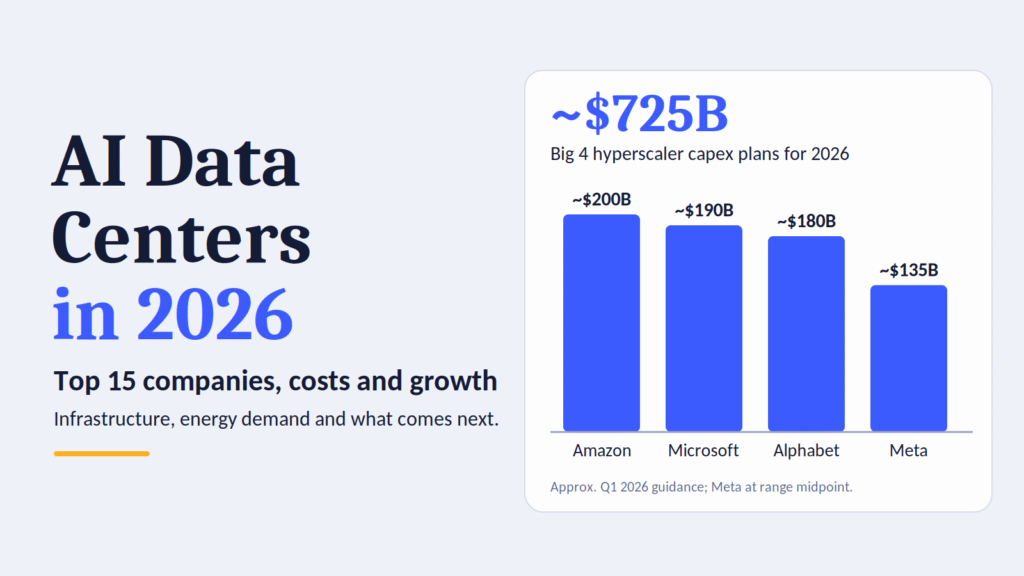
Four companies are planning to spend roughly the equivalent of a mid-sized country’s economy on computer buildings this year.
Amazon, Alphabet, Meta and Microsoft collectively plan around $725 billion of capital expenditure in 2026, up 77% from last year’s record of roughly $410 billion. Most of that money goes into GPU clusters, custom chips, power, and the buildings that hold them. aiweekly
That is the scale of the AI data center market in 2026. This guide explains what an AI data center is, how it differs from a traditional one, who the 15 most important companies are, what it costs to build one, how much electricity they use, and where the industry goes next.
A note on numbers: this market moves fast, and many figures are company guidance or analyst estimates rather than audited results. Treat them as directional, and check primary sources before using them in investment or procurement decisions.
What Is an AI Data Center?
An AI data center is a facility designed to train and run artificial intelligence models at scale. It houses thousands to hundreds of thousands of GPUs or other accelerators, connected by very fast networks, with power and cooling systems built for extreme density.
A traditional data center runs websites, databases, and business software on general-purpose servers. A GPU data center built for AI is a different machine.
| Feature | Traditional data center | AI data center |
|---|---|---|
| Main processors | CPUs | GPUs, TPUs, custom accelerators |
| Rack power density | Low to moderate | Very high |
| Cooling | Mostly air | Increasingly liquid cooling |
| Networking | Standard Ethernet | High-bandwidth, low-latency fabrics |
| Workload | Many small, independent tasks | Large, tightly coupled training and inference jobs |
| Capacity measured in | Square feet, racks | Megawatts and gigawatts |
| Typical constraint | Space and connectivity | Power availability |
That last row is the key. In AI infrastructure, the limiting factor is increasingly electricity, not floor space. That is why capacity is now described in gigawatts, and why the companies that secure power early hold a real advantage.
Training vs inference
AI workloads fall into two types:
- Training: building a model from massive datasets. It needs huge clusters working together for weeks or months, often in one giant campus.
- Inference: running a trained model to answer real user requests. It happens continuously, at scale, and often benefits from being closer to users. Inference is expected to drive a growing share of demand as AI products reach more people.
The AI Data Center Market in 2026: Key Numbers
Here are the numbers that define the market this year.
Spending is enormous and still rising. The big four hyperscalers’ 2026 plans are about $725 billion. Amazon is guiding to about $200 billion, Microsoft near $190 billion, Alphabet at $175 to $185 billion, and Meta at $115 to $135 billion, though Meta has since raised its range, with full-year 2026 capex guidance moving to $125 to $145 billion, citing higher component and data center costs. aiweeklyYahoo Finance
Analysts expect more. Evercore and Bank of America now project combined big tech capex will exceed $1 trillion in 2027. aiweekly
Demand still exceeds supply. Microsoft said it will stay “capacity constrained” through 2026, even after spending $190 billion. beehiiv
Cash flow is feeling the strain. Free cash flow has dropped at several of the biggest spenders as capex has risen. One analysis found Amazon’s trailing twelve-month free cash flow fell from $26 billion a year earlier to $1.2 billion, with Microsoft’s down 22 percent and Alphabet’s down 38 percent. That is a risk factor worth watching. om
The wider picture. Moody’s has projected about $3 trillion in global data center spending over the next five years, according to one industry report, though power grid infrastructure cannot be built at the same pace.
Top 15 AI Data Center Companies in 2026
The market includes cloud giants, AI labs building their own campuses, specialized “neocloud” GPU providers, and traditional data center operators. This list groups them by role. It is not a strict ranking, because companies are measured differently (capex, megawatts, revenue, or contracted power).
Hyperscalers
1. Amazon Web Services (AWS)
The largest cloud provider and the largest planned 2026 spender among the big four. Amazon has announced $15 billion for new AI-optimized data center campuses in Northern Indiana, contributing 2.4 GW of additional capacity. AWS also builds its own AI chips, which helps control costs and reduce dependence on a single supplier. blackridgeresearch
2. Microsoft
Microsoft runs Azure and powers much of OpenAI’s compute. Its Fairwater site in Wisconsin was described as the world’s most powerful AI data center, and will scale to two gigawatts. Microsoft’s 2026 capex plan is near $190 billion. nasdaq
3. Google (Alphabet)
Google combines Google Cloud, its own TPU chips, and Gemini models. Alphabet’s quarterly capex more than doubled year over year to $35.67 billion in Q1, with Google Cloud backlog above $460 billion. Its full-stack approach, from chips to models, is a major differentiator. Yahoo Finance
4. Meta
Meta builds data centers primarily for its own AI, including training and serving models across its apps. Its largest project is the Hyperion campus in Richland Parish, Louisiana, a $27 billion joint venture with funds managed by Blue Owl Capital, designed for up to 2 GW. blackridgeresearch
5. Oracle
Oracle has become a major AI infrastructure provider through its cloud and its role in the Stargate initiative. OpenAI, Oracle, and SoftBank announced five new U.S. Stargate sites, accelerating a push toward 10 gigawatts of AI computing capacity. convergedigest
AI-native and neocloud providers
6. CoreWeave
The best-known neocloud, renting GPU capacity to AI labs and enterprises. It operated 1 GW of active capacity across 49 data centers in Q1 2026, expects 1.7 GW by the end of 2026, and targets 8 GW by 2030. The trade-off: rapid growth comes with heavy capital needs and widening losses. fool
7. Nebius
A fast-growing AI cloud provider. Nebius expects 2026 capex of $30 billion to $35 billion and plans to double active power capacity to more than 1.7 GW, with over 3.1 GW contracted. finviz
8. Crusoe
Crusoe develops AI-focused campuses with an emphasis on finding energy for them, and it is associated with the flagship Stargate site in Abilene, Texas. Its model highlights how energy access is now central to AI infrastructure strategy.
9. Lambda
Lambda provides GPU cloud services to developers and enterprises. It has been expanding its physical footprint, including a retrofit and build in an unoccupied data center in Kansas City, Missouri. structureresearch
AI labs building their own infrastructure
10. xAI
xAI’s Colossus complex in Memphis is among the largest single AI training sites. Reports describe expansion to about 2 GW total capacity with over 555,000 NVIDIA GPUs, supported by on-site gas-fired generation. Treat this as a reported estimate, as the company does not always disclose figures independently. introl
Data center operators and developers
11. Equinix
The global colocation and interconnection leader. Equinix aims to double its data center capacity by 2029, with most of that new inventory in major markets, betting that AI inference needs proximity to users and networks. bisnow
12. Digital Realty
A leading data center REIT. It has 5 GW of large, contiguous blocks across 40 metro areas slated to come online, mostly in 2026 and 2027. Together, Equinix and Digital Realty operate close to 600 data centers worldwide. bisnow
13. QTS (Blackstone)
A major hyperscale data center developer owned by Blackstone. It reflects the growing role of private capital in funding the build-out.
14. Vantage Data Centers
A hyperscale-focused developer building very large campuses for cloud and AI customers, backed by institutional investors.
Chips and systems
15. NVIDIA
NVIDIA is not a data center operator, but it is arguably the most influential company in the AI infrastructure stack. Its GPUs and networking products sit inside most large AI facilities, and its supply decisions shape how fast the industry can grow. AMD is the main challenger, with data center growth reported above 60% annually and multi-year deals with Meta and OpenAI.
Quick comparison
| Company | Type | 2026 highlight |
|---|---|---|
| AWS | Hyperscaler | About $200B capex plan; 2.4 GW Indiana expansion |
| Microsoft | Hyperscaler | About $190B capex; Fairwater scaling to 2 GW |
| Hyperscaler | Q1 capex above $35B; cloud backlog above $460B | |
| Meta | Hyperscaler | $125B to $145B capex; Hyperion up to 2 GW |
| Oracle | Hyperscaler and Stargate partner | Major role in Stargate sites |
| CoreWeave | Neocloud | 1 GW active, 1.7 GW targeted by end of 2026 |
| Nebius | Neocloud | $30B to $35B capex; 3.1 GW+ contracted |
| Crusoe | AI infrastructure developer | Energy-focused AI campuses |
| Lambda | GPU cloud | Expanding physical sites |
| xAI | AI lab | Colossus reported near 2 GW |
| Equinix | Operator | Plans to double capacity by 2029 |
| Digital Realty | Operator | 5 GW pipeline across 40 metros |
| QTS | Developer | Blackstone-backed hyperscale |
| Vantage | Developer | Large hyperscale campuses |
| NVIDIA | Chips and systems | Core GPU and networking supplier |
Inside AI Data Center Infrastructure
Understanding the building blocks explains why costs and timelines look the way they do.
1. Compute
GPUs and custom accelerators do the heavy lifting. They are packaged into servers and racks, then linked into clusters. Chip supply, memory availability, and component pricing all affect build schedules. Both Meta and Microsoft cited component pricing as a reason for raising their 2026 capex plans.
2. Networking
AI training requires thousands of chips to exchange data constantly. Specialized high-bandwidth, low-latency networks keep them in sync. A weak network wastes expensive GPU time.
3. Power
Power infrastructure includes grid connections, substations, transformers, backup generation, and batteries. Getting electricity to the site is often the longest and least predictable part of a project. Hyperscalers have turned to owned generation solutions, including nuclear (Microsoft, Google), geothermal (Google and Fervo), and dedicated solar and wind farms. datacentres
4. Cooling
AI racks produce far more heat than traditional ones. Liquid cooling, using direct-to-chip systems or immersion, is increasingly common. It can raise upfront costs but often improves efficiency over time.
5. Storage and data pipelines
Training needs fast access to enormous datasets. High-performance storage and data pipelines keep GPUs fed.
6. Physical and operational layer
Land, buildings, fire safety, security, water access, fiber connectivity, and skilled staff round out the picture. Local permitting and community opposition can also delay projects.
How Much Does an AI Data Center Cost?
Cost depends heavily on what you count. A building without computers is one thing. A fully equipped AI campus is another.
Facility cost per megawatt
- Standard shell and core: JLL’s 2026 outlook puts global average construction costs at $11.3 million per megawatt, up from $10.7 million in 2025 and $7.7 million in 2020. coradvisors
- AI-optimized facilities: one industry guide says they typically cost $20 million or more per MW, before the GPUs and IT equipment inside. gigaenergy
- All-in with IT equipment: Bank of America has estimated $49 million per megawatt, with IT-related expenses accounting for 78% of total spending, and about $57 million per megawatt for AI-specialized “neocloud” facilities. st-hakky
These ranges look inconsistent because they measure different things. The pattern is the same, though: the building is the smaller part of the bill, and the chips are the larger part.
A one-gigawatt example
Epoch AI’s May 2026 model estimates a 1 GW AI data center carries $38 billion in upfront capex and $0.9 billion in annual operating cost, with about 60% of annualized cost going to servers and GPUs rather than the facility. axis-intelligence
Where the money goes
| Cost area | What it covers | Why it matters |
|---|---|---|
| GPUs and servers | Accelerators, memory, systems | Largest share of total spend |
| Electrical systems | Substations, transformers, distribution | Often 40% to 50% of construction cost, per one industry guide |
| Cooling | Air, liquid, heat rejection | Rising with rack density |
| Networking | Switches, optics, cabling | Critical for cluster performance |
| Land and permitting | Sites, approvals, interconnection | Highly variable by location |
| Operations | Power, staff, maintenance | Ongoing, scales with capacity |
What this means for businesses that are not hyperscalers
Most companies will not build their own AI data center. They will rent capacity, so the cost pressure shows up in cloud and GPU pricing, long-term capacity contracts, and availability. If you are managing AI spend, see our guide to AI FinOps and reducing cloud and LLM costs.
AI Data Center Energy Consumption
Electricity is now the defining constraint of the industry.
Current and projected demand
The International Energy Agency (IEA) estimates global data center electricity use at 485 TWh in 2025, rising to 945 TWh in 2030 under its Base Case. That would be just under 3% of projected global electricity consumption that year. The IEA’s 2026 update shifted that 2030 figure slightly to about 950 TWh, so check which edition any source quotes. ae-solarletsdatascience
Gartner, using a different baseline, forecasts global data center electricity demand jumping 26.4% in 2026, to 565 TWh from 447 TWh in 2025, and expects AI-optimized servers to account for 31% of data center power consumption this year. freepressjournal
The different starting numbers show why you should always check methodology. Forecasters disagree on exactly what counts, but they agree on direction: demand is climbing fast, and AI is the main driver.
Why it matters beyond the headline
Three issues sit behind the national totals:
- Local grid strain. Data centers cluster in specific regions, so their impact on local grids is much larger than their share of national demand.
- Speed mismatch. Chips can be installed in months, while grid upgrades and new generation can take years.
- Announced vs actual capacity. One analysis found that of 16 GW announced for delivery in 2026, only about 5 GW was actively under construction. Power-secured capacity is a more reliable signal than announcements.
How the industry is responding
- Nuclear and geothermal deals for firm, low-carbon power.
- On-site generation such as gas turbines, which is faster but draws environmental scrutiny.
- Efficiency gains from better chips, liquid cooling, and software optimization.
- Heat reuse, for example Meta’s Odense, Denmark facility heating thousands of homes.
- Flexible load strategies that shift non-urgent work to times when power is abundant.
Risks and Challenges
Overbuild risk. Spending guidance keeps rising, but returns on AI investment are still being proven. Some analysts warn that if demand growth slows, parts of the build-out could be underused. Investors have already shown sensitivity: Meta’s shares fell sharply after it raised its spending guidance.
Power and grid limits. Without enough electricity, even fully funded projects stall.
Supply chain constraints. Chips, memory, transformers, and skilled labor remain tight in many markets.
Financing and debt. As free cash flow tightens, more projects rely on bonds, joint ventures, and private capital. That adds financial risk if conditions change.
Rapid hardware obsolescence. As one analysis put it, the chips may be outdated before they are fully depreciated, while the buildings last decades. That creates a mismatch in how investments are valued.
Community and environmental concerns. Water use, noise, land use, and local electricity prices are drawing growing public attention and regulatory scrutiny.
Geopolitics and regulation. Export controls, data sovereignty rules, and energy policy all shape where and how capacity gets built.
Future Growth: What to Expect Next
Gigawatt campuses become normal. Single sites measured in gigawatts, once unusual, are now routine in announcements.
Inference grows in importance. As more AI products reach consumers and businesses, always-on inference will account for a larger share of demand, pushing capacity closer to users and into established metro markets.
Power-first site selection. Developers will keep choosing locations by electricity availability, not proximity to cities.
More custom silicon. Hyperscalers will continue building their own chips to manage cost and supply risk, even as NVIDIA stays dominant.
Private capital steps in. Joint ventures, infrastructure funds, and long-term leases will increasingly finance the build-out.
Sovereign AI infrastructure. Governments are backing national AI capacity, which supports growth in regions beyond the US and China, including the Gulf and parts of Europe and Asia.
Efficiency pressure. Higher costs push operators toward better cooling, modular construction, and smarter workload scheduling.
Consolidation and shake-out. In a capital-intensive race, some smaller players will partner, merge, or struggle. Contracted demand and secured power will separate strong operators from weak ones.
Frequently Asked Questions
What is an AI data center?
An AI data center is a facility built to train and run AI models, using large numbers of GPUs or other accelerators, high-speed networking, and power and cooling systems designed for very dense workloads.
Which companies lead the AI data center market in 2026?
The biggest are the hyperscalers: Amazon, Microsoft, Google, Meta, and Oracle. Neocloud providers such as CoreWeave and Nebius, operators such as Equinix and Digital Realty, AI labs like xAI, and chip suppliers like NVIDIA also play central roles in the AI infrastructure companies landscape.
How much do the biggest companies spend on AI data centers?
Amazon, Alphabet, Meta, and Microsoft collectively plan roughly $725 billion of capital expenditure in 2026, mostly for AI infrastructure. Analysts project the total could exceed $1 trillion in 2027.
How much does it cost to build an AI data center?
Standard construction averages around $11.3 million per megawatt, AI-optimized facilities often exceed $20 million per megawatt, and fully equipped AI campuses cost far more once GPUs and networking are included. One research estimate puts a 1 GW AI data center at about $38 billion upfront.
How much electricity do data centers use?
The IEA estimates about 485 TWh in 2025, rising to roughly 945 to 950 TWh by 2030, just under 3% of global electricity. Estimates vary by source and methodology.
Why is power the main bottleneck?
Chips and buildings can be delivered relatively quickly, but grid connections, substations, and new generation take much longer. AI racks also use far more electricity than traditional servers, so securing power determines where and when capacity can come online.
What is a neocloud?
A neocloud is a cloud provider focused specifically on AI and GPU workloads, such as CoreWeave, Nebius, Lambda, or Crusoe. They rent AI computing capacity to labs and enterprises, often alongside the major hyperscalers.
Is there an AI data center bubble?
Reasonable analysts disagree. Demand and revenue are growing quickly and capacity remains constrained, but spending is also rising faster than free cash flow at several major companies. Risks include overbuilding, financing strain, and uncertain long-term returns. The honest answer is that outcomes depend on how fast real AI revenue grows relative to the investment.
How can businesses benefit without building their own data center?
Most businesses rent capacity from cloud providers or neoclouds, and the key skill is managing cost and performance. Careful model selection, caching, and usage monitoring can reduce spending significantly.
Conclusion
AI data centers have moved from a technical backdrop to a central economic story in 2026. The biggest tech companies are spending hundreds of billions of dollars, specialized neoclouds are scaling at remarkable speed, and electricity has become the true bottleneck.
For readers trying to make sense of it all, a few points matter most:
- Scale is unprecedented. About $725 billion in planned 2026 hyperscaler capex, with projections above $1 trillion for 2027.
- The chips dominate the cost. Buildings cost billions, but the GPUs and servers inside cost even more.
- Power decides who wins. Companies with secured, reliable electricity can build faster than those without.
- Risks are real. Cash flow pressure, financing needs, grid limits, and the possibility of overbuilding all deserve attention.
- Growth is likely to continue. Even with risks, demand for AI computing remains strong, and capacity is still described as constrained.
Whether you invest, build, buy cloud services, or simply follow the industry, tracking power, contracted demand, and real revenue growth will tell you more than headline announcements.
