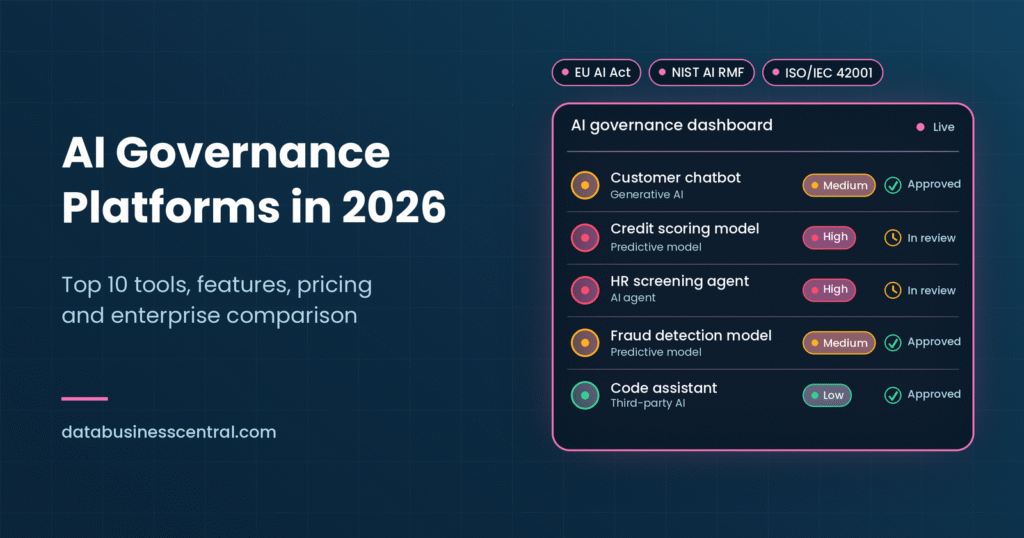
Two years ago, most companies handled AI risk with a spreadsheet, a policy PDF and good intentions. In 2026 that approach is breaking down. Employees use dozens of AI tools. Business units are deploying AI agents that take real actions. Regulators in the EU, the US and elsewhere are asking for evidence, not promises. And boards want a straight answer to a simple question: where is AI being used in our company, and is it under control?
That is the job of AI governance platforms. They give organizations a central place to inventory AI systems, assess risk, apply policies, test and monitor models, and produce audit-ready evidence.
This guide compares the top 10 platforms, explains the features that matter, breaks down how pricing works, and gives you a practical framework for choosing among AI governance tools for enterprise AI risk management and compliance.
Quick Answer: What Are the Best AI Governance Platforms in 2026?
- Gartner’s first Magic Quadrant for AI Governance Platforms (published June 2026) assessed 13 vendors. IBM, ServiceNow and Truyo were named Leaders. Credo AI, OneTrust, ModelOp, Monitaur and Airia were Visionaries, and Holistic AI was the Challenger.
- Best for IBM-centric and regulated enterprises: IBM watsonx.governance.
- Best for ServiceNow customers: ServiceNow AI Control Tower.
- Best for policy-driven governance across many AI systems: Credo AI.
- Best for privacy and GRC teams: OneTrust AI Governance or Truyo.
- Best for testing and bias evidence: Holistic AI.
- Best for model operations and lifecycle control: ModelOp or Monitaur.
- Best for governing agents at runtime: Airia and ServiceNow, among others.
- Pricing: Most vendors use custom quotes. Expect contracts based on the number of AI systems, users or modules, plus implementation costs.
1. What Are AI Governance Platforms?
An AI governance platform is software that helps an organization manage the risks, compliance obligations and accountability of its AI systems across their lifecycle, from idea to retirement. Vendors also describe their products as responsible AI software, AI risk platforms or AI compliance platforms.
A good platform answers questions such as:
- What AI systems, models and agents do we have, including those bought from vendors?
- Which ones are high risk, and why?
- Which laws, standards and internal policies apply to each?
- Have we tested for bias, accuracy, security and safety?
- Who approved this system, and what evidence do we have?
- What is it doing in production right now?
How governance platforms differ from related tools
| Tool type | Main focus | How it relates to AI governance |
|---|---|---|
| AI governance platform | Inventory, risk, policy, compliance evidence, accountability | The central control layer |
| MLOps platform | Building, deploying and managing models | Supplies technical data governance tools can use |
| AI observability and monitoring | Performance, drift and behavior of live models | Often a feature or integration inside governance platforms |
| Data governance and catalog tools | Data quality, lineage and access | Provides the data foundation for AI governance |
| GRC and privacy tools | Enterprise risk, controls and privacy compliance | Many AI governance products extend these |
| AI security tools | Defending models and agents from attacks | Complements governance, which sets the rules |
Governance is not the same as security or monitoring. It is the layer that connects policies, people and evidence.
2. Why AI Governance Platforms Matter in 2026
Regulation is real and fragmented
Organizations face a patchwork of rules. A summary of the main ones:
| Rule or framework | Region | Why it matters |
|---|---|---|
| EU AI Act | EU | Risk-based rules for AI systems. A 2026 amendment package postponed many high-risk deadlines (to December 2027 for stand-alone systems and August 2028 for those embedded in products), but several obligations, including many transparency duties, still apply from August 2026 |
| NIST AI Risk Management Framework | US (voluntary) | Widely used playbook for identifying and managing AI risk |
| ISO/IEC 42001 | Global | Certifiable standard for an AI management system |
| US state laws | US states | A growing patchwork, including laws in Colorado and Texas; effective dates and scope are changing, so check current status |
| Sector rules | Industry-specific | Examples include model risk guidance for banks and rules for health data and employment decisions |
Federal policy in the US has been shifting, which makes it harder to plan around a single rule set. A governance platform helps you map each AI system to whichever rules apply and adapt as they change.
AI agents raise the stakes
Older governance focused on a handful of predictive models. Today, companies deploy generative AI assistants and autonomous agents that read data, call tools and act on behalf of employees. That creates new questions about identity, permissions and runtime behavior. If a platform cannot see what an agent actually does, it governs paperwork about AI rather than AI itself.
Shadow AI is everywhere
Employees adopt AI tools faster than IT can approve them. Discovery features that find unapproved models, tools and agents have become a headline capability.
Boards and customers want proof
Large customers increasingly ask suppliers for AI governance evidence in security questionnaires and contracts. Insurers and auditors are asking as well.
The market has matured
In June 2026, Gartner published its first Magic Quadrant for AI Governance Platforms, evaluating 13 vendors out of more than 100 claiming the space. Coverage of the report also cites Gartner sizing the platform market at tens of millions of dollars in 2024, growing past $1 billion by 2030. Treat market-size figures as estimates, but the direction is clear: this has become an established software category.
3. Core Features to Look For
When comparing AI compliance solutions, these are the capabilities that separate serious platforms from thin ones.
Must-have features
- AI inventory and registry. A single system of record for models, applications and agents, including third-party and embedded AI.
- Discovery. Automated detection of AI use across cloud, code, SaaS tools and agents, so you are not relying on self-reporting.
- Risk assessment and classification. Templates and workflows that tier systems by risk and capture impact assessments.
- Policy and regulatory mapping. Prebuilt content for frameworks such as the EU AI Act, NIST AI RMF and ISO/IEC 42001, mapped to your controls.
- Workflows and approvals. Intake, review and sign-off steps before AI goes to production.
- Testing and evaluation. Bias, fairness, accuracy, robustness and safety testing, with evidence retained.
- Runtime monitoring and controls. Ongoing monitoring of live behavior, drift and policy violations, ideally with enforcement.
- Agent governance. Visibility into agents, their identities, permissions, tools and connections.
- Audit trails and evidence packs. Exportable records showing who decided what, when and why.
- Integrations. Connections to cloud platforms, MLOps tools, data catalogs, identity systems, ticketing and GRC.
- Reporting. Dashboards for executives, risk teams and regulators.
Nice-to-have features
- Third-party AI vendor risk assessments
- Cost and ROI tracking per AI system
- Training and attestation modules for employees
- Regulatory change alerts
- Model cards and documentation generation
- Insurance or financial protection programs offered by some vendors
Questions that reveal real depth
- Does it enforce policy at runtime or only document it?
- Can it govern AI we buy, not just AI we build?
- How are framework mappings maintained when laws change?
- Can you export all evidence if you leave?
4. Top 10 AI Governance Platforms in 2026
The following shortlist draws on analyst placements, vendor documentation and independent comparisons. The order is not a strict ranking, because the best choice depends on your stack and priorities. Details change quickly, so confirm current features and pricing with each vendor.
1. IBM watsonx.governance
- Analyst placement: Leader, Gartner Magic Quadrant for AI Governance Platforms (June 2026), according to IBM and coverage of the report.
- Best for: Large, regulated enterprises, especially those already invested in IBM or running hybrid cloud.
- Strengths: Mature lifecycle documentation, model risk workflows, automated fact sheets and mappings to frameworks such as the EU AI Act, NIST AI RMF and ISO/IEC 42001. IBM states it can govern models from other providers as well as its own.
- Watch-outs: Teams outside the IBM ecosystem may find integration effort heavy.
- Pricing: One of the few dedicated platforms that publishes some pricing, including a free trial and entry tiers. Reported figures vary by plan and source, from low monthly tiers to larger annual marketplace listings, so check IBM’s current pricing page.
2. ServiceNow AI Control Tower
- Analyst placement: Leader, Gartner Magic Quadrant (June 2026).
- Best for: Organizations that already run IT and enterprise workflows on ServiceNow.
- Strengths: Treats AI like any other managed enterprise asset, with inventory, approvals and workflows tied to its CMDB and operations platform. ServiceNow positions it around discovering AI agents, models and related connections and monitoring runtime performance.
- Watch-outs: Value is highest if ServiceNow is already your backbone.
- Pricing: Enterprise licensing, not published.
3. Credo AI
- Analyst placement: Visionary, Gartner Magic Quadrant (June 2026). The company also reports a Leader position in the Forrester Wave for AI Governance Solutions, Q3 2025.
- Best for: Enterprises that want a purpose-built governance control plane across many AI systems, including agents.
- Strengths: Central registry, policy packs and compliance mapping across major frameworks, and a policy-to-controls approach that appeals to legal and compliance teams.
- Watch-outs: Less embedded in infrastructure workflows than ServiceNow or IBM, so integrations matter.
- Pricing: No public pricing. Reported to be structured around the number of AI use cases or models governed, typically on annual contracts.
4. OneTrust AI Governance
- Analyst placement: Visionary, Gartner Magic Quadrant (June 2026).
- Best for: Organizations already using OneTrust for privacy, risk or GRC.
- Strengths: Extends existing privacy and compliance workflows to AI, with a unified asset inventory and mappings to major frameworks.
- Watch-outs: Less differentiated for buyers who do not already run OneTrust.
- Pricing: Custom quotes. Reported cost drivers include admin users and inventory size.
5. Truyo
- Analyst placement: Leader, Gartner Magic Quadrant (June 2026).
- Best for: Teams whose AI governance challenge starts as a privacy, consent and data rights problem.
- Strengths: AI inventory, impact and risk assessments, audit-ready evidence, regulatory change tracking and configurable workflows, alongside privacy tooling. Truyo is the smallest of the three Leaders, which can mean closer vendor attention but a narrower footprint.
- Watch-outs: Confirm depth of integration with your AI stack and runtime coverage.
- Pricing: Not publicly listed.
6. Holistic AI
- Analyst placement: Challenger, Gartner Magic Quadrant (June 2026).
- Best for: Organizations that need strong bias, fairness and robustness testing, and evidence for audits.
- Strengths: Shadow AI discovery, automated testing and continuous monitoring, with an emphasis on technical risk evidence.
- Watch-outs: Evaluate fit for broader enterprise workflow needs.
- Pricing: Not publicly listed.
7. ModelOp Center
- Analyst placement: Visionary, Gartner Magic Quadrant (June 2026).
- Best for: Enterprises that want a system of record covering the full AI lifecycle, from intake to retirement.
- Strengths: Embedded governance, a continuous audit trail and extension into runtime behavior, cost and value tracking. Independent coverage highlighted its agent governance capabilities.
- Watch-outs: Strong on operations, so confirm legal and policy content meets your needs.
- Pricing: Not publicly listed.
8. Monitaur
- Analyst placement: Visionary, Gartner Magic Quadrant (June 2026).
- Best for: Regulated industries such as insurance and financial services.
- Strengths: Control libraries mapped to frameworks and sector rules, and one inventory across predictive, generative, agentic and third-party AI, according to the vendor.
- Watch-outs: Smaller vendor, so check scale and integrations.
- Pricing: Not publicly listed.
9. Airia
- Analyst placement: Visionary, Gartner Magic Quadrant (June 2026).
- Best for: Organizations that want governance built into how agents are built and run, with in-line controls.
- Strengths: Runtime controls, including a gateway for agent tool connections based on the Model Context Protocol, plus continuous monitoring. Founded in 2024, so it is a newer entrant.
- Watch-outs: Younger company, so evaluate maturity and references.
- Pricing: Not publicly listed.
10. Microsoft Purview and Azure AI governance tooling
- Analyst placement: Not among the 13 vendors in the June 2026 Magic Quadrant. Included here because many enterprises will evaluate it first.
- Best for: Organizations standardized on Microsoft 365 and Azure, especially for data protection and employee use of AI.
- Strengths: Native integration with Microsoft data, security and compliance tooling, including controls for sensitive data in AI interactions.
- Watch-outs: Focused on the Microsoft ecosystem. Cross-cloud and non-Microsoft AI may need other tools.
- Pricing: Typically bundled into Microsoft licensing tiers and add-ons, so check your agreement.
Also worth knowing
Other vendors named in the Magic Quadrant include SAP, Cranium AI, Relyance AI and Saidot. Collibra, DataRobot, Dataiku and specialized monitoring vendors also play roles, particularly where data catalogs or MLOps platforms are the starting point.
Side-by-side comparison
| Platform | Gartner placement (June 2026) | Best for | Standout strength | Pricing approach |
|---|---|---|---|---|
| IBM watsonx.governance | Leader | IBM and hybrid cloud enterprises | Lifecycle documentation and model risk | Some published tiers; custom for large deals |
| ServiceNow AI Control Tower | Leader | ServiceNow customers | Workflow and CMDB integration | Enterprise licensing |
| Truyo | Leader | Privacy-led governance | Privacy plus AI governance | Not published |
| Credo AI | Visionary | Cross-cloud governance programs | Policy packs and registry | Custom, often per use case |
| OneTrust | Visionary | Existing OneTrust customers | Privacy and GRC integration | Custom quote |
| ModelOp | Visionary | Lifecycle system of record | Continuous audit trail | Not published |
| Monitaur | Visionary | Regulated industries | Sector-specific control libraries | Not published |
| Airia | Visionary | Agent builders and operators | In-line runtime controls | Not published |
| Holistic AI | Challenger | Testing and bias evidence | Automated risk testing | Not published |
| Microsoft Purview | Not in the MQ | Microsoft-centric organizations | Native data protection | Bundled or add-on |
5. AI Governance Platform Pricing: What to Expect
Pricing is the most frustrating part of buying in this category. Most vendors do not publish rates, and those that do usually cover only entry tiers.
Common pricing models
| Model | How it works | Watch for |
|---|---|---|
| Per AI system or use case | You pay based on how many models, applications or agents you govern | Costs rise as your inventory grows, so define what counts as a system |
| Per user or seat | Priced by administrators, risk owners or reviewers | Wide business user access can raise the bill |
| Per module | Separate prices for inventory, testing, monitoring and compliance | Core capabilities may be sold as add-ons |
| Usage or resource units | Metered by activity or resources consumed | Harder to forecast |
| Platform bundle | Included in a larger suite such as GRC, ITSM or cloud licensing | Confirm what is truly included |
| Enterprise agreement | Negotiated annual contract | Multi-year terms and implementation fees are common |
What actually drives cost
- Number of AI systems and agents in scope
- Number of business units and users
- Modules and frameworks required
- Integrations and data volumes
- Deployment model (SaaS, private cloud or on-premises)
- Support level and implementation services
- Contract length
What published prices look like
IBM is the exception among dedicated platforms, offering a trial and published entry tiers, though figures reported by comparison sites vary depending on plan and date. For nearly everyone else, comparison sites report “custom quote” or “contact sales.” Enterprise buyers should expect annual commitments, with implementation and integration work adding to the first-year total. Always request a written quote based on your actual inventory.
Hidden costs to budget for
- Implementation and integration. Connecting to cloud, data and identity systems takes engineering time.
- Internal staffing. Someone must own the program, review risk assessments and maintain policies.
- Content and framework updates. Confirm whether regulatory updates are included.
- Training and change management. Platforms fail when teams do not use them.
- Additional security or monitoring tools. Governance does not replace them.
- Exit costs. Ask about data export if you switch vendors.
How to negotiate
Start with a limited scope and a defined number of high-risk systems. Ask for a pilot, price protection on growth and clear definitions of billing units. Compare total cost of ownership over three years, not just the first-year license.
6. Enterprise AI Risk Management: How Platforms Fit Into the Bigger Picture
Software alone does not govern AI. Enterprise AI risk management needs people, process and tools working together.
The governance operating model
| Layer | What it covers | Typical owners |
|---|---|---|
| Strategy and policy | AI principles, risk appetite, acceptable use | Executive team, AI governance committee |
| Risk and compliance | Risk tiering, assessments, regulatory mapping | Risk, legal and compliance |
| Technical controls | Testing, monitoring, access and security | Data science, engineering, security |
| Data foundation | Quality, lineage, privacy and access | Data governance team |
| Operations | Intake, approvals, incident response, reporting | AI program office |
| Assurance | Independent review and audit | Internal audit |
A strong data foundation matters most. If you cannot trust the data feeding an AI system, no platform can make its outputs trustworthy. Our guide to building a data governance framework covers that foundation.
Risk tiering in practice
Most programs sort AI use cases into tiers:
- Low risk: Internal productivity tools with no sensitive data. Light review.
- Medium risk: Customer-facing assistants or analytics affecting business decisions. Standard testing and monitoring.
- High risk: Systems affecting credit, employment, health, safety or legal rights. Full assessment, human oversight and ongoing evidence.
Governance platforms automate this workflow so that effort goes where risk is highest. Financial services firms, for example, apply these controls to fraud and credit models, a topic we explore in our guide to AI fraud detection in 2026.
Governing AI agents
Agents deserve special attention. For each, define its identity, the data and tools it can reach, which actions need human approval and how its behavior is logged. Reliable agents also depend on well-designed information flows, as we explain in our guide to AI context engineering.
Where data location fits in
Governance also overlaps with questions about where AI runs and who controls the data. For organizations with strict residency and jurisdiction needs, see our guide to sovereign AI.
7. AI Compliance Solutions: What Platforms Can and Cannot Do
Vendors often promise “compliance in a box.” Be realistic.
What platforms do well
- Map AI systems to relevant laws and standards
- Standardize assessments and approvals
- Collect and organize evidence
- Track changes to regulations
- Provide dashboards and reports for regulators, auditors and boards
What they cannot do alone
- Decide your risk appetite. That is a leadership choice.
- Interpret ambiguous laws. Legal counsel is still needed.
- Fix poor data or weak models. They surface problems but do not solve them.
- Guarantee compliance. Certification and legal compliance depend on how you operate, not the tool you buy.
- Replace human oversight. High-risk decisions need accountable people.
Compliance checklist for 2026
- Build a complete inventory, including vendor-supplied AI.
- Classify each system by risk and by applicable regulation.
- Document purpose, data, testing and human oversight.
- Track transparency obligations, such as disclosing AI interactions where required.
- Establish incident reporting and escalation paths.
- Keep audit-ready evidence in one place.
- Review regularly, because deadlines and rules keep shifting.
This is general information, not legal advice.
8. How to Choose the Right AI Governance Platform
Match the platform to your situation
| If you are… | Consider starting with | Why |
|---|---|---|
| An IBM or hybrid cloud shop with heavy model risk needs | IBM watsonx.governance | Deep lifecycle and documentation support |
| A ServiceNow-centered organization | ServiceNow AI Control Tower | Fastest path inside existing workflows |
| Privacy or GRC-led | OneTrust or Truyo | Builds on existing programs |
| Building a cross-cloud, policy-driven program | Credo AI | Purpose-built registry and policy automation |
| Focused on testing and bias evidence | Holistic AI | Strong technical risk evidence |
| In insurance, banking or another regulated sector | Monitaur, IBM or ModelOp | Sector-specific controls and audit trails |
| Deploying many agents | Airia, ServiceNow or ModelOp | Runtime and agent governance emphasis |
| Microsoft-centric | Microsoft Purview plus a specialist if needed | Native integration, with gaps filled as required |
Ten questions for your RFP
- What does the platform discover automatically, and what must be entered manually?
- How does it govern third-party and embedded AI, not just models we build?
- Does it monitor and enforce policies at runtime?
- How does it handle AI agents, identities and tool connections?
- Which regulations and standards are prebuilt, and how quickly are they updated?
- What integrations exist with our cloud, MLOps, data catalog and identity systems?
- Can we export all evidence and data if we leave?
- How is pricing structured, and what would our three-year cost be?
- What reference customers have similar size, industry and stack?
- What is the vendor’s roadmap, and how is customer feedback incorporated?
Run a focused pilot
Pick three to five real AI systems of different risk levels, including at least one agent and one vendor-supplied tool. Measure time to onboard, quality of risk assessments, evidence produced and how well the platform fits your teams’ daily work.
9. A 90-Day Implementation Roadmap
| Phase | Timeline | Key actions |
|---|---|---|
| Foundation | Days 1–30 | Form a governance committee, define risk tiers and policies, name owners and begin inventory discovery |
| Pilot | Days 31–60 | Select a platform, onboard pilot systems, run assessments and test integrations |
| Scale | Days 61–90 | Expand to priority business units, set approval gates, train teams and launch reporting |
Metrics to track
- Percentage of AI systems inventoried and risk-tiered
- Time to approve a new AI use case
- Share of high-risk systems with completed assessments and monitoring
- Number of policy violations and time to resolve them
- Audit findings and time to produce evidence
- Employee training and attestation rates
Common mistakes to avoid
- Buying a platform before defining policies and owners.
- Treating governance as a one-time project instead of an ongoing program.
- Governing only models built in-house and ignoring vendor AI and shadow AI.
- Making the process so heavy that teams route around it.
- Assuming a vendor’s analyst placement fits your needs without testing.
- Neglecting data quality and access controls underneath the AI.
10. Trends to Watch in 2027
- Runtime enforcement becomes the dividing line. Buyers will increasingly expect platforms to control behavior in production, not just document it.
- Agent governance moves to the center. Inventory of agents, identities, permissions and tool connections becomes a standard feature.
- Convergence with GRC, data and security. Governance, data catalog, privacy and security vendors continue to overlap and partner, and consolidation is likely.
- Standards and certifications grow. More organizations will pursue ISO/IEC 42001 and seek customer-facing assurance.
- Regulation keeps shifting. Expect further adjustments to deadlines and scope across regions, which raises the value of platforms that update mappings quickly.
- Third-party AI risk rises. Organizations will scrutinize the AI inside their suppliers’ products.
- Continuous assurance replaces periodic review. Automated testing and monitoring replace annual checklists.
- Smaller, specialized vendors get acquired. Expect partnerships and acquisitions as the market matures.
11. Frequently Asked Questions
What are AI governance platforms?
AI governance platforms are software tools that help organizations inventory AI systems, assess and tier risk, apply policies, test and monitor models and agents, and produce audit-ready evidence for regulators, auditors and boards.
What is the best AI governance platform in 2026?
There is no single best option. Gartner’s first Magic Quadrant (June 2026) named IBM, ServiceNow and Truyo as Leaders, with Credo AI, OneTrust, ModelOp, Monitaur and Airia as Visionaries. The right choice depends on your existing technology stack, regulatory exposure and whether you prioritize workflow integration, policy automation, testing or runtime control.
How much do AI governance platforms cost?
Most vendors use custom quotes based on the number of AI systems, users and modules, with enterprise contracts typically annual and implementation costs on top. IBM publishes some entry pricing and a free trial. For other vendors, request a written quote based on your inventory.
What is the difference between AI governance and AI security?
AI governance sets policies, assigns accountability and collects evidence across the AI lifecycle. AI security protects models, data and agents from attacks and misuse. They complement each other, and many programs need both.
Do we need an AI governance platform, or can we use spreadsheets?
Spreadsheets can work for a handful of systems. Once you have dozens of AI use cases, vendor AI, agents and regulatory obligations, manual tracking becomes unreliable and slow, and a platform becomes worthwhile.
Can these platforms govern AI we buy from vendors?
Many can inventory and assess third-party AI, but depth varies. Ask each vendor how they handle vendor-supplied and embedded AI, and what they can monitor versus what relies on questionnaires.
Will an AI governance platform make us compliant with the EU AI Act?
No tool can guarantee compliance. Platforms help you map systems to obligations, document evidence and manage workflows, but legal compliance depends on how you design, deploy and oversee your AI. Work with legal counsel.
What is responsible AI software?
Responsible AI software is a broad term for tools that support fairness, transparency, safety, privacy, accountability and compliance in AI. It overlaps heavily with AI governance platforms, and many vendors use the terms interchangeably.
How long does implementation take?
A focused pilot can often be running in weeks, while an enterprise-wide rollout is typically a multi-quarter effort. Timelines depend on integrations, the size of your AI inventory and how mature your policies and processes already are.
What should we do first?
Build an inventory of AI use, including shadow AI, define risk tiers and assign owners. Those steps deliver value even before you choose a platform, and they make your evaluation much sharper.
Final Thoughts
AI governance has moved from a nice-to-have policy exercise to a core business capability. The arrival of a formal analyst category in 2026 signals that buyers, vendors and regulators now treat it as real infrastructure.
The best approach is practical. Start with a clear picture of where AI is used, tier your risk, assign accountable owners and choose a platform that fits your existing stack and your most important risks. Test it on real systems, including agents and vendor AI, and insist on runtime visibility, not just paperwork.
Done well, governance does not slow innovation. It gives teams a safe, fast path to deploy AI with confidence.
Want more guides on AI strategy and enterprise technology? Browse our artificial intelligence category on Data Business Central.
