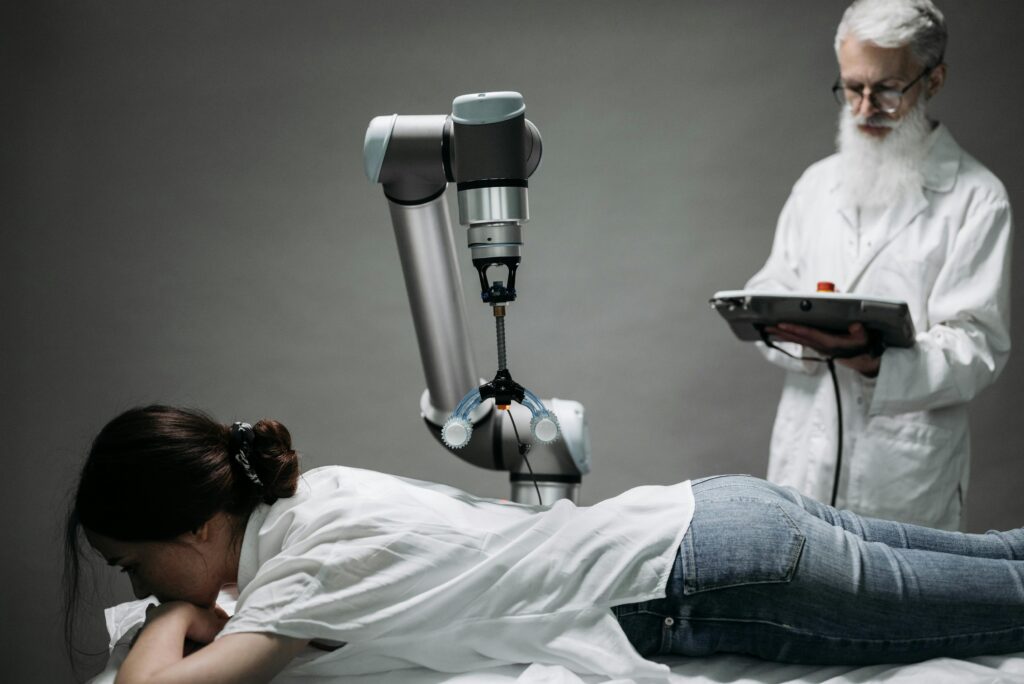
Humanoid robotics is steadily transforming healthcare and life sciences by combining advanced robotics, artificial intelligence, and human-centered design. These robots are designed to operate in human environments, making them especially suitable for hospitals, laboratories, and research facilities where interaction, precision, and safety are critical.
1. Enhanced Patient Care Support
Humanoid robots assist healthcare professionals by handling routine tasks such as patient guidance, mobility support, and basic monitoring, allowing caregivers to focus on complex clinical decisions.
2. Improved Hospital Workflow Efficiency
By automating non-clinical activities like transporting supplies and managing inventory, humanoid robots help hospitals reduce delays and optimize daily operations.
3. 24/7 Assistance and Monitoring
Humanoid robots can operate continuously, ensuring round-the-clock patient supervision and support, which is particularly valuable in critical care and elderly care settings.
4. Reduced Workload for Medical Staff
Robots take over repetitive and physically demanding tasks, helping reduce burnout among doctors, nurses, and technicians.
5. Precision in Laboratory Operations
In life science labs, humanoid robots support sample handling, equipment operation, and repetitive testing with high accuracy and consistency.
6. Support in Drug Discovery
Robots powered by AI assist researchers by analyzing large datasets, running experiments, and identifying patterns that accelerate drug development.
7. Improved Infection Control
By minimizing human contact during routine tasks, humanoid robots help reduce the risk of infection spread in hospitals and research environments.
8. Personalized Patient Interaction
With speech recognition and natural language processing, humanoid robots can provide personalized instructions and reminders to patients.
9. Assistance in Rehabilitation Therapy
Humanoid robots are used in physical and cognitive rehabilitation to guide exercises, track progress, and motivate patients.
10. Data Collection and Analytics
These robots collect real-time health data, contributing to better clinical insights and more informed decision-making.
11. Support for Aging Populations
In elder care, humanoid robots help with daily activities, medication reminders, and social interaction, improving quality of life.
12. Training and Medical Education
Medical institutions use humanoid robots to simulate clinical scenarios, helping students and professionals practice procedures safely.
13. Improved Human-Robot Interaction
Human-like design makes robots easier to accept and interact with, especially for patients unfamiliar with advanced technology.
14. Scalability in Healthcare Systems
Hospitals can scale services without proportional increases in staffing, helping manage resource constraints.
15. Advancing Life Science Research
Humanoid robotics accelerates research timelines by enabling faster experimentation, analysis, and collaboration.
Conclusion
Humanoid robotics is redefining how healthcare and life science organizations operate. By improving efficiency, enhancing patient care, and accelerating research, these robots support professionals while addressing workforce and operational challenges. As technology advances, humanoid robots will play an increasingly vital role in building smarter, safer, and more resilient healthcare systems.
Frequently Asked Questions
How are humanoid robots used in healthcare today?
They assist with patient support, logistics, monitoring, rehabilitation, and administrative tasks.
What role do humanoid robots play in life sciences?
They support laboratory automation, data analysis, drug discovery, and research efficiency.
Are humanoid robots safe for patient interaction?
Yes, when properly designed and regulated, they are safe and effective in controlled healthcare environments.
Can humanoid robots replace healthcare professionals?
No, they are designed to support professionals, not replace human judgment or care.
What is the future of humanoid robotics in healthcare?
The future includes greater autonomy, personalized care, and deeper integration with AI-driven healthcare systems.
