For non-tech enterprises, choosing how to adopt AI isn’t a technology problem — it’s a strategy problem. Get it wrong and you’ll spend years untangling it.
Every boardroom is having the same conversation right now. Your competitors are piloting AI. Your customers expect smarter experiences. Your CFO wants a business case. But before your enterprise commits budget, headcount, and momentum, there’s a foundational question most companies answer too quickly — or worse, by accident:
How should you actually get AI into your business?
The answer isn’t purely technical. It’s strategic. And for non-tech enterprises — manufacturers, retailers, financial firms, healthcare systems, logistics companies — the wrong path can mean years of costly detours. Let’s walk through the real trade-offs.
Why the question matters more than the answer
Most enterprise AI conversations jump straight to use cases: “We should automate our invoice processing” or “Let’s build a customer service chatbot.” That instinct is understandable but dangerous. The use case is the destination. The build-buy-partner decision is the vehicle — and choosing the wrong vehicle determines whether you ever arrive.
“Enterprises that let urgency drive the decision consistently overpay — either in licensing fees or in engineering years they never budgeted for.”
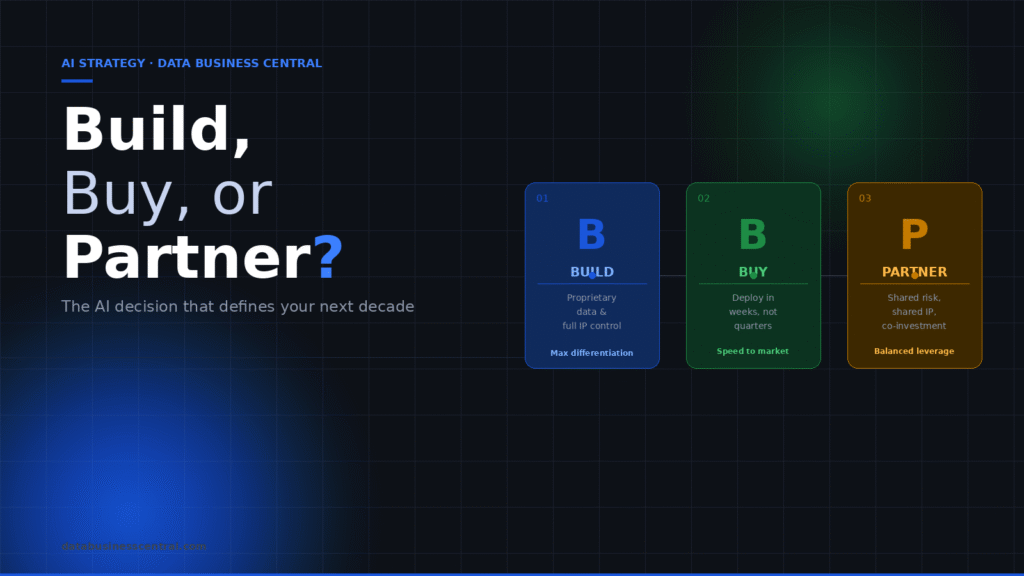
The strategic stakes are high because each path creates a different kind of organizational dependency. Build creates internal capability (and internal bottleneck). Buy creates speed (and vendor lock-in). Partner creates leverage (and shared risk). None of these is inherently superior. All three can be right, depending on where AI sits in your competitive picture.
Understanding the three paths
Build
Your team designs and develops AI systems in-house, on proprietary data, for proprietary advantage.
Buy
You license a ready-made AI product or platform — deploying in weeks rather than quarters.
Partner
You co-develop with a technology partner — sharing investment, IP, and go-to-market risk.
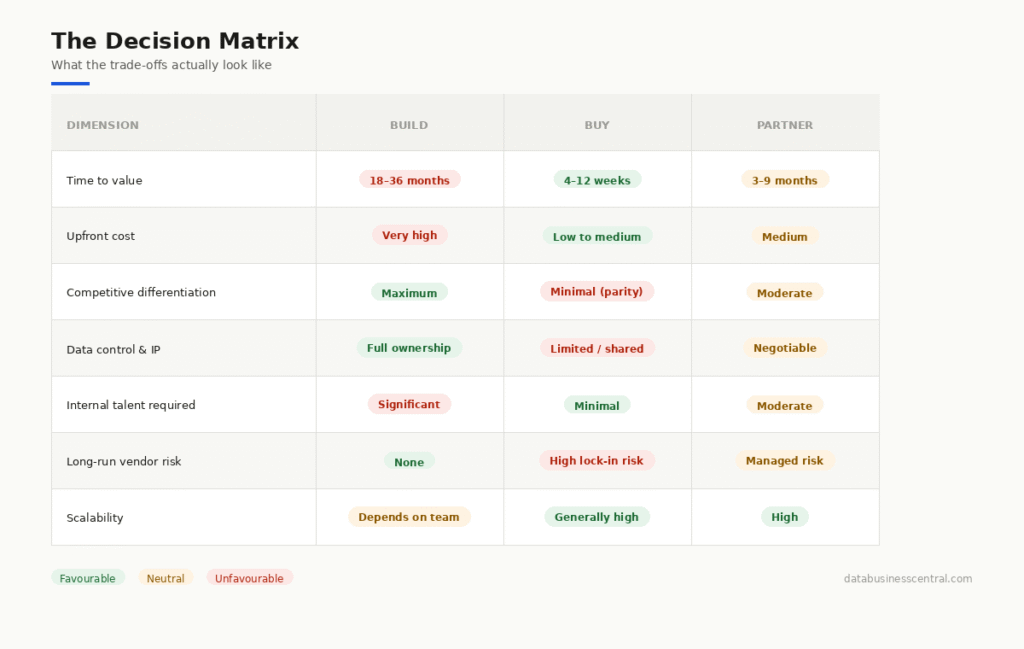
The decision matrix: what the trade-offs actually look like
Build: when your data is the moat
Building AI in-house makes sense when your proprietary data is itself the competitive advantage — and when no vendor’s off-the-shelf model could be trained on it. A specialty insurer with 40 years of underwriting decisions, a regional grocer with deep basket-level purchasing data, a logistics firm with proprietary route efficiency signals: these companies hold raw materials that become genuinely defensible AI when trained correctly.
But building requires honest accounting of what it actually costs. Machine learning engineers, data infrastructure, MLOps tooling, compliance review cycles, ongoing model governance — these are real line items. For most non-tech enterprises, this means partnering with a build partner (an agency, a consulting firm, or a dedicated internal center of excellence) even if the intellectual property remains in-house.
When to lean toward Build
- AI is central to your core product or service differentiation
- You hold proprietary data that competitors cannot replicate
- Regulatory requirements demand data sovereignty
- Your use case is truly unique — no vendor has built for it
- You have (or can hire) ML talent and a multi-year commitment
Buy: when speed and predictability win
The SaaS AI market has matured rapidly. Document processing, customer service automation, demand forecasting, accounts payable intelligence — there are credible, enterprise-grade vendors for all of it. For most horizontal functions, the buy route delivers 80% of the value at 20% of the investment.
The risk is more subtle than it appears at contract signing. AI vendors often update or sunset models with minimal notice. Your internal workflows quietly become dependent on a system you don’t control. Pricing models — per API call, per user, per token — can balloon unpredictably at scale. And if the vendor is acquired or pivots, you’re rebuilding a workflow that has become operationally critical.
Smart buyers negotiate hard on data portability, model stability clauses, and exit provisions before signing. Treat AI vendor contracts more like infrastructure agreements than software subscriptions.
Partner: the underused middle path
The most underutilized strategy for non-tech enterprises is structured co-development with a technology partner. This isn’t outsourcing — it’s a joint venture model applied to AI capability building. Your organization contributes domain expertise and proprietary data. The partner contributes AI engineering and infrastructure. The resulting system is jointly owned or licensed under negotiated terms.
“Partnership reframes AI adoption from a cost center into a shared investment — and it keeps internal teams engaged in shaping the outcome rather than just receiving it.”
Healthcare systems co-developing diagnostic tools with AI companies, retailers building recommendation engines with platform partners, banks developing credit models jointly with fintech firms — these are real patterns producing real competitive outcomes. The key is governance: who owns the training data, who controls model updates, who has the right to commercialize the system independently.
Partnership structures worth knowing
- Co-development JV: Joint ownership of IP, shared engineering resources, shared GTM
- White-label OEM: Vendor builds for you, you brand and deploy; IP is yours
- Managed AI service: Vendor runs the model ops; you own the inputs and outputs
- Academic partnership: University research lab develops, you commercialize under license
A framework for the decision
Quick diagnostic — apply to each AI initiative
1. Is this AI capability core to how we differentiate in the market — or is it a support function?
Support → Buy
2. Do we hold proprietary training data that vendors cannot access or replicate?
Yes → Build or Partner
3. Do we have (or can we hire) the ML talent to own this for 3+ years?
No → Partner or Buy
4. Would vendor lock-in materially damage us if they changed pricing or exited the market?
Yes → Build or Partner
5. Is there a credible partner willing to co-invest in building what we need?
Yes → Partner
6. Do we need AI live and operational within 6 months to meet a business commitment?
Yes → Buy (with exit strategy)
The mistake most enterprises make
Applying the same strategy across all AI initiatives. A global manufacturer might correctly choose to buy an off-the-shelf predictive maintenance tool for plant floors (horizontal use case, established vendors, no differentiation benefit) while simultaneously building a proprietary demand-shaping AI trained on its private supply chain data (unique data, core competitive advantage).
The portfolio view is the right view. Map your AI initiative backlog. Categorize each use case by competitive sensitivity and data uniqueness. That two-by-two gives you a clear allocation: commodity AI use cases go in the buy column, differentiating ones go in the build or partner column.
Then revisit the portfolio annually. What was a defensible build decision in 2023 might be a commodity buy decision in 2026, because the vendor landscape moves that fast.
“The best AI strategies aren’t locked into one path — they’re dynamic, portfolio-driven, and honest about what’s truly differentiating versus what’s just keeping the lights on.”
What to do this quarter
Start with an AI inventory. List the ten AI initiatives your organization is considering or already running. For each, answer the six diagnostic questions above. You’ll find the portfolio naturally sorts itself — and the conversations you need to have with vendors, partners, and your own engineering team become much clearer.
The enterprises that will win the next decade aren’t the ones that move fastest — they’re the ones that move with the most strategic clarity. Build what differentiates you. Buy what commoditizes cleanly. Partner where you can create leverage neither party could generate alone.
