The boardroom conversation has shifted. For years, executives invested in robotic process automation, workflow engines, and scripted bots — and for good reason. These tools slashed costs, eliminated repetitive errors, and gave operations teams breathing room. But a quiet revolution is underway, and the businesses that recognize it early will define the next decade of competitive advantage.
We’re talking about agentic AI — and it is not simply “better automation.” It’s an entirely different paradigm. Understanding the distinction between agentic AI and traditional automation isn’t just a technical exercise. It’s a strategic imperative for every data-driven organization in 2026.
What Is Traditional Automation — And Where Does It Break?
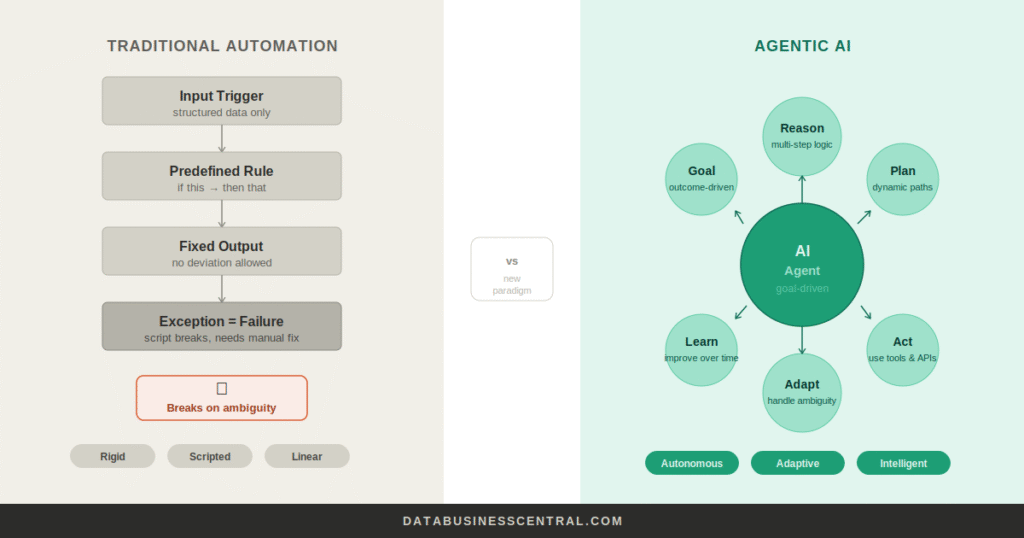
Traditional automation, including robotic process automation (RPA), rule-based workflow tools, and scripted bots, operates on a simple principle: if this, then that. A bot logs into an ERP system, extracts invoice data, pastes it into a spreadsheet, and emails the results. Every step is predefined. Every exception is a failure.
This model thrives in structured, repetitive, high-volume environments. Payroll processing. Data migration. Form submissions. Invoice reconciliation. In these contexts, traditional automation delivers extraordinary ROI — reducing manual hours, minimizing human error, and scaling effortlessly.
But it hits a wall the moment the world gets complicated.
What happens when an invoice arrives in an unexpected format? The bot breaks. What if a customer sends an ambiguous support request that requires reading context from three prior emails? The script doesn’t know. What if market conditions change and your pricing logic needs to adapt dynamically? The workflow can’t pivot.
Traditional automation is only as smart as the person who programmed it — and that programmer had to anticipate every scenario in advance. In a world of increasing data complexity, supply chain volatility, and hyper-personalized customer expectations, that’s a massive constraint.
Enter Agentic AI: The Thinking Layer
Agentic AI refers to AI systems capable of perceiving their environment, reasoning through goals, planning multi-step actions, using tools autonomously, and adapting based on outcomes — all without requiring explicit human instructions for each step.
Unlike traditional automation, agentic AI doesn’t follow a script. It pursues a goal.
Give an agentic AI system the objective of “identify and close the top three revenue leakage opportunities in our enterprise accounts this quarter,” and it will:
- Query your CRM, ERP, and data warehouse independently
- Analyze patterns across unstructured and structured data
- Draft and send personalized outreach to account managers
- Follow up, synthesize responses, and escalate anomalies
- Report findings with full reasoning transparency
No rule engine could do this. No traditional RPA bot could handle the ambiguity, the multi-system coordination, or the real-time decision-making this requires. Agentic AI doesn’t just execute — it thinks, acts, and learns within a defined operational boundary.
The Core Differences: A Strategic Breakdown
1. Adaptability vs. Rigidity
Traditional automation is brittle by nature. Any deviation from the expected input — a shifted column in a spreadsheet, a renamed API field, a new regulatory requirement — can bring the entire workflow to a halt. IT teams spend enormous effort maintaining these fragile pipelines.
Agentic AI systems, by contrast, handle ambiguity gracefully. Trained on vast corpora and fine-tuned on enterprise context, they interpret intent rather than pattern-matching inputs. A renamed data field is not a showstopper — it’s context to be reasoned through.
2. Goal-Oriented vs. Task-Oriented
RPA and traditional workflow automation are task-centric: execute Step 1, then Step 2, then Step 3. There’s no broader objective awareness.
Agentic AI is outcome-centric: define what success looks like, and the system determines the steps. This is a profound shift for business intelligence and analytics teams, who can now delegate entire research cycles, not just individual queries.
3. Multi-Step Reasoning vs. Linear Execution
Traditional automation runs in straight lines. Agentic AI navigates dynamic decision trees — pausing when uncertain, calling external tools, re-evaluating intermediate results, and rerouting when initial approaches fail.
For enterprise data workflows — where a business analyst might need to pull from 12 different internal and external data sources, reconcile conflicts, and generate a C-suite-ready narrative — this distinction is everything.
4. Tool Use and API Orchestration
Modern agentic AI systems can operate like a skilled human analyst with supercharged capabilities: they browse the web for market data, execute Python scripts for statistical modeling, query databases using natural language, call third-party APIs, manage calendars, draft documents, and more — all in a single autonomous workflow.
Traditional automation integrates with tools too, but requires every integration to be explicitly coded and maintained. Agentic AI platforms expose dynamic tool use where the AI selects the right tool for the right context without pre-scripted bindings.
5. Learning and Improvement
Rule-based systems don’t improve. They do exactly what they were told, forever — unless a developer rewrites them.
Agentic AI systems can be designed to learn from outcomes, incorporate feedback loops, and refine their strategies over time. For predictive analytics, demand forecasting, and customer intelligence functions, this continuous improvement cycle creates compounding value that traditional automation simply cannot match.
Real-World Business Impact: Where Agentic AI Wins
Financial Services: Intelligent Risk Assessment
Traditional automation in lending runs fixed eligibility checks — credit score above X, income above Y, debt-to-income ratio below Z. Efficient, but blunt.
Agentic AI conducts holistic AI-powered risk intelligence: analyzing alternative data sources, monitoring macroeconomic signals, dynamically adjusting risk models, and flagging edge cases for human review — all in real time. The result is better loan decisions, reduced defaults, and a faster customer experience.
Supply Chain and Operations: Dynamic Disruption Response
Scripted automation can reorder inventory when stock drops below a threshold. But what happens when a supplier goes offline, a port faces delays, and demand spikes simultaneously?
Agentic AI ingests signals across the entire supply chain ecosystem, reasons through interdependencies, and recommends — or autonomously executes — adaptive responses. This is autonomous operations intelligence in action, and it’s already being deployed by forward-thinking manufacturers and logistics firms.
Customer Experience: Hyper-Personalization at Scale
Chatbots built on traditional automation handle FAQs. Agentic AI-powered customer experience platforms handle relationships. They remember context across sessions, proactively anticipate needs, coordinate across back-end systems, and escalate intelligently to human agents when emotional nuance demands it.
For B2B enterprises, where account intelligence and relationship depth drive revenue, this is a game-changing capability.
Data Analytics: From Dashboards to Autonomous Insights
Business intelligence teams are drowning in dashboards but starved for actionable insights. Traditional BI tools require humans to ask the right questions. Agentic analytics platforms proactively surface anomalies, investigate root causes, and deliver insight narratives — without waiting to be asked.
This shift from reactive reporting to proactive intelligence is one of the most significant productivity multipliers available to data organizations today.
The Human-in-the-Loop Imperative
A common misconception is that agentic AI is designed to replace human judgment entirely. The most effective enterprise deployments in 2026 are built around a human-in-the-loop (HITL) architecture — where AI handles the heavy cognitive lifting and humans provide oversight, approval, and creative direction.
Think of it less as “AI instead of people” and more as “AI that makes your best people ten times more effective.”
A senior data analyst who previously spent 60% of her time on data wrangling now spends 80% on interpretation and strategy — because an agentic AI system handles the extraction, cleaning, and preliminary analysis autonomously. The output is better. The analyst is more fulfilled. The organization moves faster.
This is the real promise of agentic AI: not automation of jobs, but amplification of human capability.
Implementation Considerations for Data-Driven Organizations
Before your organization leaps into agentic AI deployment, several foundational considerations deserve attention:
Data Quality and Governance — Agentic AI is only as trustworthy as the data it reasons over. Organizations with mature data governance frameworks, clean master data management, and well-documented data lineage will see faster time-to-value.
Security and Access Controls — Agentic systems that can access multiple data sources and execute actions on behalf of users require careful permissioning. Zero-trust AI architecture is an emerging best practice, ensuring that AI agents operate only within explicitly authorized boundaries.
Explainability and Audit Trails — Regulated industries in particular need AI systems that can explain their reasoning. Look for agentic AI platforms that produce transparent decision logs — this is non-negotiable in financial services, healthcare, and legal contexts.
Change Management — The shift from traditional automation to agentic AI is as much a cultural change as a technical one. Teams need to learn to collaborate with AI agents, provide effective feedback, and trust (but verify) AI-generated outputs.
The Strategic Verdict
Traditional automation is not going away. For high-volume, fully structured, zero-ambiguity workflows, it remains the right tool. The ROI is proven, the technology is mature, and the failure modes are well-understood.
But for the growing share of knowledge work, analytical reasoning, multi-system coordination, and adaptive decision-making that defines modern enterprise operations, traditional automation has reached its ceiling.
Agentic AI is the next layer of the intelligent enterprise stack — not a replacement for automation, but its evolution. Organizations that integrate agentic AI into their data and operations ecosystems will compress decision cycles, surface insights invisible to traditional tools, and build a sustainable competitive moat.
The question is no longer whether to adopt agentic AI. The question is how fast you can move — and how strategically you can lay the foundation to do it right.
Key Takeaways for Business Leaders
- Traditional automation excels at structured, repetitive tasks but fails when complexity and ambiguity enter the picture
- Agentic AI pursues goals autonomously, using reasoning, tool use, and multi-step planning — not just scripted logic
- The business impact spans finance, supply chain, customer experience, and analytics — wherever cognitive complexity has previously bottlenecked performance
- Human-in-the-loop design is the gold standard: AI amplifies human expertise rather than replacing it
- Success requires strong data governance, security architecture, and change management alongside the technology
Data Business Central covers enterprise AI strategy, business intelligence, and data-driven transformation for technology and operations leaders. Explore our resource library for in-depth guides on deploying intelligent automation in your organization.
