The conversation around AI agents has shifted — sharply and permanently. What was a research curiosity in 2023 and a cautious pilot in 2024 is now a boardroom mandate in 2026. Enterprises are no longer asking should we deploy AI agents? They are asking which agents, where, and how fast?
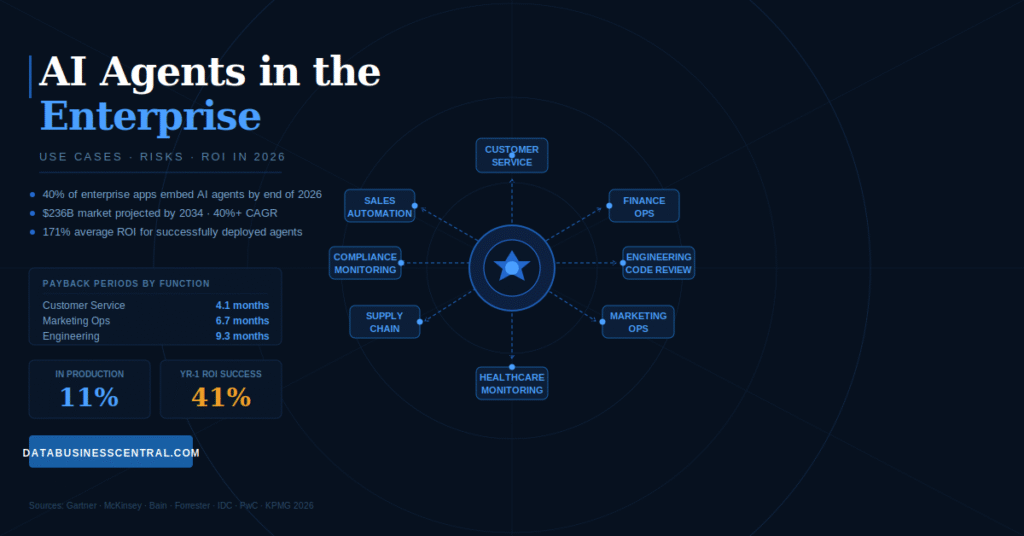
The numbers reflect this urgency. Gartner projects that by the end of 2026, 40% of enterprise applications will include task-specific AI agents — a figure that sat below 5% just twelve months ago. The global AI agents market, valued at roughly $7.6 billion today, is on a trajectory to reach $236 billion by 2034, growing at a compound annual rate exceeding 40%. For context, no enterprise technology sector has moved this fast since the earliest wave of cloud migration — and unlike cloud, AI agents affect every business function simultaneously.
But here is the number that matters most right now: 79% of organizations have adopted AI agents in some form, yet only about 11% run them in production at scale. That 68-point gap is the defining challenge of 2026 — and the enterprises that close it intelligently will capture an outsized share of the competitive advantage this technology creates.
This article is a data-oriented guide to where AI agents are delivering in enterprise settings today, where the real risks live, and what honest ROI looks like across departments and industries.
What Makes an AI Agent Different from Ordinary AI
Before diving into use cases, it is worth drawing a line that often gets blurred in enterprise discussions.
A conventional AI system responds. You give it an input, it produces an output. A language model that drafts an email summary, a recommendation engine that surfaces products, a classifier that routes support tickets — these are reactive tools. Useful, absolutely. But fundamentally dependent on a human to initiate every action.
An AI agent acts. It is given a goal, not just a prompt. It plans a sequence of steps to achieve that goal, uses tools (APIs, databases, browsers, code interpreters) to execute those steps, monitors its own progress, and adapts when the environment changes. It can initiate — and sustain — multi-step workflows without a human intervening at every turn.
The practical consequence for enterprise AI is significant. Agents can handle end-to-end processes, not just individual tasks. They can operate across systems that were never designed to talk to each other. And they can do so continuously, at a speed and scale no human team can match.
The Gartner maturity roadmap frames 2026 as the year of task-specific agents — focused, purpose-built systems operating within defined domains. Collaborative agents that coordinate across departments are mapped to 2027. Cross-application agent ecosystems to 2028. Enterprises building now are laying the foundation for capabilities that compound over the next several years.
Where AI Agents Are Delivering in 2026: High-ROI Use Cases
Customer Service and Support Automation
Customer service is the most mature and highest-proven domain for enterprise AI agents in 2026, and the cost economics are striking. Forrester’s Total Economic Impact studies and Anthropic enterprise data indicate that AI agents can resolve a contained customer service ticket for approximately $0.46, compared to $4.18 when handled by a human — a roughly 9x cost-per-task reduction.
By 2028, AI agents are projected to handle 68% of retail customer interactions. In financial services — the sector with the highest AI adoption rate of any industry at 91% — conversational agents are already managing account inquiries, fraud alerts, and loan status updates at scale.
The ROI is not only in cost reduction. Agents operate 24 hours a day, eliminate hold times, and handle volume spikes without staffing ramp-ups. For enterprises with high-contact customer bases, the combination of cost efficiency and service consistency represents a structural advantage.
Payback period: Median 4.1 months (Bain Agentic AI Benchmark 2026)
Software Engineering and Code Review
AI agents applied to software engineering workflows are producing some of the most dramatic per-task savings in the enterprise. Code-review agents completing a routine pull request review cost approximately $0.72 per task versus $48 of senior engineer time — a 66x cost differential per Forrester data.
Beyond cost, the compounding effect matters more. Engineers spending less time on routine reviews spend more time on architecture, product decisions, and high-complexity problems that agents cannot yet handle. The augmentation model — agents handling the repeatable, engineers owning the exceptional — is where the productivity gains are most durable.
McKinsey’s Global AI Survey 2026 reports a median of 6.4 hours saved per knowledge worker per week when AI agents are active in their workflows. In engineering, where context-switching costs are high, those hours concentrate into measurable output gains.
Payback period: Median 9.3 months (Bain Agentic AI Benchmark 2026)
Finance and Operations Automation
Finance operations — accounts payable, invoice reconciliation, financial reporting, compliance checks — represent one of the clearest fits for autonomous agents. The workflows are rule-governed, the data is structured, the volume is high, and the cost of errors is quantifiable.
Enterprises deploying AI automation in finance operations report processing speed improvements measured in orders of magnitude, not percentage points. Month-end closes that required days of manual reconciliation are being compressed into hours. Compliance agents that continuously monitor transaction patterns are catching anomalies that periodic human audits missed entirely.
Supply chain optimization is another high-value application, with 17% of manufacturing enterprises already running AI agents specifically for this function. Agents that monitor supplier inventory levels, shipping routes, demand signals, and disruption alerts — and adjust procurement or routing decisions in near-real time — represent a qualitatively different capability than the batch reporting systems they replace.
Marketing Operations and Personalization
Marketing operations is where the volume math for AI agents becomes compelling fastest. PwC’s 2026 AI Agent Survey found companies using agents cited 66% productivity gains and 57% cost savings across their operations, with marketing functions among the top contributors.
AI agents in marketing orchestrate content personalization at scale, manage multi-channel campaign sequencing, monitor performance signals and rebalance budget allocation, and generate performance reports with recommendations — all within a single continuous workflow. The median payback period for marketing operations agent deployments is 6.7 months.
Healthcare: High Stakes, High Adoption
Healthcare is moving faster than most conservative observers expected. By 2026, 68% of healthcare organizations use AI agents in some capacity. Four in ten healthcare executives already deploy AI for inpatient monitoring and early health warning systems. Full implementation across monitoring and diagnostic support functions is expected within three years, per IBM research.
The stakes in healthcare make governance critical — which is why this sector also leads in human-in-the-loop design and AI oversight investment. But the underlying potential is unambiguous: agents that continuously monitor patient vitals, flag anomalies to clinicians, coordinate care workflows across departments, and surface relevant clinical literature at the point of care are producing measurable improvements in both outcomes and operational efficiency.
The Real Risk Picture: What’s Going Wrong
The ROI numbers above are real — but they are selectively reported when governance and context are omitted. Here is what the full data landscape shows.
Only 41% of agent deployments achieve positive ROI within the first year. That means the majority of enterprise AI agent projects either break even late or not at all. The average sunk cost in a failed Fortune 1000 enterprise agent project is $2.1 million. And Gartner’s projection that over 40% of agentic AI projects are at risk of cancellation by 2027 is not a fringe estimate — it reflects widespread deployment without adequate governance infrastructure.
The leading failure modes, based on 306 practitioners and 20 production case studies, fall into three categories:
1. Observability gaps. Enterprises that cannot see what their agents are doing in real time cannot course-correct when behavior drifts. Without logging, monitoring, and anomaly detection at the agent layer, problems surface as incidents rather than as early signals.
2. Memory and context management failures. AI agents operating across long or complex workflows need to maintain context coherently. Poor memory architecture leads to agents losing track of prior actions, repeating steps, or making decisions inconsistent with earlier outputs in the same task chain.
3. Data quality as the hidden blocker. Over half of organizations cite data quality as their primary deployment barrier. Agents are only as reliable as the data they operate on. Unstructured, inconsistent, or stale data inputs produce inconsistent agent outputs — and in high-stakes domains, inconsistency is a liability, not just an inconvenience. IDC warns of a 15% productivity loss by 2027 for enterprises that scale AI agents on poor data foundations.
4. Security and trust surface expansion. Every AI agent that interacts with real systems — sending emails, querying databases, executing API calls — is also an expanded attack surface. Security events involving AI agents are rising. Enterprises that build governance into agent architecture from the start manage this risk. Those that add it later manage incidents.
5. The “autonomy creep” risk. Agents given broad permissions in service of efficiency can take actions outside their intended scope. Without clear operational boundaries, task-specific agents can inadvertently trigger downstream effects across connected systems. Scope definition is not just a governance exercise — it is an architectural one.
Calculating Real ROI: A Framework for Enterprise Decision-Makers
The 171% average global ROI for successfully deployed AI agents (192% in the United States, where labor cost differentials are larger) is a meaningful benchmark — but averages obscure the distribution that matters for enterprise planning.
A more useful framework evaluates AI agent ROI across four dimensions:
Cost-per-task reduction: Direct labor substitution or augmentation savings, calculated at the task level. This is the most reliable and fastest-payback metric for high-volume, repeatable workflows.
Throughput and capacity expansion: Volume of work completed per unit of time, compared against the human-staffed baseline. For functions where demand is variable or seasonal, this captures the scaling value that headcount cannot.
Error rate and quality improvement: In workflows where errors have downstream costs — compliance violations, rework, customer churn — quality improvement translates directly to avoided cost. This is frequently the largest ROI driver in finance, healthcare, and legal operations.
Speed-to-insight or speed-to-action: In competitive markets, the time between a data signal and an operational response has direct business value. Agents that compress this latency — in pricing, inventory, customer outreach, or risk monitoring — deliver ROI that is real but harder to quantify in purely cost terms.
Vendor-deployed agents reach positive ROI 2.4 times faster than custom builds, per Bain’s 2026 benchmark. For most enterprises, the right sequence is to prove the model with purpose-built solutions in high-ROI domains first — customer service, finance operations, or marketing — and then build toward custom architectures as governance and integration maturity develops
The Deployment Maturity Model: Where Does Your Enterprise Stand?
The gap between AI agent adoption and production deployment is not primarily a technology problem. It is an organizational readiness problem. Based on current data, enterprise AI agent maturity maps to four stages:
Stage 1 — Experimentation: Isolated pilots, typically in one department, with no integration into core systems. Success is measured by demo quality rather than business metrics. Most enterprises that have “adopted” AI agents are here.
Stage 2 — Validated deployment: One or two use cases running in production with measured outcomes, clear ownership, and defined escalation paths for agent failures. This is where ROI becomes real and replicable.
Stage 3 — Scaled operations: Multiple agent deployments across functions, with shared governance infrastructure, standardized monitoring, and integration into enterprise data architecture. Human-in-the-loop controls are codified by use case.
Stage 4 — Agent ecosystem: AI agents coordinating across functions, sharing context, and operating within a governed enterprise agent layer. This is the 2027–2028 horizon for most leading organizations.
The organizations progressing fastest between these stages share two characteristics: they invested in governance and observability infrastructure before scaling, and they targeted proven high-ROI use cases first rather than the most ambitious ones.
What “Responsible Enterprise AI Automation” Actually Looks Like
Responsible deployment is not about deploying slower. It is about deploying smarter — and the data supports this. Enterprises that combine governance investment with aggressive deployment timelines are outperforming both the governance-only cautious movers and the governance-later fast movers.
The baseline requirements for responsible enterprise AI agent deployment in 2026:
Clear operational boundaries per agent. Define exactly what systems each agent can access, what actions it can take autonomously, and what triggers human escalation. Scope creep in agent permissions is one of the most reliable predictors of production incidents.
Real-time observability. Every agent action should be logged, searchable, and monitored for anomaly. The goal is not audit trails for compliance (though that matters) — it is early-warning capability that lets teams intervene before a localized issue becomes a systemic one.
Kill switches and rollback capability. Agents operating in production need to be pausable. If an agent is behaving unexpectedly, the ability to halt its operations immediately — and revert any pending actions — is not a nice-to-have. It is table stakes.
Human-in-the-loop gates for high-stakes decisions. The 84% of survey respondents who report being comfortable with AI making autonomous end-to-end decisions for specific processes (KPMG 2026) are making a point about specific processes — ones where the parameters are clear and the failure mode is recoverable. Not every process qualifies.
The Strategic Bottom Line
AI agents in 2026 are not an emerging technology. They are a deployed one — with real performance data, real failure data, and a rapidly closing window for early-mover advantage.
The 68-point gap between adoption and production deployment is not a reason for caution. It is the market signal. The enterprises that build production-grade agent infrastructure now — with real governance, real measurement, and real integration into business workflows — will enter 2027 compounding on established foundations while competitors are still running pilots.
The 171% average ROI for well-governed deployments is not a promise. It is a benchmark. Earning it requires choosing the right use cases, building the right infrastructure, and maintaining the oversight discipline that keeps agents operating within their intended scope.
Enterprise AI automation is not a technology decision anymore. It is a strategy decision — and the data has arrived to make it.

4 thoughts on “AI Agents in the Enterprise: Use Cases, Risks, and ROI in 2026”
Pingback: Agentic AI vs Traditional Automation
Pingback: AI Agents vs AI Copilots: Enterprise ROI Guide
Pingback: How Fortune 500 Companies Build AI Agent Workforces
Your writing is so engaging and easy to read It makes it a pleasure to visit your blog and learn from your insights and experiences