Something remarkable happened in enterprise customer support in 2025 — and most customers didn’t even notice.
While they were getting their questions answered faster, their problems resolved on the first contact, and their issues addressed at 2 a.m. on a Sunday without waiting in any queue, the infrastructure serving them had quietly and fundamentally changed. The agent on the other end of the conversation wasn’t a human sitting in a contact center. It was an AI agent in customer service — autonomous, intelligent, and operating at a scale no human team could match.
By mid-2026, AI agents in customer support have moved from pilot program to primary channel for the world’s most customer-obsessed enterprises. Not because the technology is impressive. Because the results are undeniable.
This is the complete picture of what’s happening, why it’s working, what the data shows, and how forward-thinking enterprises are building the customer support infrastructure of the next decade.
The Breaking Point That Made AI Agents Inevitable
To understand why AI-powered customer service has transformed so dramatically, you need to understand what was breaking before it arrived.
Enterprise customer support in 2023 was running on a model that hadn’t fundamentally changed in thirty years: hire agents, train them on scripts and product knowledge, route inbound contacts to available humans, hope volumes stay manageable. The costs were enormous — the average fully-loaded cost of a human customer service agent runs $38,000–$52,000 annually in North America, not including infrastructure, management overhead, and quality assurance.
The volumes were unmanageable. Global customer support contact volume grew 34% between 2021 and 2024 as digital product complexity increased and customer expectations for instant resolution accelerated. Meanwhile, customer service labor markets remained brutally competitive — average annual agent attrition rates running at 45% in many enterprise environments, with replacement and retraining costs eating another $4,000–$7,000 per departing agent.
Customer expectations, meanwhile, were evolving in the opposite direction. By 2024, 73% of customers expected companies to resolve their support issues in a single interaction. 67% expected 24/7 availability. 58% said they would switch to a competitor after two bad customer service experiences — regardless of how good the product was.
The math was impossible. Human-only customer support couldn’t scale to meet demand without unsustainable cost increases. The quality and consistency that customers demanded couldn’t be maintained through high-attrition human teams. Something had to give.
AI agents in customer service didn’t just fill the gap. They redefined what was possible.
What AI Customer Service Agents Actually Do in 2026
The term “AI agent” in customer service covers a far more sophisticated capability set than most business leaders realize. This isn’t a chatbot with a decision tree. This isn’t a keyword-matching FAQ bot that sends users in circles. Autonomous AI customer service agents in 2026 are systems that:
Understand intent across all input types. Modern AI customer service agents process natural language queries in any format — typed chat, voice transcription, email — and accurately identify customer intent even when queries are vague, misspelled, multi-layered, or expressed with emotional intensity.
Access and act on live data. Unlike static FAQ systems, AI agents integrate directly with CRM platforms, order management systems, billing systems, and product databases. They don’t just tell customers what the policy is — they look up the customer’s specific account, order, or issue and take action on it in real time.
Resolve issues end-to-end, not just triage them. Processing a refund. Updating account information. Resetting credentials. Rescheduling deliveries. Modifying subscription plans. Escalating tickets with full context. Agentic AI systems for customer support complete the full resolution loop — not just surface information for a human to act on.
Maintain contextual memory across interactions. A customer who contacted support last Tuesday about a billing discrepancy doesn’t have to re-explain their situation when they reach out again on Friday. AI agents with persistent memory handle continuity that human agents rarely achieve.
Detect and respond to emotional signals. Sentiment analysis embedded in customer support AI agents identifies customer frustration, urgency, and distress in real time — adjusting tone, escalation priority, and response strategy accordingly.
Escalate intelligently with complete context. When a situation genuinely requires human judgment — an unusually complex technical issue, a legally sensitive situation, a highly distressed customer — AI agents escalate to human specialists with a complete interaction summary, customer history, and suggested resolution path already prepared. Human agents enter the conversation informed, not cold.
The Data: What Enterprise Deployments Are Delivering
The business case for AI agents in customer service is no longer theoretical. The 2026 enterprise deployment data tells a clear story.
Resolution & Efficiency Metrics
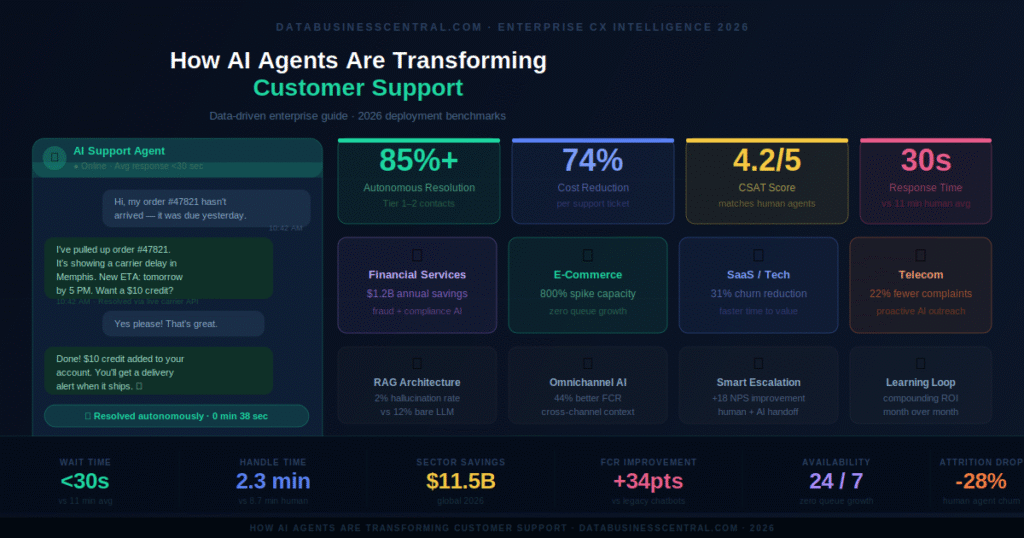
- 85–92% autonomous resolution rate for Tier 1 and Tier 2 support contacts in mature AI agent deployments — up from 45% in 2023’s first-generation chatbot implementations
- First Contact Resolution (FCR) rates have improved by an average of 34 percentage points for AI-handled interactions vs. legacy chatbot implementations
- Average Handle Time (AHT) for AI agent interactions: 2.3 minutes vs. 8.7 minutes for equivalent human-handled contacts
- Cost per ticket reduced by 68–74% in enterprises with mature AI customer service deployments
- $11.5 billion — estimated enterprise savings from AI-automated customer support in 2026 globally
- AI agents handle volume spikes of up to 800% above baseline without degraded performance — something that would require weeks of hiring and training for human teams
Quality & Customer Experience Metrics
- Customer Satisfaction (CSAT) scores for AI-handled interactions average 4.2/5 in mature deployments — matching or exceeding human agent benchmarks in many enterprise contexts
- Net Promoter Score (NPS) improvements of +18 points have been documented at enterprises that transitioned to AI-first support with well-designed escalation protocols
- Wait time reduced from an average of 11 minutes in human-queue environments to under 30 seconds for AI agent response
- 24/7 availability — 100% of support volume now addressable at any hour, vs. the 37% coverage typical human staffing models achieved outside business hours
- Language and channel consistency — AI agents deliver identical quality across 40+ languages without the quality degradation that affected multilingual human support teams
Human Agent Impact Metrics
- Human agents in AI-augmented environments handle 3.4x more complex cases than in human-only environments, because AI handles all routine volume
- Agent satisfaction scores improve in AI-augmented contact centers — human agents report higher job satisfaction when they work on complex, intellectually engaging issues rather than high-volume repetitive interactions
- Attrition rates drop by an average of 28% in contact centers that implement AI agents effectively — partly because remaining human agents have better work and partly because team size reduction means fewer agents to retain at higher investment per person
- Training time for new human support specialists reduced by 40% — because AI handles routine protocols, human training focuses on higher-order judgment and relationship skills
The Architecture Behind High-Performance AI Customer Service
Not all AI customer service deployments deliver these results. The enterprises achieving top-quartile performance share a common architectural approach.
Retrieval-Augmented Generation (RAG) for Knowledge Accuracy
The most critical technical decision in enterprise AI customer service deployment is knowledge architecture. AI agents that rely purely on training data produce inconsistent, potentially outdated responses. The market-leading implementations use RAG (Retrieval-Augmented Generation) — where the AI agent dynamically retrieves current product documentation, policy updates, and account-specific data at query time, grounding every response in live, accurate information.
Enterprises using RAG-architecture customer service agents report hallucination rates of under 2%, compared to 12–15% for unaugmented LLM implementations. In customer support, where a single incorrect piece of information can trigger a complaint, a refund request, or a regulatory issue, this accuracy gap is not marginal — it’s the difference between deployment success and failure.
Omnichannel Orchestration
Customers don’t interact through a single channel. They start a chat on the website, follow up via email, call when frustrated, and leave a review when delighted or disappointed. The highest-performing AI customer support systems in 2026 maintain unified context across every channel — so a customer’s journey is coherent regardless of where each interaction happens.
This omnichannel AI orchestration requires integration architecture that most customer support platforms are still building toward. Enterprises that have achieved it report 44% higher first-contact resolution rates for cross-channel interactions and significantly higher customer satisfaction with multi-touch support journeys.
Intelligent Escalation Design
The single biggest mistake in enterprise AI customer service deployment is treating escalation as a failure state. The most sophisticated implementations treat escalation as a designed feature — a deliberate handoff that combines AI efficiency with human expertise for maximum customer outcome.
An AI agent that recognizes it cannot resolve an issue with high confidence — and seamlessly transfers the customer to a human specialist with a complete context summary and warm handoff message — creates a better customer experience than either an AI that fails awkwardly or a human who starts from scratch. The enterprises with the highest CSAT scores in AI customer service deployments invest as much in escalation design as they do in resolution automation.
Continuous Learning Infrastructure
AI customer service automation that doesn’t improve over time is a depreciating asset. Leading enterprises build continuous learning loops into their customer service AI architecture:
Every resolved interaction feeds quality scoring. Escalated cases flag knowledge gaps. Customer satisfaction outcomes train response strategy. Product updates trigger knowledge base refreshes. Seasonal patterns adjust volume and staffing predictions.
The result is a system that delivers meaningfully higher performance in Month 12 than Month 1 — compounding value in ways that human-only teams cannot match structurally.
Industry-Specific Transformation: Where AI Customer Service Shines
Financial Services: Compliance-Safe, Always Available
Banks, insurers, and fintech platforms face a unique customer service challenge: every interaction carries regulatory risk, and the most sensitive customer queries — fraud disputes, loan decisions, account closures — require both speed and precision.
AI agents in financial services customer support now handle account inquiries, transaction disputes, fraud alerts, and payment processing questions with documented compliance guardrails, full audit trails, and real-time regulatory check integration. Major banks report $1.2 billion in annual customer service cost reduction from AI deployment, while simultaneously improving issue resolution accuracy and reducing regulatory exposure from inconsistent human responses.
E-Commerce & Retail: Handling the Volume Peaks
No sector experiences customer service demand volatility like retail — Black Friday volumes can spike 15x above baseline in hours. Human staffing cannot respond to that curve. AI can.
Leading e-commerce enterprises use AI customer service agents to handle order tracking, return processing, exchange orchestration, delivery exception management, and product inquiry resolution autonomously. During peak periods, AI agents absorb the volume surge without queue growth, maintaining response times under 60 seconds regardless of inbound contact rate.
SaaS & Technology: Technical Depth at Scale
For software companies, customer support is inextricably linked to product adoption and retention. A customer who can’t get their technical question answered quickly churns — often silently. AI agents trained on technical documentation, API references, and product knowledge bases now resolve Tier 1 and Tier 2 technical support tickets with accuracy that rivals Tier 1 human technical specialists.
The measurable impact: 31% improvement in 90-day customer retention at SaaS companies with AI-first technical support, and 2.3x faster time to resolution for common technical blockers.
Telecommunications: Proactive, Not Reactive
Telecom companies carry some of the highest customer service contact volumes of any industry — and some of the highest churn rates when service issues aren’t resolved fast. AI agents in telecom support are transforming the model from reactive to proactive: monitoring network performance data, identifying service degradation before customers report it, and autonomously reaching out to affected customers with status updates and resolution timelines.
Telecom operators using proactive AI customer service report 22% reduction in inbound complaint contacts — because AI resolves issues before customers feel the need to reach out at all.
The Risks Enterprise Leaders Must Manage
The case for AI-powered customer service is strong. The risks of poorly executed deployment are equally real.
Over-automation without adequate escalation design is the most common failure mode. AI systems that attempt to handle everything — including situations genuinely requiring human empathy and judgment — produce frustrated customers and eroded brand trust. The guardrail is explicit: design for intelligent limits, not unlimited automation.
Knowledge base quality is a ceiling, not a floor. AI customer service agents are only as accurate as the knowledge they’re grounded in. Outdated, inconsistent, or incomplete product documentation will produce AI responses that erode rather than build customer confidence. Data governance for the customer service knowledge base must be treated as a continuous operational investment.
Transparency and trust remain important design considerations. Customers in 2026 are broadly accepting of AI customer service — particularly when it delivers faster resolution. But they retain the right to know they’re interacting with AI, and they expect clear, friction-free access to human agents when they request it. Enterprises that obscure AI identity or make escalation difficult pay a measurable trust penalty.
Building Your AI Customer Service Roadmap
For enterprise leaders planning their customer support AI transformation, the data from 2026 deployments suggests a phased approach that consistently outperforms big-bang implementations:
Phase 1 — Foundation (Months 1–3): Deploy AI for highest-volume, most structured inquiry types. Order status, account information, FAQs, credential resets. Build measurement infrastructure for CSAT, resolution rate, and escalation patterns from day one.
Phase 2 — Expansion (Months 4–9): Extend AI coverage to Tier 2 workflows with transaction processing capability — refunds, account modifications, subscription changes. Implement RAG knowledge architecture. Refine escalation protocols based on Phase 1 data.
Phase 3 — Intelligence (Months 10–18): Deploy proactive outreach capabilities, omnichannel context unification, and continuous learning infrastructure. Enable AI agents to initiate customer interactions based on behavioral signals, not just respond to inbound contacts.
Phase 4 — Optimization (Ongoing): Shift human specialist capacity to complex, high-value customer relationships. Use AI performance data to drive product improvement, knowledge base updates, and policy refinement.
The Competitive Verdict
In 2026, the gap between enterprises with mature AI customer service deployments and those still operating predominantly human-only models is measurable in dollars, points, and percentage rates. Response times. Resolution accuracy. Cost per interaction. Customer satisfaction. Churn prevention.
Every metric that defines customer support quality is moving in favor of enterprises that have made the AI-first transition — not because human customer service agents aren’t valuable, but because AI agents in customer service have changed the scale, consistency, and economics of what great customer support can deliver.
The question enterprise leaders face is no longer whether to transform their customer support with AI agents. It’s how quickly they can build the infrastructure, knowledge architecture, and escalation design that separates market leaders from followers.
The customers are already expecting it.
Data Business Central delivers enterprise AI strategy, customer experience intelligence, and data-driven transformation insights for technology and operations leaders. Subscribe for weekly analysis on AI in customer service, enterprise ROI benchmarks, and intelligent support transformation.
Tags: AI agents in customer service, AI-powered customer service, enterprise AI customer support, autonomous AI customer service, AI customer support automation, agentic AI customer experience, AI contact center, customer service AI agents, AI support resolution, RAG customer service, omnichannel AI support, AI CSAT improvement, customer support transformation 2026, AI ticket resolution, enterprise customer experience AI, intelligent virtual agents, AI customer service ROI, NLP customer support, AI escalation design, proactive AI customer service

1 thought on “How AI Agents Are Transforming Customer Support: The Complete Enterprise Guide for 2026”
Pingback: AI Agents in Customer Support: Reduce Costs in 2026