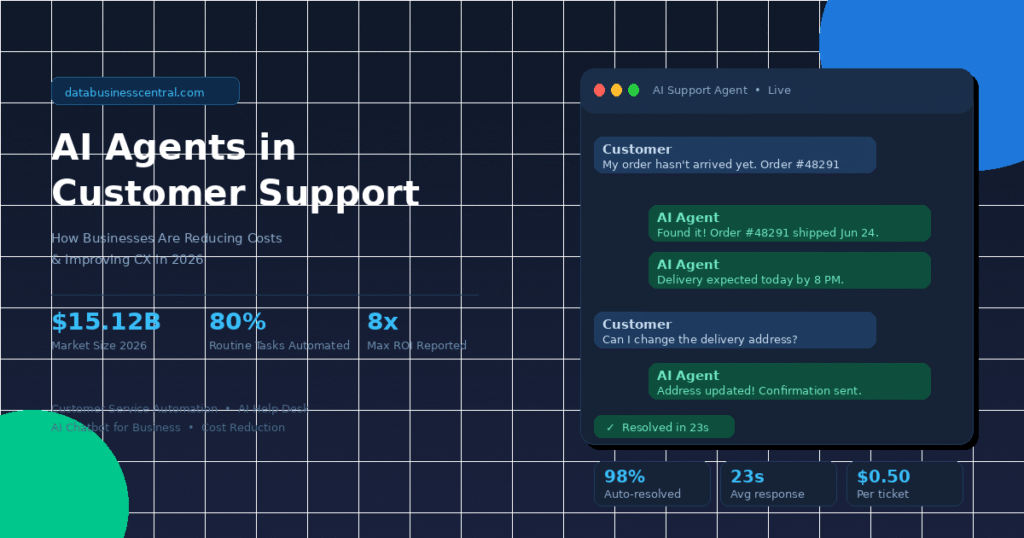
Something fundamental has shifted in how businesses handle customer support. It is not just faster chatbots or smarter FAQs. It is a wholesale reimagining of the support function — driven by AI agents in customer support that can understand context, take action, and resolve issues end-to-end without a human ever touching the ticket.
The numbers confirm what businesses on the ground are already feeling. The global AI customer service market is projected to reach $15.12 billion in 2026, growing at a compound annual rate of 25.8% toward a projected $117.87 billion by 2034. Customer service now represents the single largest segment of the agentic AI market — bigger than sales, marketing, or any other business function.
So what is actually driving this? And more importantly, what does it mean for your business?
From Chatbots to AI Agents: What Changed
The phrase “AI chatbot for business” used to conjure images of frustrating decision trees and scripted responses that left customers more annoyed than helped. That era is over.
Modern customer support AI agents are a fundamentally different category of technology. Where legacy chatbots responded, today’s AI agents act. They can access backend systems, initiate refunds, update account details, escalate appropriately, and close tickets — all within a single conversation, with no human handoff required.
ServiceNow’s AI agents now handle 80% of customer support inquiries autonomously, producing a 52% reduction in the time required to resolve complex cases and an estimated $325 million in annualized productivity value. Bank of America’s Erica voice assistant resolves 98% of queries within 44 seconds. These are not pilot programs. These are production deployments at enterprise scale.
What separates a modern AI help desk from its chatbot predecessor comes down to three capabilities:
Agentic reasoning — the ability to break a customer’s problem into steps and work through them logically, rather than matching keywords to scripted replies.
System integration — real-time connections to CRMs, order management platforms, billing systems, and knowledge bases, so the AI has the full context it needs to actually resolve issues rather than just describe them.
Adaptive learning — ongoing improvement from each interaction, meaning AI support systems typically get meaningfully better in their second and third year of deployment, not worse.
The Cost Case: Numbers That Are Hard to Ignore
Let’s talk about what businesses care about most when evaluating customer service automation: the cost.
Human agent interactions cost between $6 and $8 per ticket. AI-handled interactions cost between $0.50 and $0.70. That is roughly a 12x cost advantage per resolution. For a business handling 10,000 support interactions per month, the difference between human-only and AI-first support runs into hundreds of thousands of dollars annually.
The broader labor cost story is just as striking. Gartner projected that conversational AI would cut $80 billion in contact center labor costs by 2026 — and current deployment trends confirm that projection is on track.
The ROI data is similarly compelling:
- Businesses see an average return of $3.50 for every $1 invested in AI customer service
- Top-performing organizations achieve up to 8x returns on their AI support investments
- Year 1 ROI averages around 41%, climbing to 87% in Year 2 and exceeding 124% by Year 3 — because AI systems improve as they accumulate interaction data
Health insurer NIB saved $22 million through AI-driven digital assistants, cutting the need for human customer service support by 60% and reducing phone calls with agents by 15%. McKinsey reports that AI deployments reduce total interaction volumes by 40–50%, meaning the savings compound: fewer tickets handled by cheaper channels.
For retail specifically, 94% of companies report that using AI has helped lower costs. It is one of the most consistent findings across the industry research.
The Speed Transformation
Cost reduction gets the headlines, but speed transformation may be the more meaningful improvement for customer experience.
Before widespread AI adoption in support, average first response times exceeded 6 hours. With AI-first support infrastructure, first response times have dropped to under 4 minutes on average. Leading implementations have pushed that figure down to 23 seconds — a 97% reduction from the 15-minute baseline typical of human-only teams.
Resolution times have seen similar compression. What once took 32 hours now takes 32 minutes in AI-assisted environments. AI-native platforms achieve average handle times under 3 minutes for resolved interactions, compared to the 4–7 minute industry average for agent-assisted voice contacts.
For customers, speed matters as much as quality. 51% of consumers say they prefer interacting with bots over humans specifically when they want immediate assistance. That preference flips for complex or sensitive issues — but for the high-volume, repetitive inquiries that make up the bulk of support queues, speed is the primary driver of satisfaction.
Adoption Reality: Who Is Actually Using AI Customer Support
The adoption story in AI customer support has a paradox at its center.
On one hand, adoption is nearly universal. 88% of contact centers report using some form of AI in their operations. In telecom — the leading vertical — AI adoption sits at 95%. Banking and financial services follow at 92%.
On the other hand, deployment depth varies enormously. Only 25% of contact centers have fully integrated AI automation into daily workflows. Just 10–12% of organizations have reached what researchers call “mature deployment,” where AI is genuinely handling tickets at scale rather than sitting in a pilot program that everyone is quietly waiting to expand.
The gap between “using AI somewhere” and “scaling customer support AI agents across the business” is the defining challenge of 2026. Organizations that have crossed that gap are seeing substantially better outcomes than those still running limited deployments.
The trajectory is clear: 75% of businesses are now planning agentic AI implementation within the next two years. The question is no longer whether to adopt AI for customer service — it is how fast to scale it.
What Customers Actually Think
Any honest discussion of AI agents in customer support has to reckon with customer sentiment, which is more nuanced than the adoption statistics suggest.
79% of Americans still say they prefer interacting with a human over an AI agent for customer service. That preference is real and should not be dismissed. At the same time, 51% prefer bots when immediate service is the priority. And 92% of businesses report improved customer satisfaction scores after implementing AI support — suggesting that well-executed AI satisfies customers even when they say they would prefer a human.
The resolution lies in context. Customers want AI for speed and routine issues. They want humans for complexity and emotional stakes. 62% prefer chatbots over waiting for human agents. 74% prefer chatbots for simple questions. But for medical advice, financial decisions, or emotionally charged complaints, human agents remain strongly preferred.
The businesses seeing the best customer experience outcomes are not replacing human agents wholesale. They are deploying AI for the high-volume, low-complexity tier and freeing human agents to focus where empathy and judgment actually matter. 95% of customer service leaders plan to retain human agents — the model is augmentation, not elimination.
Real-World Business Impact: Industry Examples
The data points are compelling in the abstract. The real-world applications make them concrete.
E-commerce and retail businesses are using AI chatbots for business to handle order tracking (which represents roughly 49% of all customer inquiries), return processing, and product recommendations without any human involvement. The volume reduction is significant: companies using AI for tier-1 support resolve 65% of issues without human intervention.
Financial services firms are deploying AI help desk solutions for account queries, fraud alerts, and transaction disputes — functions that previously required trained agents with compliance knowledge. In banking and finance, AI implementation is improving productivity by 3–5% and reducing expenditures by approximately $300 billion across the industry.
Healthcare and insurance companies are using AI to handle claims status, appointment scheduling, and benefit inquiries. NIB’s $22 million in documented savings represents one of the cleaner ROI case studies in the literature, but it is far from isolated.
Telecommunications — the sector with the highest AI adoption — is using agentic systems to handle billing disputes, service outages, and plan changes at scale. AI-native platforms in this space regularly achieve 55–70% first contact resolution rates, compared to the industry average that hovers significantly lower.
What “Good” AI Customer Support Actually Looks Like
Not all AI support implementations perform equally. The difference between a 3.5x ROI and an 8x ROI comes down to execution, not just adoption.
The highest-performing deployments share several characteristics:
Deep system integration. AI agents with access to order management, billing, CRM, and inventory systems can resolve issues. AI agents without that access can only redirect them. Resolution — not deflection — is the metric that matters.
Clear escalation logic. Customers who feel trapped in an AI loop become the most frustrated customers you have. The best implementations make it genuinely easy to reach a human when the situation calls for one, and they are smart enough to recognize when that is.
Continuous improvement cycles. The AI systems that deliver the best three-year outcomes are the ones that treat every interaction as training data. Organizations that deploy and walk away see diminishing returns. Organizations that actively monitor and improve their AI support see accelerating returns.
Honest positioning. Customers who discover they were deceived about whether they were talking to an AI are significantly more negative about the experience than customers who knew upfront. Transparency builds the trust that makes AI support work over time.
The Market Ahead
The trajectory for customer service automation in the next several years is not ambiguous. Gartner projects that agentic AI will autonomously resolve 80% of common customer service issues by 2029. The agentic AI sub-market alone is valued at $9.14 billion in 2026, with a projected 40.5% CAGR through 2034.
Currently, 30% of businesses are using AI agents in customer support and 44% more plan to adopt them soon — meaning the majority of the market will have implemented agentic support within the next two to three years. The businesses that build strong AI support infrastructure now will have a meaningful advantage in both cost structure and customer experience as that transition completes.
One important caveat from Gartner’s January 2026 forecast: by 2030, generative AI cost per resolution could begin approaching the cost of offshore human agents as data center costs rise. The cost advantage is real today, but organizations should think of AI support as a permanent capability investment rather than a permanent arbitrage opportunity.
What This Means for Your Business
If you are evaluating AI agents for customer support, the data points toward a clear set of priorities:
Start with your highest-volume, most repetitive inquiries. Order tracking, account questions, basic troubleshooting — these deliver the fastest ROI and the lowest implementation risk.
Measure resolution, not deflection. A ticket that gets redirected to a human is not a win. Build your success metrics around genuine issue closure.
Plan for the human layer. The businesses seeing the best outcomes are using AI to make their human agents more effective, not to eliminate them. AI handles volume; humans handle complexity.
Invest in integration. The difference between an AI help desk that handles 20% of tickets and one that handles 70% is almost always system access, not AI capability.
Final Thought
The businesses that approached AI customer support as a cost-cutting shortcut have consistently underperformed compared to those that approached it as a genuine experience investment. The cost benefits are real — but they compound with the experience benefits, and they last longer when customers feel well-served rather than processed.
AI agents in customer support are not coming. They are here, operating at scale, delivering measurable results across every major industry. The 2026 question is not whether to adopt them. It is how seriously to take the implementation.
