For decades, data pipelines needed humans to build them, babysit them, and fix them at 2 a.m. AI agents are ending that era — and what comes next will fundamentally reshape how enterprises think about data.
Every data engineer knows the midnight alert. A pipeline fails silently. Customer dashboards freeze. Revenue reports go stale. Someone — always a human, always exhausted — has to log in, trace the fault, patch the schema, restart the job, and pray nothing else cascades.
This has been the unglamorous reality of enterprise data infrastructure for thirty years. And for thirty years, the accepted solution was the same: more engineers, more monitoring tools, more runbooks, more on-call rotations.
AI agents in data engineering are offering a genuinely different answer. Not more automation of the same kind — but a fundamentally new class of system that can reason about data problems, diagnose root causes, propose and execute fixes, and learn from the outcomes, all without a human in the critical path.
This isn’t hype dressed up as a trend piece. The numbers coming out of early enterprise adopters are striking. The use cases are concrete. And the architectural implications are significant enough that every data leader should be thinking carefully about what this shift means for their team, their stack, and their strategy.
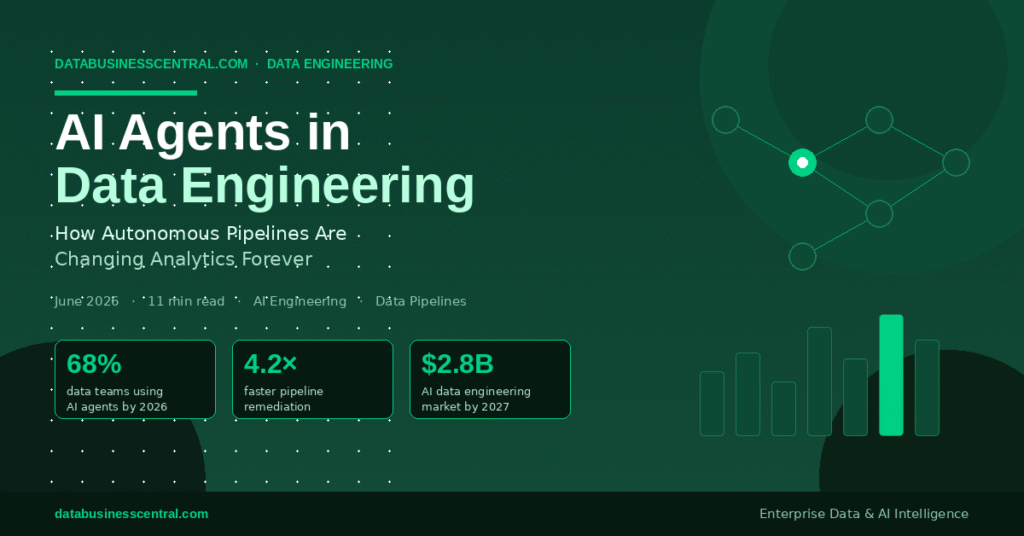
68% -of data engineering teams piloting AI agents in production pipelines by end of 2026
4.2× -faster mean-time-to-remediation for pipeline failures with agentic monitoring
$2.8B -projected AI data engineering market size by 2027, up from $480M in 2023
41% -reduction in data quality incidents reported by enterprises using autonomous data validation agents
The Pipeline Problem That AI Agents Are Finally Solving
Modern data infrastructure has a paradox at its core. The tools for building pipelines — dbt, Apache Spark, Airflow, Kafka, Flink — have become dramatically more powerful. But the operational burden of running those pipelines at scale hasn’t decreased proportionally. It has, in many organizations, grown faster than the teams tasked with managing it.
The reason is complexity explosion. A mid-sized enterprise data platform in 2026 might involve dozens of data sources, hundreds of transformation models, thousands of scheduled jobs, and millions of daily data events — all of which need to be monitored, maintained, and evolved as the business changes. Schema drift, API deprecations, upstream outages, data volume spikes, query regressions: these are not edge cases. They are the daily operational reality of production data infrastructure.
Traditional responses to this complexity have been additive: more observability tooling, more alerting thresholds, more documentation, more test coverage. These are valuable — but they share a common limitation. They detect problems and surface them to humans. They do not solve them.
“AI agents don’t just tell you the pipeline is broken. They diagnose why, propose a fix, implement it in a sandboxed environment, validate the output, and promote the change — all before your on-call engineer has finished reading the alert.”
This is the qualitative difference that agentic AI introduces to data engineering: the shift from reactive observability to autonomous remediation. And it extends far beyond incident response into the full lifecycle of how data pipelines are designed, built, optimized, and governed.
What Makes an AI Agent Different From Traditional Automation
It’s worth being precise here, because the term “AI agent” is used loosely enough to encompass everything from a rule-based alerting script to a fully autonomous multi-step reasoning system. For the purposes of data engineering, three properties define what makes a system genuinely agentic.
Goal-Directed Reasoning
A traditional automation script executes a fixed sequence of steps. An AI agent is given an objective — “ensure this pipeline produces accurate customer revenue figures by 6 a.m.” — and determines the sequence of actions needed to achieve it. If the first approach fails, it tries another. It can reason about tradeoffs, prioritize competing concerns, and adapt to novel situations that weren’t anticipated when the system was designed.
Tool-Augmented Execution
Modern data engineering agents operate by invoking tools: querying metadata catalogs, running SQL, reading logs, calling data quality APIs, modifying transformation code, triggering reprocessing jobs. The agent’s intelligence lies in knowing which tools to use, in which order, to solve a given problem — not in having all the answers pre-loaded.
Feedback-Driven Learning
Unlike static automation, agentic systems can incorporate feedback from their actions. An agent that tries a schema fix and observes that downstream data quality checks still fail will try a different approach. Over time, well-designed agentic systems build operational memory — a persistent understanding of which failure patterns correspond to which root causes and which remediation strategies work best in a given environment.
Key Distinction
Traditional automation asks: “What should happen in this specific situation?” Agentic AI asks: “What outcome do we need, and what’s the best sequence of actions to achieve it given current conditions?” This distinction sounds subtle. In practice, it’s the difference between a system that handles the expected and a system that handles the unexpected.
The Anatomy of an Autonomous Data Pipeline
An AI-augmented data pipeline looks structurally similar to a conventional one — ingestion, transformation, validation, serving — but agents are embedded at each stage, not just watching from the outside.
At the ingestion layer, agents monitor source system schema changes and automatically update ingestion configurations before failures occur. At the transformation layer, agents can identify when a dbt model’s logic no longer reflects business reality and propose updated transformation rules. At the validation layer, agents run statistical anomaly detection and flag records that pass syntactic checks but fail semantic coherence — the kind of subtle data quality issue that rule-based checks routinely miss. And at the serving layer, agents can proactively re-run and cache results in anticipation of usage spikes, or alert downstream consumers when data freshness guarantees cannot be met.
Six High-Impact Use Cases Redefining Data Engineering
Incident Response
🔧 Self-Healing Pipeline Remediation
Agents detect pipeline failures, trace root cause across logs and metadata, implement fixes in isolated environments, validate outputs, and promote changes — cutting MTTR from hours to minutes.
Data Quality
🔍 Autonomous Anomaly Detection
Beyond rule-based checks, agents apply statistical models to identify distributional drift, volume anomalies, and semantic inconsistencies that traditional data quality frameworks cannot catch.
Schema Management
🗂️ Proactive Schema Evolution
Agents monitor upstream source systems for schema changes, assess downstream impact, generate migration scripts, and update data contracts — before a breaking change reaches production.
Pipeline Generation
⚡ Natural Language Pipeline Authoring
Data analysts can describe business requirements in plain English; agents translate them into tested, documented, production-ready pipeline code — compressing weeks of engineering work into hours.
Optimization
📈 Cost and Performance Optimization
Agents continuously profile query patterns, identify expensive transformations, suggest partition strategies, and implement compute optimizations — autonomously reducing cloud data warehouse spend.
Lineage
🔗 Automated Data Lineage Documentation
Agents instrument pipelines to capture end-to-end data lineage automatically, generating human-readable documentation and impact analysis that stays current with every pipeline change.
Traditional vs. Agentic Pipelines: A Side-by-Side View
| Dimension | Traditional Pipeline | Agentic Pipeline | Winner |
|---|---|---|---|
| Failure Response | Alert fired → human investigates → manual fix | Agent detects, diagnoses, and remediates autonomously | Agentic |
| Schema Changes | Breaking change causes downstream failure | Agent detects upstream change, updates contracts proactively | Agentic |
| Data Quality | Rule-based checks; misses semantic anomalies | Statistical + semantic validation; context-aware flagging | Agentic |
| Pipeline Authoring | Engineer writes code from requirements document | Agent generates code from natural language; engineer reviews | Agentic |
| Cost Optimization | Periodic manual review; quarterly tuning cycles | Continuous autonomous profiling and optimization | Agentic |
| Predictability | Deterministic; behavior is explicit and auditable | Goal-directed; behavior must be governed and monitored | Traditional |
| Governance Overhead | Low; humans are the control mechanism | Higher; requires agent identity, audit logging, access controls | Traditional |
The Real Numbers: What Enterprises Are Reporting
Beyond benchmarks and vendor case studies, enterprise data teams running agentic pipelines in production are reporting a consistent pattern of outcomes across three dimensions.
Operational Efficiency
Organizations deploying AI agents for pipeline monitoring and remediation report a median reduction of 62% in time spent on reactive pipeline maintenance within the first six months of deployment. Data engineers describe spending significantly more time on strategic pipeline design and less on incident triage — a shift that has measurable impact on team retention and morale.
Data Quality Improvement
Teams using autonomous data quality agents report a 41% reduction in data quality incidents reaching downstream consumers, and a 73% improvement in mean-time-to-detection for data anomalies compared to threshold-based alerting. The improvement is most pronounced for the class of issues that rule-based systems consistently miss: subtle distributional shifts, business logic violations, and cross-table referential inconsistencies.
Pipeline Development Velocity
When AI agents assist with pipeline authoring — generating initial transformation code, writing documentation, creating test suites — teams report a 2.8× acceleration in time-to-production for new data products. The gains are not evenly distributed: junior engineers benefit most, with experienced engineers maintaining their velocity advantage in complex architectural design work where human judgment remains decisive.
“The agents don’t replace data engineers. They eliminate the work that was preventing data engineers from being engineers — and that’s an entirely different value proposition.”
Your Five-Step Implementation Roadmap
For data engineering leaders ready to move from interest to implementation, the following roadmap reflects the sequencing used by enterprises that have successfully deployed agentic data systems in production.
Start With Observability, Not Autonomy
Before giving agents the ability to act, give them the ability to see. Deploy agentic observability on your highest-criticality pipelines first — monitoring, anomaly detection, root-cause analysis. Build confidence in the agent’s diagnostic accuracy before enabling autonomous remediation.
Establish Agent Identity and Audit Infrastructure
Issue unique, scoped credentials to each agent. Implement session-level audit logging that captures every tool call, data access event, and action taken. Your compliance team will thank you; your governance team will require it.
Define Human-in-the-Loop Thresholds
Not every action should be fully autonomous. Define clear categories: which remediations agents can execute independently, which require human approval, and which are explicitly off-limits. These thresholds will evolve as you build trust in agent performance.
Instrument for Feedback and Learning
Build mechanisms for data engineers to rate agent actions — correct, incorrect, partially correct. This feedback loop is the foundation for improving agent performance over time and for identifying systematic gaps in agent reasoning about your specific data environment.
Expand Scope Incrementally, Measure Continuously
Resist the temptation to deploy agents across your entire data platform simultaneously. Expand scope pipeline by pipeline, use case by use case, measuring impact at each stage. The organizations with the most successful agentic deployments are those that treat it as an engineering discipline, not a product launch.
The Risks No One Is Talking About
The efficiency gains from agentic data engineering are real. So are the risks — and the most significant ones are structural rather than technical.
- Cascading autonomous failures. An agent that autonomously remediates one pipeline failure can, if poorly governed, introduce changes that cascade into failures elsewhere. Every autonomous action is a potential change event. Your change management and rollback infrastructure must be agent-aware.
- Skill atrophy in engineering teams. When agents handle routine pipeline maintenance and debugging, engineers may lose direct familiarity with low-level pipeline behavior. This creates fragility: when something goes wrong that the agent cannot handle, the human backup may be less capable than before. Maintaining engineering depth requires intentional design.
- Governance debt accumulation. Agents that are productive but ungoverned accumulate data access debt silently. Without agent identity management, audit logging, and access controls deployed from day one, you may discover months later that your agents have been operating with far broader data access than their tasks required.
- Explainability gaps in regulated industries. In sectors subject to data regulation — financial services, healthcare, insurance — the ability to explain why a specific data transformation was applied to a specific record is not optional. Ensure your agentic infrastructure produces explainable, auditable action logs before deploying in regulated contexts.
What This Means for the Future of Data Engineering
The data engineer of 2028 will not spend their days writing Airflow DAGs or debugging Spark jobs. Those tasks will largely be handled by agents. What they will do is something harder and more valuable: design the systems, set the objectives, define the guardrails, and make the judgment calls that autonomous systems cannot.
This is not a diminishment of the data engineering discipline. It is its elevation. The work that remains after agents absorb the routine is, by definition, the work that requires human expertise, institutional knowledge, and strategic judgment. If you invest in building the agentic infrastructure and the governance layer that keeps it trustworthy, you will end up with a data team that does more with less friction — and produces data products that are faster, more reliable, and more aligned with the business than anything built the old way.
The organizations building that infrastructure today are not just improving their pipelines. They are establishing the data foundation for whatever comes next in enterprise AI. And that is the real reason every data leader should be paying attention to AI agents — not because they are a trend, but because they are the infrastructure layer on which the next generation of competitive advantage will be built.
Explore the Full DataOps & AI Engineering Resource Hub
Frameworks, benchmarks, and implementation guides for data engineering leaders building autonomous data infrastructure.
