Not long ago, enterprise data governance meant writing policies for humans — data engineers who queried warehouses, analysts who pulled dashboards, and compliance teams who ran quarterly audits. The data moved when a person asked it to.
That model is now obsolete.
Today’s autonomous AI agents — large language model-powered systems that plan, reason, retrieve, and act without human intervention at each step — are querying enterprise databases, calling APIs, writing back to data stores, and orchestrating multi-step workflows that cross departmental and jurisdictional boundaries. They do all of this at machine speed, continuously, and often with access privileges designed for a very different era.
The result is what practitioners are starting to call the Agentic Data Dilemma: governance frameworks built for human-in-the-loop data usage are fundamentally mismatched with the autonomous, high-velocity, high-breadth data consumption patterns of AI agents. And the gap is widening fast.
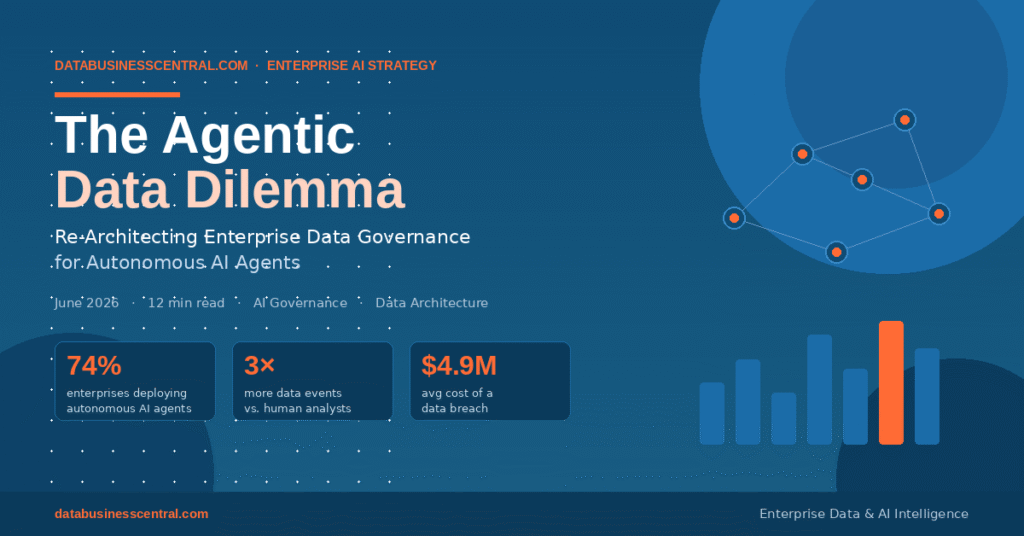
74%-of enterprises plan to deploy autonomous AI agents in production by end of 2026
3×-more data access events generated by AI agents vs. human analysts in early deployments
$4.9M-average cost of a data breach in 2025 — AI-related exposures rising fastest
61%-of CDOs say their governance policies were NOT designed with AI agents in mind
Why Traditional Governance Breaks Under Agentic AI
Enterprise data governance has evolved through distinct generational shifts. The first generation — the era of data warehouses and ETL pipelines — required governance to manage where data lived and who could see it. Role-based access control (RBAC), data classification schemas, and audit logging were the foundational instruments.
The second generation brought the cloud data lakehouse, streaming architectures, and self-service analytics. Governance had to manage how data moved — lineage tracking, data contracts, and schema registries became essential infrastructure.
We are now entering the third generation: agentic data governance. In this generation, governance must manage not just who accesses data and how it flows, but why an autonomous system is accessing it, what it intends to do with it, and what consequences its actions may trigger — all in real time, at scale.
“The old governance model assumed a human brain was always in the critical path. AI agents remove that assumption entirely — and expose every policy gap that the human presence was quietly papering over.”
Traditional RBAC was never designed to handle an agent that can simultaneously hold the permissions of a data analyst, a workflow orchestrator, and an API consumer — and invoke all of them in a single reasoning loop. Static, coarse-grained access controls create exactly the kind of overpermissioned agent profiles that become enterprise-scale attack surfaces and compliance liabilities.
What “Agentic” Actually Means for Your Data Stack
Before re-architecting governance, it’s worth being precise about what distinguishes an AI agent from previous categories of automated systems. Three properties are particularly important from a data governance perspective.
Autonomous Goal Pursuit
Unlike a scheduled ETL job or a deterministic microservice, an AI agent is given an objective and determines its own sequence of actions to achieve it. That means data access patterns are not predictable at design time. An agent tasked with “prepare the board’s quarterly risk report” might query financial data, pull customer churn metrics, call an external market data API, write interim results to a shared workspace, and trigger a notification — all without a pre-specified script. Governance systems that rely on known, catalogued query patterns will miss the novel access chains that agents create.
Tool Use and External API Calls
Modern AI agents operate through tool-calling interfaces — they invoke functions, APIs, and data retrieval systems as instruments. This means an agent’s data footprint extends beyond internal data warehouses to encompass third-party SaaS platforms, external APIs, browser-based information retrieval, and code execution environments. Enterprise data governance has historically stopped at the boundary of internally managed data. That boundary no longer exists.
Persistent Memory and Cross-Session Context
Long-running and memory-augmented agents accumulate context across sessions. They may store intermediate results, embed retrieved information into vector databases, or carry forward personal and organizational data across extended agentic workflows. This introduces a new class of data residency and retention risk that conventional data lifecycle management frameworks have no mechanism to address.
Key Insight
AI agents don’t just consume data — they also produce and propagate it. Every tool call, every retrieved document, every generated output is a potential data event. Governance frameworks that only monitor ingress will be blind to the majority of an agent’s actual data impact.
The Five Core Governance Gaps
Organizations deploying agentic AI systems at scale consistently encounter five structural gaps in their existing governance posture. Understanding these gaps is the prerequisite to closing them.
| Governance Gap | Root Cause | Risk Level | Primary Impact |
|---|---|---|---|
| Coarse-Grained Access Control | RBAC designed for human roles, not agent contexts | High | Overpermissioned agents; data exfiltration exposure |
| Audit Trail Fragmentation | Logs exist per-system, not per-agent-session | High | Inability to reconstruct agent decision chains for compliance |
| Invisible Data Lineage | Agents synthesize data from multiple untracked sources | High | Unverifiable provenance; regulatory non-compliance |
| Unmanaged External Tool Calls | Third-party API access not within governance scope | Medium | Shadow data flows; contractual violations |
| Agent Memory Persistence | No lifecycle policies for vector store / session memory | Medium | Retention violations; PII leakage across agent boundaries |
A Framework for Agentic Data Governance
Re-architecting enterprise data governance for autonomous AI agents requires a shift from policy-as-configuration to policy-as-enforcement infrastructure. The following five-pillar framework provides a structured approach to building that infrastructure without dismantling the governance investments organizations have already made.
Pillar 01
Agent Identity and Credential Management
Every AI agent must be issued a unique, scoped identity — not a borrowed human credential. Agent identities should map to minimum-viable permissions derived from the specific task context, not from a static role definition.
Pillar 02
Dynamic, Context-Aware Access Control
Replace static RBAC with policy engines capable of evaluating access requests in the context of the agent’s current task, session history, and the sensitivity classification of the requested data — in real time.
Pillar 03
End-to-End Agentic Lineage Tracking
Extend data lineage infrastructure to capture agent-generated data flows — including tool calls, external API retrievals, intermediate synthesized outputs, and any data written back to enterprise systems.
Pillar 04
Agent-Scoped Audit Logging
Instrument the agentic layer — not just the underlying data systems — to produce session-level audit trails that can reconstruct the full reasoning and action chain of any agent execution for forensic and compliance purposes.
Pillar 05
Memory and Retention Lifecycle Management
Treat agent memory stores — vector databases, session contexts, intermediate workspaces — as first-class data assets subject to classification, retention policies, access controls, and deletion schedules.
Implementing Agent-Aware Access Control
Of the five pillars, dynamic access control represents the most significant architectural departure from current enterprise practice. Most organizations today rely on one of two access control paradigms: role-based access control (RBAC), which grants permissions based on a user’s role, or attribute-based access control (ABAC), which evaluates permissions against a richer set of attributes at request time.
Neither paradigm was designed to handle the access context of an AI agent. What’s needed is a purpose-aware access control model — one that evaluates access requests against the declared purpose of the agent session, the sensitivity of the data, the risk profile of the intended action, and real-time behavioral anomaly signals.
The Four Evaluation Dimensions
Effective agentic access control evaluates every data access request across four dimensions simultaneously:
- Task context alignment — Does this data access request logically align with the task the agent was assigned? An agent tasked with generating a product roadmap summary should not be accessing payroll records, regardless of its technical permissions.
- Data sensitivity grade — Is the sensitivity classification of the requested data proportionate to the task purpose? Access to personally identifiable information (PII) or confidential financial data requires heightened justification even for agents with broad access profiles.
- Action risk level — Is the intended action read-only, or does it involve write-back, deletion, or external transmission? Higher-risk actions should trigger automated approval gates or human-in-the-loop checkpoints before execution.
- Behavioral baseline deviation — Is the agent’s current access pattern consistent with its historical behavior profile? Statistically anomalous access patterns — unusual data volumes, unexpected cross-domain queries, off-hours activity — should trigger real-time alerting.
Architecture Note
Implementing purpose-aware access control requires a policy decision point (PDP) that sits in the agentic orchestration layer — not just at the data system level. This means governance infrastructure must be integrated into the agent framework itself, whether that’s LangGraph, AutoGen, CrewAI, or a proprietary orchestration platform.
The Compliance Imperative: Regulatory Risk in the Agentic Era
For compliance and legal teams, agentic AI introduces a category of regulatory risk that existing frameworks are struggling to classify. The key question — one that regulators across the EU AI Act, NIST AI RMF, DORA, and emerging US state-level AI statutes are actively grappling with — is: who is accountable for the data actions of an autonomous agent?
The emerging consensus points to the organization that deploys the agent as the responsible party, regardless of whether the agent’s actions were anticipated or intended. This creates a direct organizational liability for every data action an AI agent takes — and a corresponding obligation to demonstrate that appropriate controls were in place.
What Regulators Are Looking For
- Explainability of agent decisions — Can the organization reconstruct why an agent accessed a particular data asset and what it did with that data? Session-level audit logs and lineage tracking are the foundational evidence.
- Data minimization compliance — Under GDPR and similar privacy regulations, the principle of data minimization applies regardless of whether the consumer is human or machine. Agents must be provably constrained to access only the data necessary for their defined purpose.
- Cross-border data transfer controls — Agents that call external APIs or retrieve data from third-party sources may inadvertently trigger cross-border data transfer obligations under GDPR, China’s PIPL, or similar frameworks. Automated tool-call governance must include jurisdictional checks.
- Right to erasure operationalization — If an AI agent has ingested, synthesized, or stored PII as part of its operation, subject access requests and right-to-erasure obligations extend to those agent-generated data stores. Vector databases and agent memory must be treated as regulated data repositories.
Building the Governance Roadmap: A 90-Day Sprint Model
For enterprise data and AI leaders tasked with closing the agentic governance gap, the challenge is rarely a shortage of ambition — it’s a shortage of a credible starting point. The following 90-day sprint model provides a structured acceleration path from current-state assessment to initial production governance capability.
Days 1–30: Inventory and Risk Triage
Begin with a comprehensive audit of all AI agents currently in production or pre-production deployment. For each agent, document its data access scope, the identity credentials it uses, the external tools and APIs it calls, and whether any form of session-level logging is in place. Score each agent against the five governance gap dimensions identified earlier. The output of this sprint is a prioritized risk register — the governance debt your organization has already accumulated.
Days 31–60: Identity and Logging Infrastructure
Issue unique, scoped identity credentials to all production agents and implement agent-scoped audit logging at the orchestration layer. This does not require replacing existing data governance infrastructure — it requires extending it. The most pragmatic approach integrates with existing SIEM and observability platforms via structured log emission from the agentic layer. By the end of this sprint, every data access event generated by an AI agent should be traceable to a specific agent identity, session, and task context.
Days 61–90: Dynamic Access Control and Lineage Integration
Deploy the policy decision point layer for purpose-aware access control, beginning with the highest-risk agents identified in the Day 1–30 triage. Simultaneously, extend the organization’s existing data lineage infrastructure — whether built on Apache Atlas, OpenLineage, or a commercial catalog — to ingest agentic lineage events. By Day 90, the governance team should have end-to-end visibility into what data every agent is touching, why, and what it’s doing with it.
“Agentic governance is not a project that waits until your AI strategy is mature. It’s the infrastructure that determines whether your AI strategy is trustworthy enough to scale.”
The Strategic Stakes
The organizations that will extract sustained competitive advantage from autonomous AI are not necessarily those that deploy the most agents or adopt AI fastest. They are the organizations that build the governance infrastructure to deploy AI at scale, with confidence — because they can demonstrate to their board, their regulators, their customers, and their partners that their AI systems operate within defined, auditable, and enforceable data boundaries.
The Agentic Data Dilemma is real, and it is urgent. But it is also solvable — not by slowing down AI adoption, but by building the governance layer that enables AI adoption to accelerate without accumulating unmanageable risk.
The enterprises that treat agentic data governance as a strategic capability rather than a compliance afterthought will be the ones that define the competitive landscape of the next five years. The question is not whether to build this infrastructure. The question is whether you build it proactively — or scramble to build it after the first incident.
Ready to Audit Your Agentic Governance Posture?
Explore DataBusinessCentral’s enterprise AI governance resource library — frameworks, checklists, and case studies for data and AI leaders navigating the agentic era.
