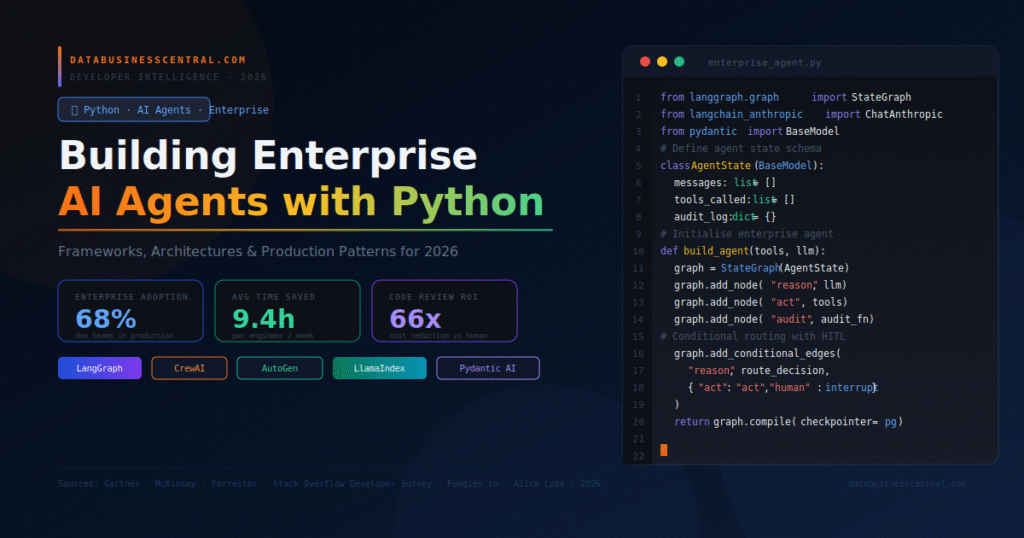
By mid-2026, 68% of enterprise development teams have moved beyond simple AI coding assistants to full agentic AI systems. These are not autocomplete tools. They are autonomous agents that plan, reason, use tools, and execute complex workflows with minimal human intervention. Companies that deployed agents in production saw an average 40% reduction in time-to-market for new features. Software engineers using production AI agents recover a median 9.4 hours per week—the highest productivity recovery of any enterprise function.
Python is the language of choice for building them. Every major agentic framework ships Python as its primary or only runtime. The ecosystem of tools, libraries, integrations, and observability infrastructure around Python agent development has no peer.
This guide covers everything a development team needs to move from the first agent prototype to a production-grade enterprise deployment: the frameworks that matter, the architectures that work at scale, the code patterns that separate agents that reach production from the 88% that never do, and the governance layer every production system requires.
Why Enterprise AI Agents Are Different from Chatbots
Before touching a framework, the distinction matters. A chatbot takes a question and returns text. An agent is a language model connected to systems—it has memory, it has tools, it has defined escalation paths and permissions.
The difference in outcome is categorical, not marginal. Consider an IT helpdesk scenario. A chatbot tells an employee which form to fill out. An agent reads the ticket, diagnoses the issue, checks the employee’s device inventory, provisions a replacement, and sends a confirmation—all without a human in the loop. The same cognitive distance separates agent-driven workflows from their chatbot predecessors across every enterprise function.
The numbers make this concrete. Code-review agents complete a routine pull request review for $0.72 versus $48 of senior-engineer time—a 66x cost reduction, per Forrester TEI studies and Anthropic enterprise data. Customer service agents resolve contained tickets for $0.46 versus $4.18 for human-handled cases. These are production figures from governed deployments, not benchmark estimates.
The 88% of agents that never reach production share a consistent failure profile: absent governance, missing observability, and no defined success metrics. The 12% that do succeed all start with the same four attributes: pre-deployment infrastructure investment, governance documentation before deployment, baseline metrics captured before pilots, and dedicated business ownership with post-deployment accountability.
Architecture and framework selection is where that success gap opens.
The Python Agent Framework Landscape in 2026
The framework decision is the most consequential choice a team makes in the first sprint. Porting between frameworks after production launch costs weeks. The right frame is not “which framework is most popular” but “which framework matches this workload shape.”
LangGraph: The Production Standard for Complex Workflows
LangGraph is the leading standard for production-grade agent systems in 2026. Built on LangChain, it models agent workflows as directed graphs—nodes represent functions or agents, edges represent transitions. Around 400 companies now use LangGraph Platform to deploy agents in production, including Cisco, Uber, LinkedIn, BlackRock, and JPMorgan.
The graph model handles cycles naturally. An agent that needs to retry a step, gather more information, or loop through a planning process is a graph with cycles. The developer defines when to move forward and when to loop back. Human-in-the-loop (HITL) support is a first-class primitive: LangGraph can interrupt at any node, accept modified state, and resume—which is what enterprise approval flows require. LangGraph Platform handles streaming, sessions, retries, and idempotency out of the box; rolling these manually is a multi-week engineering project.
Best for: Complex stateful workflows requiring branching logic, retry handling, and production-grade human oversight. Customer support escalation paths, multi-step data processing pipelines, and any system where auditing exact agent behavior is a compliance requirement.
GitHub: 33,900+ stars, 34.5 million monthly downloads.
A basic research agent in LangGraph:
python
from langgraph.graph import StateGraph
from langchain_anthropic import ChatAnthropic
from pydantic import BaseModel

class AgentState(BaseModel):
    messages: list = []
    tools_called: list = []
    audit_log: dict = {}

def build_agent(tools, llm):
    graph = StateGraph(AgentState)
    graph.add_node("reason", llm)
    graph.add_node("act", tools)
    graph.add_node("audit", audit_fn)

    # Conditional routing with human-in-the-loop
    graph.add_conditional_edges(
        "reason", route_decision,
        {"act": "act", "human": interrupt}
    )
    return graph.compile(checkpointer=postgres_checkpointer)
The checkpointer parameter is the most important production detail. In-memory checkpointing works for prototypes. For production agents that must survive restarts, resume interrupted workflows, and support time-travel debugging, PostgreSQL-backed checkpointing is the standard.
CrewAI: Role-Based Multi-Agent Teams
CrewAI models agents as a team of specialists—each with a role, a goal, and a backstory—that collaborate on shared tasks. It reached 52,800 GitHub stars and 5.2 million monthly downloads in under two years, growing faster than any other Python agent framework. Its coordination model maps naturally to how product teams think: a researcher, an analyst, a writer, and a reviewer each with defined responsibilities.
CrewAI requires 30 to 60 lines of code to reach a first working agent, versus 80 to 150 for LangGraph. The tradeoff is control: complex conditional branching requires workarounds that LangGraph handles natively.
python
from crewai import Agent, Task, Crew

researcher = Agent(
    role="Senior Research Analyst",
    goal="Find current enterprise AI adoption data",
    backstory="Expert in enterprise technology research",
    tools=[web_search_tool, database_tool],
    llm=llm
)

analyst = Agent(
    role="Data Analyst",
    goal="Synthesize research into executive insights",
    backstory="Specializes in agentic AI market analysis",
    llm=llm
)

research_task = Task(
    description="Research Q2 2026 enterprise AI adoption metrics",
    agent=researcher,
    expected_output="Verified statistics with source citations"
)

crew = Crew(agents=[researcher, analyst], tasks=[research_task])
result = crew.kickoff()
Best for: Role-based multi-agent workflows where task delegation mirrors how human teams operate. Intuitive to design and easy to explain to non-technical stakeholders.
Microsoft AutoGen / Agent Framework
Microsoft merged AutoGen with Semantic Kernel into the unified Microsoft Agent Framework (MAF), which shipped Python and .NET at GA on April 3, 2026. AutoGen popularized the idea of agents collaborating through structured conversation, with no central controller enforcing a strict execution path. The conversation itself drives progress. This makes it ideal for exploratory, research-driven, and creative multi-agent systems—at the cost of the predictability and strict execution control that most enterprise production environments require.
For teams already on the Microsoft stack (Azure AI Foundry, Azure OpenAI), MAF is the forward path. For Python-first stacks not tied to Microsoft, LangGraph has a larger ecosystem and more community resources.
Best for: Conversational multi-agent experimentation, coding agents, brainstorming systems, and enterprise teams invested in the Azure ecosystem.
LlamaIndex Workflows: Document-Heavy and RAG-Intensive Pipelines
LlamaIndex provides the best indexing primitives in the Python ecosystem. Its Workflows framework handles event-driven orchestration for document-heavy, data-intensive pipelines—the right choice when retrieval-augmented generation (RAG) is the core product requirement. Novo Nordisk implemented it for data science workflows. Finance teams building agents over large document corpora consistently reach for LlamaIndex first.
Best for: Agents that primarily reason over large document sets—contracts, research papers, financial filings, technical documentation. RAG is the center of the product.
Pydantic AI: Type-Safe, FastAPI-Ergonomic Agent Development
Pydantic AI is the newest framework gaining production traction in 2026. Teams that prioritize type safety, structured responses, and FastAPI-style ergonomics report excellent developer experience. Production references are growing, the ecosystem is smaller than LangChain’s, and it pairs naturally with Langfuse for observability.
Best for: Teams building FastAPI-based agent services who want strict type guarantees and Pydantic’s validation ecosystem throughout their agent stack.
The Five-Layer Production Architecture
Framework selection is the first decision. Production architecture is the second—and it is where most pilots stall. The enterprises delivering the strongest outcomes in 2026 share a five-layer architecture pattern.
Layer 1: Model Layer
The model layer is the reasoning engine. In Python enterprise stacks, langchain_anthropic, langchain_openai, and provider SDKs handle model calls. The critical production decision is whether to hardcode a single provider or design for provider agnosticism from the start. LangChain’s model-agnostic design prevents costly migrations when providers change pricing or policies—a real risk that has already forced rewrites at several large deployments.
python
from langchain_anthropic import ChatAnthropic

llm = ChatAnthropic(
    model="claude-sonnet-4-6",
    temperature=0,          # Determinism for enterprise workflows
    max_tokens=8192,
    timeout=30,
    max_retries=3
)
Set temperature=0 for enterprise workflows that require deterministic, auditable outputs. Reserve higher temperatures for creative tasks where variability is acceptable.
Layer 2: Tool Layer
Tools are how agents interact with the world—APIs, databases, internal systems, search engines, code execution environments. LangGraph exposes 100+ pre-built tools through LangChain. CrewAI includes 20+ common tools. AutoGen requires manual tool definitions, which gives more control but costs time.
python
from langchain.tools import tool
from langchain_community.tools import DuckDuckGoSearchRun
from pydantic import BaseModel

class DatabaseQueryInput(BaseModel):
    query: str
    table: str
    limit: int = 100

@tool("database_query", args_schema=DatabaseQueryInput)
def query_enterprise_db(query: str, table: str, limit: int) -> str:
    """Query the enterprise database with audit logging."""
    audit_log_access(table, query)  # Always audit before execution
    result = db.execute(query, table, limit)
    return format_result(result)

tools = [
    DuckDuckGoSearchRun(),
    query_enterprise_db,
    internal_knowledge_base_tool,
    crm_lookup_tool
]
Every tool that touches production data requires audit logging before execution. This is not optional in regulated environments—it is the difference between a deployment that survives a compliance review and one that doesn’t.
Layer 3: Memory and State Layer
Enterprise agents require three types of memory:
In-context memory holds the current conversation and tool call history within a single agent run. This is managed automatically by LangGraph’s AgentState schema.
Short-term memory persists state across multiple agent turns within a session. PostgreSQL-backed checkpointers in LangGraph handle this natively.
Long-term memory enables agents to recall information from past interactions. Production implementations use vector stores (Pinecone, Weaviate, pgvector) for semantic retrieval combined with structured databases for factual lookups.
python
from langgraph.checkpoint.postgres import PostgresSaver
from langchain_community.vectorstores import PGVector

# Durable state persistence
checkpointer = PostgresSaver.from_conn_string(DATABASE_URL)

# Long-term semantic memory
vector_memory = PGVector(
    connection_string=DATABASE_URL,
    embedding_function=embeddings,
    collection_name="agent_memory"
)

# Retrieve relevant past context
def get_memory_context(query: str, k: int = 5) -> list:
    return vector_memory.similarity_search(query, k=k)
Layer 4: Orchestration Layer
Orchestration defines how agent nodes connect, how decisions route between them, and how human oversight integrates into the workflow. For LangGraph, this means conditional edges, interrupt points, and checkpointer-backed state management.
The human-in-the-loop pattern is the most important production orchestration decision. 70% of leaders identify non-deterministic outputs as the number one production-readiness barrier. HITL interrupts at decision nodes—before an agent takes a high-stakes action—are how enterprises manage that unpredictability.
python
from langgraph.graph import StateGraph, END
from langgraph.checkpoint.postgres import PostgresSaver

def route_decision(state: AgentState) -> str:
    """Route to human review if action risk score exceeds threshold."""
    last_action = state.proposed_actions[-1]
    if last_action.risk_score > ENTERPRISE_RISK_THRESHOLD:
        return "human_review"
    if state.iteration_count > MAX_ITERATIONS:
        return "escalate"
    return "execute"

graph = StateGraph(AgentState)
graph.add_node("plan", planning_node)
graph.add_node("execute", execution_node)
graph.add_node("human_review", human_review_node)
graph.add_node("audit", audit_node)

graph.add_conditional_edges("plan", route_decision, {
    "execute": "execute",
    "human_review": "human_review",
    "escalate": END
})
Layer 5: Observability Layer
Without observability, enterprise agents cannot be debugged, evaluated, or governed. The observability stack that 2026 production deployments converge on is: LangSmith for LangGraph deployments, Langfuse for CrewAI and Pydantic AI, and Azure Application Insights for Semantic Kernel.
41% of stalled programs—per MIT Sloan’s 2026 longitudinal study—had no automated eval running at month 12. Programs without continuous evaluation lost 14 to 23 percentage points of accuracy over 18 months relative to their month-three baseline. Observability is not a post-launch concern. It is a sprint-one requirement.
python
from langsmith import Client
from langchain.callbacks import LangChainTracer

# Production observability
tracer = LangChainTracer(
    project_name="enterprise-agent-prod",
    client=Client(api_url=LANGSMITH_API_URL, api_key=LANGSMITH_API_KEY)
)

# Cost and latency tracking
def track_agent_run(agent_func):
    def wrapper(*args, **kwargs):
        with tracer.trace("agent_run") as run:
            start_time = time.time()
            result = agent_func(*args, **kwargs)
            latency = time.time() - start_time
            run.log_metrics({
                "latency_ms": latency * 1000,
                "tokens_used": result.usage.total_tokens,
                "cost_usd": calculate_cost(result.usage)
            })
            return result
    return wrapper
The Production Deployment Checklist
The gap between a working prototype and a production agent is not technical capability—it is operational discipline. Here is what separates the 12% that ship from the 88% that stall.
Governance before deployment. Define who owns the agent’s behavior, who owns the data it accesses, and who owns incidents when they occur. The accountability structure must be documented before a line of production code is written.
Baseline metrics before pilots. 22% of agent deployments report negative ROI at 12 months—almost always tied to scope creep, missing evals, or absent ownership. If there is no pre-deployment baseline, ROI cannot be measured and executive support cannot be sustained past the pilot phase.
Scoped tool permissions. Agents should have access only to the tools required for their designated task. Broad permissions are the primary source of the security incidents that 88% of enterprises with deployed agents have experienced.
Evaluation harness from sprint one. A regression test suite that runs on every prompt change is the single investment that most reliably separates agents that compound in value over time from agents that degrade silently.
Cost monitoring from launch. LLM API costs for multi-step agents run 5 to 20 times the tokens of a single chat call. Eval-and-integration cost amortization adds another 28 to 44% on top of raw token costs, per Forrester’s mature deployment data. Unmonitored costs are the most common reason enterprise AI programs lose executive support.
Production Outcomes: What Python-Built Agents Deliver
The ROI data from production Python agent deployments is consistent across research organizations. The median knowledge worker recovers 6.4 hours per week. Software engineers recover 9.4 hours—the highest of any enterprise function. Code-review agents deliver 66x cost-per-task reduction. Customer service agents deliver 9x cost-per-task reduction.
Klarna’s customer support bot, built on LangGraph, handles two-thirds of all customer inquiries, doing the work of 853 employees and saving $60 million annually. AppFolio’s Copilot Realm-X improved response accuracy by 2x. Elastic uses LangGraph for AI-powered threat detection in SecOps workflows. These are not research projections—they are production numbers from Python-built agents operating at enterprise scale.
The median payback period is 4.1 months for customer service deployments, 3.4 months for SDR agents, and 9.3 months for engineering workflows. The average enterprise deployment delivers 171% ROI—192% in the US, per BCG and Forrester.
The companies capturing those returns are not the ones with the best models. They are the ones with the best architecture—and the discipline to build governance, observability, and evaluation into their Python agent stacks from sprint one, not after the first incident.

3 thoughts on “Building Enterprise AI Agents with Python”
Pingback: Best Python Libraries for AI Agents 2026 Guide
Pingback: Async Python for Multi-Agent Systems: 2026 Guide
Pingback: Creating Autonomous AI Workflows with Python 2026