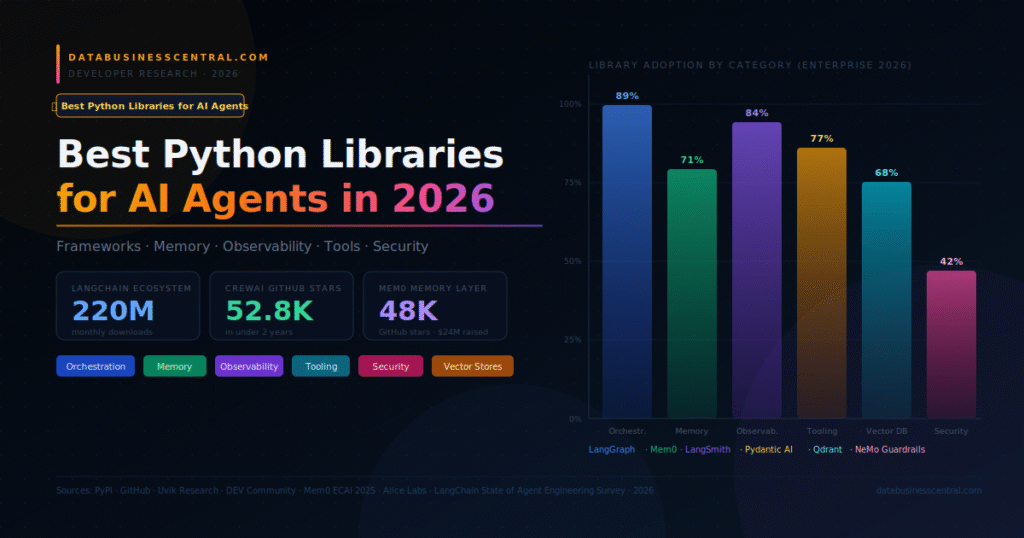
Python did not become the language of AI agents by accident. Every major agentic framework ships Python as its primary runtime. The ecosystem of orchestration libraries, memory layers, observability tools, vector stores, and security guardrails built around Python has no peer in any other language. <cite index=”40-1″>LangChain integrates with more than 700 third-party connectors as of May 2026—the largest integration library in the ecosystem.</cite>
Yet the Python AI agent library landscape in 2026 is fragmented in ways that catch teams off guard. Twelve production-grade frameworks are under active development. Six distinct memory architectures compete for the same use cases. <cite index=”40-1″>RAG is no longer a framework decision—it is a layer decision.</cite> Teams that treat library selection as a single choice rather than a stack decision end up refactoring months into production.
This guide cuts through the noise. It covers the libraries that matter across six functional categories—orchestration, memory, observability, tooling, vector stores, and security—with the selection criteria that separate libraries worth deploying from libraries worth watching.
Category 1: Orchestration Libraries
Orchestration is where the agent reasoning loop lives. The library you choose here determines your branching logic, state management, human-in-the-loop capabilities, and error recovery patterns. It is also the hardest decision to reverse.
LangGraph — The Production Default
<cite index=”25-1″>LangGraph has over 33,900 GitHub stars and 34.5 million monthly downloads. It focuses on building controllable, stateful agents that maintain context throughout interactions, and integrates with LangSmith for monitoring agent performance.</cite> <cite index=”42-1″>The combined LangChain ecosystem—core package plus langchain-core, community, and integration packages—now exceeds 220 million monthly downloads.</cite>
LangGraph models agent workflows as directed state machines. Nodes represent discrete functions or agents. Edges are transitions. Conditional edges route based on runtime state. The architecture handles retry loops, branching logic, and human-in-the-loop interrupts as first-class design primitives rather than workarounds.
<cite index=”25-1″>Around 400 companies now use LangGraph Platform to deploy agents in production, including Cisco, Uber, LinkedIn, BlackRock, and JPMorgan. Klarna’s customer support bot handles two-thirds of all customer inquiries, doing the work of 853 employees and saving the company $60 million.</cite>
python
from langgraph.graph import StateGraph
from langgraph.checkpoint.postgres import PostgresSaver
from pydantic import BaseModel

class AgentState(BaseModel):
    messages: list = []
    tool_calls: list = []
    iteration: int = 0

def build_production_agent(llm, tools):
    graph = StateGraph(AgentState)
    graph.add_node("reason", llm.bind_tools(tools))
    graph.add_node("act", execute_tools)
    graph.add_conditional_edges(
        "reason",
        should_continue,
        {"continue": "act", "end": "__end__", "human": interrupt}
    )
    checkpointer = PostgresSaver.from_conn_string(DATABASE_URL)
    return graph.compile(checkpointer=checkpointer)
The PostgresSaver checkpointer is the single most important production detail. In-memory checkpointing loses state on process restart. PostgreSQL-backed checkpointing enables time-travel debugging, workflow resumption after failures, and the kind of audit trail that regulated enterprise environments require.
Install: pip install langgraph langchain-anthropic Best for: Complex stateful workflows, multi-step pipelines with branching, regulated deployments requiring full auditability.
CrewAI — Fastest Path to Multi-Agent Systems
<cite index=”25-1″>CrewAI orchestrates role-playing AI agents for collaborative tasks. Launched in early 2024, it has over 52,800 GitHub stars and 5.2 million monthly downloads.</cite> Its role-based abstraction produces working multi-agent systems in twenty to fifty lines of Python—roughly a third of the code LangGraph requires for equivalent functionality.
python
from crewai import Agent, Task, Crew, Process

analyst = Agent(
    role="Data Intelligence Analyst",
    goal="Extract enterprise AI adoption metrics",
    backstory="Expert in synthesizing enterprise technology research",
    tools=[search_tool, database_tool],
    verbose=True
)

writer = Agent(
    role="Technical Writer",
    goal="Produce executive-ready summaries",
    backstory="Translates complex data into decision-ready insights",
    llm=llm
)

task = Task(
    description="Research and summarize Q2 2026 AI agent ROI data",
    agent=analyst,
    expected_output="Verified data points with source attribution"
)

crew = Crew(
    agents=[analyst, writer],
    tasks=[task],
    process=Process.sequential
)
Install: pip install crewai Best for: Role-based task delegation, multi-agent prototypes, workflows that map naturally to team structures.
Pydantic AI — Type Safety for Production Agents
<cite index=”48-1″>Pydantic AI, built by the team behind Pydantic itself, treats AI agents like well-typed functions. With 16,800 GitHub stars and a stable 1.x API since late 2025, it has become the default choice for teams that already use Pydantic for data validation. The standout feature is type safety that catches errors at write time, not runtime.</cite>
<cite index=”46-1″>In Pydantic AI, your output models are Python dataclasses or Pydantic models—the framework literally won’t return a response that fails validation.</cite> For enterprise agents where a malformed LLM response should never silently corrupt downstream systems, that validation-at-the-framework-level is a significant operational guarantee.
python
from pydantic_ai import Agent
from pydantic import BaseModel
from dataclasses import dataclass

class AnalysisResult(BaseModel):
    summary: str
    confidence: float
    data_sources: list[str]
    risk_flags: list[str] = []

@dataclass
class AgentDeps:
    database_conn: DatabaseConn
    user_id: int

agent = Agent(
    "anthropic:claude-sonnet-4-6",
    output_type=AnalysisResult,
    deps_type=AgentDeps,
    instructions="Analyze enterprise data and return structured results."
)

result = await agent.run(
    "Summarize Q2 AI adoption metrics",
    deps=AgentDeps(database_conn=db, user_id=42)
)
# result.output is guaranteed to be a valid AnalysisResult
<cite index=”39-1″>Pydantic AI supports virtually every model and provider: OpenAI, Anthropic, Gemini, DeepSeek, Grok, Cohere, Mistral, and Perplexity—plus Azure AI Foundry, Amazon Bedrock, Google Cloud, Ollama, LiteLLM, and dozens more.</cite>
Install: pip install pydantic-ai Best for: Teams already using Pydantic, FastAPI-style developer experience, systems where structured output validation is a hard requirement.
Category 2: Memory Libraries
An agent without persistent memory forgets everything between sessions. <cite index=”55-1″>AI agents without memory are stateless by design—each LLM call is independent, and anything learned in session one is gone by session two unless the developer manually reconstructs context.</cite> <cite index=”55-1″>Persistent memory reduces token usage by 30–60% for repeated tasks by replacing verbose context reconstruction with targeted memory retrieval.</cite>
Mem0 — The Standard Standalone Memory Layer
<cite index=”51-1″>Mem0 is the most widely adopted standalone memory layer for AI agents, with roughly 48,000 GitHub stars and a multi-store architecture that combines vector search, graph relationships, and key-value storage.</cite> <cite index=”55-1″>With a $24M Series A closed in October 2025 and YC backing, Mem0 has become the default choice for teams that want to bolt production-grade memory onto an existing agent in under a day.</cite>
python
from mem0 import MemoryClient
from langgraph.graph import StateGraph

memory = MemoryClient(api_key=MEM0_API_KEY)

def memory_aware_node(state: AgentState):
    # Retrieve relevant memories for this user
    relevant_memories = memory.search(
        query=state.messages[-1]["content"],
        user_id=state.user_id,
        limit=5
    )

    # Inject memories into context
    memory_context = "\n".join([m["memory"] for m in relevant_memories])
    enriched_prompt = f"Past context:\n{memory_context}\n\nCurrent request: {state.messages[-1]['content']}"

    response = llm.invoke(enriched_prompt)

    # Store new learnings
    memory.add(
        messages=state.messages,
        user_id=state.user_id
    )
    return {"messages": state.messages + [response]}
<cite index=”55-1″>Mem0’s adaptive memory runs a three-step pipeline on every add: extract discrete facts, check each fact against existing memories for semantic overlap, then decide whether to insert, update, or discard. A user who says “I prefer Python” in session one and “use Python, not JavaScript” in session five doesn’t accumulate two conflicting entries—Mem0 detects the semantic overlap and updates the single canonical preference.</cite>
Install: pip install mem0ai 20 vector store backends supported, including Qdrant, Chroma, Weaviate, Milvus, pgvector, Pinecone, and Redis.
LangMem — Native LangGraph Memory
<cite index=”57-1″>If you are building in Python and already use LangGraph, LangMem is the lowest-friction entry point.</cite> It exposes memory as a native LangGraph store, enabling agents to read and write long-term memory within the same graph execution model used for everything else. The tradeoff is ecosystem coupling—LangMem requires LangGraph and adds friction if you later move frameworks.
Install: pip install langmem Best for: LangGraph-native stacks where adding another vendor is not acceptable.
Category 3: Observability Libraries
<cite index=”32-1″>47% of stalled programs had no automated eval running at month 12, and programs without continuous eval lost 14–23 percentage points of accuracy over 18 months relative to their month-three baseline.</cite> Observability is not a post-launch concern. It determines whether the agent compounds in value or degrades silently.
LangSmith — The Agent Tracing Standard
LangSmith provides distributed tracing, evaluation pipelines, prompt versioning, and cost tracking for LangChain and LangGraph deployments. It is framework-agnostic in practice—89% of agent practitioners in the State of Agent Engineering survey have implemented observability, and LangSmith is the leading tracing layer across the ecosystem.
python
from langsmith import Client, traceable

client = Client(api_url=LANGSMITH_URL, api_key=LANGSMITH_KEY)

@traceable(name="enterprise_agent_run", project_name="prod-agents")
async def run_agent(query: str, user_id: str):
    with client.trace("agent_execution") as run:
        result = await agent.run(query, deps=deps)
        run.log_metrics({
            "tokens_used": result.usage.total_tokens,
            "cost_usd": calculate_cost(result.usage),
            "latency_ms": result.latency * 1000,
            "output_valid": result.validation_passed
        })
    return result
Install: pip install langsmith Pricing: Free tier available. Paid from $39/seat/month.
Pydantic Logfire — OpenTelemetry-Native Observability
For teams using Pydantic AI, <cite index=”39-1″>Logfire is the observability platform from the Pydantic team, providing real-time debugging, evals-based performance monitoring, and behavior, tracing, and cost tracking through native OpenTelemetry integration.</cite> The shared provenance with Pydantic AI means zero configuration friction—structured agent outputs and structured traces share the same schema conventions.
Install: pip install logfire
Category 4: Tooling and Integration Libraries
Tools are how agents interact with the world. The quality of tool libraries determines how quickly a team can connect an agent to real systems.
MCP (Model Context Protocol) — The Tool Interoperability Standard
The Model Context Protocol reached 97 million downloads within months of release and now has 1,000+ servers in its ecosystem. MCP standardizes how agents connect to external tools and data sources—databases, APIs, file systems, search engines—without bespoke integration code for each connection.
python
from langchain_mcp_adapters import MCPToolkit

# Connect to any MCP-compatible service
toolkit = MCPToolkit(server_url="https://mcp.yourservice.com/sse")
tools = toolkit.get_tools()

# Tools are immediately usable in any LangGraph or Pydantic AI agent
agent = build_production_agent(llm, tools)
Every major agent framework in 2026 supports MCP natively. Standardizing on MCP-compatible tools from the start prevents the bespoke integration debt that slows enterprise deployments.
LangChain Community Tools — 700+ Pre-Built Integrations
python
from langchain_community.tools import (
    DuckDuckGoSearchRun,
    WikipediaQueryRun,
    PythonREPLTool,
    SQLDatabaseTool
)
from langchain_community.utilities import SQLDatabase

# Instantly connect agents to databases, search, and code execution
db_tool = SQLDatabaseTool(db=SQLDatabase.from_uri(DATABASE_URL))
search_tool = DuckDuckGoSearchRun()
code_tool = PythonREPLTool()
Install: pip install langchain-community
Category 5: Vector Store Libraries
Vector stores provide the semantic retrieval infrastructure that powers RAG pipelines, agent long-term memory, and knowledge base search. The right choice depends on scale requirements, deployment model, and retrieval complexity.
Qdrant — Flexible Payload Filtering at Scale
<cite index=”53-1″>Qdrant is known for its payload filtering, which is among the most flexible in the category.</cite> Its filtering model enables agents to retrieve documents by semantic similarity combined with structured metadata conditions—critical for enterprise deployments where agents must respect data access controls at the vector retrieval layer.
python
from qdrant_client import QdrantClient
from qdrant_client.models import Filter, FieldCondition, MatchValue

client = QdrantClient(url=QDRANT_URL, api_key=QDRANT_KEY)

# Semantic search with access control filtering
results = client.search(
    collection_name="enterprise_docs",
    query_vector=embedding,
    query_filter=Filter(
        must=[
            FieldCondition(
                key="department",
                match=MatchValue(value=user.department)
            ),
            FieldCondition(
                key="clearance_level",
                range={"lte": user.clearance_level}
            )
        ]
    ),
    limit=10
)
Install: pip install qdrant-client
pgvector — Postgres-Native Vector Search
For teams already running PostgreSQL, pgvector adds vector similarity search without introducing a separate infrastructure component. LangGraph’s PostgreSQL checkpointer and pgvector can share the same database—simplifying the operational footprint for teams that want to minimize managed services.
Install: pip install pgvector psycopg2-binary
Category 6: Security and Guardrails Libraries
<cite index=”8-1″>88% of enterprises deploying AI agents report security incidents. Only 14% of organizations have prompt injection detection capabilities, and just 8% have documented agent incident response procedures.</cite> Security is the most systematically underinvested layer of the Python AI agent stack in 2026.
NeMo Guardrails — Programmable Agent Safety
NVIDIA’s NeMo Guardrails provides programmable safety rails for LLM-powered agents. It enables topic restrictions, output validation, jailbreak resistance, and custom policy enforcement—all defined in Colang, a purpose-built guardrail specification language.
python
from nemoguardrails import RailsConfig, LLMRails

config = RailsConfig.from_path("./guardrails_config")
rails = LLMRails(config)

# Agent responses automatically validated against defined rails
response = await rails.generate_async(
    messages=[{"role": "user", "content": user_query}]
)
Install: pip install nemoguardrails
LLM Guard — Input/Output Scanning
LLM Guard provides a security toolkit for scanning agent inputs and outputs to prevent prompt injection, sensitive data leakage, and toxic content generation. It integrates at the tool-call boundary rather than the model layer—the right place to catch security issues before they propagate through multi-step agent workflows.
Install: pip install llm-guard
The Full Production Stack
No single library covers all six categories. The production Python AI agent stack in 2026 is a deliberate composition:
| Layer | Primary Choice | Alternative |
|---|---|---|
| Orchestration | LangGraph | Pydantic AI / CrewAI |
| Memory | Mem0 | LangMem (LangGraph-native) |
| Observability | LangSmith | Logfire (Pydantic AI) |
| Tool Integration | MCP + LangChain Community | Custom via @tool decorator |
| Vector Store | Qdrant | pgvector (Postgres-native) |
| Security | NeMo Guardrails | LLM Guard |
The selection criteria across all six layers converge on two questions: does this library have a stable production API, and does it integrate without friction with the other layers in the stack?
<cite index=”45-1″>Framework choice is necessary but insufficient. Production agents also need observability, guardrails, evaluation harnesses, and a deployment story. Underestimating these is the most common reason agent projects stall after a successful demo.</cite>
The teams delivering the strongest outcomes in 2026 are not the teams with the most sophisticated models. They are the teams that composed the right libraries across all six layers, built governance and evaluation infrastructure before launch, and measured outcomes against defined baselines from day one.
Quick Selection Decision Tree
Building a complex stateful workflow with HITL? → LangGraph + LangSmith + Mem0
Need a working multi-agent prototype in an hour? → CrewAI + LangSmith
FastAPI shop that values type safety above all else? → Pydantic AI + Logfire
RAG-heavy document pipeline? → LlamaIndex Workflows + Qdrant + LangSmith
Already on Azure/Microsoft stack? → Microsoft Agent Framework + LangSmith
Regulated industry requiring full audit trail? → LangGraph + pgvector + NeMo Guardrails + LangSmith
The libraries listed above are all open-source under MIT or Apache 2.0 licenses. The cost of running a Python AI agent stack is not the libraries—it is the LLM API calls the agents make, which for multi-step enterprise workflows can run 5 to 20 times the tokens of a single chat call. Getting the library stack right is how you control the cost structure of what you deploy on top of it.

2 thoughts on “Best Python Libraries for AI Agents in 2026”
Pingback: Building Your First AI Agent in Python (2026 Guide)
Pingback: Python vs Power BI: What to Learn First in 2026