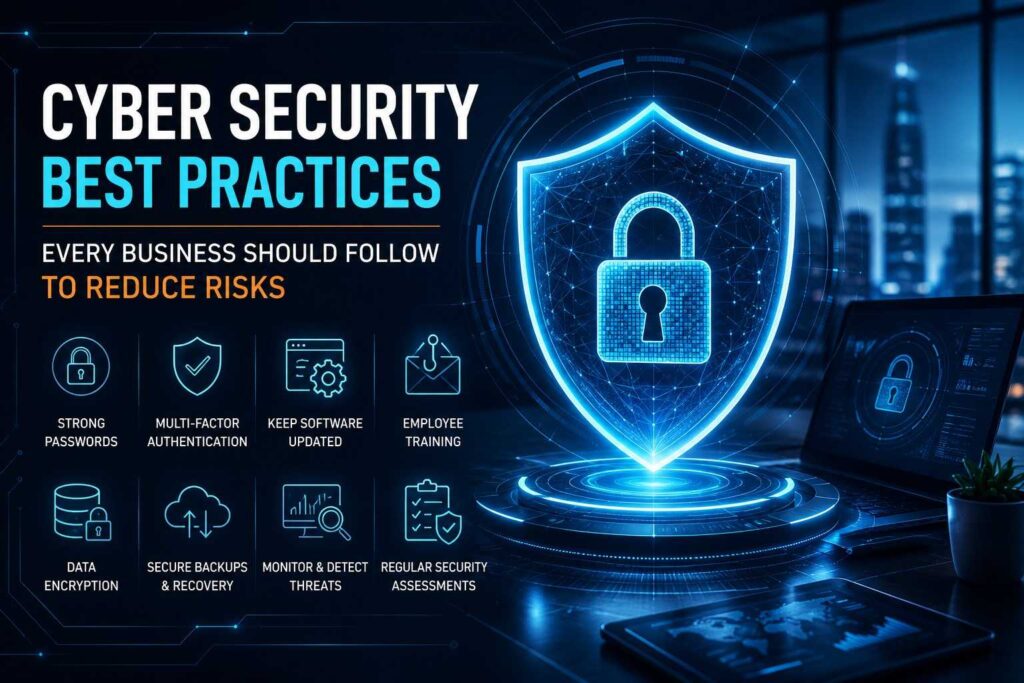
Cyber threats continue to evolve, making strong cyber security practices essential for businesses of every size. From phishing attacks and ransomware to insider threats and supply chain vulnerabilities, organisations face increasing pressure to protect sensitive information while maintaining business continuity.
Implementing proven cyber security best practices helps reduce security risks, improve regulatory compliance, and build customer trust. Rather than reacting to incidents after they occur, businesses should focus on creating a proactive security strategy that combines people, processes, and technology.
Why Cyber Security Matters More Than Ever
Cyber attacks can lead to financial losses, operational disruption, regulatory penalties, and long-term reputational damage. Even a single successful attack can expose confidential customer information and interrupt critical business operations.
Small and medium-sized businesses are increasingly targeted because attackers often view them as having fewer security controls than larger enterprises. Every organisation should treat cyber security as a business priority rather than simply an IT responsibility.
1. Enable Multi-Factor Authentication Across All Accounts
Passwords alone cannot adequately secure modern business infrastructure. Multi-factor authentication provides a necessary second layer of identity verification, drastically complicating an attacker’s ability to breach accounts with stolen login details. Businesses should require multi-factor authentication for email, cloud platforms, remote access, administrative accounts, and any application containing sensitive information.
2. Keep Software and Systems Up to Date
Outdated software remains one of the most common entry points for cyber criminals. Security patches often address vulnerabilities that attackers actively exploit shortly after they become public.
Establish a structured patch management process to ensure operating systems, business applications, network devices, and cloud services receive updates as quickly as practical.
3. Train Employees to Recognise Cyber Threats
Employees are often the first line of defence against cyber attacks. Regular awareness training helps staff identify phishing emails, suspicious links, fraudulent attachments, and social engineering attempts.
Training should be continuous rather than a one-time activity. Simulated phishing exercises can also help organisations measure awareness and identify areas requiring additional education.
4. Apply the Principle of Least Privilege
Not every employee requires access to every business system. Limiting user permissions reduces the potential damage if an account becomes compromised.
Review access rights regularly and remove unnecessary privileges, inactive accounts, and shared credentials. Access should always align with each employee’s role and responsibilities.
5. Encrypt Sensitive Business Data
Encryption protects confidential information even if attackers gain access to systems or devices. Businesses should encrypt customer records, financial information, intellectual property, and employee data both in transit and at rest.
Encryption should also extend to portable devices, cloud storage, and backup systems to minimise exposure following a security incident.
6. Maintain Reliable Backup and Recovery Processes
Backups remain one of the most effective defences against ransomware and accidental data loss. Without tested backups, recovering critical business information can become expensive and time-consuming.
Following the 3-2-1 backup strategy helps improve resilience by maintaining multiple copies of important data across different storage locations, including one offline copy.
7. Continuously Monitor Your Environment
Modern cyber attacks often remain undetected for extended periods before causing noticeable damage. Continuous monitoring enables organisations to identify suspicious behaviour before it escalates into a major incident.
Security monitoring should include endpoint activity, network traffic, authentication events, cloud environments, and privileged user actions.
8. Conduct Regular Security Assessments
Security assessments provide valuable insight into vulnerabilities that attackers could exploit. Regular vulnerability scans, penetration testing, and security audits help organisations identify weaknesses before they become business risks.
Many organisations also work with professional cybersecurity consulting providers to strengthen their security posture and receive independent recommendations for improving resilience.
9. Develop and Test an Incident Response Plan
Every organisation should assume that security incidents may eventually occur. A documented incident response plan enables teams to respond quickly, minimise disruption, and recover more efficiently.
The plan should clearly define responsibilities, communication procedures, containment measures, evidence collection, and recovery activities. Regular testing ensures everyone understands their role during an actual incident.
10. Prioritise Compliance Alongside Security
Cyber security and regulatory compliance should work together rather than independently. Standards such as GDPR, ISO 27001, and PCI DSS compliance help organisations establish structured security controls while meeting legal and industry obligations.
Compliance alone does not eliminate cyber risk, but it creates a strong foundation for protecting sensitive information and demonstrating due diligence.
Common Mistakes Businesses Should Avoid
Many security incidents result from preventable mistakes rather than sophisticated attacks. Addressing these common weaknesses can significantly improve an organisation’s overall security posture.
- Reusing passwords across multiple systems.
- Delaying critical software updates.
- Allowing excessive user permissions.
- Neglecting employee security awareness training.
- Failing to monitor business systems.
- Storing backups without regular testing.
- Ignoring third-party cyber risks.
Building a Long-Term Cyber Security Strategy
Cyber security should evolve alongside business growth and changing technology. As organisations adopt cloud services, artificial intelligence, remote working, and connected devices, security programmes must adapt to address new risks.
A mature strategy combines governance, technical controls, employee awareness, continuous monitoring, and regular reviews. Businesses that invest in proactive security are better positioned to reduce incidents, maintain customer confidence, and support long-term operational resilience.
Organisations looking to strengthen their overall cyber security strategy should regularly evaluate emerging threats, review existing controls, and update security policies to reflect changing business requirements.
Conclusion
Cyber security is no longer optional for modern businesses. A proactive approach that combines strong technical controls, informed employees, regular assessments, and effective governance significantly reduces the likelihood and impact of cyber incidents.
By implementing these best practices today, organisations can better protect sensitive information, strengthen compliance, and build resilience against the evolving cyber threat landscape.
Frequently Asked Questions
What are cyber security best practices?
Cyber security best practices are proven security measures that help organisations protect systems, reduce cyber risks, prevent attacks, and safeguard sensitive business information.
Why is employee cyber security training important?
Employees frequently encounter phishing and social engineering attacks. Regular training improves awareness, reduces human error, and strengthens an organisation’s overall security posture.
How often should businesses perform security assessments?
Businesses should conduct vulnerability assessments regularly and perform comprehensive security reviews at least annually or after significant infrastructure or operational changes.
Can small businesses become targets of cyber attacks?
Yes. Small businesses are common targets because attackers often assume they have weaker security controls, limited monitoring, and fewer dedicated cyber security resources.
Is compliance enough to protect against cyber threats?
No. Compliance establishes important security controls, but organisations should also implement continuous monitoring, employee training, regular testing, and proactive risk management.
