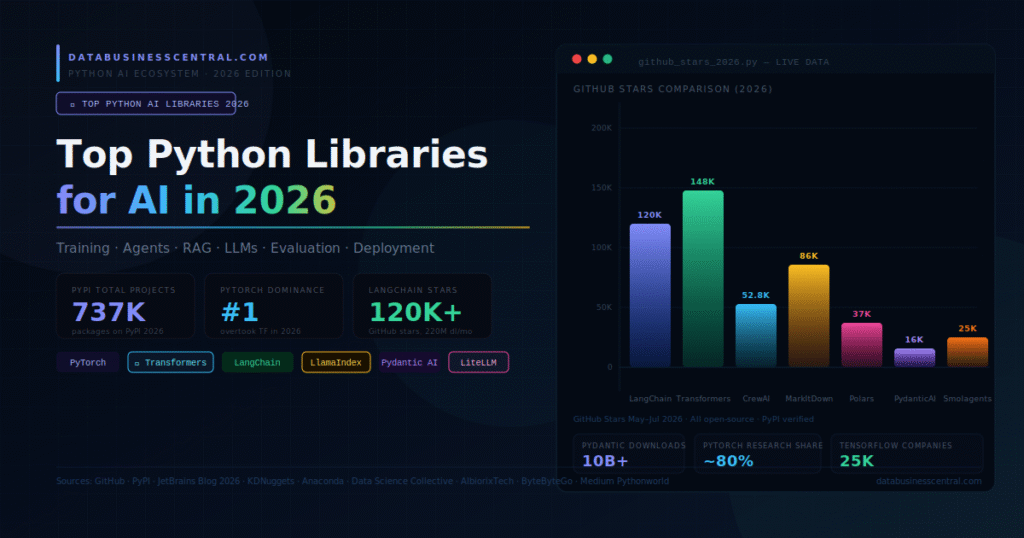
The landscape has also shifted dramatically. The stack a data scientist used in 2023 — TensorFlow, Keras, vanilla Pandas, and maybe a LangChain prototype — looks nothing like the stack a production AI engineer deploys in 2026. Agentic frameworks, vector stores, LLM evaluation suites, and typed output libraries have gone from experiments to production essentials in under two years.
This guide covers the fifteen Python AI libraries that matter most in 2026, organized by functional layer — from raw numerical compute up through agent orchestration, observability, and deployment. Every library is selected on the basis of verified GitHub stars, PyPI download volumes, enterprise production usage, or demonstrable technical merit. Opinion has been minimized; evidence has not.
Layer 1: Foundations — Numerical Compute and Data Manipulation
Every AI system, regardless of architecture, eventually touches these libraries.
NumPy — The Bedrock That Never Moves
NumPy is the numerical foundation that everything else in the Python AI ecosystem is built on. Virtually every AI and ML library in this guide — PyTorch, TensorFlow, scikit-learn, Pandas — either wraps NumPy arrays, accepts them as input, or outputs them. <cite index=”20-1″>NumPy sits at 32K GitHub stars and 800M monthly PyPI downloads.</cite>
import numpy as np

# Vectorised operations — the foundation of AI compute
embeddings = np.random.randn(1000, 1536)          # 1000 documents, 1536-dim embeddings
query      = np.random.randn(1536)
# Cosine similarity: no loops, no Python overhead
similarities = embeddings @ query / (
    np.linalg.norm(embeddings, axis=1) * np.linalg.norm(query)
)
top_5 = np.argsort(similarities)[-5:][::-1]
Install: pip install numpy
Pandas vs. Polars — The Data Manipulation Choice in 2026
<cite index=”12-1″>Pandas remains the most widely used tool for data manipulation, with 77% adoption among data scientists.</cite> For datasets under 10 million rows, Pandas remains the default for its library ecosystem breadth and intuitive API.
<cite index=”15-1″>Polars has 37K GitHub stars</cite> and is the performance-first alternative for larger datasets. Written in Rust, it processes data 5–10x faster than Pandas, uses a fraction of the memory, and its lazy execution model pushes computation down to only what is required. For ETL pipelines processing millions of rows before feeding an AI model, switching from Pandas to Polars is often the highest-impact change available.
import polars as pl

# Lazy execution: Polars builds a query plan and optimizes before executing
result = (
    pl.scan_csv("transactions.csv")          # Lazy scan — no data loaded yet
      .filter(pl.col("amount") > 1000)
      .group_by("customer_id")
      .agg([
          pl.col("amount").sum().alias("total_spend"),
          pl.col("transaction_date").max().alias("last_seen")
      ])
      .sort("total_spend", descending=True)
      .limit(1000)
      .collect()                             # Execute now, all at once
)
Rule: Pandas for familiarity and ecosystem depth on moderate datasets. Polars when speed or memory is a constraint.
Layer 2: Machine Learning — Training and Classical Models
scikit-learn — Classical ML, Still Essential
<cite index=”13-1″>For machine learning, scikit-learn is still the default toolset for classical modelling and clean pipelines, while XGBoost, LightGBM, and CatBoost continue to dominate structured data problems where accuracy and performance matter.</cite>
scikit-learn’s Pipeline and ColumnTransformer APIs are the cleanest path from raw features to deployable model for tabular problems — classification, regression, clustering, anomaly detection. <cite index=”18-1″>If you’re just getting started with machine learning or working on structured tabular problems, scikit-learn is still the right starting point.</cite>
from sklearn.pipeline import Pipeline
from sklearn.preprocessing import StandardScaler
from sklearn.ensemble import GradientBoostingClassifier
from sklearn.model_selection import cross_val_score
import numpy as np

pipeline = Pipeline([
    ("scaler",    StandardScaler()),
    ("classifier", GradientBoostingClassifier(n_estimators=200, max_depth=4))
])

scores = cross_val_score(pipeline, X_train, y_train, cv=5, scoring="roc_auc")
print(f"Cross-val AUC: {scores.mean():.4f} ± {scores.std():.4f}")
Install: pip install scikit-learn
PyTorch — The Deep Learning Default in 2026
<cite index=”12-1″>In 2026, PyTorch has overtaken TensorFlow in adoption. It has become the first choice of researchers and AI engineers alike.</cite> <cite index=”18-1″>PyTorch holds approximately 80% research-paper usage share.</cite> Its dynamic computation graph — where the graph is built as code executes rather than before — makes debugging feel like debugging regular Python code. That alone explains most of its adoption among engineers who spent years fighting TensorFlow 1.x’s static graph.
python
import torch
import torch.nn as nn
from torch.utils.data import DataLoader

class EnterpriseClassifier(nn.Module):
    def __init__(self, input_dim: int, hidden_dim: int, num_classes: int):
        super().__init__()
        self.layers = nn.Sequential(
            nn.Linear(input_dim, hidden_dim),
            nn.BatchNorm1d(hidden_dim),
            nn.GELU(),
            nn.Dropout(0.3),
            nn.Linear(hidden_dim, hidden_dim // 2),
            nn.GELU(),
            nn.Linear(hidden_dim // 2, num_classes)
        )

    def forward(self, x: torch.Tensor) -> torch.Tensor:
        return self.layers(x)

model     = EnterpriseClassifier(input_dim=512, hidden_dim=256, num_classes=10)
optimizer = torch.optim.AdamW(model.parameters(), lr=1e-3, weight_decay=0.01)
criterion = nn.CrossEntropyLoss()

# Training step — dynamic graph built here, every forward pass
model.train()
outputs = model(batch_inputs)
loss    = criterion(outputs, batch_labels)
loss.backward()
optimizer.step()
<cite index=”18-1″>TensorFlow still holds a 37% market share in data science and machine learning, adopted by 25,000 companies globally.</cite> For enterprise teams with existing TensorFlow infrastructure, the deployment ecosystem — TensorFlow Serving, TFX, TensorFlow Lite — remains mature and well-supported.
Install: pip install torch torchvision
Hugging Face Transformers — The Model Hub
<cite index=”15-1″>Hugging Face Transformers has 148K GitHub stars</cite> — the highest of any library in this guide. It is the practical interface to every major open-source language model, embedding model, vision model, and multimodal model. Rather than training from scratch, teams use transformers to load a pre-trained model, fine-tune it on domain-specific data, and deploy it to production.
python
from transformers import AutoTokenizer, AutoModelForSequenceClassification
from transformers import Trainer, TrainingArguments
import torch

model_name = "bert-base-uncased"
tokenizer  = AutoTokenizer.from_pretrained(model_name)
model      = AutoModelForSequenceClassification.from_pretrained(
    model_name, num_labels=3
)

# Fine-tune on proprietary data in hours, not days
training_args = TrainingArguments(
    output_dir="./model_output",
    num_train_epochs=3,
    per_device_train_batch_size=16,
    warmup_steps=200,
    weight_decay=0.01,
    evaluation_strategy="epoch",
    fp16=True                        # Mixed precision — 2x training speed
)

trainer = Trainer(
    model=model,
    args=training_args,
    train_dataset=train_dataset,
    eval_dataset=eval_dataset
)
trainer.train()
<cite index=”12-1″>In 2026, Hugging Face has become the de facto home for generative AI solutions. Whether you’re building an AI-powered customer service bot or a document intelligence tool, Transformers is likely to be a core part of your Python AI stack.</cite>
Install: pip install transformers datasets
Layer 3: LLM Integration and Agent Orchestration
LangChain + LangGraph — The Agent Infrastructure Layer
<cite index=”18-1″>LangChain has over 120,000 GitHub stars and has become essential infrastructure for the AI agent revolution.</cite> It provides the connective tissue between LLMs and real systems: prompt management, chain composition, memory, tool use, multi-agent orchestration, and RAG pipeline construction. <cite index=”18-1″>LangGraph extends this with support for complex, stateful agent workflows that include cycles and conditional branching.</cite>
<cite index=”14-1″>LangChain has cemented its position as the foundational framework for building reliable AI agents in Python. Many of the other projects in the AI ecosystem build on top of LangChain or integrate with it directly.</cite>
python
from langgraph.graph import StateGraph, END
from langchain_anthropic import ChatAnthropic
from pydantic import BaseModel
from typing import Annotated
import operator

class AgentState(BaseModel):
    messages: Annotated[list, operator.add]
    iteration_count: int = 0

llm   = ChatAnthropic(model="claude-sonnet-4-6", temperature=0)
tools = [web_search_tool, database_tool, calculator_tool]
llm_with_tools = llm.bind_tools(tools)

def reasoning_node(state: AgentState) -> dict:
    response = llm_with_tools.invoke(state.messages)
    return {"messages": [response], "iteration_count": state.iteration_count + 1}

graph = StateGraph(AgentState)
graph.add_node("reason", reasoning_node)
graph.add_node("act", ToolNode(tools))
graph.set_entry_point("reason")
graph.add_conditional_edges("reason", should_continue, {"act": "act", "end": END})
graph.add_edge("act", "reason")

agent = graph.compile(checkpointer=postgres_checkpointer)
Install: pip install langgraph langchain-anthropic
LlamaIndex — Document-Centric RAG
Where LangChain excels at agent orchestration, LlamaIndex excels at connecting LLMs to structured and unstructured data stores. Its indexing primitives — document loaders, node parsers, query engines, and retrieval pipelines — make it the first choice for teams building knowledge bases, document Q&A systems, and RAG applications over large corpora.
python
from llama_index.core import VectorStoreIndex, SimpleDirectoryReader
from llama_index.core.node_parser import SemanticSplitterNodeParser
from llama_index.embeddings.openai import OpenAIEmbedding
from llama_index.llms.anthropic import Anthropic

embed_model = OpenAIEmbedding(model="text-embedding-3-large")
llm         = Anthropic(model="claude-sonnet-4-6")

# Load, chunk, embed, and index in one pipeline
documents   = SimpleDirectoryReader("./enterprise_docs").load_data()
splitter    = SemanticSplitterNodeParser(embed_model=embed_model)
index       = VectorStoreIndex(
    splitter.get_nodes_from_documents(documents),
    embed_model=embed_model
)

# Query engine with source attribution
query_engine = index.as_query_engine(llm=llm, similarity_top_k=5)
response     = query_engine.query("What is our Q2 refund policy?")
print(response.response)
print("Sources:", [node.metadata["file_name"] for node in response.source_nodes])
Install: pip install llama-index llama-index-embeddings-openai
Pydantic AI — Type-Safe Agent Development
<cite index=”16-1″>Pydantic AI hit its 1.x stable API in late 2025 and has been picking up steam throughout 2026, passing 16,000 GitHub stars by April.</cite> <cite index=”16-1″>The Pydantic team described their goal simply: bring the FastAPI feeling to AI agent development.</cite> <cite index=”11-1″>The parent Pydantic library has crossed 10 billion downloads across all Python projects</cite> — the same team that built the validation layer used by OpenAI’s SDK, LangChain, and Anthropic’s Python SDK.
python
from pydantic_ai import Agent
from pydantic import BaseModel

class AnalysisOutput(BaseModel):
    summary:      str
    confidence:   float
    key_findings: list[str]
    risk_level:   str   # "low" | "medium" | "high"

agent = Agent(
    "anthropic:claude-sonnet-4-6",
    output_type=AnalysisOutput,       # Output guaranteed to match this schema
    instructions="""You are a risk analyst. Analyse the provided data and
    return a structured assessment. Be precise and cite specific figures."""
)

result = await agent.run("Analyse Q2 transaction anomalies from the report.")
# result.output is a validated AnalysisOutput — not a string to parse
print(f"Risk: {result.output.risk_level}")
print(f"Confidence: {result.output.confidence:.1%}")
<cite index=”11-1″>PydanticAI sits in the sweet spot between raw API calls and heavyweight frameworks. Typed inputs, typed outputs, tool definitions, dependency injection.</cite>
Install: pip install pydantic-ai
CrewAI — Role-Based Multi-Agent Teams
<cite index=”14-1″>CrewAI orchestrates role-playing AI agents for collaborative tasks.</cite> With <cite index=”15-1″>52,800 GitHub stars</cite> accumulated in under two years, it is the fastest-growing agent framework in the Python ecosystem. Its role-based abstraction — each agent has a role, a goal, a backstory, and a tool set — maps naturally to how teams think about task delegation.
python
from crewai import Agent, Task, Crew, Process

researcher = Agent(
    role="Senior Market Research Analyst",
    goal="Gather verified AI market statistics for 2026",
    backstory="Expert in AI industry research with 10 years' experience.",
    tools=[web_search_tool, database_tool],
    llm=llm, verbose=True
)

writer = Agent(
    role="Technical Content Strategist",
    goal="Transform research into clear, data-backed narratives.",
    backstory="Bridges technical depth with business clarity.",
    llm=llm
)

research_task = Task(
    description="Research enterprise AI agent adoption stats, ROI data, and market size for 2026.",
    agent=researcher,
    expected_output="Structured data points with verified source citations."
)

crew   = Crew(agents=[researcher, writer], tasks=[research_task, writing_task],
              process=Process.sequential)
result = crew.kickoff()
Install: pip install crewai
Smolagents — Hugging Face’s Code-First Agent Framework
<cite index=”15-1″>Smolagents is an AI agent framework from Hugging Face with 25,000 GitHub stars. It helps you build intelligent agents that write code or call tools, supports multiple LLMs, and allows multi-step reasoning.</cite> Its distinctive design philosophy: agents that generate Python code rather than structured JSON tool calls. Code generation as a reasoning substrate produces more flexible, composable agent behavior for complex analytical tasks.
python
from smolagents import CodeAgent, DuckDuckGoSearchTool, HfApiModel

model = HfApiModel("Qwen/Qwen2.5-Coder-32B-Instruct")
agent = CodeAgent(
    tools=[DuckDuckGoSearchTool()],
    model=model,
    additional_authorized_imports=["pandas", "numpy"]
)

result = agent.run(
    "What were the top 5 enterprise AI platforms by revenue in Q1 2026? "
    "Create a comparison table with market share percentages."
)
Install: pip install smolagents
Layer 4: Document Parsing and Data Enrichment
MarkItDown — Microsoft’s LLM Document Converter
<cite index=”15-1″>MarkItDown converts documents like PDFs, Word, Excel, and PowerPoint into Markdown. It preserves structure such as headings, tables, and lists and is designed for LLM workflows.</cite> <cite index=”11-1″>Microsoft built this — it has 86K GitHub stars. When building a document Q&A system for internal knowledge bases, the ingestion pipeline was 40% of the codebase. MarkItDown would cut that to a few lines.</cite>
python
from markitdown import MarkItDown

md      = MarkItDown()
# Converts PDF, DOCX, XLSX, PPTX, HTML to clean Markdown
result  = md.convert("enterprise_q2_report.pdf")

# Clean, structured Markdown ready to chunk and embed
print(result.text_content[:500])

# Works on all Office formats
xlsx_result = md.convert("financial_model.xlsx")
pptx_result = md.convert("board_deck.pptx")
Install: pip install markitdown Best for: RAG ingestion pipelines over mixed document types. Replaces PyMuPDF + python-docx + python-pptx with a single consistent interface.
LiteLLM — The LLM API Unification Layer
<cite index=”11-1″>LiteLLM is the library that replaces custom LLM wrappers.</cite> It provides a single unified interface — always using the OpenAI SDK format — across 100+ LLM providers: Anthropic, OpenAI, Google Gemini, Cohere, Mistral, Bedrock, Azure, and more. When provider pricing or performance changes (a quarterly event in 2026), swapping models requires changing one string, not rewriting API integration code.
python
from litellm import acompletion
import asyncio

async def call_with_fallback(prompt: str) -> str:
    """Try primary model, fall back to secondary on failure."""
    for model in ["anthropic/claude-sonnet-4-6", "openai/gpt-4o", "gemini/gemini-pro"]:
        try:
            response = await acompletion(
                model=model,
                messages=[{"role": "user", "content": prompt}],
                max_tokens=1024,
                temperature=0
            )
            return response.choices[0].message.content
        except Exception as e:
            print(f"{model} failed: {e}, trying fallback...")
    raise RuntimeError("All models failed")

result = asyncio.run(call_with_fallback("Summarise enterprise AI trends Q2 2026."))
Install: pip install litellm
Layer 5: Evaluation and Observability
RAGAS — RAG Evaluation
<cite index=”13-1″>Many successful teams use multiple frameworks together. A common pattern: scikit-learn for preprocessing, PyTorch for model development, TensorFlow for production deployment, and LangChain for LLM-powered features.</cite> Evaluation infrastructure is what ties them together and catches regressions before they reach production.
RAGAS provides the industry-standard metric suite for evaluating RAG systems: faithfulness, context_precision, context_recall, and answer_relevancy. Run it in CI against a golden dataset on every pipeline change.
python
from ragas import evaluate
from ragas.metrics import faithfulness, context_precision, answer_relevancy
from datasets import Dataset

eval_data = Dataset.from_dict({
    "question":     golden_questions,
    "answer":       agent_answers,
    "contexts":     retrieved_chunks,
    "ground_truth": verified_answers
})

results = evaluate(eval_data, metrics=[faithfulness, context_precision, answer_relevancy])
df      = results.to_pandas()

# Flag regressions automatically in CI
assert df["faithfulness"].mean() > 0.85,   f"Faithfulness regression: {df['faithfulness'].mean():.3f}"
assert df["answer_relevancy"].mean() > 0.85, f"Relevancy regression"
Install: pip install ragas
LangSmith — Agent Tracing and Evaluation
LangSmith provides distributed tracing, cost tracking, and evaluation pipelines for LangGraph and LangChain deployments. Every tool call, reasoning step, and token cost is captured automatically without instrumentation code.
python
import os
os.environ["LANGCHAIN_TRACING_V2"] = "true"
os.environ["LANGCHAIN_PROJECT"]    = "production-agents"
os.environ["LANGCHAIN_API_KEY"]    = LANGSMITH_API_KEY
# All LangGraph calls now traced automatically
Install: pip install langsmith
Layer 6: The 2026 Recommended Stack by Use Case
<cite index=”18-1″>Selecting the best AI framework depends on your specific project characteristics, but the choice is rarely binary. Many successful teams use multiple frameworks together.</cite>
| Use Case | Primary Libraries |
|---|---|
| Classical ML on tabular data | scikit-learn + Polars + XGBoost |
| Deep learning / model training | PyTorch + Transformers + Hugging Face Datasets |
| Enterprise RAG pipeline | LlamaIndex + Qdrant + Cohere Rerank + RAGAS |
| LLM agent with HITL | LangGraph + LangSmith + Pydantic AI |
| Multi-agent task delegation | CrewAI + LangGraph + LiteLLM |
| Document ingestion | MarkItDown + Polars + LlamaIndex |
| Provider-agnostic LLM calls | LiteLLM + Pydantic AI |
| Code-generation agents | Smolagents + LangGraph |
The table above is not a pick-one decision. A production AI system in 2026 typically combines three to six of these libraries, each handling a distinct layer of the stack. <cite index=”11-1″>The best AI engineering stack isn’t the most sophisticated. It’s the one that ships. None of these libraries require buying into a single framework. All of them delete code you shouldn’t have been writing.</cite>
The libraries that generate the most excitement — the newest agentic frameworks, the fastest embedding models — tend to rotate. The ones that persist across every stack are those that solve a specific, well-bounded problem with a clean API and active maintenance. NumPy, Polars, Pydantic, and the Hugging Face ecosystem share that quality. So do the best production agent libraries, when chosen to match the workload they are built for.
Start with the layer that is your actual bottleneck. Add the next library when that layer works. That sequencing produces production systems; the alternative produces abandoned notebooks.
