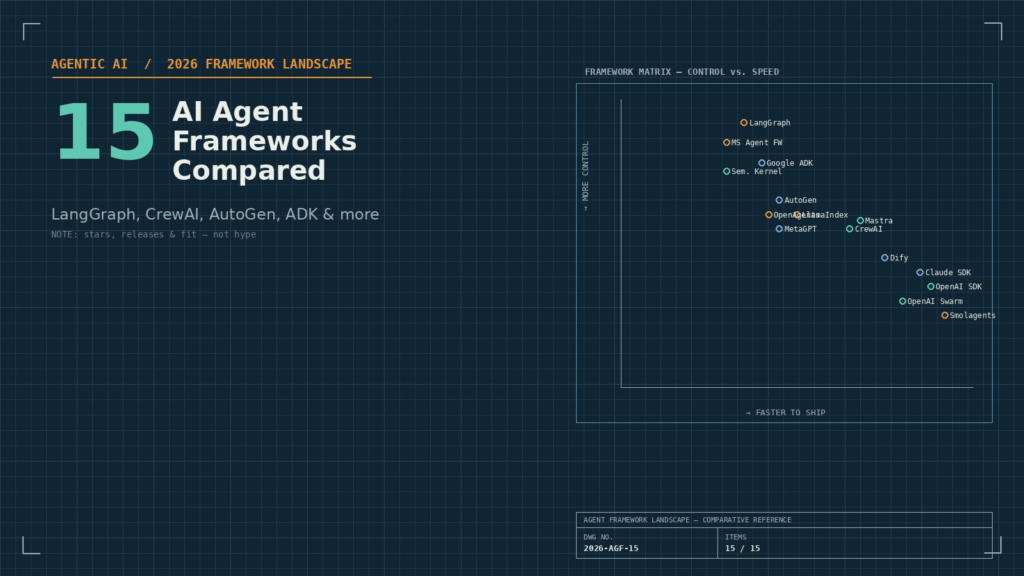
The agent framework landscape didn’t just grow in 2026 — it consolidated and fragmented at the same time. Microsoft merged AutoGen and Semantic Kernel into a single Agent Framework that hit GA on April 3, 2026. Anthropic’s Claude Agent SDK overtook AutoGen on production deployment count sometime between February and April, per LangChain’s State of AI report. Every major framework — LangChain’s LangGraph, CrewAI, and AutoGen — shipped a stable release within the same month, February 2026, which is either a coincidence or a sign of how fast this category is maturing under competitive pressure.
None of that makes the “best” framework question easier to answer, because there isn’t one answer. The right pick depends on workload shape, team language, and how much control you actually need over the reasoning loop. Here’s how the 15 frameworks actually shaping production agent systems in 2026 stack up.
1. LangGraph (LangChain)
The default runtime for LangChain agents, LangGraph models an agent as an explicit directed graph — nodes for actions, edges for control flow, persistent state throughout. The broader LangChain ecosystem carries 110,000+ GitHub stars and over 600 integrations. Best for: production systems needing precise control over execution order, error recovery, and audit trails.
2. CrewAI
CrewAI hit 30,000 GitHub stars in just 18 months by keeping multi-agent orchestration readable — agents get named roles and tasks instead of raw graph logic. Its two-layer Crews/Flows architecture balances autonomy with deterministic control. Best for: teams that want role-based agent prototypes running fast, including non-engineers on the design side.
3. Microsoft AutoGen
AutoGen reached 1.0 general availability in February 2026, promoting its event-driven v2 architecture to the default — a breaking change from v0.2 that forced a real migration cycle across existing deployments. AutoGen models collaboration as conversation between agents rather than a fixed workflow. Best for: conversational multi-agent research and Microsoft-aligned stacks.
4. Microsoft Agent Framework
Announced October 2025 as the unified successor to both AutoGen and Semantic Kernel, this framework combines AutoGen’s conversational abstractions with Semantic Kernel’s enterprise features — session state, middleware, telemetry — plus graph-based workflows. Python and .NET runtimes reached GA simultaneously on April 3, 2026. Best for: teams standardizing on the Microsoft/Azure AI Foundry stack long-term.
5. OpenAI Agents SDK
Built for tightly scoped assistants with minimal abstraction overhead, this is consistently cited as the fastest path from prototype to production when you’re already committed to OpenAI models. Best for: single-provider builds where you want tool use, memory, and tracing without framework tax.
6. Anthropic Claude Agent SDK
The newest major entrant by adoption curve — it passed AutoGen on enterprise production-deployment count during a two-month window in early 2026. Like the OpenAI SDK, it ships tool use, memory, and tracing natively rather than through a heavier abstraction layer. Best for: single- or few-tool agents where a vendor SDK beats framework overhead.
7. LlamaIndex Workflows
Originally a retrieval-augmented-generation library, LlamaIndex’s event-driven Workflows extension is now a legitimate agent orchestration option for document- and data-heavy pipelines. Best for: RAG-first products where retrieval quality matters as much as agent reasoning.
8. Semantic Kernel
Microsoft’s original enterprise-grade SDK for combining LLMs with conventional code across Python, .NET, and Java. It’s being formally succeeded by Microsoft Agent Framework, but existing deployments continue receiving security patches during the support window. Best for: teams already invested in Semantic Kernel who aren’t ready to migrate yet.
9. Google Agent Development Kit (ADK)
Released April 2025, Google ADK structures agents as a hierarchical tree — a root agent delegates to sub-agents, which can delegate further, more like an org chart than a group chat. It’s the framework with native, standout support for the Agent-to-Agent (A2A) protocol, letting an ADK agent discover and invoke agents built on entirely different frameworks. Best for: GCP-native teams building on Gemini and Vertex AI.
10. Smolagents (Hugging Face)
The lightweight option: a simple ReAct agent runs in roughly 40 lines in Smolagents versus around 120 in LangGraph — a direct tradeoff of control for simplicity. It’s positioned to dominate the Hugging Face ecosystem and open research use cases. Best for: research prototypes and teams that want minimal boilerplate.
11. OpenAI Swarm
OpenAI’s earlier, lightweight experimental framework for multi-agent coordination — since largely superseded in production contexts by the OpenAI Agents SDK, but still referenced as a clean, minimal example of agent-handoff patterns. Best for: learning multi-agent coordination concepts before committing to a heavier framework.
12. MetaGPT
Purpose-built for software development automation — agents take on roles like product manager, architect, and engineer to collaboratively produce code artifacts from a specification. Best for: automated software development pipelines rather than general-purpose agent tasks.
13. OpenAgents
Built around the A2A protocol from the ground up, OpenAgents’ focus is interoperability — a LangGraph agent, a CrewAI agent, and a custom Python agent can all participate on the same network. It’s also cited for financial task execution use cases. The tradeoff is a smaller community and fewer out-of-the-box integrations than the LangChain ecosystem. Best for: cross-framework, cross-organization agent networks.
14. Mastra
The leading TypeScript-native option, Mastra packages workflows, memory, and a Studio development environment into one product. Best for: TypeScript/JavaScript teams building production agents who don’t want to bridge into a Python-first framework.
15. Dify
A more platform-oriented entry than a pure library, Dify pairs agent orchestration with a visual builder and deployment layer, positioned for teams that want production infrastructure bundled in rather than assembled from separate pieces. Best for: teams that want an agent platform, not just an orchestration library.
The Pattern Across All 15
A few things hold true across nearly every comparison published in 2026, regardless of which framework wins the specific use case:
Frameworks compose — they’re not exclusive choices. A common production pattern uses LangChain for tool management and retrieval while CrewAI or AutoGen handles multi-agent orchestration on top. Treat these as libraries, not monoliths.
None of them are a complete governance layer. An agent framework shapes the reasoning loop — tool calls, memory, planning — but doesn’t natively provide pre-dispatch approval gates, policy enforcement, or audit evidence before an agent touches production systems. Teams running agents with real permissions are increasingly pairing a framework with a separate control-plane layer for that reason.
Version discipline matters more than it used to. With AutoGen 1.0, LangGraph 0.4, and CrewAI 0.105-plus all shipping meaningful architecture changes within months of each other, “which framework” is no longer a one-time decision — it’s paired with an ongoing version-pinning strategy, since skipping releases can mean missing checkpointing or observability features you’ll want within six months.
Popularity and fit are different questions. LangGraph’s star count reflects ecosystem breadth, not necessarily reflects the best fit for a narrow, single-tool agent — where a vendor SDK from OpenAI or Anthropic is frequently the faster, leaner path in 2026.
Choosing Without the Hype
Before picking a framework, it’s worth asking the harder question first: does this workload actually need one? A narrow task with one or two tools often does better with direct code and a vendor SDK than with a full orchestration layer — adding a framework before a workflow proves it needs persistent state, retries, or multi-agent handoffs is one of the most common overengineering mistakes teams make in this space right now.
For everything past that threshold, the fifteen frameworks above cover the realistic 2026 shortlist. Pick based on the job — control versus speed, single-agent versus crew, Python versus TypeScript, vendor-native versus open ecosystem — not on which one has the most GitHub stars this quarter.

1 thought on “Top 15 AI Agent Frameworks Compared”
Pingback: How Enterprises Build Multi-Agent AI Systems (2026)