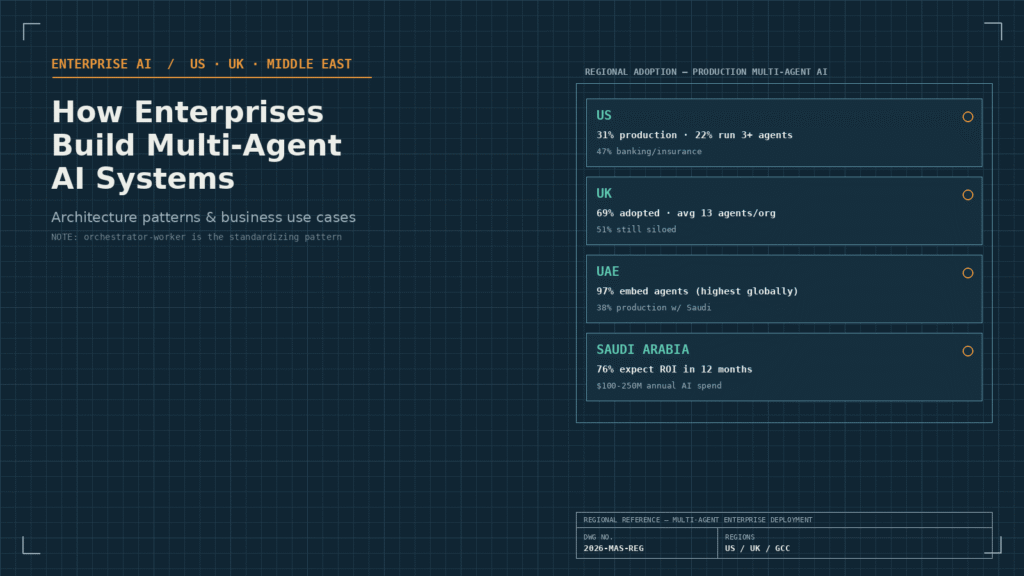
The UK’s average enterprise now runs 13 distinct AI agents — and expects that number to double within two years. In the UAE, 97% of organizations report embedding AI agents into workflows, products, and services, the highest integration rate recorded anywhere globally. In the US, 22% of production AI deployments now coordinate three or more agents working together, not a single assistant answering isolated prompts. Across all three regions, the same shift is happening in parallel: enterprises are moving past single-agent pilots and into genuine multi-agent architecture — and the data shows real differences in how the US, UK, and Middle East are getting there.
What Makes a System “Multi-Agent,” Not Just “AI-Enabled”
A single AI agent handles one bounded task with its own tools and context. A multi-agent system splits a larger workflow across multiple specialized agents that coordinate — an orchestrator agent that plans and delegates, and worker agents that execute narrow, well-defined pieces of the task, then report back. The distinction matters operationally, not just architecturally: a single agent’s failure mode is a wrong answer, while a poorly coordinated multi-agent system’s failure mode is redundant work, conflicting actions, or silent data leakage between agents that were never meant to share context.
That distinction is exactly where most enterprises currently sit exposed. Research across UK organizations found that 51% of deployed agents still operate in isolated silos rather than as part of a coordinated multi-agent system — creating duplicated automations and the kind of ungoverned “shadow AI” sprawl that’s hard to detect until it shows up in an incident report.
The Architecture Enterprises Are Actually Standardizing On
The pattern showing up repeatedly across US, UK, and Gulf deployments is orchestrator-worker: a single coordinating agent breaks a business task into subtasks and routes each one to a specialized agent, then assembles the results.
                    ┌─────────────────────┐
                    │   ORCHESTRATOR       │
                    │   (plans, routes,     │
                    │    assembles output)  │
                    └──────────┬────────────┘
             ┌──────────────────┼──────────────────┐
             │                  │                   │
    ┌────────▼────────┐ ┌───────▼────────┐ ┌────────▼─────────┐
    │  RESEARCH AGENT   │ │  ACTION AGENT   │ │  COMPLIANCE AGENT │
    │  (retrieval, data  │ │  (CRM, ERP,     │ │  (policy checks,   │
    │   lookup)          │ │   transactions)  │ │   audit logging)   │
    └─────────────────────┘ └─────────────────┘ └────────────────────┘
             │                  │                   │
             └──────────────────┴───────────────────┘
                           MCP / API LAYER
                    (tools, systems, data sources)
UK IT leaders are converging on API-driven architecture specifically to make this pattern work at scale — connecting, orchestrating, and governing a growing fleet of agents through a unified integration layer rather than point-to-point connections between each agent and each system. That’s the same underlying logic driving Model Context Protocol adoption globally: standardize the connection layer once, and every agent in the orchestration pattern above can use it without custom wiring per agent, per tool.
The US: Production Is Real, But Concentrated
In the United States, 31% of enterprises now have at least one AI agent in production, with banking and insurance leading adoption at 47% and healthcare and government trailing at 18% and 14% respectively — a gap driven largely by data sensitivity and regulatory friction rather than lack of interest. Fortune 500 companies are further ahead: 51% report production adoption against an 88% pilot rate, running an average of 3.4 distinct agents per organization.
The multi-agent signal specifically: 22% of US production deployments now coordinate three or more agents, up from a market where single-assistant deployments dominated as recently as 2024. Governance structures are catching up in parallel — 56% of enterprises now name a dedicated “AI agent owner” or “agentic ops” lead, up sharply from just 11% in 2024, and that ownership maturity correlates directly with which organizations actually cross the production threshold rather than stalling in pilot. Median payback across functions sits at 5.1 months, with customer-service and sales-development agents paying back fastest at 3.4 months and finance and operations agents taking closer to 8.9 months.
The UK: Adoption Outpacing Orchestration
The UK’s numbers show a market that’s adopted agents faster than it’s learned to coordinate them. 69% of UK organizations report that most or all teams and functions have already adopted AI agents, running an average of 13 agents per organization — a figure IT leaders expect to double within two years. 94% of UK IT leaders say agent success now depends specifically on integration across systems, and the same share believe agents have already improved, or will soon improve, employee experience.
But that 51% of agents still sitting in isolated silos is the UK’s defining challenge right now, not adoption itself. The response has been architectural: enterprises are standardizing on API-driven, MCP-style connection layers specifically to convert siloed single agents into coordinated multi-agent systems, treating orchestration as the current bottleneck rather than model capability or initial adoption.
The Middle East: Fastest Production Rollout, Sovereign-First
The Gulf tells a different story again — and by one measure, a more advanced one. According to Confluent’s 2026 Data Streaming Report, 38% of organizations in both the UAE and Saudi Arabia already have agentic AI running in production, among the highest production rates recorded anywhere globally. KPMG’s UAE Tech Report 2026 found 97% of UAE organizations are embedding AI agents into workflows, products, services, and value streams — again, the highest integration rate globally recorded. Saudi Arabia leads on confidence and capital: 76% of Saudi organizations expect AI to deliver measurable ROI at enterprise scale within twelve months, the highest confidence level of any region surveyed, with 39% of Saudi enterprises committing between $100 million and $249.9 million annually to digital technology.
What distinguishes Gulf adoption structurally is the sovereign AI layer underneath it. Deloitte’s 2025 State of AI in the Middle East report found more than 80% of regional organizations feel intense pressure to adopt AI, with the UAE’s Charter for AI Development and Saudi Arabia’s AI Adoption framework both pushing enterprises toward locally governed infrastructure rather than purely foreign-hosted models. Roughly 17% of Gulf enterprises have already adopted dedicated sovereign AI platforms — the highest rate globally — reflecting national data-residency priorities as much as technical preference. The region’s own data infrastructure is still catching up to its ambition, though: nearly three-quarters of IT leaders in both the UAE and Saudi Arabia cite insufficient real-time data infrastructure and unclear data lineage as active obstacles to further agentic AI deployment.
Business Use Cases Multi-Agent Systems Are Actually Solving
Across all three regions, the workflows converting from pilot to production share a common shape: high transaction volume, structured inputs, and short feedback loops.
Customer service and support triage. The single highest-adoption function globally, now typically run as an orchestrator routing between an intent-classification agent, a knowledge-retrieval agent, and an action agent that executes account changes or refunds — with a compliance agent auditing the interaction in parallel.
Banking, insurance, and fraud detection. The leading US vertical at 47% production adoption, where multi-agent systems split real-time transaction monitoring, historical pattern analysis, and regulatory reporting across specialized agents that need to act inside second-scale latency windows.
Government and sovereign service delivery. A defining Gulf use case, where AI is projected to reduce manual workload in government ministries by up to 30%, typically through orchestrator agents routing citizen requests across document-processing, verification, and Arabic-language response agents built specifically for regional linguistic and regulatory context.
Sales development and finance operations. The fastest and slowest payback functions respectively in US deployments — SDR agents pay back in roughly 3.4 months by qualifying and routing leads through a research-and-outreach pipeline, while finance and ops agents take closer to 8.9 months coordinating reconciliation, reporting, and compliance checks across more tightly regulated workflows.
What Ties the Three Regions Together
Different starting points, but the same underlying lesson: the US shows that governance ownership predicts production success more than model choice does; the UK shows that adoption without orchestration just produces sprawl; and the Gulf shows that production speed and sovereign infrastructure investment can move together when national strategy and enterprise incentives point the same direction.
For enterprises building multi-agent systems in any of these markets in 2026, the practical takeaway is consistent regardless of region: get the orchestration and connection layer right before scaling the number of agents, name a clear owner for the resulting system, and treat the architecture diagram — not the individual agent count — as the thing that actually determines whether the deployment survives contact with production.
