How data engineering practices can improve the reliability of enterprise analytics, AI, and knowledge systems
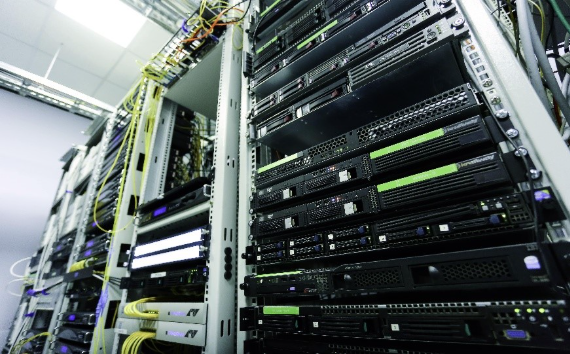
Figure 1: The Hidden Layer Beneath Enterprise Knowledge: Server infrastructure and network cabling — the raw data layer that every knowledge system, dashboard, and AI assistant ultimately depends on.
Every enterprise knowledge system — a dashboard, a search index, a RAG-powered AI assistant — sits on top of a data engineering pipeline most of its users never think about. That pipeline is where the real reliability problem lives, and it’s a data engineering problem before it’s anything else: source systems change, schemas drift, and nothing formally stops a silent upstream change from propagating straight into whatever gets built on top of it.
Data contracts are a data engineering discipline for closing that gap. Get the discipline right at the pipeline layer, and the systems built on top of it — analytics, AI, knowledge management — inherit that reliability automatically. Get it wrong, and no amount of good taxonomy design or model tuning downstream can fully compensate for data nobody can trust.
The Engineering Problem: Pipelines Have No Interface
Application engineering solved an equivalent problem years ago. If Service A depends on Service B, that dependency is explicit — an OpenAPI spec, a `.proto` file, a GraphQL schema. Service B can’t silently rename a field without breaking a contract test. Data pipelines, by contrast, usually have no such interface. A source table or an event stream gets treated as an implicit contract: “just read from this table,” “subscribe to this topic.” There’s no enforced agreement about the data’s shape or meaning, so there’s no accountability when it changes.
The consequences show up downstream, not at the source. A backend team renames a column, changes a timestamp from local time to UTC, or drops a field they assumed nobody used. Somewhere downstream, a nightly ETL job breaks, an analytics dashboard reports zeroes, or a RAG pipeline retrieves and confidently surfaces stale or malformed context. The team best positioned to prevent the failure — the data engineering team owning the pipeline — has, in most organizations, no formal mechanism to catch it before it ships.
What a Data Contract Actually Specifies
A data contract is a data engineering artifact: a machine-readable, enforced agreement between a data producer and its consumers that specifies:
- Schema — field names, types, nullability, structure — expressed in something checkable: JSON Schema, Avro, Protobuf, or a dedicated format like the Open Data Contract Standard (ODCS).
- Semantics — what a field actually means, not just its type. `created_at` is ambiguous: row-creation time in the source database, or the real-world event time? Getting this wrong is invisible to schema validation and is one of the most common root causes of bad analytics.
- Quality guarantees — uniqueness of a key, acceptable null rates, freshness SLAs (“updated within 15 minutes of the source event”).
- Change rules — what counts as a breaking change, what doesn’t, and how much notice consumers get before a breaking change ships.
The distinction that makes this an engineering practice rather than documentation is enforcement. A data dictionary describing a schema is documentation — it drifts. A contract is checked automatically, in the producer’s CI pipeline, before a violating change can ship — the same discipline a contract-testing framework like Pact applies to service APIs.
Where Enforcement Belongs in the Pipeline
Contracts get validated at two points in a well-built data engineering pipeline:
- At the source, before data is emitted. The producing service validates outgoing records — written to a database, published to Kafka, exposed via change data capture — against the agreed schema before the code ships. A violating change fails the build, exactly as a breaking REST change fails a consumer-driven contract test.
- At the ingestion boundary, as a second line of defense — using dbt tests, Great Expectations, or Soda — particularly for data from systems the data engineering team doesn’t directly control: third-party vendors, acquired companies, or legacy systems.
The architectural shift is that validation moves left, into the producer’s development lifecycle, instead of relying entirely on downstream monitoring that fires only after bad data has already reached an analytics dashboard or an AI system’s retrieval index.
A Concrete Engineering Example

Figure 2: “Sealing the Data Agreement
Consider a common integration pattern: two source systems, each owned by a different team and built independently, need to feed one unified data layer that will power both internal analytics and a knowledge-retrieval system for an AI assistant. Neither source system was designed with the other — or with the downstream AI use case — in mind.
Without contracts, the data engineering team building the unified layer discovers the mismatches the hard way: one system encodes status as an integer, the other as a string; one enforces a foreign key the other allows to be null; a `completion_date` in one system means something subtly different from the same-named field in the other. Every mismatch surfaces in production — a broken join, a wrong total in a report, or an AI assistant retrieving and confidently citing a record whose status field means something other than what the model assumes.
With contracts in place, that discovery moves earlier, into the engineering workflow itself: each source publishes a contract describing its schema and the precise meaning of ambiguous fields; the unified layer defines a derived contract specifying exactly what downstream analytics and AI systems need; and CI checks the mapping between them whenever either source changes, blocking a breaking change before it ever reaches a dashboard, a search index, or a model’s context window.
Breaking vs. Non-Breaking Changes
Borrowed directly from API versioning discipline:
Usually safe:
- Adding a new optional field
- Adding a new enum value, if consumers are built to handle unknown values gracefully
- Widening a numeric type, if consumers are built defensively
Usually breaking:
- Renaming or removing a field
- Narrowing a type, or changing it incompatibly
- Changing a field’s semantic meaning without changing its name — the most dangerous category, since nothing about the schema looks different
- Flipping non-null to nullable
- Changing table granularity (one row per order → one row per order line)
A data engineering team that treats the second list as advisory guidance rather than a CI hard-stop isn’t actually enforcing a contract — it’s maintaining better-organized documentation that will still drift.
Why This Matters Beyond the Pipeline
The direct payoff of data contract discipline is data engineering reliability: fewer broken builds, fewer 2 a.m. pages, fewer silent failures. But the more consequential payoff shows up one layer up, in every system built on top of that pipeline:
- Analytics — dashboards and reports stop silently drifting out of sync with what source systems actually mean, because the meaning was pinned down and enforced at the point of change, not discovered after a stakeholder complains about a wrong number.
- AI and RAG systems — this is where reliable data engineering matters most acutely. A human reading a slightly wrong report might catch the error from context. An AI assistant retrieving from the same source and generating an answer doesn’t have that instinct — it states what it retrieves with full confidence, whether or not the underlying data is still accurate. As organizations lean further into RAG and agentic AI, the cost of an unvalidated upstream change shifts from “an analyst double-checks a number” to “a customer-facing agent states something false with total confidence.”
- Knowledge management — every KM initiative depends on the assumption that the underlying data is trustworthy. A well-organized taxonomy sitting on top of silently corrupted source data doesn’t produce trustworthy knowledge; it produces well-organized untrustworthy knowledge. Data contracts are the data engineering practice that makes the trust assumption underneath KM actually hold.
In other words: data engineering discipline at the pipeline layer is a precondition for reliability everywhere above it, not a separate concern from it.
Making It Organizational
The tooling for data contracts has matured — ODCS, Confluent’s Data Contracts for Schema Registry, and dbt’s contract feature all provide the mechanics. Most data engineering teams that have implemented this successfully report the tooling was the easier half. The harder half is organizational: getting a producing team, optimizing for its own application’s velocity, to treat its data output as a product with consumers, SLAs, and a deprecation policy. That requires:
- Named ownership for every dataset — an accountable engineer or team, not a diffuse “platform team.”
- A CI-enforced review gate for any schema change that would break a contract.
- Consumer registration, so a producer knows their blast radius before shipping, not after.
- Incentive alignment — teams whose changes cause downstream incidents need that reflected in their reliability metrics, the same way an API’s error budget affects the team that owns the service.
Getting Started
- Pick the highest-blast-radius pipeline — the dataset where a silent change has caused the most downstream damage — and write a contract for just that one.
- Make it machine-readable, even if minimal. A JSON Schema file checked into the producer’s repository is enough to start.
- Add one CI check that fails the producer’s build on a contract violation. This is the step that converts a contract from a document into an enforced engineering practice.
- Layer in quality and freshness checks once schema enforcement is trusted and routine.
- Formalize ownership and a change-notification process as more teams and datasets are onboarded — the step most rollouts skip, and the one that determines whether the practice survives the first tight deadline.
Conclusion
Reliable analytics, trustworthy AI, and usable enterprise knowledge all rest on the same foundation: a data engineering pipeline where nobody can silently break what everyone downstream depends on. Data contracts are the practical, enforced version of that foundation — the data engineering discipline that turns an implicit, fragile handshake between producer and consumer into an explicit agreement, checked automatically, before a breaking change can ever reach a dashboard, a model, or a knowledge system built to be trusted.
