For more than two decades, organizations have invested heavily in data warehouses, business intelligence tools, and analytics platforms. The goal has always been the same: use data to make better decisions.
Yet many companies still struggle with a familiar challenge. They have more data than ever before—but turning that data into timely, meaningful action remains difficult.
Dashboards multiply. Reports become more complex. Analyst teams grow. But the gap between having data and acting on it often remains wide.
A new shift is beginning to change this. The combination of Agentic AI and Unified Data Platforms (UDPs) is moving analytics beyond manual reporting and toward something far more powerful: systems that actively help organizations discover insights and guide decisions.
This shift is turning traditional data platforms into decision platforms.
The Growing Gap Between Data and Decisions
Modern businesses generate enormous amounts of data. Information flows from ERP systems, supply chains, customer interactions, marketing campaigns, digital channels, and operational platforms.
But turning that data into insight is rarely simple.
In most organizations, the process still follows a familiar path. A business leader asks a question. Analysts search for the right datasets. Data is cleaned and prepared. Reports or dashboards are built. Finally, results are interpreted and shared.
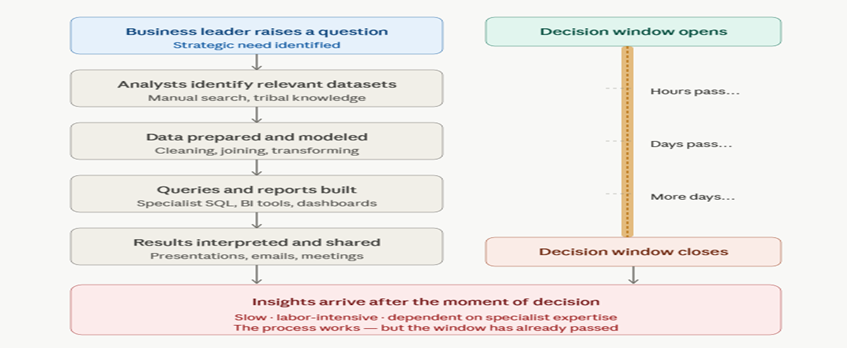
This process works—but it often takes time. And by the time insights arrive, the opportunity to act may already have passed.
Research highlights how large this gap can be. According to Gartner, more than 80% of enterprise data is never used for analytics. Valuable information sits unused while teams continue to search for answers.
At the same time, organizations that successfully use data to guide decisions see significant advantages. Research from McKinsey & Company shows that data-driven companies are 23 times more likely to acquire customers and 19 times more likely to be profitable.
The issue isn’t a shortage of data.
The real challenge is building systems that can turn data into decisions quickly and consistently.
This Is Where Agentic AI Makes the Difference
Agentic AI represents a major step forward in enterprise analytics.
Traditional AI models typically generate predictions or automate specific tasks. Agentic AI goes further. It works through autonomous digital agents that can reason, plan, and carry out analytical work on their own.
Instead of asking users to manually build complex analyses, these agents can:
- Understand business questions asked in everyday language
- Identify the relevant data automatically
- Run multiple layers of analysis
- Detect unusual patterns or emerging trends
- Provide explanations and recommended actions
In other words, analytics moves from being a tool people operate to becoming a system that actively helps guide decisions.
Rather than navigating dashboards or writing queries, business users can simply ask questions—and receive clear answers.
Why Trusted Data Foundations Matter
Even the most advanced AI systems depend on one essential ingredient: trusted data.
If the underlying data is incomplete, inconsistent, or poorly governed, AI systems cannot produce reliable insights. In fact, they may amplify existing problems.
This is where Unified Data Platforms (UDPs) become essential.
Unified Data Platforms bring together the key components of a modern data environment into a single, governed ecosystem. They combine:
- Data ingestion from enterprise systems
- Data preparation and transformation
- Analytics and querying capabilities
- Governance and lineage tracking
- Security and access controls
- Collaboration and knowledge sharing
By integrating these capabilities in one place, UDPs create a consistent environment where data is reliable and accessible.
Think of it this way: the unified platform provides the foundation, while Agentic AI provides the intelligence that activates it.
Together, they enable organizations to move beyond fragmented tools toward a more connected and responsive analytics environment.
What Agentic AI Enables Inside a Unified Data Platform
When Agentic AI operates within a unified data platform, several powerful capabilities emerge.
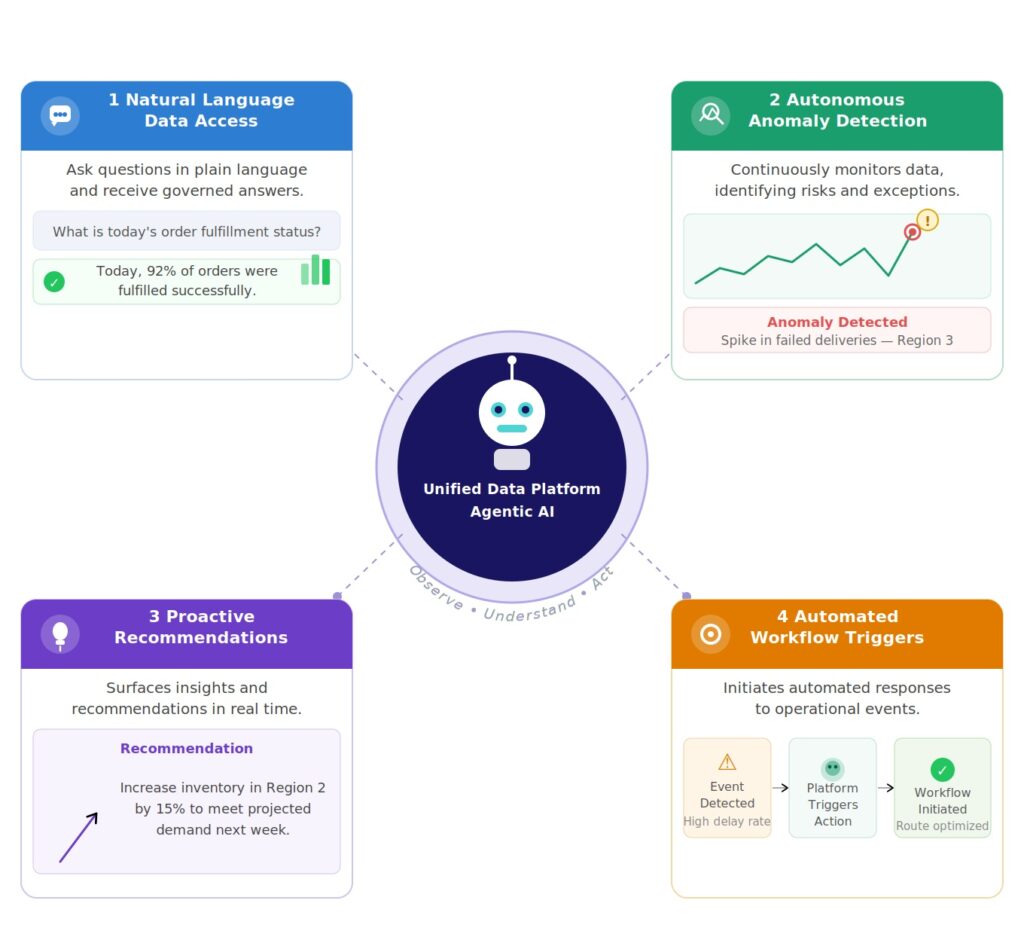
Natural Language Data Access
One of the biggest barriers to analytics has always been technical complexity.
Agentic AI removes much of that barrier. Business users can ask questions in plain language, such as:
- “Why did sales drop in the western region last quarter?”
- “Which suppliers are causing delivery delays?”
- “What factors are driving inventory shortages?”
The AI system interprets the question, finds the right data, runs the analysis, and delivers a clear explanation.
This dramatically expands access to analytics across the organization.
Autonomous Analytics
Traditional analytics waits for someone to ask a question. Agentic AI does not.
These systems continuously monitor key business metrics. When something unusual happens, they investigate automatically.
For example, an AI agent might detect a sudden drop in store-level sales. It could then analyse inventory levels, promotion data, and supply chain activity to identify the likely cause—and alert business teams with a clear explanation.
In this model, analytics becomes proactive rather than reactive.
Deeper Context and Understanding
Dashboards often tell us what happened, but rarely explain why.
Agentic AI connects information across multiple systems to uncover the drivers behind business outcomes. It can reveal relationships between factors such as supply delays, pricing changes, promotions, and customer behaviour.
This deeper understanding helps leaders move beyond surface-level metrics toward meaningful insight.
Continuous Intelligence
Many organizations still rely on scheduled reports—daily, weekly, or monthly.
But modern businesses move faster than reporting cycles.
Agentic AI enables continuous intelligence, where systems monitor operational data in real time and surface insights the moment meaningful changes occur.
This allows organizations to respond more quickly to risks, disruptions, and opportunities.
Shared Knowledge Across the Organization
Another advantage of Agentic AI is its ability to capture and share knowledge.
When AI agents generate insights, they can automatically summarize findings, document the analysis, and store explanations in a shared system. Over time, this creates a growing knowledge base that teams across the organization can learn from.
Instead of isolated reports, organizations begin to build shared intelligence.
Governed Data Foundations
Trust remains critical.
Unified Data Platforms ensure data quality through standardized metrics, clear data lineage, and role-based access controls. These governance mechanisms ensure that AI systems operate within defined rules.
Without governance, even advanced analytics systems can lose credibility.
Research shows that 81% of organizations experience data quality issues because of poor data governance (Gitnux Data Governance Statistics, 2024). Strong governance helps ensure that insights remain accurate, consistent, and trusted across the business.
From Insight to Impact: The Strategic Business Value
When organizations combine Agentic AI with Unified Data Platforms, the impact extends well beyond faster reporting.
They gain the ability to:
- Make decisions faster through automated analysis
- Expand access to insights across the business
- Reduce the workload on analysts
- Discover deeper patterns and opportunities
- Respond quickly to operational changes
Most importantly, intelligence is no longer limited to a small group of specialists. Instead, it becomes available across the entire organization.
The benefits can be significant. Research from McKinsey & Company shows that data-driven organizations are 23× more likely to acquire customers, 6× more likely to retain customers, and 19× more likely to be profitable.
Meanwhile, research from Deloitte shows that companies using data-driven insights are twice as likely to exceed their business goals.
These outcomes highlight the competitive advantage that intelligent analytics platforms can deliver.
The Next Stage in Data Platform Evolution
Enterprise data platforms have evolved steadily over time.
Data warehouses gave organizations centralized visibility into historical data.
Unified Data Platforms expanded those capabilities by bringing integration, analytics, and governance together in a single environment.
Now, Agentic AI–powered platforms represent the next stage. These systems actively analyse data, identify insights, and guide decisions.
In this new model, data platforms no longer act as passive storage systems. They become active partners in decision-making.
The Future: Data Platforms That Think and Act
The future of enterprise analytics will not be defined only by larger data lakes or faster query engines.
Instead, it will be defined by systems that can continuously learn from data and help guide action.
Agentic AI introduces the autonomy and reasoning needed to move analytics closer to real-time decision support. Unified Data Platforms provide the trusted data foundation that makes this possible.
Together, they mark the beginning of a new generation of enterprise systems—intelligent decision ecosystems.
Organizations that embrace this shift will not only analyse their data more effectively. They will operate faster, respond more intelligently, and unlock far greater value from the information they already possess.
In the coming decade, the most successful companies will not simply store data.
They will build systems capable of continuously turning data into decisions.
References
Data Governance Statistics | 2026 Edition – Gitnux
Five facts: How customer analytics boosts corporate performance | McKinsey

1 thought on “From Data Platforms to Decision Platforms: How Agentic AI Is Changing Enterprise Analytics”
Your ideas and insights are unique and thought-provoking I appreciate how you challenge your readers to see things from a different perspective