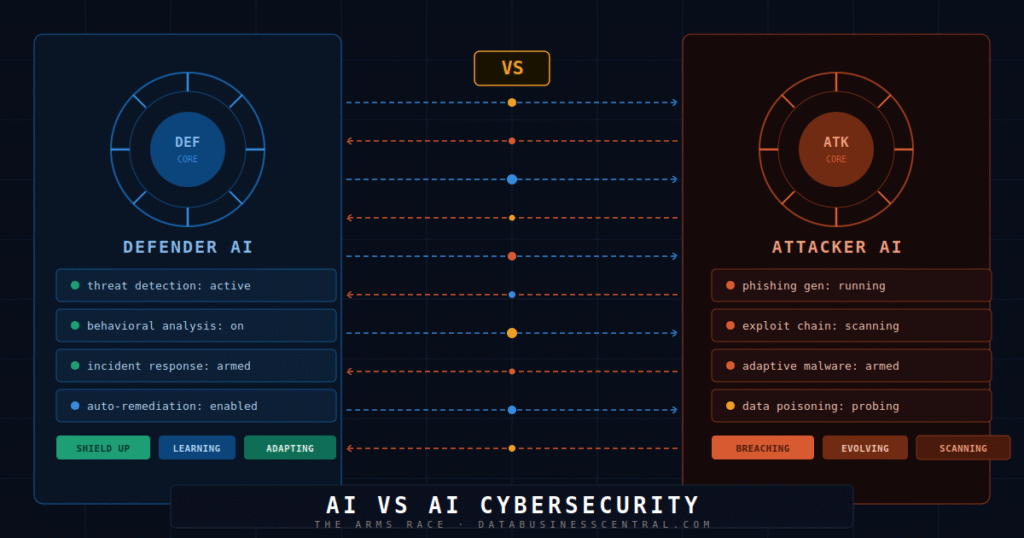
There’s a war being fought right now inside your network — and neither side is human.
Artificial intelligence has crossed a threshold that security professionals warned about for years: it’s no longer just a tool that defenders use to spot threats faster. Attackers have it too. And they’ve gotten very good at using it. The result is a relentless, high-speed arms race where machine fights machine, algorithm battles algorithm, and the organizations caught in the middle are scrambling to keep up.
Welcome to the age of AI vs AI cybersecurity.
Why the Old Playbook Is Dead
For most of the last decade, cybersecurity was fundamentally a human problem. A skilled attacker would probe a network, find a weakness, and exploit it — usually over days, weeks, or even months. Defenders had time to respond. Not much time, but some.
That window has collapsed.
According to recent data, adversary breakout times — the speed at which an attacker moves from initial access to full lateral movement across a network — have shrunk to as little as 27 seconds in some observed cases. Human analysts simply cannot respond at that speed. No SOC team, however talented, can outpace an AI-driven attack operating in real time.
The State of AI Cybersecurity 2026 report, drawn from over 1,800 security professionals, puts it plainly: 73% of organizations are already feeling the direct impact of AI-powered threats. This isn’t a future scenario. It’s happening now, in businesses of every size and sector.
The Attack Side: How AI Is Arming the Adversary
Understanding the threat requires looking at what AI actually enables on the offensive side. The answer is sobering.
Hyper-Personalized Phishing at Scale
Traditional phishing was a numbers game — send a million emails, hope a few land. AI-powered phishing is surgical. Attackers now use large language models to craft individualized messages that reference real colleagues, recent projects, and genuine business context scraped from LinkedIn, company blogs, and social media.
Hyper-personalized phishing is the number one concern among security professionals in 2026, cited by 50% of respondents in the State of AI Cybersecurity report. The attack surface isn’t just email anymore — deepfake voice fraud, where AI clones the voice of a CFO or CEO to authorize wire transfers, is now a documented reality flagged by 40% of security teams.
Adaptive Malware That Learns As It Goes
Perhaps the most unsettling development is the rise of AI-driven malware that adapts in real time to evade detection. Traditional malware had a fixed signature — once identified, it could be blocked. Adaptive malware rewrites its own code, changes its behavior based on what defenses it encounters, and learns from failed intrusion attempts.
This isn’t theoretical. Security researchers are already tracking malware samples that use machine learning techniques to identify and route around endpoint detection tools. Automated vulnerability scanning and exploit chaining — where AI identifies a flaw, builds an exploit, and chains it with other vulnerabilities automatically — is a concern for 45% of security leaders.
Attacking the AI Itself
Here’s where the threat landscape gets genuinely novel: attackers are now targeting AI systems directly.
Data poisoning — where adversaries corrupt the training data used by an organization’s AI models — is emerging as a major 2026 threat vector. The goal isn’t to steal data. It’s to silently compromise the model’s judgment, embedding hidden backdoors that cause the AI to make subtly wrong decisions. Imagine a fraud detection model that’s been poisoned to ignore a specific class of transaction. The damage could go unnoticed for months.
Even more alarming is the targeting of AI agents. As enterprises deploy autonomous AI agents with broad access to systems, data, and APIs, those agents become high-value targets. A single well-crafted prompt injection can turn a trusted internal agent into an insider threat — one that can silently execute transactions, exfiltrate data, or delete backups. Machine identities — bots, agents, and automated systems — now outnumber human employees by 82 to 1 in the average enterprise. That’s an enormous, and largely unsecured, attack surface.
The Defense Side: How AI Is Fighting Back
The same capabilities that empower attackers are being deployed aggressively by defenders. And in many respects, AI-powered security is achieving things that were simply impossible before.
Smarter, Faster Threat Detection
Traditional security tools worked on rules: if traffic matches pattern X, flag it. AI-based detection works on behavior: if a user account suddenly starts accessing files it has never touched, at 2am, from an unfamiliar location — that’s anomalous, regardless of whether any specific rule covers it.
Behavioral analysis allows security systems to detect threats that would sail past signature-based tools entirely. Novel malware, zero-day exploits, and insider threats all leave behavioral traces that machine learning models can identify at speeds no human analyst could match.
Organizations using AI-driven security and automation are identifying and containing breaches 98 days faster than those relying on manual methods. In cybersecurity, 98 days is the difference between a contained incident and a catastrophic breach.
Autonomous Security Operations
The security operations center (SOC) is being fundamentally reimagined. AI now handles the first pass on threat triage, automatically correlating alerts across dozens of data sources and surfacing only the incidents that genuinely require human attention.
This matters because alert fatigue is a real and documented crisis. Analysts at many organizations spend nearly half their time maintaining tools rather than doing actual security work. AI-driven automation clears the noise, allowing skilled humans to focus on the threats that actually need human judgment.
AI-Powered Incident Forensics
When a breach does occur, AI dramatically accelerates forensic investigation. Systems can automatically reconstruct attack timelines, trace lateral movement across the network, identify the initial entry point, and produce detailed incident reports — work that previously took teams of analysts days or weeks.
The faster an organization understands what happened, the faster it can contain damage, remediate vulnerabilities, and satisfy regulatory notification requirements.
The Real Battleground: Where Humans Still Matter
None of this means human security professionals are obsolete. Far from it. AI systems, however powerful, have blind spots.
AI models can be biased, manipulated, or simply wrong. They require human oversight to catch edge cases, make judgment calls under uncertainty, and understand business context that no model fully captures. The cybersecurity skills gap remains a serious problem — 95% of organizations report gaps, and 59% describe them as critical — but the answer isn’t more humans doing repetitive alert triage. It’s humans doing the work only humans can do: strategy, judgment, and accountability.
The organizations winning the AI cybersecurity battle are those that have figured out how to combine human expertise with machine speed. AI handles the volume; humans handle the complexity.
What Business Leaders Need to Do Now
The AI vs AI arms race isn’t something you can observe from a safe distance. Every organization with a digital footprint is a potential target, and AI-powered attacks don’t discriminate by company size.
Here’s where to focus:
Audit your AI footprint. Shadow AI — employees using unsanctioned AI tools without security oversight — is now a contributing factor in approximately 1 in 5 breaches. You cannot secure what you don’t know exists.
Invest in phishing-resistant authentication. AI-powered phishing is sophisticated enough to fool almost anyone. Multi-factor authentication using hardware keys or app-based authenticators (not SMS) is no longer optional. Organizations that consistently enforce phishing-resistant MFA and strong identity management see meaningfully fewer credential-based incidents.
Treat AI agents as high-risk assets. If you’re deploying AI agents with access to sensitive systems or data, they need the same governance, access controls, and monitoring as privileged human accounts.
Build for speed. The adversary is operating at machine speed. Your incident response plan, your detection tools, and your escalation procedures all need to be evaluated against that reality. Tabletop exercises that assume human-speed attacks are no longer sufficient.
Stay ahead of regulation. The compliance environment is tightening fast. The EU AI Act’s high-risk system deadline is August 2026. In the US, regulatory and class-action exposure from breaches is increasing sharply. The CISO role is gaining legal accountability at a pace that’s reshaping employment contracts across the industry.
The Bottom Line
The question in cybersecurity used to be: how do we keep humans out? The question now is: how do we keep AI out? And the only credible answer is: with better AI, better humans, and better integration between the two.
The organizations that treat AI vs AI cybersecurity as someone else’s problem — a technology issue for the IT team to handle — are building up a debt they will eventually have to pay in the worst possible circumstances.
The ones that treat it as a core business risk, deserving of board-level attention and real investment, are the ones building something resilient enough to survive what’s coming.
The arms race isn’t slowing down. But the teams that invest in the right mix of technology, process, and skilled people — starting now — are the ones who get to write the next chapter.
DataBusinessCentral.com covers the intersection of data strategy, technology, and business leadership. For more insights on AI, cybersecurity, and digital transformation, explore our latest articles.

2 thoughts on “AI vs AI: The New Cybersecurity Arms Race You Can’t Afford to Ignore”
Pingback: AI-Powered Cybersecurity: Benefits and Risks
Pingback: Top Cybersecurity Threats Organizations Face in 2026