Your AI is only as intelligent as the data you feed it. Right now, most enterprises are feeding it junk — and the bill is coming due.
There is a crisis hiding inside every AI budget spreadsheet, and it doesn’t look like a failed model or a bad algorithm. It looks like a mislabeled customer record. A schema change no one documented. A pipeline that silently delivered partial data for three weeks before anyone noticed.
In 2026, enterprises worldwide are on track to spend over $2.5 trillion on artificial intelligence. Yet the silent killer of that investment is not the technology itself — it’s the data flowing into it. Poor AI data quality has become the defining enterprise risk of this decade, draining budgets, destroying trust, and quietly killing initiatives that once looked promising.
This article breaks down exactly how poor data quality manifests in enterprise AI environments, what it’s actually costing you, and what data-forward organizations are doing differently in 2026.
The Scale of the Problem
For years, data quality was treated as a back-office concern — something data engineers cleaned up before reports were published. The arrival of large-scale AI changed that calculus completely.
When a reporting error occurs, a dashboard is wrong. When a data quality error occurs inside an AI system, the consequences compound across every output, every prediction, and every automated decision that system makes. The damage isn’t contained to one report — it’s replicated thousands of times per day across your operations.
“AI doesn’t solve data problems. It exposes them — and then amplifies them across everything the system touches.”
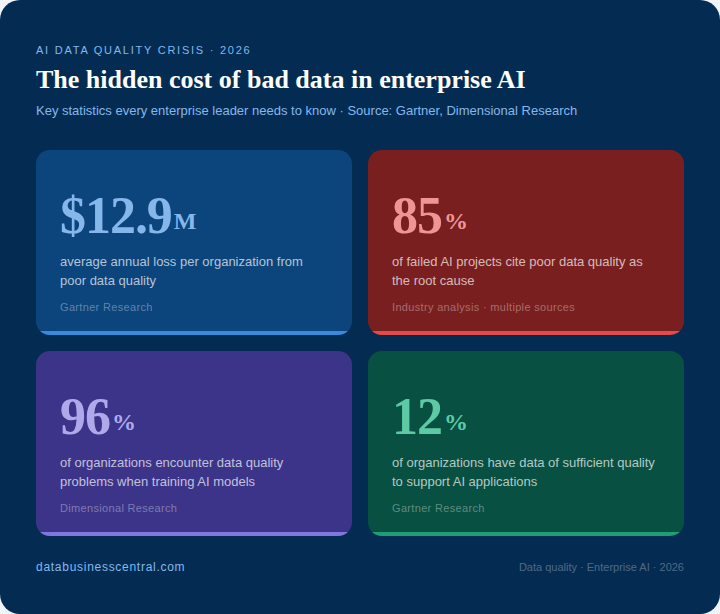
Gartner’s research places the average organizational loss at $12.9 million annually from data quality issues alone. But the true cost is almost certainly higher. That figure captures direct costs: failed projects, remediation, and lost productivity. It rarely accounts for the downstream erosion of customer trust, the regulatory penalties in heavily governed industries, or the strategic cost of decisions made on corrupted insights.
The IBM Institute for Business Value found that 43% of chief operations officers now rank data quality as their most significant data priority — outranking talent gaps, infrastructure costs, and model selection. The problem has left the technical layer and landed squarely in the boardroom.
Why AI Amplifies Bad Data
Traditional software fails predictably. If you feed a broken record into a billing system, it throws an error. If you feed broken data into an AI model — particularly a generative or retrieval-augmented system — it produces confident-sounding, plausible-looking, completely wrong output. This is the core danger of the current moment.
AI systems in production depend on data quality not just during training, but during every single inference. In RAG (Retrieval-Augmented Generation) pipelines, which 79% of organizations are now deploying in some form, stale or inaccurate grounding data causes hallucinations that are indistinguishable from accurate responses to end users. In predictive models, data drift — where the statistical properties of incoming data silently diverge from training data — causes models to degrade quietly over months without triggering obvious alerts.
How bad data propagates through AI systems
- Garbage in, garbage out — at scale. A mislabeled training batch doesn’t create one wrong answer. It biases thousands.
- Hallucination from stale retrieval data. RAG systems citing outdated records produce confident misinformation.
- Silent model drift. Data that shifts gradually causes model performance to erode without obvious failure signals.
- Duplicated records compound errors. AI agents acting on duplicate customer profiles send duplicate communications, process duplicate transactions.
- Schema changes break pipelines. Undocumented upstream changes cause partial loads that models treat as complete data.
Perhaps most damaging is the trust problem. When AI outputs align with operational reality, adoption grows. When they conflict — even occasionally — adoption stalls. Organizations are watching their AI investments hit a wall not because the technology is incapable, but because frontline employees have learned not to trust it.
The Real Cost Breakdown
When enterprises audit the full cost of poor data quality, they typically find five distinct loss vectors. Most budgets only account for one or two of them.
Failed AI projects & abandoned pilotsGartner estimates 60% of AI projects lacking AI-ready data will be abandoned by end of 2026
High severity
Data scientist time wasted on cleaning60–80% of data science hours go to data preparation, not model development
High severity
Lost revenue from inaccurate predictionsPricing errors, demand miscalculations, and churn prediction failures tied directly to data gaps
Medium–High
Regulatory & compliance exposureIn regulated industries, data quality failures carry direct financial penalties under GDPR, HIPAA, and emerging AI governance frameworks
Variable
Remediation costsOrganizations that skip data foundations early pay 2.8× more in remediation costs later
Compounding
A Forrester survey found that over 25% of data and analytics professionals report their organizations lose more than $5 million annually from poor data quality, with 7% reporting losses exceeding $25 million. These are not outliers — they are organizations that built AI strategies on data foundations they assumed were solid.
The Five Root Causes Driving AI Data Quality Failures
1. Incomplete or Inconsistent Data at Ingestion
The most common failure point is also the least glamorous: data enters the system in a broken state and no one catches it. Missing validation at ingestion points, inconsistent data entry standards across business units, and absent quality gates on real-time feeds all allow corrupted records to propagate deep into AI pipelines before they’re detected — if they’re detected at all.
2. Outdated Training and Reference Data
Customer records go stale. Addresses change. Email domains expire. Product catalogs shift. In traditional reporting, this creates errors of omission. In AI systems, it creates confident errors of commission — the model generates authoritative outputs based on a reality that no longer exists. Post-implementation reviews consistently surface the same issues: duplicated customer records, invalid contact data, incomplete consent and preference information that conflicts with what AI systems are acting upon.
3. Schema Changes Without Downstream Notification
One of the most damaging and silent root causes in enterprise environments is an upstream schema change that no one communicated downstream. A field renamed. A data type modified. A column deprecated. AI pipelines that were working perfectly continue running — but now processing malformed inputs without failing, producing outputs that look valid but aren’t. This kind of silent failure can run for weeks.
4. No Active Metadata Management
Without current, machine-readable metadata, AI pipelines deliver data that models cannot confidently use. Most organizations have metadata — they simply don’t maintain it at the cadence AI development requires. Annual governance reviews and quarterly audits made sense for reporting environments. AI models in production need data quality signals measured in hours, not quarters.
5. Fragmented Ownership and Governance
When no one owns data quality end-to-end, everyone assumes someone else is handling it. Engineering assumes the business defined the quality standards. The business assumes engineering validated the pipelines. Data science assumes both are correct. In reality, only 12% of organizations have data of sufficient quality to support AI applications — a sobering reflection of how widespread this governance gap truly is.
What High-Performing Organizations Are Doing Differently
The organizations that are succeeding with AI in 2026 share a common pattern: they treated data quality as a strategic foundation, not a pre-launch checklist item. Here is what that looks like in practice.
01
Data readiness before model development
Successful teams conduct honest data readiness assessments before committing to AI development and address quality gaps before ML work begins. They budget 40–50% of total resources for data infrastructure.
02
Real-time quality monitoring
Replacing quarterly data audits with automated pipeline monitoring that flags anomalies in near-real time. Data quality signals measured in hours, not months — matching the cadence AI requires.
03
Data contracts and SLAs
Formalizing agreements between data producers and consumers that define expected schema, freshness, completeness, and accuracy. Schema changes trigger downstream notifications automatically.
04
Clear asset-level ownership
Assigning named accountability for every data asset, with defined quality standards and governance checkpoints that are enforced — not aspirational. Governance at the asset level, not the department level.
05
Real-time validation at capture
Preventing known errors from ever entering storage through validation at the point of data capture. Stopping bad data at the source rather than cleaning it throughout the pipeline.
06
Semantic modeling for consistency
Investing in semantic layers that make data consistent, discoverable, and interpretable across teams and systems — a priority that vendors like Snowflake and GoodData have accelerated in 2026.
The research is consistent on one point: organizations that define AI success metrics upfront and invest in data foundations first show a 4.5× improvement in AI project success rates. The path is not secret. It is, as one analysis noted, simply a discipline.
Data Governance Is No Longer Optional
BARC’s Trend Monitor for 2026 ranks data quality management as the number one data and analytics priority — ahead of new AI platforms, new tooling, and even new models. The analyst community has reached a rare consensus: AI systems do not fail in isolation. They fail because the data they rely on is unreliable.
“In 2026, organizations that succeed with AI will be those that treat data quality as a strategic discipline rather than a technical clean-up task.”
Effective data governance in an AI context means something different from what it meant in a reporting context. It means asset-level ownership with access controls, quality standards, and metadata management that updates at the cadence AI development demands — not on annual audit cycles. It means governance frameworks that are embedded in pipelines, not bolted on after deployment.
For enterprises using AI agents — and 79% are, in some form — this urgency is compounded. Agents don’t just retrieve information. They take actions: sending communications, updating records, triggering workflows. When an agent acts on bad data, the damage is not a wrong number on a dashboard. It is a wrong action taken in the world, often at scale, before anyone notices.
The Bottom Line for Enterprise Leaders
Every dollar invested in AI infrastructure is leveraged by the quality of data underneath it. Poor data quality doesn’t just reduce AI ROI — it inverts it, turning investments into liabilities. The enterprises losing millions in 2026 are not losing because they chose the wrong model or the wrong vendor. They are losing because they built on a foundation they didn’t adequately inspect.
The good news: data quality is a solvable problem. It requires investment, discipline, and organizational commitment — but it is not a research frontier. The practices are known. The organizations succeeding today are simply the ones that started earlier and took data readiness seriously before, not after, the models went live.
If your organization is planning AI initiatives in 2026, the most important question to answer first is not “which model?” — it’s “is our data ready?” The answer will determine everything that follows.

1 thought on “How AI Data Quality Issues Are Costing Enterprises Millions in 2026”
Pingback: Data Teams Need an AI Provenance Apprenticeship