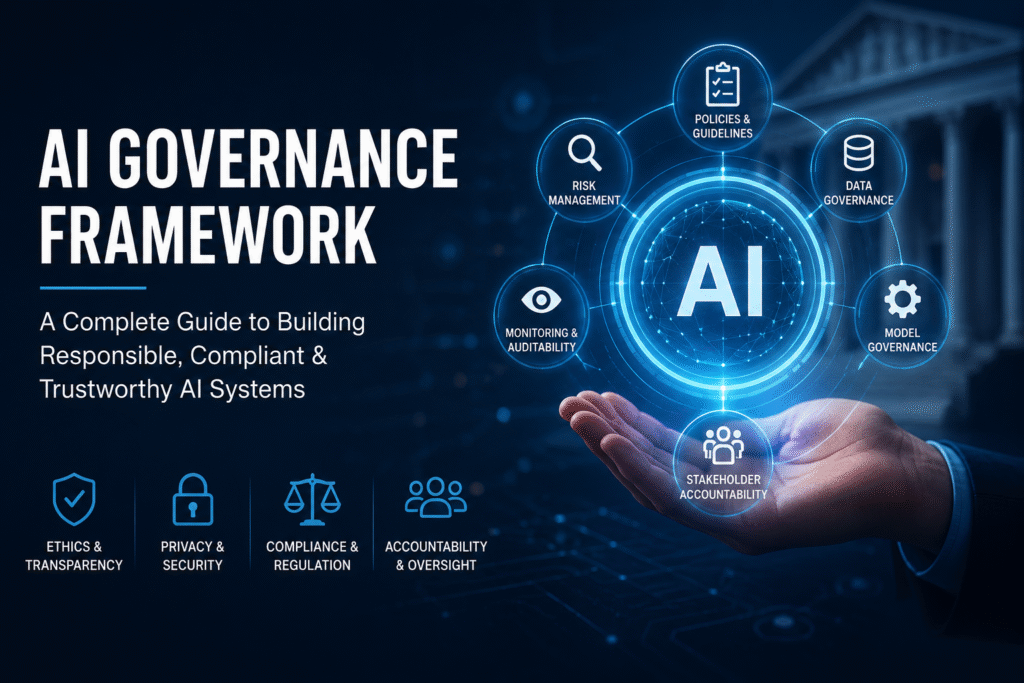
Three major frameworks now shape how organizations build and deploy AI responsibly. Here’s how they differ — and how to decide which one fits your strategy.
Artificial intelligence is moving fast. Regulatory frameworks are scrambling to keep up. If your organization develops, deploys, or procures AI systems, you’ve almost certainly heard the names: NIST AI RMF, ISO 42001, EU AI Act. But what do they actually require — and which one should you care about?
Why AI governance matters right now
For years, AI governance was a “nice to have.” A handful of internal principles, a model card here and there, maybe a fairness audit if the use case was sensitive enough. That era is ending.
Enterprises are deploying generative AI into customer-facing products, hiring pipelines, and financial decisions. Regulators have noticed. Boards are asking questions. And the three frameworks covered in this article now represent the clearest benchmarks the industry has — even if they take very different approaches.
The core question isn’t “which framework is best.” It’s “which framework fits my organization’s risk profile, operating geography, and maturity level” — and whether you can build a governance architecture that satisfies more than one.
NIST AI Risk Management Framework (AI RMF)
NIST AI RMF 1.0
National Institute of Standards and Technology · Released January 2023
Voluntary
The NIST AI Risk Management Framework was built for a specific purpose: give organizations — regardless of size, sector, or AI maturity — a common language and structure for thinking about AI risks. It doesn’t tell you what to do so much as how to think about what you should do.
At its heart, the AI RMF organizes AI risk management into four functions: Govern, Map, Measure, and Manage. These aren’t sequential phases. They’re interdependent activities that happen in parallel across the lifecycle of an AI system.
The framework also introduces the concept of trustworthy AI through a set of properties it calls the “TEVV” attributes — valid and reliable, safe, secure and resilient, explainable and interpretable, privacy-enhanced, and fair with bias managed. These properties give practical texture to what “responsible AI” actually means in practice.Issued by
NIST (US Dept. of Commerce)Type
Voluntary guidanceGeographic focus
US-centric, globally adoptedBest for
US organizations, federal contractors
What the four core functions actually mean
Govern is about building the organizational culture, policies, and accountability structures that make AI risk management possible. Think of it as the foundation — without governance, the other three functions don’t hold.
Map is where you contextualize the AI system. What is it doing? Who is affected? What are the relevant risks? This function forces explicit thinking about the deployment context — not just the model itself.
Measure involves analyzing and assessing those risks with rigor. Not just listing them, but actually quantifying or qualifying their likelihood, severity, and detectability.
Manage is the operational response — how you prioritize, respond to, and monitor AI risks in production. This includes incident response, ongoing monitoring, and decommissioning processes.
Who should care about NIST AI RMF
If your organization operates primarily in the United States — especially if you’re a federal contractor, work in financial services, or have executive stakeholders who want a credible benchmark to reference — NIST AI RMF is the natural starting point. It’s flexible enough to apply to any industry and any AI system, from a simple classification model to a complex generative AI deployment.
The voluntary nature is both a strength and a limitation. It gives you flexibility. But it also means there’s no third-party certification to demonstrate compliance, which matters if you’re trying to assure customers or regulators of your governance posture.
ISO/IEC 42001: The AI Management System Standard
ISO/IEC 42001:2023
International Organization for Standardization · Published December 2023
Certifiable
ISO 42001 is the world’s first international standard for AI management systems. It draws heavily on the structure of ISO 9001 (quality management) and ISO 27001 (information security), which means organizations already certified under those frameworks will find the architecture familiar.
Unlike NIST’s risk-function model, ISO 42001 takes a systems management approach — it’s about building and maintaining an AI Management System (AIMS): a documented, auditable, continuously improving organizational system for responsible AI development and use.
The standard covers everything from policy and leadership commitment to operational planning, performance evaluation, and continual improvement. It applies to any organization that develops, provides, or uses AI systems — regardless of type, size, or AI maturity.Issued by
ISO / IEC Joint Technical CommitteeType
Certifiable management system standardGeographic focus
International (190+ countries)Best for
Global enterprises, B2B trust-building
What an AI Management System actually looks like
If you’ve implemented ISO 27001, you know the pattern: leadership defines scope and policy, the organization conducts risk assessments, controls are selected and implemented, internal audits verify compliance, and management reviews drive continual improvement. ISO 42001 applies the same logic to AI.
The standard introduces AI-specific elements that go beyond generic management system requirements. These include defining your organization’s AI policy, conducting AI impact assessments, establishing processes for AI system development and acquisition, and documenting the responsibilities of “AI providers” versus “AI users” within your organization — a distinction that matters considerably when you’re buying third-party AI services rather than building your own.
The certification advantage
The single biggest differentiator of ISO 42001 is certification. A third-party accredited certification body can audit your AIMS and issue a certificate — the same way organizations get ISO 9001 or ISO 27001 certified. This creates a verifiable, externally validated signal of AI governance maturity.
For B2B enterprises, this is increasingly valuable. Procurement teams, enterprise customers, and supply chain partners are starting to ask about AI governance. An ISO 42001 certificate is a concrete, internationally recognized answer to that question.
Important nuance: ISO 42001 certification confirms that your AI management system meets the standard’s requirements — not that every specific AI system you operate is safe, fair, or compliant with any particular regulation. The distinction matters when communicating with stakeholders.
EU AI Act: Regulation with Legal Weight
EU AI Act
European Union · Entered into force August 2024 · Phased implementation through 2026
Mandatory
The EU AI Act is not a framework you choose to adopt. If you place AI systems on the EU market — or if your AI systems affect people in the EU — the Act applies to you. Full stop.
The regulation takes a risk-tiered approach, classifying AI systems into four categories: Unacceptable Risk (prohibited), High Risk (heavily regulated), Limited Risk (transparency obligations), and Minimal Risk (largely unregulated). The category your system falls into determines your compliance obligations.
High-risk systems — which include AI used in hiring, credit scoring, medical diagnosis, law enforcement, critical infrastructure, and education — face stringent requirements: conformity assessments, technical documentation, human oversight mechanisms, accuracy and robustness standards, and registration in an EU database.Issued by
European Parliament & CouncilType
Binding regulation with penaltiesGeographic focus
EU market (extraterritorial reach)Best for
Any org deploying AI to EU users
The risk-tier breakdown
Unacceptable risk systems are banned outright. These include AI that exploits psychological vulnerabilities, real-time biometric surveillance in public spaces (with narrow exceptions), social scoring by governments, and systems that predict criminal behavior from personal characteristics.
High-risk systems are where the compliance burden is heaviest. Organizations deploying these systems must implement a risk management system, maintain comprehensive technical documentation, ensure data governance, provide human oversight, and achieve declared levels of accuracy and robustness. Pre-market conformity assessments are required for certain categories.
Limited-risk systems — primarily chatbots and systems generating synthetic content — face transparency requirements. Users must be told they’re interacting with AI. Deepfakes must be labeled.
Minimal-risk systems, such as spam filters or AI-powered video games, face no specific obligations beyond general product liability law.
Implementation timeline
The Act entered into force in August 2024. Prohibited practices became enforceable in February 2025. Rules for general-purpose AI models (including large language models) apply from August 2025. High-risk system requirements for most applications take full effect in August 2026. Organizations should be well into their compliance planning now.
Penalties for non-compliance are substantial — up to €35 million or 7% of global annual turnover for the most serious violations, whichever is higher. The extraterritorial reach means US and global companies serving EU customers cannot ignore these requirements.
“The EU AI Act’s risk-tier approach is conceptually clean. The challenge is that categorization is harder than it looks — the same AI system can be high-risk in one deployment context and minimal-risk in another.”
Side-by-side comparison
| Dimension | NIST AI RMF | ISO 42001 | EU AI Act |
|---|---|---|---|
| Type | Voluntary guidance | Certifiable standard | Binding regulation |
| Issuer | US Federal Agency | International Standards Body | European Union |
| Geographic scope | US-centric, globally used | 190+ countries | EU market (extraterritorial) |
| Approach | Risk function model (Govern, Map, Measure, Manage) | Management system (AI policy, controls, audit) | Risk-tiered regulation (prohibited → high → limited → minimal) |
| Enforcement | None — self-assessed | Third-party certification (optional) | National regulators, fines up to €35M / 7% revenue |
| Certification | No formal certification | Yes — accredited certification bodies | Conformity assessment for high-risk systems |
| Flexibility | High — principles-based, adaptable | Medium — structured but flexible implementation | Low for high-risk; high for minimal-risk |
| Best suited for | US orgs, early-stage governance programs | Global enterprises, B2B trust signals | Any org with EU market exposure |
How to choose the right framework
The honest answer is that the “choice” is partially made for you by geography and sector. But within those constraints, there’s genuine strategic decision-making to be done.
Start with NIST if…
You’re a US company with limited EU exposure, new to structured AI governance, or need a flexible framework to build internal literacy and risk culture without heavy process overhead.
Prioritize ISO 42001 if…
You operate globally, need a certifiable benchmark to demonstrate to enterprise customers, or already have ISO 27001 / 9001 management systems and want to extend them to AI.
Act on the EU AI Act if…
You deploy AI systems used by customers, employees, or citizens in the EU — regardless of where your organization is headquartered. This isn’t optional.
Can you use more than one? (You probably should)
The frameworks are complementary, not competing. In practice, most sophisticated organizations will need to engage with more than one — and the good news is they’re designed with interoperability in mind.
NIST AI RMF provides a risk management vocabulary and structure. ISO 42001 provides the management system architecture and certification pathway. The EU AI Act provides the legal compliance floor. Together, they cover different dimensions of AI governance: how you think about risk, how you organize your processes, and what you’re legally required to do.
Practically speaking, an organization can map NIST AI RMF functions to ISO 42001 clauses, and both can inform the compliance documentation required for EU AI Act high-risk system registration. Investing in any one framework tends to make the others more achievable.
Governance tip: Many organizations find it useful to use NIST AI RMF as their internal methodology for AI risk assessment, pursue ISO 42001 certification as an external trust signal, and treat the EU AI Act as the non-negotiable baseline for their European operations. These three don’t conflict — they layer.
Getting started: practical next steps
If your organization doesn’t have a formal AI governance framework in place, the barrier to starting is lower than most teams expect. Here’s a realistic path forward:
Conduct an AI inventory. Before you can govern AI, you need to know what AI systems you’re operating — including third-party tools and embedded AI in SaaS products. Most organizations are surprised by how many AI touchpoints exist across their stack.
Classify your risk exposure. Work through your AI inventory against the EU AI Act’s risk tiers (even if you don’t have EU customers yet — the categorization framework is useful regardless). Identify which systems are high-risk under any reasonable framework.
Choose your governance structure. Decide whether AI governance sits within legal, compliance, IT risk, or a dedicated AI governance function. Assign clear ownership. Document it.
Adopt NIST AI RMF as your working methodology. The Govern-Map-Measure-Manage structure is practical and well-documented. Use it as the operating model for your AI risk assessments, even if formal certification isn’t on your roadmap yet.
Assess ISO 42001 certification readiness. If you already have ISO 27001, the gap analysis is manageable. A certification timeline of 12–18 months from standing start is realistic for most mid-sized organizations.
Build your EU AI Act compliance roadmap. If you have EU market exposure and haven’t started, the clock is running. High-risk system requirements take full effect in August 2026. Map your systems, identify gaps, and prioritize accordingly.
AI governance doesn’t happen in a single project. It’s an ongoing organizational capability — one that, like information security before it, will become a baseline expectation for any company that takes AI seriously. The frameworks covered here give you the scaffolding. What you build on it is up to you.
for your reference:

1 thought on “AI Governance Frameworks Compared: NIST vs ISO 42001 vs EU AI Act”
Pingback: AI Governance Frameworks for Enterprise LLM Deployment