Your AI agent passes every demo. Then it goes live, and things get strange. It quotes last year’s pricing. It reports revenue using the wrong definition of “customer.” It confidently answers a question it should never have been allowed to answer.
The model is rarely the problem. The problem is what the model was given to work with. That is the core idea behind AI context engineering: the discipline of making sure an AI agent sees the right information, in the right form, at the right moment.
As businesses head into 2027, this has become one of the most important topics in enterprise AI. Companies have access to the same powerful models. The ones getting reliable results are the ones that engineer their context well.
In this guide, you will learn what AI context engineering is, how it differs from prompt engineering, how AI context platforms work, which tools to evaluate, and how to roll it out step by step.
1. What Is AI Context Engineering?
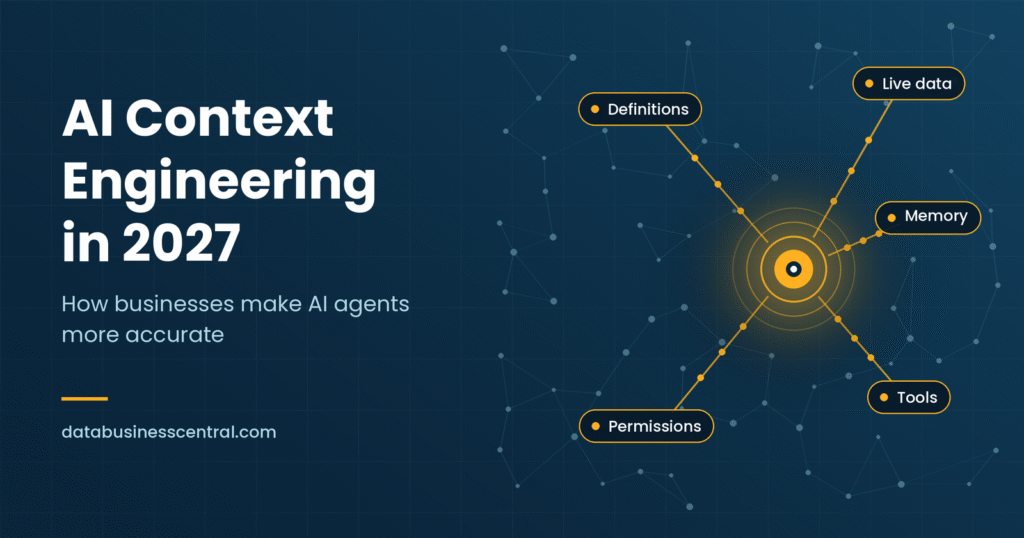
AI context engineering is the practice of designing systems that automatically assemble the right information, tools and business knowledge into an AI model’s working memory (its context window) before it answers or acts.
Think of a new employee on their first day. Even a brilliant hire will make mistakes if nobody explains how the company defines revenue, which systems are trustworthy, or who is allowed to see what. Context engineering is the onboarding, handbook and access badge for your AI agents, delivered automatically on every request.
A well-engineered context typically includes:
- Instructions: the agent’s role, rules and tone.
- Business definitions: what terms like “active customer” or “net revenue” actually mean at your company.
- Retrieved data: current, relevant documents and records pulled in at the moment of the question.
- Memory: what the agent learned earlier in the conversation or in past sessions.
- Tools: the systems the agent is allowed to call, such as a CRM, a database or a ticketing platform.
- Permissions and policies: what this particular user is allowed to see and do.
The term gained momentum in 2025, when industry analysts and AI leaders began arguing that the focus should shift from clever wording to well-built information flows. Gartner, for example, publicly framed context engineering as the successor to prompt engineering and has predicted it will be built into a large majority of AI tools by 2028.
AI data context in plain English
You will also hear the phrase AI data context. It simply means the data-related knowledge an agent needs to interpret your information correctly: table meanings, metric definitions, data lineage, quality scores and ownership. An agent without it can read a database. An agent with it can understand the database.
2. Why AI Agents Need Better Context
Large language models know a great deal about the world. They know almost nothing about your business unless you tell them. That gap is where most enterprise AI failures begin.
The four ways context fails
Most accuracy problems trace back to one of four context failures:
- Missing context. The agent does not have the document, policy or data point it needs, so it guesses.
- Stale context. The agent uses an outdated price list, org chart or policy because nothing refreshed it.
- Conflicting context. Two systems define the same metric differently, and the agent picks one at random.
- Irrelevant context. The agent is flooded with loosely related text, which buries the useful facts and raises cost.
Notice that none of these are “the model is not smart enough” problems. They are information problems, which is why a better model alone rarely fixes them.
The shift from chatbots to enterprise AI agents
The stakes are rising because enterprise AI agents do more than answer questions. They file tickets, approve refunds, update records, draft contracts and trigger workflows. Gartner has projected that around 40% of enterprise applications will include task-specific AI agents by the end of 2026, up from under 5% in 2025. When an agent can take action, a wrong answer is no longer an embarrassing chat reply. It is a wrong action in a live system.
Bigger context windows are not the answer
Modern models can read hundreds of thousands of tokens at once, so some teams try to simply paste everything in. This usually backfires:
- Cost and latency rise with every extra token.
- Accuracy can drop when relevant facts are buried among irrelevant ones.
- Security risks grow when agents receive data the user should never see.
The goal is not more context. It is the right context, which is exactly what engineering is for.
3. Context Engineering vs Prompt Engineering
The phrase context engineering vs prompt engineering comes up constantly, so let’s make the difference clear.
Prompt engineering focuses on how you phrase a request: the instructions, examples and formatting you write for the model. It is useful, and it is not going away.
Context engineering focuses on the whole information environment around that request: what data is retrieved, what memory is loaded, what tools are available, and what rules are enforced. The prompt becomes just one ingredient.
| Prompt Engineering | Context Engineering | |
|---|---|---|
| Main question | How should I word this request? | What information does the agent need to succeed? |
| Scope | A single prompt or template | The entire system around the model |
| Data handling | Usually static text written by hand | Dynamic, retrieved and refreshed at runtime |
| Memory | Rarely addressed | Short-term and long-term memory managed deliberately |
| Governance | Mostly out of scope | Permissions, policies and audit trails built in |
| Who owns it | Individual users or developers | Data, AI and platform teams together |
| Best for | Quick tasks, drafting, one-off workflows | Production agents, multi-step workflows, enterprise use |
| Typical failure | Vague or inconsistent output | Stale, missing or conflicting information |
An example that shows the difference
Suppose a sales manager asks an agent, “What was our Q3 churn in the Midwest?”
- Prompt-engineering fix: rewrite the instruction to say “be precise and cite your sources.” The agent is more polite, but it can still pull the wrong table.
- Context-engineering fix: give the agent the certified definition of churn, the current Midwest territory mapping, access to the governed Q3 dataset, and a rule that it must show where the number came from. Now the answer is both accurate and explainable.
Both skills matter. But in production, context usually decides whether the answer is right.
4. How AI Context Platforms Work
AI context platforms are tools that automate context engineering at scale. Instead of every team hand-building retrieval scripts and prompt templates, a context platform provides a shared layer that sits between your business data and your AI agents.
The core layers of enterprise AI architecture
A solid enterprise AI architecture for context usually has five layers working together:
- Data and knowledge sources. Databases, data warehouses, documents, wikis, CRMs, ticketing systems and APIs.
- Metadata and semantic layer. Definitions, relationships, lineage, ownership and quality signals that explain what the data means.
- Retrieval and memory. Search, vector databases, knowledge graphs and memory stores that find relevant information quickly and remember what matters.
- Orchestration and delivery. Frameworks and protocols that assemble the final context and pass it to the model, often through standards such as the Model Context Protocol (MCP).
- Governance and observability. Access controls, audit logs, evaluation and monitoring that keep everything trustworthy.
What happens when an agent gets a question
Here is a simplified view of one request moving through a context platform:
- A user asks a question or an event triggers an agent.
- The platform identifies intent and determines what kind of information is needed.
- It retrieves relevant data from approved sources, using search, graph lookups or database queries.
- It attaches business meaning: certified definitions, lineage and quality indicators.
- It applies permissions, removing anything this user or agent is not allowed to access.
- It compresses and ranks the material so only the most useful content enters the context window.
- The model reasons and responds, and the platform logs what context was used.
- Feedback is captured so the system can improve over time.
Why MCP matters
The Model Context Protocol, introduced as an open standard for connecting AI systems to tools and data, has become a common way to deliver context to agents. Industry reports in 2026 describe very large monthly download numbers for MCP software development kits and thousands of available servers, so support for it is increasingly treated as a baseline feature when evaluating platforms. Treat those adoption figures as directional, since they come from vendor and community reports, but the trend is clear.
Real-time data makes context fresh
Context is only useful if it is current. An agent that sees yesterday’s inventory will make yesterday’s decisions. That is why many teams pair their context layer with strong real-time data analytics pipelines, so agents always work from live information.
5. Benefits for Enterprise Businesses
When businesses invest in context engineering, the gains show up in several places.
Higher AI agent accuracy
This is the headline benefit. When agents are grounded in certified definitions and current data, they stop inventing metrics and mixing up terms. Analyst commentary has suggested meaningful accuracy gains from context engineering, with Gartner-linked claims often cited at 30% or more. Your own results will vary, so measure them against your baseline before and after.
Fewer hallucinations and less rework
Grounded answers mean fewer confident-sounding mistakes. Employees spend less time double-checking outputs and fixing errors.
Explainability and trust
Good context platforms can show why an agent answered the way it did: which sources, which definitions, which rules. That traceability is essential for audits and for winning over skeptical stakeholders.
Stronger security and compliance
Because permissions are enforced at the context layer, an agent only sees what the requesting user is allowed to see. This reduces the risk of accidental data exposure, which matters for industries such as healthcare, finance and government contracting.
Lower cost per task
Sending only relevant context keeps token usage down. Over thousands of daily requests, that adds up.
Reusability across teams
One well-built context layer can serve many agents. Instead of five teams solving the same data-definition problem five times, they share one governed foundation.
Faster, safer scaling
With a consistent architecture, launching the tenth agent is far easier than launching the first.
6. Real-World Business Use Cases
Below are practical scenarios showing how context engineering improves AI agent accuracy in different functions. These are illustrative examples of common patterns rather than named customer case studies.
Customer support
Without good context: An agent answers a warranty question using a generic policy, ignoring that the customer bought a product with extended coverage.
With context engineering: The agent retrieves the customer’s order history, the exact product’s warranty terms and the latest policy update, then drafts a correct reply and cites the policy.
Financial services and fraud prevention
Banks and fintech companies use agents to triage alerts and assist investigators. Context such as transaction history, device signals, customer risk profiles and regulatory rules helps the agent prioritize cases correctly. If you want the machine learning side of this story, see our guide to AI fraud detection in 2026.
Sales and revenue operations
Sales agents summarize accounts, draft outreach and forecast pipeline. Accuracy depends on consistent definitions of “qualified lead” and “closed-won,” current CRM data and territory rules. Context engineering keeps those definitions aligned across teams.
Data and analytics self-service
Business users increasingly ask questions in plain English, such as “Which region had the biggest margin decline last quarter?” A text-to-SQL agent needs to know which tables are certified, how margin is calculated and which columns contain sensitive data. Without that context, it may generate a query that runs perfectly and returns the wrong answer.
Legal and compliance
Agents that review contracts or answer policy questions must work from the current approved clause library and the right jurisdiction rules. Context engineering ensures they cite approved sources and respect confidentiality boundaries.
IT and software engineering
Coding and operations agents perform better when they understand the codebase conventions, architecture decisions, runbooks and incident history. Many engineering teams now maintain shared instruction files, reusable skills and tool connections so agents behave consistently.
Supply chain and operations
Planning agents need live inventory, supplier lead times and demand signals. Fresh, connected context helps them recommend reorders that reflect reality instead of last month’s spreadsheet.
Human resources
HR assistants answer benefits and policy questions. Context ensures they use the correct plan year, employee location and eligibility rules, while keeping salary and personal data locked down.
7. Best AI Context Engineering Tools
No single product covers everything. Industry comparisons in 2026 consistently note that most production teams combine several tools across different layers rather than buying one platform. Here is a practical way to think about the landscape.
Tool categories at a glance
| Category | What it does | Example tools to evaluate | Best for |
|---|---|---|---|
| Orchestration frameworks | Assemble prompts, tools and workflows into agents | LangChain and LangGraph, LlamaIndex, OpenAI Agents SDK | Developer teams building custom agents |
| Retrieval and vector search | Find relevant content using semantic search | Pinecone, Weaviate, Elasticsearch, pgvector | Knowledge search and document Q&A |
| Knowledge graphs | Model relationships between entities | Neo4j, Amazon Neptune | Complex, connected data and reasoning |
| Agent memory | Persist facts across sessions | Mem0, Zep, Letta | Personalization and long-running tasks |
| Enterprise context and metadata platforms | Govern definitions, lineage, quality and access | Atlan, Alation, Collibra, Informatica, DataHub, OvalEdge | Regulated or large enterprises needing trusted data context |
| Cloud agent platforms | Managed build, deploy and security for agents | Google Vertex AI Agent Builder, AWS Bedrock Agents, Microsoft Azure AI Foundry | Teams standardized on one cloud |
| Warehouse-native AI | Run AI close to governed data | Snowflake Cortex, Databricks Mosaic AI and Unity Catalog | Data teams already on these platforms |
| Protocols and connectors | Standardize how agents reach tools and data | Model Context Protocol (MCP) servers | Connecting many systems consistently |
Product names and capabilities change quickly, so confirm current features directly with each vendor before you decide.
How to choose: seven evaluation criteria
When comparing options, score each one against these criteria:
- Data coverage: Does it connect to your actual sources, including legacy systems?
- Governance and security: Can it enforce role-based access and keep audit logs?
- Freshness: How quickly do updates in source systems reach the agent?
- Explainability: Can you trace an answer back to its sources and definitions?
- Interoperability: Does it support open standards such as MCP, so you avoid lock-in?
- Evaluation tooling: Can you test accuracy before and after changes?
- Total cost: Include licensing, engineering time, compute and ongoing maintenance.
Build, buy or blend?
- Build gives maximum control but demands strong engineering talent and long-term maintenance.
- Buy speeds up deployment and brings built-in governance, but may limit flexibility.
- Blend is the most common approach: use an open framework for orchestration, a vector or graph store for retrieval, and a governed metadata platform for trusted business context.
A good rule of thumb: the more regulated and high-stakes your use case, the more weight you should place on governance and traceability over raw developer convenience.
8. Challenges and Implementation Strategies
Context engineering delivers real value, but it is not plug and play. These are the hurdles teams most often hit, along with ways to address them.
| Challenge | Why it happens | How to address it |
|---|---|---|
| Poor data quality | Inconsistent, duplicated or missing records feed bad context | Invest in data quality management before scaling agents |
| Conflicting definitions | Teams define metrics differently | Create certified business glossaries and one owner per metric |
| Weak governance | Agents may access data users should not see | Build a clear data governance framework with role-based access |
| Context overload | Too much text confuses the model and raises cost | Rank, filter and compress context; retrieve only what is needed |
| Stale information | Sources are not refreshed on time | Set freshness rules and monitor pipelines |
| Unclear ownership | Context spans data, AI, security and business teams | Assign a cross-functional owner and define responsibilities |
| No measurement | Teams cannot tell if changes help | Create evaluation sets and track accuracy over time |
| Security threats | Prompt injection and data leakage through retrieved content | Treat retrieved content as untrusted, filter inputs and test adversarially |
A practical 7-step implementation roadmap
- Pick one high-value use case. Choose a workflow with clear business impact and measurable accuracy, such as support answers or analytics Q&A. Avoid starting with everything at once.
- Audit your context sources. List where the needed knowledge lives, who owns it, how current it is and how trustworthy it is.
- Define the business meaning. Document key terms, metrics and relationships. Get business and data owners to certify them.
- Design the retrieval and memory strategy. Decide what is searched, what is remembered, how long it is kept and how it is ranked.
- Build in governance from day one. Add permissions, logging and approval rules before launch, not after an incident.
- Create an evaluation set and baseline. Collect real questions with verified answers. Measure accuracy, citation quality, latency and cost before you change anything.
- Launch, monitor and iterate. Review failures weekly, trace each one to a context problem, fix the context, and re-test.
Metrics worth tracking
- Answer accuracy against your verified test set
- Groundedness, meaning how often claims are backed by retrieved sources
- Citation correctness
- Escalation rate to human reviewers
- Latency and cost per task
- User satisfaction
The people side
Context engineering is a team sport. Data engineers, analysts, AI developers, security specialists and business subject-matter experts all contribute. Some large services firms have publicly announced hiring or training programs for dedicated context engineers, which signals that this is becoming a recognized role. Whether you create a new title or expand existing ones, make sure someone owns the quality of context end to end.
9. Future of Context Engineering in 2027
Here are the trends most likely to shape the year ahead.
Context becomes core enterprise infrastructure
Just as data warehouses became standard, a governed context layer is on track to become a normal part of enterprise AI architecture. Expect budget lines, owners and service-level targets for context, not just for models.
Context graphs and living knowledge
Instead of static document stores, more organizations are building connected maps of customers, products, policies and decisions. These graphs update as the business changes and help agents reason across relationships rather than isolated files.
Persistent memory across sessions
Agents are moving beyond one-off conversations. Governed long-term memory will let agents remember preferences, prior decisions and project history, while privacy controls determine what can be stored and for how long.
Multi-agent systems need shared context
When several agents collaborate, they must share facts without contradicting each other. Shared, versioned context becomes the glue that keeps multi-agent workflows consistent.
Open standards win
Protocols such as MCP reduce the cost of connecting agents to tools and data. Expect continued convergence on open standards, along with stronger security expectations around them.
Evaluation becomes continuous
Teams will treat context like software: version it, test it and roll it back when quality drops. Automated evaluation will run constantly, not just before launch.
Governance and regulation tighten
As AI regulation matures in the US and globally, organizations will need to show what data influenced an automated decision. Context platforms with built-in audit trails will have an advantage.
Smarter, more dynamic context assembly
Expect agents to decide for themselves when to retrieve more information, compress what they already have, or ask a clarifying question, moving from fixed pipelines to adaptive context strategies.
The bottom line: models will keep improving, but the winning enterprises will be those that give those models the best information to work with.
10. Frequently Asked Questions
What is AI context engineering?
AI context engineering is the practice of designing systems that supply an AI model or agent with the right information, tools, memory and rules at the moment it needs them. It covers retrieval, business definitions, permissions and memory, not just the wording of a prompt.
What is the difference between context engineering and prompt engineering?
Prompt engineering is about how you phrase instructions. Context engineering is about the entire information environment around the model, including retrieved data, memory, tools and governance. Prompt engineering is one part of context engineering.
Does context engineering reduce AI hallucinations?
It can reduce them significantly by grounding answers in verified, current sources and by instructing the agent to cite its evidence. It does not eliminate hallucinations entirely, so human review and evaluation remain important for high-stakes decisions.
What are AI context platforms?
AI context platforms are tools that automate the collection, organization, governance and delivery of context to AI agents. They typically combine metadata management, retrieval, semantic definitions, permissions and integrations into a shared layer.
Do I need a context platform, or can I build my own?
Small pilots can often succeed with an open-source framework and a vector database. As you add more agents, data sources and compliance requirements, a governed platform usually saves time and reduces risk. Many enterprises blend both approaches.
How does context engineering improve AI agent accuracy?
It ensures the agent has the correct definitions, current data and relevant documents, and removes irrelevant or unauthorized information. Most agent errors come from missing, stale or conflicting context, so fixing context directly targets the root cause.
Is a bigger context window enough?
No. Larger windows help, but filling them with unfiltered information raises cost and can hurt accuracy. Selecting and structuring the right context matters more than maximizing volume.
How long does it take to implement?
A focused pilot for a single use case can often be stood up in weeks, while a broad enterprise context layer is typically a multi-quarter effort. Timelines depend heavily on data quality, governance maturity and how many systems must be connected.
Who should own context engineering in a company?
Ownership works best as a partnership between data, AI engineering, security and business domain experts, with one accountable lead. Business owners should certify definitions, while technical teams manage pipelines and platforms.
Which industries benefit most?
Any industry using AI agents benefits, but regulated and data-heavy sectors such as financial services, healthcare, insurance, retail and manufacturing see especially strong value because accuracy and traceability are critical.
Final Thoughts
The next wave of enterprise AI will not be won by whoever picks the flashiest model. It will be won by whoever gives their AI agents the clearest, freshest and most trustworthy understanding of the business.
That is what AI context engineering delivers: fewer mistakes, more explainable answers and agents you can actually rely on in production.
To get started, choose one workflow, document the definitions and data it depends on, add governance from the beginning, and measure accuracy before and after. Small, well-measured wins build the case for scaling.
Want to keep learning? Explore more guides in our artificial intelligence category on Data Business Central.
