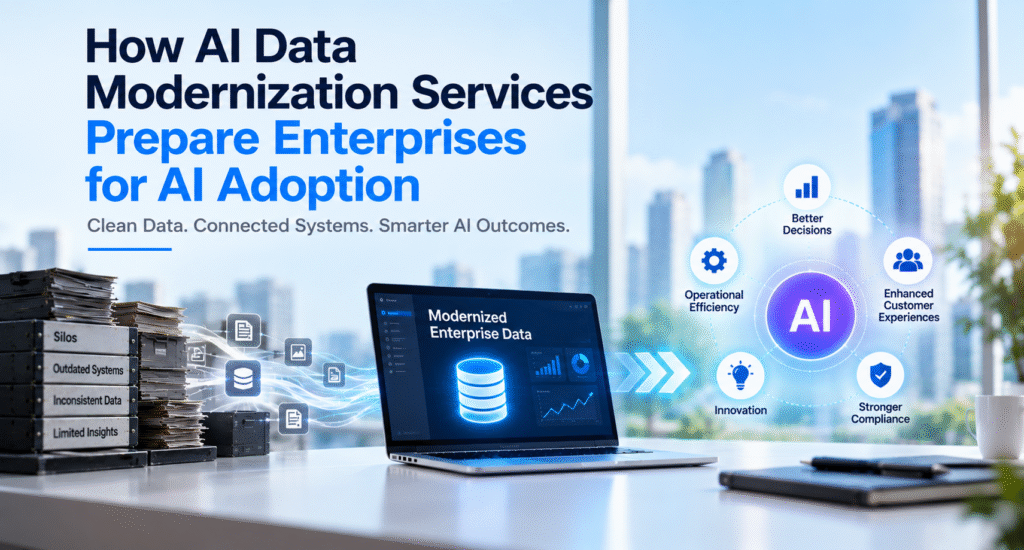
Artificial intelligence is rapidly becoming part of enterprise technology strategies. Organizations are exploring generative AI, predictive analytics, intelligent automation, recommendation systems, conversational applications, and machine learning to improve productivity and make better business decisions.
However, successful AI adoption depends on more than selecting an AI model or deploying a new AI application.
The quality, accessibility, governance, architecture, and security of enterprise data play a critical role in determining whether an AI initiative can deliver meaningful results. Many organizations still operate with fragmented databases, outdated data platforms, inconsistent data formats, disconnected applications, and legacy systems that make it difficult to provide reliable information to modern AI workloads.
This is where Application Modernization Services can make a significant difference.
AI data modernization focuses on transforming legacy and fragmented data environments so organizations can create a more reliable, scalable, governed, and AI-ready data foundation. Instead of treating data modernization as a simple database migration, enterprises can use it to improve how data is collected, stored, integrated, processed, governed, and made available for analytics and AI applications.
For organizations preparing for large-scale AI adoption, modernizing data can be one of the most important steps toward building a sustainable AI strategy.
What Are AI Data Modernization Services?
AI Data Modernization Services involve transforming existing enterprise data environments to support modern analytics, artificial intelligence, machine learning, and data-driven applications.
Traditional data environments may have been designed primarily for transactional workloads and reporting. Modern AI applications often require access to larger volumes of structured and unstructured information from multiple sources.
An enterprise may need to bring together information from customer relationship management systems, enterprise resource planning platforms, websites, mobile applications, operational databases, documents, customer interactions, IoT devices, and external data sources.
AI data modernization helps create the architecture and processes required to manage this information effectively.
The modernization process may include enterprise legacy modernization platform, database modernization, data integration, data migration, data quality improvement, metadata management, governance, security, cloud adoption, and the development of pipelines that make trusted data available to AI systems.
The objective is not simply to move data to a newer platform. The objective is to create a data foundation that can support current business requirements while remaining flexible enough for future AI initiatives.
Why Data Modernization Matters for AI Adoption
AI systems depend heavily on the data used to train, evaluate, augment, and operate them.
A sophisticated AI model cannot compensate for incomplete, inaccurate, inconsistent, or poorly governed enterprise data.
Consider an organization attempting to build an AI-powered customer service assistant. If customer information is distributed across several legacy databases and the data contains outdated addresses, duplicate customer records, inconsistent product information, and incomplete transaction histories, the AI application may produce unreliable results.
The problem in this situation is not necessarily the AI model. The underlying data foundation is not sufficiently prepared.
This illustrates an important principle: AI readiness begins with data readiness.
AI Data Modernization Services can help enterprises address these underlying data challenges before deploying AI at scale.
Breaking Down Enterprise Data Silos
One of the biggest obstacles to enterprise AI adoption is fragmented data.
Large organizations often grow through acquisitions, business expansion, and the introduction of new applications. As a result, different departments may maintain separate data environments.
Marketing may have one customer dataset. Sales may use another. Finance may maintain transaction information in a separate system, while customer support uses another platform.
These data silos make it difficult to develop a unified understanding of customers, products, operations, and business performance.
Data modernization can help organizations establish standardized integration patterns that connect information across different sources.
This may involve APIs, data pipelines, event-driven architectures, integration platforms, data warehouses, data lakes, or lakehouse architectures depending on business requirements.
The objective is not necessarily to place every piece of information into a single database. Instead, organizations should make relevant and governed information accessible to the systems and teams that need it.
For AI applications, this accessibility is particularly important because intelligent systems often need information from multiple business domains to generate useful results.
Improving Data Quality for AI
Data quality is one of the most important considerations in AI adoption.
Enterprise data may contain duplicate records, missing values, inconsistent naming conventions, incorrect formats, outdated information, and conflicting business definitions.
For traditional reporting, these problems can already create inaccurate insights. For AI systems, poor-quality data can create even more complicated problems.
Data modernization programs can introduce processes for profiling, cleansing, standardizing, validating, and monitoring data.
For example, customer information from different systems may use different formats for names, addresses, phone numbers, or account identifiers. Data quality processes can help establish consistent standards.
Organizations can also implement validation rules and automated monitoring to identify quality issues as they occur.
This creates a more reliable foundation for analytics, machine learning, and AI applications.
Creating a Scalable Data Architecture
AI workloads can generate significant data processing requirements.
As organizations expand their use of machine learning and generative AI, they may need to process structured and unstructured information at increasing scale.
Legacy data platforms may not have been designed for these requirements.
Modern data architectures can provide greater flexibility through cloud infrastructure, distributed processing, scalable storage, managed data services, and modern analytical platforms.
The appropriate architecture depends on the organization’s workload and business requirements.
Some enterprises may benefit from cloud data warehouses, while others may require data lakes, lakehouses, streaming architectures, or hybrid environments.
The important consideration is that the architecture should support scalability without introducing unnecessary complexity.
A modern data platform should also provide appropriate controls for performance, cost management, security, governance, and operational monitoring.
Supporting Generative AI and Large Language Models
The growth of generative AI has increased the importance of enterprise data modernization.
Organizations are increasingly interested in using large language models to interact with internal knowledge, documents, customer information, product data, policies, and operational content.
However, enterprises typically cannot rely on a general-purpose model alone to answer organization-specific questions accurately.
They need mechanisms that allow AI applications to securely access relevant enterprise information.
Modern data architectures can support approaches such as retrieval-augmented generation, where an AI application retrieves relevant information from trusted enterprise data sources before generating a response.
For this to work effectively, the underlying information needs to be discoverable, appropriately structured or indexed, governed, and accessible through secure mechanisms.
This means AI modernization and data modernization increasingly need to be considered together.
Modernizing Data for Machine Learning
Traditional machine learning applications also require well-managed data.
Machine learning models depend on training data, features, labels, evaluation datasets, and production information.
Legacy data environments can make it difficult for data scientists and machine learning engineers to access consistent datasets.
AI Data Modernization Services can help establish pipelines that make data available for model development and operational use.
Modern data engineering practices can support automated ingestion, transformation, validation, feature processing, monitoring, and lineage.
This can reduce the amount of manual preparation required before data can be used for machine learning.
It can also improve repeatability, allowing organizations to create more consistent processes for developing and maintaining models.
The Role of Data Governance in AI Adoption
AI adoption increases the importance of data governance.
Organizations need to understand where their data comes from, who owns it, how it can be used, and whether it contains sensitive information.
Without effective governance, enterprises can face challenges involving privacy, regulatory requirements, security, data ownership, and inappropriate access.
Modern data platforms can support governance through metadata management, data catalogs, access controls, lineage tracking, classification, and policy enforcement.
Data governance should not be viewed simply as a compliance exercise.
Good governance helps organizations understand the information they have and determine whether that information is trustworthy enough for important business decisions.
For AI systems, this becomes particularly important because organizations need confidence in the sources used by models and AI applications.
Protecting Sensitive Data
Enterprise AI applications may interact with sensitive business and customer information.
Depending on the industry, data may include financial records, personal information, healthcare information, intellectual property, employee records, or confidential business information.
Modernization provides an opportunity to strengthen data security before AI systems gain broader access to enterprise information.
Organizations can implement role-based access controls, encryption, data masking, tokenization, identity management, audit logging, and monitoring.
Access should also follow the principle of least privilege. An AI application should not automatically receive unrestricted access to every enterprise dataset simply because it needs access to some information.
Security controls should be incorporated into the data architecture from the beginning.
Enabling Real-Time AI Applications
Some AI applications require information that changes continuously.
Fraud detection, recommendation engines, operational monitoring, predictive maintenance, and dynamic customer experiences may depend on near-real-time data.
Legacy batch-oriented systems may not be suitable for these requirements.
Data modernization can introduce streaming pipelines and event-driven architectures that allow information to move through the organization more quickly.
This can help AI applications respond to changing conditions without waiting for periodic batch processes.
However, real-time architecture can increase technical and operational complexity. Enterprises should adopt it when the business use case actually requires real-time information rather than simply because the technology is available.
Improving Data Accessibility for Business Teams
AI readiness is not only about data scientists and engineers.
Business teams also need access to trusted information.
Modern data platforms can provide governed access to information through analytics tools, dashboards, APIs, semantic layers, and AI-powered interfaces.
This can help business users make decisions without relying entirely on technical teams to retrieve and prepare information.
For example, a sales manager could use a natural-language interface to ask questions about regional sales performance, customer trends, or product demand.
The quality of these experiences depends heavily on the underlying data architecture.
If business definitions are inconsistent or information is incomplete, AI-generated answers may be misleading.
How Data Migration Supports AI Modernization
Many enterprises need to migrate data from legacy databases and platforms before adopting modern data architectures.
Data Migration Services can help organizations plan and execute these transitions.
A migration program may involve discovering existing datasets, mapping data structures, transforming information, validating records, and moving data into a modern platform.
Data migration should not be treated as a simple copy-and-paste exercise.
Legacy environments often contain years of accumulated information, including duplicated records, obsolete data, undocumented fields, and inconsistent formats.
Organizations should determine which data needs to be retained, which should be archived, and which can be safely removed.
This can reduce unnecessary storage and management costs while improving the quality of the information available to AI applications.
Modernizing Legacy Applications Alongside Data
Data modernization and application modernization are closely connected.
Legacy applications often generate and consume data using outdated formats and architectures.
Modernizing the data platform without considering these applications may create integration problems.
Similarly, modernizing applications without addressing the underlying data environment can leave organizations with fragmented information.
Application Modernization Services can help enterprises transform legacy applications while updating the ways those applications interact with modern data platforms.
APIs, modern integration patterns, event-driven architectures, and standardized data interfaces can create stronger connections between applications and data environments.
This integrated approach can help organizations build a more consistent foundation for AI adoption.
Reducing the Cost and Complexity of AI Adoption
Data modernization can also influence the economics of AI adoption.
When data is fragmented and poorly managed, teams may spend significant time locating, cleaning, transforming, and validating information before it can be used.
This creates delays and increases the cost of AI initiatives.
A modernized data environment can establish reusable pipelines and standardized processes.
Instead of repeatedly preparing similar datasets for different AI projects, organizations can create governed data assets that can support multiple use cases.
This can improve productivity and help AI teams focus more on developing and deploying useful solutions rather than repeatedly solving the same data engineering problems.
Building an AI-Ready Data Strategy
Enterprises should avoid beginning data modernization by selecting a technology platform first.
A stronger approach starts with business and AI use cases.
Organizations should identify where AI could create measurable value and then determine what data those use cases require.
For example, an AI-powered customer service application may require customer profiles, product information, support histories, and knowledge documents.
A predictive maintenance application may require equipment telemetry, maintenance records, operating conditions, and historical failure information.
Once the required information is identified, organizations can assess whether the existing data environment can provide it reliably.
This creates a use-case-driven modernization strategy rather than a technology-driven transformation.
Measuring Data Modernization Success
Data modernization should be measured using meaningful technical and business metrics.
Organizations may track data quality, pipeline reliability, data availability, processing time, infrastructure utilization, access latency, data governance coverage, and the time required to prepare datasets for AI projects.
AI-specific measurements can include the time required to develop models, data preparation effort, model performance, retrieval accuracy for AI applications, and the percentage of AI workloads supported by governed data.
The appropriate metrics depend on the organization’s goals.
A modernization initiative focused on improving AI development speed may prioritize dataset preparation time and pipeline automation, while an initiative focused on governance may prioritize data lineage, classification, and access control coverage.
Common Challenges in AI Data Modernization
AI data modernization can create significant value, but enterprises should be prepared for challenges.
One challenge is discovering where important data actually resides. Large organizations may have undocumented databases, spreadsheets, file repositories, and departmental systems that are not included in official data inventories.
Another challenge is data ownership. Different departments may have conflicting definitions of important business entities such as customers, products, or revenue.
Data quality can also be difficult to address because legacy systems may have accumulated inconsistencies over many years.
Security and privacy create additional complexity, especially when sensitive data is being made available to AI systems.
Organizations may also face skills gaps involving cloud data platforms, data engineering, machine learning, AI security, and governance.
These challenges reinforce the importance of phased modernization and strong collaboration between business and technology teams.
A Practical Roadmap for AI Data Modernization
A successful AI data modernization program typically begins with an assessment of the existing data environment.
Organizations should identify major data sources, applications, databases, integrations, ownership structures, security requirements, and data quality issues.
The next step is to identify priority AI use cases and determine what information each use case requires.
Once priorities are established, organizations can design a target data architecture and modernization roadmap.
Implementation can then proceed in phases, beginning with high-value and manageable workloads.
Organizations should establish governance, security, monitoring, and quality controls throughout the process rather than adding them after modernization is complete.
As new AI use cases emerge, the data platform can continue to evolve.
This makes modernization an ongoing capability rather than a one-time project.
The Future of AI Data Modernization
AI will continue to increase the importance of enterprise data.
As organizations move beyond experimentation and begin deploying AI in production, the need for trusted, accessible, secure, and scalable data will become even more significant.
AI-assisted data engineering may help automate activities such as data profiling, transformation development, documentation, anomaly detection, and pipeline optimization.
Organizations may also increasingly use AI to help discover relationships between datasets and identify data quality issues.
However, automation should complement rather than replace data governance and human oversight.
Enterprises still need clear ownership, security policies, validation processes, and accountability for how data is used.
The organizations best positioned to benefit from AI will likely be those that treat data as a strategic asset rather than simply as infrastructure.
Final Thoughts
AI adoption is often presented as a model or software challenge, but the underlying data foundation is equally important.
Enterprises cannot consistently build reliable AI applications on fragmented, inaccessible, poorly governed, or low-quality data.
AI Data Modernization Services provide a structured approach for transforming these environments and preparing enterprise information for modern AI workloads.
Through data platform modernization, data integration, quality improvement, governance, security, migration, and scalable architecture, organizations can create a stronger foundation for artificial intelligence.
The most effective strategy is not to modernize data simply because new technology is available. Instead, enterprises should start with meaningful business and AI use cases, understand the data required to support them, assess the limitations of the existing environment, and build a phased modernization roadmap.
When data modernization is approached strategically, organizations can reduce the friction involved in AI adoption while improving the reliability, accessibility, governance, and scalability of their broader data ecosystem.
Ultimately, AI readiness is data readiness. Enterprises that invest in modern data foundations today can be better positioned to turn AI initiatives from isolated experiments into sustainable business capabilities.
